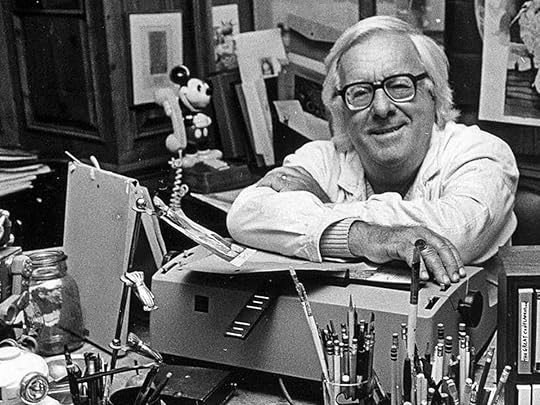
Sam Weller opens his bio on Ray Bradbury by admitting he is a Bradbury fan boy. But that doesn't deter how good this look at the fantasy/sci-fi writer is. Weller presents a fair, balanced look at the author of a different type of literary genre. Is it fantasy? Is it sci-fi? Is it fictionalized childhood memories with a dash of drama? Weller takes on the journey of how Bradbury got to be Bradbury.
I was especially interested in his early days in Waukegan, Ill. I met my wife to be near Waukegan in 2015 and took many, many trips up there to see her. One of my favorite places in the country is the harbor park in Waukegan and Sheridan Road that travels along the shore of Lake Michigan. We've seen Bradbury's named park, the Genesee Theater and the library there.
Weller writes of influences on Bradbury... walking home through the ditch near the shore and being frightened when his brother ran off and left him, the lakeshore carnival and an encounter with Mr. Electrico, a stained glass window in his home. Weller is great with those details and writes a very compelling look at Bradbury's life.
Later, he chronicles the author's move to Los Angeles and his slow rise in fame. Bradbury, if not anything else, was confident and boasted how good he would become. Most of his boasts did come true. He wrote constantly, supported by his wife. He was so poor at times that he couldn't afford a telephone and gave out the number of a phone booth at a neighboring gas station to his home. He'd leave his office window open and run out to answer the phone when he heard it.
There are downsides to Bradbury and Weller does point that out. He was egotistical near the end of his career. He often thought others were stealing his work. He was especially accusatory of Rod Serling for "taking" some of his ideas and using them for "The Twilight Zone."
Weller also notes discrepancies in Bradbury's recall of things. He mentioned fleeing from his family's car on the return trip from the funeral of a relative on Labor Day to see the carnival. Weller found that the relative who died actually had his funeral in October, some three weeks later.
Weller doesn't shy way from other indiscretions. He notes two of Bradbury's affairs late in his marriage and writes of how Bradbury's wife asked for divorces twice (not as a result of those affairs, but because she said she no longer loved him). Bradbury's wife, when asked by Weller for the book, said she did not recall wishing for a divorce at any time. Was that Bradbury's made-up excuse for his own affairs, because Weller portrayed Maggie Bradbury as a super supportive wife during Bradbury's writing career.
All of that and much more is in Weller's book. There's the evolution of how his classic Fahrenheit 451 came to be, story origins, discussions with editors and publishers, his scriptwriting days and much more. This is quite the fascinating biography for anyone who is either a fan of Bradbury or, like me, doesn't know much of him.