

What do you think?
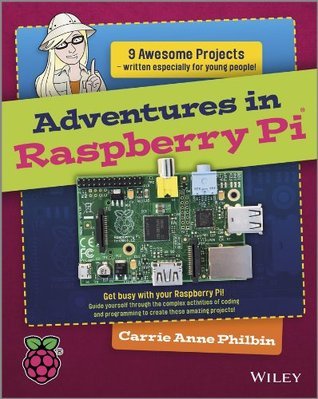
Adventures In Raspberry Pi
Coding for kids is cool with Raspberry Pi and this elementary guide Even if your kids don't have an ounce of computer geek in them, they can learn to code with Raspberry Pi and this wonderful book. Written for 11- to 15-year-olds and assuming no prior computing knowledge, this book uses the wildly successful, low-cost, credit-card-sized Raspberry Pi computer to explain fundamental computing concepts. Young people will enjoy going through the book's nine fun projects while they learn basic programming and system administration skills, starting with the very basics of how to plug in the board and turn it on.
Each project includes a lively and informative video to reinforce the lessons. It's perfect for young, eager self-learners—your kids can jump in, set up their Raspberry Pi, and go through the lessons on their own.
Written by Carrie Anne Philbin, a high school teacher of computing who advises the U.K. government on the revised ICT Curriculum Teaches 11- to 15-year-olds programming and system administration skills using Raspberry Pi Features 9 fun projects accompanied by lively and helpful videos Raspberry Pi is a $35/£25 credit-card-sized computer created by the non-profit Raspberry Pi Foundation; over a million have been sold Help your children have fun and learn computing skills at the same time with Adventures in Raspberry Pi.
Each project includes a lively and informative video to reinforce the lessons. It's perfect for young, eager self-learners—your kids can jump in, set up their Raspberry Pi, and go through the lessons on their own.
Written by Carrie Anne Philbin, a high school teacher of computing who advises the U.K. government on the revised ICT Curriculum Teaches 11- to 15-year-olds programming and system administration skills using Raspberry Pi Features 9 fun projects accompanied by lively and helpful videos Raspberry Pi is a $35/£25 credit-card-sized computer created by the non-profit Raspberry Pi Foundation; over a million have been sold Help your children have fun and learn computing skills at the same time with Adventures in Raspberry Pi.
257 pages, Kindle Edition
First published November 15, 2013
Ratings & Reviews
Friends & Following
Create a free account to discover what your friends think of this book!
Community Reviews
Displaying 1 - 9 of 9 reviews

January 12, 2014
This is a really excellent introduction to the Pi, and programming generally. It got us through setting up the gear to performing minecraft wizardry. Everything is explained simply but clearly with enough detail to help children learn what it is they're actually doing.

July 1, 2017
This is a great book for beginners and even people with some experience using Raspberry Pi. It's well written and easy to follow with lots of code examples. Though I'm experienced with Raspberry Pi I learned new coding with this book. Great resource for anyone seeking to learn more.
March 11, 2014
Introductory book, aimed at high school pupils. Basic intro and also various projects. Includes scratch, turtle graphics, python, Minecraft Worlds, sonic pi, GPIO pins, and how to make a pi jukebox.

March 22, 2014
Totally fun stuff, useful and attractive to read. The projects actually work as written.

July 24, 2014
This is a great introduction to the Pi. Though aimed at kids, most adults who are new to programming won't feel that they're being talked down at. Clear layout, easy to follow.

January 17, 2016
Very good tutorial on operating system.
November 7, 2017
It mainly covered the programming with raspberry pie, as one would on a regular computer. So as a proof of concept that the raspberry is a computer, this is fine.
It is worthwhile investing time in learning scratch and python on their own, each with a separate source. Then you can practice what you have learned on the pie.
I was hoping that the book would cover the hardware, but it did not.
So, while this book highlights a nice scope of capabilities on the pi, it is not particularly useful in teaching what the pie can do that you cannot readily and easily do by yourself in other systems.
We are not going to use this book.
It is worthwhile investing time in learning scratch and python on their own, each with a separate source. Then you can practice what you have learned on the pie.
I was hoping that the book would cover the hardware, but it did not.
So, while this book highlights a nice scope of capabilities on the pi, it is not particularly useful in teaching what the pie can do that you cannot readily and easily do by yourself in other systems.
We are not going to use this book.
August 30, 2018
This book gives a great introduction to the Raspberry Pi for younger users, but will be challenging for people who have no experience in coding, computing or electronics.
It's very difficult to give an introduction to the major capabilities of the Raspberry Pi, but all things considered - this is an excellent effort. The difficulties are partly because there is so much one can do with a Raspberry Pi, but also partly because some knowledge is needed to use the tools available. For example, you need to know python to write normal programs. You need some basic Ruby for SonicPi. You need to feel ready to play with small electronic parts to do the electronics. You need to understand basic coding concepts like 'while', 'for' and 'if' for python programming and scratch. And so on.
I think this book does a great job in introducing all of these things, but for total beginners I would recommend obtaining literature which focuses on different parts (like the Raspberry Pi MagPi Beginners guide, or, a python for beginners or a Scratch for beginners book). I think these will go through their areas in more detail providing more explanations and potential pitfalls to support the learner.
However, if you have some basic idea about programming this could be the best book to let you know what you can do on a Raspberry Pi. It has lots of 'adventures' (objectives to achieve) which makes it fun.
I didn't do most of the adventures (unlike with Python for Beginners) because I mainly read the book to see if it would be good to advise my students to read.
Do note, if you want to do the electronics for the last few projects there is some special equipment you need to get (e.g. an Adafruit LCD display).
Someone who completes the projects in this book will learn a lot and will have a good understanding of what more could be done.
If you don't care about learning Scratch or manipulating minecraft, maybe look for something else like a book focussed not just on young people.
It's very difficult to give an introduction to the major capabilities of the Raspberry Pi, but all things considered - this is an excellent effort. The difficulties are partly because there is so much one can do with a Raspberry Pi, but also partly because some knowledge is needed to use the tools available. For example, you need to know python to write normal programs. You need some basic Ruby for SonicPi. You need to feel ready to play with small electronic parts to do the electronics. You need to understand basic coding concepts like 'while', 'for' and 'if' for python programming and scratch. And so on.
I think this book does a great job in introducing all of these things, but for total beginners I would recommend obtaining literature which focuses on different parts (like the Raspberry Pi MagPi Beginners guide, or, a python for beginners or a Scratch for beginners book). I think these will go through their areas in more detail providing more explanations and potential pitfalls to support the learner.
However, if you have some basic idea about programming this could be the best book to let you know what you can do on a Raspberry Pi. It has lots of 'adventures' (objectives to achieve) which makes it fun.
I didn't do most of the adventures (unlike with Python for Beginners) because I mainly read the book to see if it would be good to advise my students to read.
Do note, if you want to do the electronics for the last few projects there is some special equipment you need to get (e.g. an Adafruit LCD display).
Someone who completes the projects in this book will learn a lot and will have a good understanding of what more could be done.
If you don't care about learning Scratch or manipulating minecraft, maybe look for something else like a book focussed not just on young people.
November 19, 2015
Great for kids of all ages.
I really enjoyed the ease of reading this book. This book I'd very informative and clearly written from a teacher's perspective. While it is written for the young, I in my old age enjoyed it and learned as well.
I really enjoyed the ease of reading this book. This book I'd very informative and clearly written from a teacher's perspective. While it is written for the young, I in my old age enjoyed it and learned as well.
Displaying 1 - 9 of 9 reviews