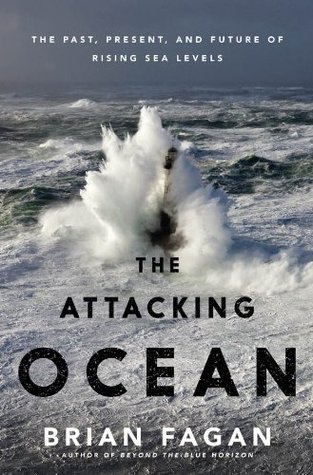
The Ocean is not to be blamed.
In some Asian cities, there are slums (and even markets), which are placed on top of the existing railways. Every hour a train comes through, and people need to give way. Once in a while, a small child, an elderly, or a drunk ends up on the rails at the wrong time. As sad as it may be, nobody blames the train or even its engineer. The slum has come long after the railway, the slum has no right to be here first place... Can you say the train has "attacked" the slum dwellers?
The book of Brian M. Fagan is interesting to read and well-researched (although his definition of a nautical "knot" is wrong), unfortunately the author constantly contradicts himself, desperately trying to link already discarded catastrophic anthropogenic global warming (CAGW) hypotheses to his text, even if his archaeological evidence shows the opposite. If he simply omitted any notion of IPCC and such, the text would be much more objective.
Indeed, from about 22000 years ago, the ice sheets were constantly melting and the sea levels rose. The fastest such event was between approximately 12900 and 11900 BC, and in one thousand years the sea rose by 23-24 meters - that is 2.4 meters per century. The sea rise continued even through the relatively cold Younger Dryas epoch, coming up 15 m in 1200 years, or 1.3 meters per century.
The first half of our current geological epoch, Holocene, which started about 9650 BC, - yet another "rapid" sea rise: 59 m in 4650 years, or the same 1.3 m per century. Neither rise was "catastrophic" (too slow) or "anthropogenic" (humans were simply too small in numbers at that time). The prior warm period, Eemian interglacial, happened 130-110 thousand years ago, the sea level was higher than our present, and homo sapiens species existed only in Africa. All in all, the current global warming, Holocene, in the last 12 thousand years made our planet way more habitable and led to the very existence of our modern technical civilization.
On the page 10, the author shows the only time series in the book, which starts "conveniently" at year 1870 and shows a sea rise of 21 cm in 150 years. Which gives - sca-a-a-a-a-a-ary figure - 0.13 meters per century! Thirteen bloody centimeters! An order of magnitude less than in the first half of Holocene. Is that all the humans could do with all their CO2?
Well, the sea rise continued from 5000 BC to the present day, at about 0.06 m per century on average. Sometimes the rate was faster, like now, sometimes slower, like during the "Little Ice Age" (1300-1850 BC). Anyway, even 0.31 m per century (as measured by satellites since 1991) is nothing "abnormal" and "unnatural", neither "anthropogenic" nor "catastrophic". The Mother Earth goes its own ways for the last 4.5 billion years and does not give a damn about IPCC bureaucrats. The Antarctica and Greenland still hold enough water (27 million cubic km) to increase the sea level by about 75 meters. No doubt, as Holocene continues, they continue to melt slowly for another five or nine thousand years. By the time, Holocene will be over, plunging the planet into another 100000 years of ice and snow, our civilization will be over, and our distant descendants will be either all over Solar System or back to the caves.
So, the Holocene Global Warming (HGW - neither anthropogenic nor catastrophic) is a good thing after all, and not a drama.
To make the book more dramatic, the author mixes-in some real catastrophic events: earthquake-induces tsunamis, severe storms, flash-flooding and even failing dams. He adds also some local geological mishaps, like natural subsidence, which have been there for millennia. All of these have nothing to do with HGW and the global sea rise. Most disasters are caused (as the author correctly pointed out), by human's desire to leave near the water, for reasons both esthetic and economic, and have nothing to do with the climate change. I wonder why the author mentioned the IPCC first place? Desire to be more Catholic than the Pope himself?
The overpopulation and over-development of coastal areas are real problems what should be dealt with. The Ocean (or Mother-Nature in general) is not to be blamed.