The A Very Short Introduction considers the structure, roots, and day-to-day functioning of the modern philharmonic society. Far from an anachronistic organization that cannot long survive, it is shown to be powerful political and social force, occupying critical positions in cultural diplomacy, national identity, and civic pride.
Dallas Kern Holoman is an American musicologist and conductor, particularly known for his scholarship on the life and works of Hector Berlioz. He is Distinguished Professor of Music emeritus at the University of California, Davis and Conductor emeritus of the UC Davis Symphony Orchestra.
"...without music, life would be a mistake." - Fredrich Nietzsche, quoted in The Orchestra, A VSI
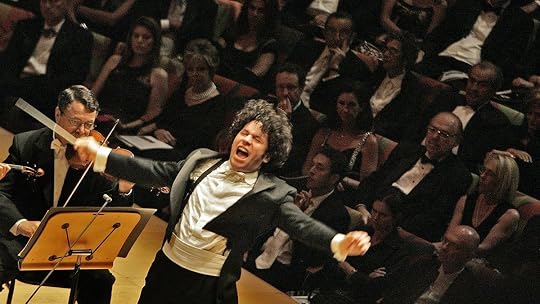
I didn't grow up listening to classical music, but orchestral music grew on my in college as I bought cheap Naxos sets (while still mainly fixated on alternative and punk rock). I continued to deepen my appreciation for the form, however, slowly year after year. Most recent years find me attending one or two concerts. This year (next week actually), I'm flying out to LA with my wife to see Dudamel and the LA Philharmonic perform Mahler's 9th. There is something about seeing an orchestra peform a piece by Mahler, Beethoven, Mozart, Brahams, etc., that is hard to capture in a CD or vinyl reproduction.
That said, this has also been a perfect time to collect CDs of classical music. You can buy cheap, wonderful pressings of the classical repertoire. I pick up, almost weekly, at Goodwill or other 2nd-hand-stores: Sony, Deutsche Grammophon, RCA Victor, Archiv, Decca, London Classics, etc., for $1-$3 a cd (practically unlistened to).
This book reads almost like David Byrne's How Music Works but for the Orchestra. Holoman describes the history, politics, money, art, venues, conductors, and music of orchestral music. As a lover of the orchestra it was entertaining and enlightening. Nothing came as a shock, but it put a lot in historical and musical perspective and reminded me both how dynamic and new orchestral music (as currently structured) really is.
Among the various interesting things I have learnt over the last few days reading this, is very little about any actual music, disappointingly. On the other hand, it is reasonably clear and easy to read, at least by the usual dire standards of art music.
Somehow OUP published hundreds of titles in the Very Short Introduction series without my having noticed until now. You want a book like this to be short, sure, but also pleasant to read, informative, and subtly opinionated. This was all of those.
This should have been titled "The Orchestra, chiefly in America". It's not very bad, it's just unbalanced. Surprisingly, United States are not the centre of the world in classical music.
Dr. Kern Holoman's very short introduction to the symphony orchestra opens a multi-faceted and insightful window on one of the most mysterious institutions to have graced the modern era. Admittedly the book has been written with a fairly strong North American bias but that doesn't detract from its value for European readers. Many of the challenges befalling contemporary orchestras are shared the world over.
The book falls into ten chapters:
Philharmonia: the history of the orchestra as an institution. Musicians: financial reward, unionization, gender and race. Venue: the concert hall as fixture of the classical music universe Money: pay, the role of agents, star soloists and conductors, the economics of orchestra management. Conductors: history, role, practice. Repertoire: programming, trends, commissions, HIP. Commentary: music criticism and its demise, outreach and education. Recordings: broadcasting and recording, the recording industry and its collapse, new technology. Peace: connections between music and politics, WWII, Cold War, Palestine-Israel, pacifism. Civics: reinventing the philharmonic ideal.
Obviously, the motto theme woven into Holoman's discussion is a reflection on the future of the symphony orchestra. The 'great symphonic boom' fizzled in the 1980s under pressure of economic, demographic and cultural drivers. Orchestras need to reinvent themselves to justify their large operating budgets to philanthropic and governmental grant givers. It is also clear from this book that there is no silver bullet. The philharmonic ideal that joins musicians, financial backers and listeners in an alliance that reflects civic pride in local talent and timeless musical heritage will have to be rediscovered and re-embodied. There have been few genuine success stories in recent times. The Los Angeles Philharmonic under the leadership of Deborah Borda is one notable example of a successful rebirth of an orchestra. According to the visionary conductor Ivan Fischer, time is running out. The 100-strong, heavily institutionalized orchestra has perhaps two or three decades to live. By then it will either have shrunk to a very small niche with a museum-like mission of conserving heritage, or it will have reinvented itself as a hub of civic life.
I had meant to read Leonard Bernstein’s wonderful Childrens’ Concerts book as my work by a musician, but realized too late that my preferred method of playing and listening along would take more time than I had left in the year. Enter this book, which I read on NYE. I hadn’t expected much from it other than brevity, but was pleasantly surprised when I got a smattering of different histories of the orchestra, all competently written. Holoman covers the economic, artistic, cultural, musical, architectural and political aspects of these organizations in a really eye-opening way. I especially enjoyed how he uses cross-border performances pre-WW1 and in the Cold War to explore and combat the notion that shared arts cultures can actually lead to peace rather than mere temporary goodwill.