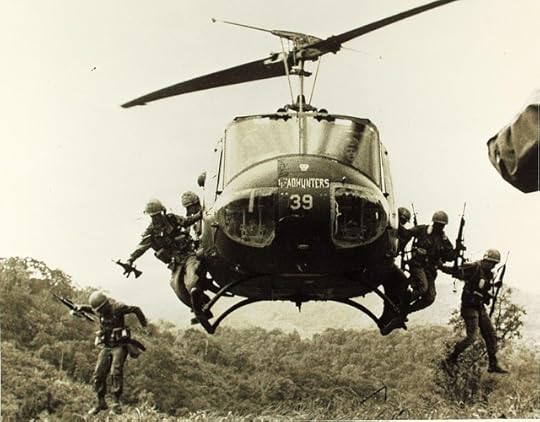
Robert Olen Butler served in Vietnam 1969 to 1971 - first as a counter-intelligence agent, and then as a translator. In an interview he remembers the time he spent in the country:
The army got me coming out of the University of Iowa, but they sent me to language school for a year before I went over. I spoke fluently from my first day there. And then I did work in intelligence for five months out in the countryside. I loved Vietnam and I loved the culture and I loved the people, I mean instantly. And had access to all of that in most ways other outsiders didn’t. I had contacts with woodcutters and farmers and fishermen and provincial police chiefs and so forth and then, this was in 1971, the unit stood down. Some units were starting to go home at that point. I got transferred to Saigon where I worked as a translator and administrative assistant for an American Foreign Service officer who was an advisor to the mayor of Saigon. So it was a civilian-clothes job. I lived in an old French hotel and I worked at Saigon city hall. But every night I would go out after midnight and wander alone into the steamy back alleys of Saigon where nobody ever seemed to sleep. I’d crouch in the doorways with people and talk to them. The Vietnamese people are perhaps the warmest, most generous spirit-people in the world, and they invited me into their houses, and into their culture, and into their lives. And of course, that shaped me as an artist.
After the return to the U.S. he wrote stories, which were accepted and published by various literary journals, such as The Southern Review, The Hudson Review and New England Review. The reviews were good, too - some of the stories got reprinted in a volume of The Best American Short Stories, and in 1987 Butler received the Tu Do Chinh Kien Award from the Vietnam Veterans of America for outstanding contributions to American culture by a Vietnam veteran. he received broad recognition in 1993, when a collection of these stories - published a year before and titled A Good Scent from a Strange Mountain - was awarded the Pulitzer Prize for Fiction.
Many novels have been written about the Vietnam War - both by American and Vietnamese authors - but here the concept is new: Butler gives voice to the Vietnamese refugees to America, who have settled in southern Louisiana - near New Orleans. These stories explore the immigrant experience - the contrast between the immigrants and Americans, and the two countries - Vietnam and the United States - with their vastly different cultures and customs; the distant Far East is contrasted the definition of the West. Each of the stories is narrated in the first person by a different Vietnamese immigrant, and all are filled with a sense of longing and nostalgia for their past lives - their country with its natural beauty and way of life, specific places and moments, the friends and relatives they had to leave behind. The Grove reissue contains two additional stories - Salem and Missing - which are set in post-war Vietnam, and form a neat narrative coda.
The Vietnam War ended in 1975, after the fall of Saigon, forcing more than three million Vietnamese to flee for safety - hundreds of thousands dying in the process of often dangerous crossing. The majority - around 1,4 million - settled in the United States. These refugees found themselves in a peculiar situation - their old country was taken away from them and transformed into something different, and the new country proved to be completely different, too. Like Tom Hank's character in The Terminal, they can't go home - and struggle to live in the new environment. Some stay together in hopes of preserving their heritage and culture, while others openly want to shed it. There are other Vietnamese here in Lake Charles, Louisiana - the protagonist of Snow remarks - but we are not a community. We are all too sad, perhaps, or too tired. But maybe not. Maybe that's just me saying that. Maybe the others are real Americans already.
In Crickets, the Vietnamese man and his wife had a hard time adapting to American culture and life. Their American-born son adapted easily and shows little interest in Vietnamese language and culture, making his father think of a childhood game as a way of becoming closer to the boy. In Relic, a Vietnamese man sees America as a land of opportunity. He wishes to break away from the Vietnamese community but his business depends on it. He feels that the other Vietnamese are preventing him from becoming fully American and more succesful. The relic of the title is a shoe that was supposedly worn by John Lennon when he was shot to death. The man sees the shoe as a symbol of America, and longs to own the other shoe so his collection can be complete, and he can be complete as a person, an American person. But even he lives in the past: he remembes the wife he left in Vietnam, who did not want to abandon her country and chose to stay there with their children, but expresses no desire to return to them; he wishes to get away from the Vietnamese community as he feels that it drags him back to Vietnam, and become a part of the American community, pursue his own American Dream and estabilish his own identity in his new country.
Butler's Vietnamese characters are unique, with their own quirks and distinctive characteristics. In Love a jealous husband used to bring doom on his wife's suitors in Vietnam, and struggles to do the same in the U.S.; he journeys to New Orleans to search for a voodoo master who will put a curse on the man whom he suspects she is having an affair. Letters from my Father is narrated by a Vietnamese girl, who has grown up without her American father, and with whom she is having a difficult and distant relationship. She discovers a stack of his old letters to the U.S. government, where he writes with fury and longing, demanding his daughter be allowed entrance to the U.S. and accusing the government of deliberately keeping them separate for years, arguing that if she was white they would welcome her with open arms. In The Trip Back a Vietnamese woman eagerly awaits to be reunited with her grandfather, and has been arranging for him to live in the U.S. for years. He is finally allowed to immigrate to America and her husband drives to pick him up from the airport. There he discovers that the elderly man has gone senile, and lives so deeply in the past that he is able to remember the color and smell of the South China Sea, but has no recollection of his granddaughter, who loves him deeply. Her husband fears that he too will become like the old man, unable to remember both his homeland and his wife.
Mr. Green is narrated by a Vietnamese woman, who remembers her grandfather. The story touches on the theme of subjugation of women in Vietnamese society before and during the war, with the grandfather telling her that she can't pray for the souls of her ancestors because she is a female. She came to the U.S. with his parrot, Mr.Green, whose favorite saying is "not possible", and tries to find her identity in a society experiencing the sexual revolution and second-wave feminism, coping wit the feelings of love and obligation, resentment and death.
Fairy Tale is an all-American tale of succes, and seems to be written to spite critics accusing the author of putting on a yellowface and exploiting Asian characters - it's an unbearably cliched story of a Miss Noi (as in Hanoi without the Ha), a Vietnamese prostitute who works as a stripper in a New Orleans bar and meets a G.I. who asks her out. It's almost ridiculously stereotypical and predictable, but very consciously so - it's very self-aware of all its flaws, and by this it turns them into its advantages. It's also full of humor, employing the peculiar feature of the Vietnamese language where the meaning of the word depends on how it is said - one man wants to woo Miss Noi by trying to say "May Vietnam live for ten thousand years" in Vietnamese, but what he says - very clearly - is "The sunburnt duck is lying down".
These stories also employ elements of mysticism and Vietnamese folklore, such as the beautiful Mid-Autumn, where an expectant mother tells a fairy tale to her unborn child, about the emperor who went to the moon and found happiness there, remembering her lover who died in Vietnam. In the title story a dying man is visited by the ghost of Ho Chi Minh, with whom he has worked as a youth; Ho confessess to his friend that he is not at peace, and political tensions between the Vietnamese Americans play in the background. A Ghost Story is a story which the narrator claims to be true, about the ghost of a beautiful Vietnamese woman, Miss Linh, who saved his acquaintance from a disaster. When he found her again to thank her, she devoured him alive. The man telling the story also has seen the woman two times, and although she spared his life he is also devoured - by a ghost of a whole country, which continues to torment him in his new American life. In America he is a ghost, riding the Greyhound in an attempt to escape his demons. The last two stories Salem and Missing are narrated by two soldiers, Vietnamese and American, who stay in the country. Salem comes from the pack of cigarettes that the Vietnamese soldier finds on a body of an American GI that he has killed - along with the picture of his girlfriend, and Missing is the only story in the collection narrated by an American. It's a reversal of the theme of Vietnamese immigrants trying to live in American society - here an American is trying to live among the Vietnamese in their country and culture The narrator is a U.S. soldier who has stayed in Vietnam after the war and married a Vietnamese girl, and together they raise their daughter. He has been living in a village with his family in peace for a long time, until one day someone brings an American newspaper which has a photo of him taken from a distance, recognizing him as one of the soldiers who went MIA and implying that he needs help to be brought back from Vietnam to America. But the narrator thinks differently - "I'm not missing. I'm here", he says, and he feels it - he is in his village, with his people and family.
The stories in this collection are written with care and compassion, giving voice to those who are largely unheard in this particular branch of fiction. It is remarkable that such a deeply felt and personal book about Vietnamese immigrants would be written by a white American - which is only a testament to the author's respect and admiration for the people he met in Vietnam, and who moved him to write these stories. They are beautifully written, full of honesty and compassion, without pretension. Different voices of these stories come together in this remarkable collection - a worthy winner of the Pulitzer, which I am very happy to have discovered and will gladly return in the future.