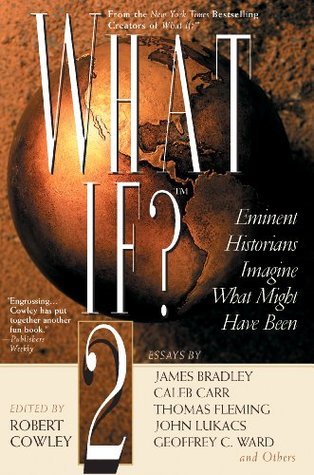
What if Lincoln didn't abolish slavery? What if an assassin succeeded in killing FDR in 1933? This volume presents 25 intriguing "what if..." scenarios by some of today's greatest historical minds-including James Bradley, Caleb Carr, James Chace, Theodore F. Cook, Jr., Carlos M.N. Eire, George Feifer, Thomas Fleming, Richard B. Frank, Victor Davis Hanson, Cecelia Holland, Alistair Horne, David Kahn, Robert Katz, John Lukacs, William H. McNeill, Lance Morrow, Williamson Murray, Josiah Ober, Robert L. O'Connell, Geoffrey Parker, Theodore K. Rabb, Andrew Roberts, Roger Spiller, Geoffrey C. Ward, and Tom Wicker.
Robert Cowley is an American military historian, who writes on topics in American and European military history ranging from the Civil War through World War II. He has held several senior positions in book and magazine publishing and is the founding editor of the award-winning MHQ: The Quarterly Journal of Military History; Cowley has also written extensively and edited three collections of essays in counterfactual history known as What If?
As part of his research he has traveled the entire length of the Western Front, from the North Sea to the Swiss Border.
Some of these "eminent historians" are nothing of the kind; several aren't even historians, but novelists or journalists.
The essays dealing with the modern era--roughly half the book--tend to be Cold Warriorish and/or fanatically deterministic. No matter what any historical figure might have done, things come out more or less the same as they did in real life. This not only undermines the purpose of the book, it suggests rigidity of the imagination and a belief that the individual has no power to shape the course of events, so we'd might as well all stay home and let the authorities do as they please.
The essays dealing with earlier events are somewhat better. I enjoyed the piece in which the French don't go to war in 1870, while recognizing its fancifulness. The same goes for an equally pleasant but extravagant fantasy in which Mark Antony defeats Octavian and a hypothetical Cleopatra IX goes on to become pope (!). More sensible, and fairly stimulating, are essays in which Luther is executed before the Reformation gets fully underway, and there is war instead of a Munich agreement in 1938. But the writer who argues that the Nazis would have collapsed like a house of cards had Pius XII spoken sternly to them is perhaps a little too imaginative.
The path untrodden, counterfactual reality, or simply alternate history. Twenty-five of the 20th Century’s eminent historians look at what might have been in the essay anthology What If? 2 edited by contributor Robert Cowley.
The twenty-five essays range from 424 B.C. in Ancient Greece to the 1948 Elections in the United States covering a variety of topics though for roughly 300 of the 430 pages covered the time between 1912 and 1948. Unlike the previous volume, many of the essays focused on the actual event than going into an alternative scenario or would briefly speculate about things happening differently in the last two paragraphs. The essays that focused on the assignment that were good were Thomas K. Rabb’s essay on Charles I dying in 1641 of the plague and adverting the English Civil War, Alistair Horne’s fanciful piece on Napoleon III not taking Otto von Bismark’s bait to advert the Franco-Prussian war, George Feifer’s essay on Lenin on influencing the Russian Revolution, and Richard B. Frank’s essay on if the United States hadn’t dropped the atomic bombs.
What If? 2: Eminent Historians Imagine What Might Have Been is an interesting set of essays, a lot are knowledgeable for someone who doesn’t know specific points talked about however the “alternate” aspect was lacking compared to the previous collection.
This book was pretty painful to read, from start to finish. It consists of essays about notable important events, and what would happen if they had not occurred. Or at least that is what the title would lead you to believe. Rather, they ended up being essays about great historical events, followed by a tiny bit of conjecture. And typically, this conjecture was not that interesting. For example, what would have happened had Socrates been killed when he was younger? Philosophy would not have been the same. Really? It takes an eminent historian to come to that conclusion? I think I could have come to the same conclusion pretty easily. One essay even stated that since we can never be certain, we should not conjecture. Had I wanted to read a book of historical essays I would have been pleased with this book, because the writing was good and the historical facts interesting. But I felt that I had been cheated and tricked by the title, so I was not happy with it.
I received the first What If? volume along with Virtual History as a gift in high school, a well-intentioned gift as the gift-giver knew I liked to study and read history. I didn't particularly care for them, but upon receiving them and upon completing them I thanked the gift-giver for their generous and thoughtful gifts. When asked if I enjoyed them, to spare their feelings I said that I did.
Receiving this book as a gift a few years later, I feel, is a strong argument against the telling of white lies.
I'm a sucker for alternate ending scenerios. This is a great source from a military strategist who ponders the idea of "what if" something happened differently during major military engagements and how the alternate outcome might affect today. Fascinating!
I recently read and liked "What If," about military battles that could have gone otherwise and the consequences to world history that would have probably occurred.
The followup book, "What If 2," is about world, not military, events that could have gone otherwise. Too many of the scenarios (some of which are military, in fact) could have been better chosen, in my opinion, but a few are fascinating and make this book worth looking for in the library.
1. What if Pontius Pilate had spared Jesus. 2. What if the Chinese Emperor had not stopped the expeditions of his eunuch admiral in the 15th Century. 3. What if Germany hadn't helped Lenin reach St Petersburg in 1917. 4. What if Pope Pius XII had protested the Holocaust. 5. What if the atomic bombs had not been dropped on Hiroshima and Nagasaki.
Number five forever lays to rest, in my mind anyway, any doubt on the use of atomic weapons in Japan. Not diminishing the lives that were lost in those two cities, but the evidence seems clear that many more Japanese lives would have been lost if we hadn't used the bombs. That Japan, in fact, would have been invaded by Russia, still smarting over the Russo-Japanese War of 1904-1905.
A good history read, but every essayist has their own styles - which means they do not particularly mesh well together. Some are really interesting, some start out interesting and then lose momentum.... others are uninteresting from the start. But the book still has a subject matter worth paying attention to, with hypothetical ideas of what might have happened if things were different, and that at least provides a solid platform to pay attention to.
Hardly any alternate history. Mostly nuggets of information about a specific incident in history. Even so, much of that seems too flippant, not really considering the thing unbiasedly. Some things to think about, if not trust without further research.
Another proof that historians are not writers. the questions are interesting but the conservative outcome of the answers is disappointing, to say the least.
It is always interesting and entertaining to think of what might have happened if one specific event had been a bit different. When people that know history engage in such actions it is also educational. This book contains 25 essays based on what might have happened if an event had a different outcome. The timeframe starts in ancient Greece and moves through the aftermath of World War II. The first essay is based on a little-known fact, that Socrates was a soldier before he became a sage. He fought in the battle of Delium in 424 B. C. and apparently barely escaped capture or death. The “What If?” scenario is based on the consequences of his being killed in that battle. Given his influence on Greek thought, the emergence of what we now call philosophy and how the ancients Greeks formed the foundation of Western Civilization, the changes could have been considerable. One of the most interesting alternative scenarios is that Henry Wallace was not replaced by Harry Truman as the Vice-Presidential nominee on the ticket with Franklin Roosevelt in 1944. Wallace was a much more seasoned and famous politician than Truman was, and his political philosophy was much more progressive. If he had remained on the ticket, Wallace would have become president on the death of Roosevelt in 1945. His openly stated position on trying to reach some form of understanding with the Soviet Union would have been an interesting expression if he had become president. However, the most interesting essay is the last one and is not based on a single event taking a different track. In that essay, the question is based on if conquistador Pizarro had not discovered the potato in South America and brought it back to Europe. The story of how the potato altered the history of Europe after it was widely planted is fascinating. Peasants planted their crops of grain and potatoes, often leaving the tubers in the ground. When marauding armies swept through, they would requisition all the grain, but would not bother to dig the potatoes out of the ground. This food reserve allowed the peasants to avoid starvation as the potatoes were an excellent source of calories and were easy to keep over the winters. Although the enjoyment of the reader will be enhanced if they have some understanding of basic history, that foreknowledge is not essential to understand and appreciate these brief stories of alternate history.
If I am to be perfectly honest, this collection didn’t really meet my expectations, neither in regard of selection of topics nor depth of analysis. Vast majority of the ‘tweaks’ discussed in this book are, in my opinion at least, too vast in scope for anyone to even be able to speculate about their effects. The first essay in this book is a perfect example – if Jesus of Nazareth managed to live to an old age, is it even possible to provide a credible speculation about how it would affect what today is one of major religions of the world?
Other essays in this collection gave me a distinct impression of not being “counterfactual history” at all, but rather arguments for or criticisms of actual historical decisions – the essay arguing against Eisenhower’s “broad approach” strategy in late 1944 and one arguing for use of atomic weapons against Japan in 1945 are probably best examples of this type of essays in this book.
And finally there was a couple of essays about topics which I personally question deserve to be analyzed from counter-factual perspective. For example, battle of Hastings was (regardless of what the author claims) a local event and I fail to see how Harold Godwinson’s victory would have affected the ‘big picture’. And while I found the essay about effect of introduction of potatoes to European society to be one of the most interesting in this collection, it was because it mostly discussed those effects (who would have thought history of potato was so fascinating?). But the premise of that particular essay – that Pizarro failed to find potatoes to be begin with – how was that supposed to happen? It was the major crop of the area after all!
In my opinion, counterfactual history discussions are historian’s equivalent of kids arguing who would win in a fight between Superman and Batman. They are universally pointless. They have serious potential to ruffle some feathers. But if the point of contention is selected wisely and argued cleverly, they can also be a lot of fun. Essays in this collection completely validated my first point, confirmed to certain degree the second one, but failed to entertain me in the way that I expect from this type of book.
This was a fun read. It opens your eyes to the different machinations of history. How little things can change the history of the world. Do we really know or understand history. History is filled with facts but also with blank spots and interpretations. Are we just guessing?
Some of the essays are absurd fantasy, while others are 90% going over actually history and 10% the counterfactual. The essays are well written and filled with powerful vocabulary. This is a fun boy book.
I often view history in a cosmic lense. That humanity has gotten to where it is and there is only one path. This book is a reminder that humanity does not have a set out path. Things could have gone many different ways. On the cosmic scale we are just one of billions of possibilities and plants with civilizations that have existed. We are a data point of life in the universe, fighting to break through the great filter. There are civilizations that have gotten further than us and others that have ended sooner. For better or worse, our road is what it has been and will be
As with the first volume in the set – indeed, perhaps even more so – this is a mixed bag. Most of the essays contain at least some interesting historical insight, but this time around several entries are almost completely devoid of counterfactual speculation (which, at least in theory, is the book’s raison d’etre). For example, “No Finland Station” by George Feifer says nothing more profound about Russian history than the observation that Lenin wasn’t a very nice person. True (or at the very least copiously argued), but how might history have been different without him? On the opposite end of the spectrum, one or two of these things demonstrate how quickly counterfactuals can collapse under their own weight (such as John Lukacs’s bizarre tale of Teddy Roosevelt’s alternative career). Overall my review of the original applies to this set as well: if nothing else, this is an interesting way to learn a little history.
Twenty=five authors, historians and novelists, provide essay-length vignettes of alternative history. They elaborate on how a single change in a historical event or human life might spawn a radically changed world as, step by step, sequential events and circumstances follow logically from the initial change. They cover a wide range of possibilities ranging from, What would our culture be like now if Socrates had been killed along with a thousand of his fellow citizens of Athens at the battle of Delium in 424 BC?, to how simple changes in the political careers of three congressmen in the late 1940s, Richard Nixon, Lyndon Johnson, and John Kennedy, all of whom became president in the 1960s, might have altered the history of the United States.
The speculations are only that, of course, but they do help us to appreciate the vagaries of life on a scale larger than the individual. Some of the essays are quite evocative, but not all. Overall, worth a look.
The authors imagine what might have turned the course of human events if a specific element in human history had played out differently. What if Jesus hadn't been crucified? What if WWII had gone differently here or there? The problem was that the writers weren't very imaginative. For example, in this version Jesus is another prophet who reaches divinity in his 90's. What if Lyndon Johnson hadn't had any assistance from Archie Parr? The problem with there scenarios is that they DID happen. It was both boring to read the back stories that were sometimes told in excruciating detail, and irritating to see how little imagination the writers used in their alternative worlds.
The follow up of What if. All of those counterfactuals are plasuible and its not Turtledove reptilians in ww2 stuff. From ancient Greece to 1948(a turning point for JFK, LBJ and Richard Nixon). Famous historians like John Lukas , Williamson Murray, and Thomas Flemming. One essay shows that if Chamberlain and Daladier had stood up to Nazi Germany in 1938 for Checkslovakia Hitler would have ltoppled and he woudn,t have conquered continental europe between 1939-41.
An interesting and thought provoking collection of counter factual history essays that ask the question what if historical events did not happen the way they did. What if one little thing changes? My favorite entries are:
- VE Day - November 11, 1944 - N0 Bomb: No End - What If Pizarro Had Not Found Potatoes in Peru?
All the essays pretty much have the same conclusion. The world would be a very different place for better or worse if one little thing changes.
This book had two or three decent essays, but almost all of them devoted far too much space to describing the actual history of the events under examination, followed by a page or two of vague and noncommittal musings like, “But might things have gone differently? Suppose that X hadn’t happened. While it is impossible to know how events would have unfolded, our world today could be very different indeed.” Very little imagination or speculation. Disappointing.
Really interesting, just as good as the first volume. It was very 20th-century heavy - I would have preferred to see more ancient and medieval chapters. Other than that, my main criticism is that there was too much focus on what did actually happen, rather than on what might have happened, which is supposed to be the whole point of the book!
I was expecting better. It's a fantastic premise, but I found the vast majority of the chapters uninteresting and too inclined to focus on small effects, rather than the wider consequences of the changes.
Really interesting and thought provoking chapters in this book!
Would I re-read this book? Yes Would I keep a copy in my collection? Yes Would I recommend this book to someone? Yes Would I gift this book to someone? Yes
Even more alternate timeline historical essays raising the question "How different would our world be if..." again, some of the essays might seem a little dry for the casual reader, but history buffs will definitely find plenty to enjoy.
These books posit how the world might've been different if history went a different way at certain key points. Very creative stuff—an enjoyable read... really makes you think about how malleable and tenuous history really is.
so bad. maybe if i'd soldiered on i might've come across some writers who actually did a bit of research... but i doubt it. juart seemed clunky and clueless.