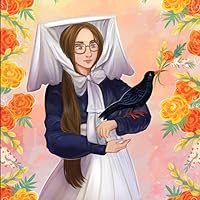
The survival of the British monarchy as a popular institution owes a lot toits queens who were, more often than not, more intelligent than theirhusbands. Caroline of Ansbach is such a queen. Well-educated and from one ofthe poorer German principalities, Caroline married into the boorish House ofHanover. It isn't long before she discovered she's caught between aloathsome, vindictive father-in-law, George I, and her not-too-bright anddomineering husband, the future George II. The House of Hanover, newlyascended to the English throne, would not have survived on the personalpopularity of its kings. It took the cleverness of Caroline coupled withthat of Sir Robert Walpole, the Prime Minister, to keep things in balance.Jean Plaidy tells the tale of the reign of George I through the personaltrauma of this most remarkable of English Queens.
Eleanor Alice Burford, Mrs. George Percival Hibbert was a British author of about 200 historical novels, most of them under the pen name Jean Plaidy which had sold 14 million copies by the time of her death. She chose to use various names because of the differences in subject matter between her books; the best-known, apart from Plaidy, are Victoria Holt (56 million) and Philippa Carr (3 million). Lesser known were the novels Hibbert published under her maiden name Eleanor Burford, or the pseudonyms of Elbur Ford, Kathleen Kellow and Ellalice Tate. Many of her readers under one penname never suspected her other identities. -Wikipedia
What a great woman Queen Caroline was. I so much enjoyed reading her story and nobody, in my opinion, writes historical fiction better than Jean Plaidy did. Caroline was beyond clever and suffering with a pompous fool of a husband (the King) along with a painful illness. She managed to achieve most of what she wanted despite it all. This is the third book in the 11 book series.
The survival of the British monarchy as a popular institution owes a lot to its queens who were, more often than not, more intelligent than their husbands. Caroline of Ansbach was such a queen. Well-educated and from one of the poorer German principalities, Caroline married into the boorish House of Hanover. She is soon caught between a vindictive father-in-law, George I, and her not-too-bright and domineering husband, the future George II.
The House of Hanover, newly ascended to the English throne, would not have survived on the personal popularity of its kings. It took the cleverness of Caroline coupled with that of Sir Robert Walpole, the Prime Minister, to keep things in balance.
Jean Plaidy tells the tale of the reign of George I through the eyes and personal trauma of this most remarkable of English Queens. This is the 3rd book in her Georgian Saga and the 2nd detailing the life of Caroline of Ansbach. The first telling the story of her childhood and early married life to George II and this following it through from the death of George I and being crowned Queen of England to her death after complications from one of her later pregnancies and reluctance to seek medical attention as she was fearful of losing her influence on her husband if he knew she had physical health issues. George II did not care for illness and had no time for it. Very sad as this condition may have been rectified.
Like a lot of readers of my generation, I first encountered the fascinating figure of Caroline of Ansbach in Neal Stephenson's giant Baroque Cycle, which touched upon her early life as a refugee princess in Germany who finally washed up in the court of the redoubtable Sophie Charlotte, Electress of Hanover and there was a pupil of Gottfried Liebniz. She finished those novels as the wife of Sophie's grandson George Augustus, the future Prince of Wales and thus the future George II of England. All signs at the end of the third novel, The System of the World, pointed to her as being a figure on which many hopes are to be pinned, a future champion of reason and science, the reconciler of Liebniz and Isaac Newton, perhaps even a latter-day Elizabeth, albeit with a lunkheaded husband...
It's hard to reconcile that portrait with Jean Plaidy's though. Caroline the Queen picks up Caroline's life many years after the Hanoverians came to power on a wave of Whig adoration. She has learned to manage her difficult husband and endured many years of his father's somewhat ridiculous rule, but at great cost to her intellectual life and continued education. The death of George I, who had all but exiled George Louis and his pretty, clever wife, is the first act of this novel and caused a flutter in this Baroque Cycle lover's heart, but this Baroque Cycle lover knew better than to expect anything remotely like more of Stephenson's version of Caroline and her life and times. No, this is Jean Plaidy -- not really a bad thing, just a very different thing.
Long before Stephenson was anything but just another beardy, computer nerdy face in the crowd, Jean Plaidy (and her various alters ego, Victoria Holt, Philippa Carr, Eleanor Hibbert, et al) reigned supreme as a chronicler of the lives and times of British royalty, especially those of its queens. Some of the first books I truly shared with my mother were Plaidy's cycle of Plantagenet novels, chiefly concerned with the amazing Eleanor of Aquitaine, wife of both Louis VII of France and Henry II of England, mother of Richard the Lion-Hearted and John Lackland, Duchess of Aquitaine and Countess of Poitiers and kickass heroine in her very own right (she even accompanied her first husband on the Second Crusade to the Holy Land). Plaidy's books made Eleanor one of my first not-made-up heroines, even though I knew I was reading fiction. So when I found out she had written a book about Caroline, I knew I was going to have to hunt it up at some point.
But so, like in her Eleanor books, Plaidy is much more interested in the domestic and personal life of Queen Caroline than in any of her intellectual pursuits -- except for Caroline's exercising of her considerable political acumen in partnership with Robert Walpole, the Whig Prime-Minister-before-there-was-a-Prime-Minister whose power was already considerable before Caroline became queen but who really came into his prime at her side and with her help. Plaidy's version of this duo* is the real governing power in Britain, with Walpole proposing and Caroline persuading her husband that disposing was all his own idea in the first place through a campaign of swallowing insults and bad behavior in public and making subtle suggestions during royal pillow talk, the latter form of influence she was only able to exercise by concealing from pretty much everyone the umbilical hernia (a result of multiple pregnancies and bad luck) that ultimately claimed her life when it caused her womb to rupture. But in her heyday, as depicted in Caroline the Queen, she winds up ruling Britain outright as Regent four times when her husband hares off to Hanover, his native land which she has convinced him he prefers to Britain. After all, there's no Parliament or Cabinet to deal with there, and the Hanoverians are ever so much more docile and respectful than the bratty, chatty English, aren't they, dear? I'll miss you terribly while you're away, and I'm just a girl in the world, but I'll do my best to make do... Hey, Sir Robert, dust off all those treaties and plans we've been saving up!
Thus Plaidy's Caroline is a poster child for the most old-fashioned version of female power: great indirect influence at great personal cost and sacrifice. She may be brilliant, she may be educated, she may have more ability in her little finger than her husband has in his whole strutting body, but she's still a she, so that's how it has to be. Did Caroline dream of better? I'm pretty sure Eleanor did. Did Plaidy?
In any case, the real fun of the book doesn't surface until just past the halfway mark, when the redoubtable Sarah Churchill, the dowager Duchess of Marlborough (widow of John Churchill, whose exploits are given a fun airing in the Baroque Cycle) turns up as a minor villainess, trying, mostly in vain, to recover her lost glory from the days when she bullied Queen Anne and ruled behind the scenes the way Caroline does now. Proud, shrewd, calculating, litigious, shrewish, scheming, she is by far the most entertaining character in the book, and never more so than in defeat. This may not be an entirely fair portrait of her, but it's an amusing one. I would have liked to have seen more of this, but alas, Sarah and Caroline were too far apart in age to have much to do with each other, and it's likely that Plaidy beefed up Sarah's part as it is.
But of course the real villain of this piece is Caroline's eldest son, Frederick, the Prince of Wales**, raised in Hanover on the orders of George I, come as an adult stranger to his family to take up his post after a long delay he has always resented, ready and willing to be a tool for Walpole's enemies once he realizes that his parents are going to keep him on a tight leash in perceived poverty. He spends most of the novel doing what he considers to be his best to annoy them (though of course he never stoops to attempting to improve his means by his own actual efforts). The courtiers jockeying for his favor reminded me rather tiresomely of perhaps my least favorite of Plaidy's books, The Follies of the King, though here, at least, none of the men are competing to be the Prince's lover, just his pal and maybe also his creditor.
The result of all this is an entertaining little stew of a book, if salted a bit too much by the repetition of the same observations over and over again. Yes, Ms. Plaidy, we get that George liked to write letters to Caroline about his love affairs; yes, we get that Caroline found Lord Hervey especially amusing; yes, we get that Frederick liked making his parents angry. Telling us once and then just showing us would have been fine, really.
As I look over Plaidy's catalog, I see that I've only read maybe 15-20% of her total output (and that's just using this particular pen name). I can't at this point decide if I feel like a peasant at a banquet or a student in a cafeteria, contemplating this fact. I can't decide if all of those other books are going to be richly varied courses and delicacies or blandly similar steam-table offerings. Right now I'm inclined to suspect the latter -- but I believe I have felt that way before. And sometimes, one is just plain hungry.
*Which seems pretty factual. Plaidy always did her homework, that's for certain.
**Whom we know from history never got to be king, but whose son grew up to be George III. Yeah, that George III. Which maybe makes Frederick an even better villain, eh?
This is the second Jean Plaidy book I’ve read – Queen Caroline. As the title hints, it’s about Queen Caroline of Ansbach, or Caroline of Brunswick-Wolfenbüttel, who reigned over Great Britain for just a year. She’s not exactly a celebrity in British historical writing – overshadowed by the Tudors, Victorians, and modern royals – which is, in my view, quite unfair.
Caroline’s story is a tragic chapter in British history. In 1794, she was engaged to her first cousin, George, Prince of Wales, without ever meeting him. He was already illegally married to Maria Fitzherbert, but their royal wedding went ahead in 1795. The marriage collapsed soon after the birth of their only child, Princess Charlotte, in 1796. By 1806, salacious rumours accused her of multiple affairs and an illegitimate child. The official investigation found “no foundation” to the claims, yet she was still kept from her daughter.
In 1817, Charlotte died in childbirth at just 21. Caroline learned of it from a passing courier – George hadn’t bothered to write. Determined to divorce her, he launched another adultery investigation. But when George became king in 1820, she became queen consort and refused to play along. Public opinion adored her and despised him, making divorce tricky. George then barred her from his coronation in July 1821. Her health was not in the best state before – Caroline suffered from an umbilical hernia and podagra. Constant stress made her feel ill in London, and she died three weeks later. Her body was taken to her native Brunswick for burial.
Why three stars? Plaidy’s writing is light and accessible, making her books ideal for those who love historical fiction and want to delve deeper into British history. Yet she lacks details. Queen Caroline seemed very vague to me, trying to focus not on the life of one person, but on capturing her whole surroundings. As a result, none of the characters were well-presented, and I had to search for information about them in other sources. Overall, this book was not great, but not horrible, and I am looking forward to reading more works of Jean Plaidy.
This was another Amazing book by Jean Plaidy. It was the 3rd in the Georgian Saga about King George 2nd and his wife Caroline who was really the ruler of England. Queen Caroline and Walpole ran the government and made King George 2nd think everything was his idea. George 2nd was an idiot and unable to do anything. He had several mistresses and told his wife Caroline all the intimate details of his affairs with them. He did this because he thought she loved him so much she would want to know what really made him happy. They were both horrible to their oldest son, Frederick. He was kept away from them by his grandfather, George 1st and not allowed to come to England from the time he was 7 years old until he was 20. As a result Caroline did not love him and wanted her younger son, William to inherit the throne instead of her oldest son, Frederick.
A vintage novel about Queen Caroline that is full of historical detail and court intrigue. Interesting to see an eighteenth century Lady Diana Spencer called "Lady Di" in a novel published in 1968, The chapters focused on Caroline herself were quite enjoyable but there are a lot of subplots about the royal mistresses of Caroline's husband King George II and son Frederick Prince of Wales that are repetitive and slow down the narrative. There could have been more emphasis on Queen Caroline's intellectual interests and social circle.
So this is the story of the second King George of Hanover who was the king of England in the 1700's. It's really how his wife saw him, from her point of view. He seemed to be a real jerk. But not as bad as his cousin, but still a jerk. it is interesting to see how they expected a marriage to be.
Behind every great man is an even better women and never had that been more true. Married to a hot tempered child man, Caroline must for aliences to keep the kingdom together during one of England's most turbulent times, the Georgian Era.
I know very little about the Georgian era pre-George III. There is a gap in my knowledge between Charles II and George II outside of classic literature. This was an entertaining way to get an idea of those who came just before him.
I have a soft spot for historical fictions involving royalty and Jean Plaidy books. So I eagerly started reading this book and naturally I wasn't disappointed.
It was fun and fascinating to read a Queen who understood how to use her power and intelligence for the great good. But alas, why wasn't she the King? Poor Caroline, had to constantly placate her husband, King George, who had very little thought in his mind and had no idea his thoughts were directed and controlled by Caroline and Walpole.
In this book, we got to see the more intimate and personal side of things. Like her family life and how she worked so hard to conceal her illness for so many years at the risk alienating George. Something about these Hanovers, they just seem to enjoy quarrelling with each other, so much so that nothing really gets accomplished.
The plots, the wild ideas and the court going ons, there is never a due moment!
A rather easy and quick read as most of Plaidy / Holt's books are. I found the German "accent" written into the early dialogue distracting but once the story got started it was hard to put down. Plaidy writes in a rather matter-of-fact way and thankfully skips the most gratuitous of scenes choosing to focus more on the intrigue and interplay of various personal agendas.
I have to say I loved this story! Pompous George II has me in stitches laughing, and it is great to read about a strong female historical figure who used her intelligence to hide from the men that it was really her who ruled England. Brilliant!