Jump to ratings and reviews
Rate this book

Discworld #40

Raising Steam

Rate this book
NEW YORK TIMES BESTSELLER • The international bestselling author of the hilarious Discworld series—a writer who’s been compared to Mark Twain and Kurt Vonnegut—introduces the first steam engine into his complex, zany fantasy world. “Everything that makes Pratchett one of the world’s most delightful writers.” —Cory Doctorow, author of Boing Boing   Mister Simnel has produced a great clanging monster of a machine that harnesses the power of all the elements—earth, air, fire, and water—and it’s soon drawing astonished crowds. To the consternation of Ankh-Morpork’s formidable Patrician, Lord Vetinari, no one is in charge of this new invention. Who better to take the lead than the man he has already appointed master of the Post Office, the Mint and the Royal Bank?   Moist von Lipwig is not a man who enjoys hard work—unless it is dependent on words, which are not very heavy and don’t always need greasing. He does enjoy being alive, however, which makes a new job offer from Vetinari hard to refuse. Moist will have to grapple with gallons of grease, goblins, a controller with a history of throwing employees down the stairs, and some very angry dwarfs if he’s going to stop it all from going off the rails.

386 pages, Kindle Edition

First published November 7, 2013

2093 people are currently reading
22450 people want to read

About the author

Terry Pratchett

684 books46k followers
Sir Terence David John Pratchett was an English author, humorist, and satirist, best known for the Discworld series of 41 comic fantasy novels published between 1983–2015, and for the apocalyptic comedy novel Good Omens (1990), which he co-wrote with Neil Gaiman.
Pratchett's first novel, The Carpet People, was published in 1971. The first Discworld novel, The Colour of Magic, was published in 1983, after which Pratchett wrote an average of two books a year. The final Discworld novel, The Shepherd's Crown, was published in August 2015, five months after his death.
With more than 100 million books sold worldwide in 43 languages, Pratchett was the UK's best-selling author of the 1990s. He was appointed an Officer of the Order of the British Empire (OBE) in 1998 and was knighted for services to literature in the 2009 New Year Honours. In 2001 he won the annual Carnegie Medal for The Amazing Maurice and His Educated Rodents, the first Discworld book marketed for children. He received the World Fantasy Award for Life Achievement in 2010.
In December 2007 Pratchett announced that he had been diagnosed with early-onset Alzheimer's disease. He later made a substantial public donation to the Alzheimer's Research Trust (now Alzheimer's Research UK, ARUK), filmed three television programmes chronicling his experiences with the condition for the BBC, and became a patron of ARUK. Pratchett died on 12 March 2015, at the age of 66.

Ratings & Reviews

What do you think?
Rate this book

Friends & Following

Create a free account to discover what your friends think of this book!

Community Reviews

5 stars
16,260 (36%)
4 stars
16,340 (36%)
3 stars
9,365 (20%)
2 stars
2,232 (4%)
1 star
469 (1%)
Displaying 1 - 30 of 3,265 reviews
Profile Image for Patrick.
Author 81 books243k followers
February 13, 2015
This is a tricky book for me to review.

For one thing, it's hard for me to view this book as a thing unto itself. Anyone who knows anything about my reading habits knows that I'm a huge fan of Terry Pratchett. Of all his books, Thud! is perhaps my favorite. And this book is a follow-up to that one. Not exactly a sequel, but a continuance of theme.

So what I was really looking for here was a brilliant book. A book that I loved as much as Thud!, plus, say... 10%.

That's what my heart wanted, even though my brain knows full well that that is a profoundly ridiculous thing to wish for.

The other problem is that I know Mr. Pratchett's health is failing. He has Alzheimers, and from what I understand, it's progressing to an unfortunate degree. When I pick up one of his books, I can't help thinking about that. It colors my reading in an unfortunate way.

For example, when I first read Unseen Academicals, I found myself thinking, "Oh no. This obviously isn't as good as his other work...." But when I read it a second time, years later, I thought it was a perfectly fine example of his writing.

So. Was this my favorite discworld book? No.

Was it an enjoyable read and a good use of my time? Yes.

Did it feel different from his usual style? Yes.

Structurally, this book felt odd to me. Some of the scenes felt more described or summarized rather than fully executed.

And there were a few odd choices, too. Bashfull's character seemed oddly different than when he appeared in Thud!. Also, it seemed odd that in a book where a *lot* of familiar characters appeared for cameos... Captain Carrot was conspicuously absent. Especially since so much of the book was centered around the dwarves. The lack of Carrot in the conversation felt like an odd choice to me.

(As an author, I can *completely* understand why an author might want to keep Carrot out of this story. Carrot is a dangerous character as he moves in straight lines and tends to solve problems by sheer force of his personality. Even so, for him to not appear at all when so many of the other guardsmen were present in the story, with no explanation of why he's absent.... it just struck me as odd.)

Anyway. Is this novel worth your time? Yes. But you're going to get the biggest bang for your buck if you've read the other books first.

Does it have a few issues I can quibble with? Yeah. Sure.

But then again, this was my first read-through. Pratchett has more than earned a second chance with me. I hope to pick it up again in another year or so, and wonder at why I was so bitchy my first time around....
Profile Image for Shelley.
4 reviews
November 20, 2013
I was troubled while reading this book. Where were the characters I loved? I could see them there on the page. Vetinari, Moist, Adora-belle etc but their names could have been interchangeable. Their personalities were a blur. I recognise Sir Terry's struggle with his health, but I get the distinct impression that someone else, with a lesser grasp of the intricacies of this fantastical world, is wielding the pen. So to speak. One sentence stood out to me just this morning.

"Tak never mentioned that dwarfs should cover their faces in the society of their friends. It struck Rhys that this practice was deliberately provocative and, of course, disdainful." - Raising Steam by Terry Pratchett.

We know how incisive Sir Terry can be regarding politics, religion and so forth. But it has always been by using parody. This direct comment, without his usual humour or satire struck me as a little sharp.

Unfortunately, this was not how I wished to say goodbye to the Discworld and the characters I fell in love with, but if future novels will just mangle the memories I have, perhaps it is best I farewell here.
Profile Image for Tim Hicks.
1,785 reviews136 followers
January 4, 2014
OK, 4.6 rounded up.

I've seen a lot of reviews here that panned this book but seemed to be doing so mostly because it wasn't what they wanted it to be. Too little of this, too much of that. Pfui. Authors get to write whatever they want.

To me, this one's about Moist and the Discworld growing up, maturing. And I suspect it's a wish that Roundworld would too. The retro grags sure felt like the U.S. Tea Party, but not so specifically that readers in other countries couldn't recognize their fringe conservatives too.

Not enough conflict? Surely the whole point of the book is that some technologies are just so transformative that it is impossible to resist them, and as such there won't be as much conflict.

I rather like the way Vetinari seems not to care any more that the audience can see the strings by which he controls everything. He has a girlfriend in Uberwald and doesn't care who knows it.

Speaking of Vetinari, the I-won't-spoil-it about him at the end didn't work for me.

And I was underwhelmed by the solution for the weak bridge at the end. It only barely holds together, and surely wouldn't stand close examination.

Despite rumours that Moist will move to taxes next, I have to think this is the last Moist novel. I Shall Wear Midnight might have been the last Tiffany Aching. Vimes might have one adventure left, and maybe we can see Nanny and Granny one last time. Beyond that, what's left to talk about? And I wouldn't blame TP a bit of he decided that there is no really good way to wind up the story of the witches; it might be better just to leave it. Unseen Academicals probably wraps it up for the wizards. Maybe we can revisit Death again, perhaps by having one or two of the major characters cash in their chips? Again, I wouldn't be surprised or disappointed if TP decided not to go there. Or can we resolve Captain Carrot's situation, and let a few key players retire?

Whatever happens, I hope TP finds one or two more stories for us in his wonderful world. Maybe he can go sideways and give us another standalone like Monstrous Regiment.

Whatever happens, thank you, Sir Terry, it's been a wonderful ride and you have brought a great deal of happiness to my life. I hope there's more.
Profile Image for Lyn.
2,009 reviews17.6k followers
September 6, 2024
The penultimate novel in the Discworld series.

Truth be told, I very much enjoyed our little adventure with Moist von Lipwig, he of the scandalous and dangerous success, literally coming from the gallows a few books back to become an efficacious leader of the post office, the mint and the bank. But throughout the book, there was always the needling sense that we were drawing to the end, that there was only one book left after this one. That as I read each page, thinking of Sir Terry typing away, that the infinite world of the Discworld had a finite last page approaching.

It was bound to happen. Pratchett has been teasing us with the industrial revolution series within the Discworld series, books like Moving Pictures, The Truth, and Going Postal; an evolving and brave new world on the Discworld. And who better to lead the way than Moist, who Lord Vetinari said could accomplish the impossible. And how about these two for a wink and a nod from old Pratchett, the political leader trained as an assassin and the executive a former crook?

A tinkerer develops a train on the Discworld and rails start going down everywhere. Like in our own spinning sphere, locomotion brings the world together, people like to travel to see new lands, merchants like to ship their goods fast and cheap. Pratchett surveys the changing land and notes in the sub-plot how the times are a changing for most races on top of old A’Tuin. The dwarves are reluctantly catching up to the times and ancient superstitions and prejudices are unraveling. In this way, Pratchett makes note of social, cultural and economic trends in both our worlds.

Another fun Discworld book, and now – (sigh) – on to The Shepherd's Crown and the end.

*** 2024 Reread -

This begins with a tasty reference to the multiverse and this is off and running, Pratchett's railroad story moves just as fast as they can lay the tracks.

We also get to know Sir Harry King a little better, I've always liked him as a character and I like the way Pratchett has presented him, here especially. Even though this is a Moist von Lipwig novel, we also get to see plenty of City Watch characters and even some surprises. This book revealed a better connection between Moist and the Patrician.

There are also multiple connections to the earlier books Fifth Elephant and Jingo.

Let the good times roll.

description
Profile Image for K.J. Charles.
Author 65 books12.1k followers
Read
November 6, 2022
This just shouldn't have been published. I've been on a Discworld reread binge since reading the excellent bio by Rob Wilkins, in which I revisited the later books. Unseen Academicals is a lot better than I remembered, Snuff less so but still stands up. This, though...this is not. This is not how Pratchett wrote, or how he thought, or how his characters worked, and if you are acquainted with someone suffering from the hell that is dementia you can really see its clawmarks all over the text (rambling, plotlessness, recurring obsessions, inappropriateness, loss of detail). It's not a good book, and it's not a good Discworld book.

I can well imagine how much he wanted to write a last book and, more, how much his closest people wanted him to still be able to write. But...ugh, this does not feel even slightly okay. And I'm glad Pratchett had his hard disc run over by a steamroller after his death, because I have absolute faith that otherwise the publisher would still be milking his drafts folder for whatever they could "complete" and sell. I'm depressed now.
Profile Image for Dan.
3,204 reviews10.8k followers
March 29, 2014
A young man invents the steam engine and the train and railroad soon follow. Lord Vetinari feels the winds of change blowing and puts Moist von Lipwig in charge of the burgeoning railway industry. But not everyone likes the idea of progress...

Here we are, the 40th Discworld book. Even after 40 books, I forget how clever Terry Pratchett is the time between volumes. I wasn't sold on this at first. The grag subplot felt disjointed and it seemed like old Pratch might have been going off the rails. Then the rhythm caught and soon it was full steam ahead.

Moist and Vetinari were in fine form. I was also pleased to see Vimes, Harry King, Lao-Tze, Mustrum Ridcully, and other old favorites make appearances. The fascination with the Iron Girder and the rest of the trains was completely understandable since I'm part of the large segment of the male population that is oddly fascinated with trains.

The goblins acclimating to life in Ankh-Morpork was another nice touch. The usual Discworld social commentary is present, as is the usual making me grin like a jackass. I even enjoyed the dwarfish subplot as I drew near the end, although it still seemed a little off.

It's not the best Discworld book out there but even on his worst day, Terry Pratchett always manages to keep me entertained. Four out of five stars.


1 review2 followers
November 18, 2013
Terry Pratchett is a writer with a timebomb ticking in his head. Although this is common knowledge, you have to be a very close reader to notice the strain this exerts on him. Pratchett has written his very best work in the period just before his 'embuggerance' Monstruous regiment, the wee free men trilogy (notice here I do not include I shall wear midnight!), Thud, going postal en making money are all fenomenally good. Unseen academicals on the other hand, heralds the change in Pratchetts writing.
It follows Nation, an unusual intermission in Pratchetts discworld series. The change was there but only barely visible. In I shall wear midnight this change slowly emerged more unto the surface and in Snuff it bobbed up and didn't go under. Dodger showed the same change of pace.
The change being? Less and less dialogue, more painting of the scenery, More dutiful telling of the tale, less trapdoors that suddenly open under your feet as you try to follow the plot Pratchett is deliberately misspelling out for you.

Raising Steam promises to be a grand gathering of a whole lot of the Disc world family. Moist von Lipwig, Adora Belle Dearheart, Sam Vimes, Lord Vetinari, The Low King, the new found goblins from Snuff. It is clear that Pratchett is bringing the threads from at least four disc world novels together: Thud,Snuff,Going Postal and Making Money. Blatantly absent is captain Carrott, who is not even mentioned in the story, which is a bit odd, considering that captain Angua, his beloved Werewolf girlfriend of old, briefly appears.

So, a story that takes the follow-up of these exceptionally well written novels to a new height? Unfortunately this is not the case. Yes, it is a real Pratchett. Sure it has a good plot. But it lacks the chilling surprises of Thud. The brilliant dialogues of Moist in going Postal and making money have paled a little. Even the razorsharp conversations with Vetinari are getting stale.

Is it a badly written novel? No. It still contains a strong story about the invention of the steam engine. The grand finale with the coming out of the Low King, already hinted at at the end of Thud! is powerful. It is just not as grippingly good as the aforementioned novels.

But it's fun to read, and although not Pratchett's best work, it is actually far far better than a lot of other books, published today.

I am ready for number 41.
Profile Image for Thibault Busschots.
Author 6 books206 followers
November 4, 2024
Lord Vetinari has another job proposal for Moist von Lipwig that’s hard to refuse. A brilliant young inventor has found out how to harness power from steam, and Moist basically becomes responsible for creating the Discworld’s new railway system.


There are some good themes and concepts to be found here. As with other new technology books, introducing a new technology brings with it many challenges to overcome. You for example have resistance from people who fear change, doing everything they can to stop this new technology from becoming the new normal. There’s also the creation of new jobs, the need for more people to fill in those jobs, …


As mentioned before, Terry Pratchett had been living with his Alzheimer diagnosis for a while when this book was written. Though this book marks the first time for me where it’s noticeable in his writing. The writing just doesn’t feel as sharp anymore as it used to be. One character in particular, Lord Vetinari, feels like a parody of himself. The story also takes a long time to actually start. Which is a bit unfortunate, but it’s still Terry Pratchett’s genius at work here. I also appreciate the teaming up of two main characters in the series, Moist von Lipwig and Sam Vimes. This for me makes the book worth reading for any Discworld fan. The story also gets better once they start sharing the spotlight.


It’s unfortunate that this book doesn’t manage to reach the same level as a lot of other Discworld books. But it’s a great concept and it features great and beloved characters from the Discworld series.
Profile Image for Jean Menzies.
Author 17 books11.3k followers
April 11, 2021
This is a generous 3 stars. There is always a certain level of enjoyment from returning to Pratchett's writing, humour and the discworld itself. Unfortunately as one of his final discworld novels this was quite disappointing. The characterisation felt off, especially of Vetinary; Moist felt like a minor character, which I wouldn't have expected from a book following on from his series; there was a noticeable decrease in laugh out loud moments and there was very little plot or moments of suspense to make up for it. I didn't hate reading it, I'm glad I did but nor was I taken away by the story and honestly I will never re-read it despite having re-read the first in the series 'Going Postal' into the double figures.
Profile Image for Belinda Lewis.
Author 5 books31 followers
September 10, 2014
I honestly didn't even finish this book. It was just so dreadfully boring. I made it about 80% through - and I only got that far because I love Terry Pratchett and wanted to persevere - and then just gave up. The dialogue is terrible, the narrative lacks any kind of rhythm (its just and then and then and then and then) and worst of all the characters are unrecognizable. Moist, Vimes and Vetinari are probably my 3 favourite characters in the entire mythos - they don't behave like themselves, and they don't behave like real people. Such a disappointing book.
Profile Image for Melindam.
885 reviews407 followers
June 10, 2025
I am raising my rating from 3 to 4 stars as I enjoyed the story much more on re-read, and yet... and yet ... and yet...

Something was definitely off-kilter here. Despite this book being part of the Indsutrial Revolution sub-series, instead of having 1 major character & their storyline, this was like a collection of brief cameos all round.
I felt that the characters from Vetinari to Moist and to Harry King were similar to, but not exactly themselves. Like someone was trying really hard to copy them and while making a good job, they just did not get them exactly right.

Also, quite a few recycled storylines from earlier Discworld novels with much weaker impact. (Although for me this sadly reached its nadir with the very last book: The Shepherd's Crown.)

As a side note: Seems I totally missed Pratchett's cheeky salute salute to E. Nesbith first time round, but spotted it this time, so well done, me. 😊🚂
Profile Image for Sanjukta.
27 reviews1 follower
February 25, 2014
I couldn't have imagined that a day would come when this is to be said of Sir Pratchett, but sadly, I must say that he disappoints with this one. All the usual ingredients are present, the City Watch, the Tyrant, the Turtle, the rolls, dwarfs and goblins, as are the smart-alecy quips and puns and double entendres, but, Where is the Plot, the Enticing Tale? Even the pleasure that the exploration of an idea for its own sake provides, such as in Long Earth, is completely missing here. The only excitement spread over all those pages is that the steam engine and hence railway locomotion has arrived in the Discworld. The question is, are we feeling excited enough by this as readers, again, sad to write this, 'No'. An now I am struggling to finish it, only out of deference to this usually superb author :(
Profile Image for Ms. Smartarse.
698 reviews369 followers
October 29, 2022
The invention of the steam engine takes Ankh-Morpork by storm. Everyone wants a piece of it, from the city's richest, to its most powerful, all the way to its simple people. Even foreigners take a keen interest in the steam engine's evolution, excited about all the new money-making opportunities.

While its technical and monetary needs are well looked after, the steam engine's marketing needs are held in Lord Vetinari's firm grasp, by overworking Ankh Morpork's most charming crook. For all of Lipwig's initial reluctance, our hero turns out to be quite the negotiating wiz.

steam locomotive

I've been both looking forward and dreading starting this last completed installment of the Discworld series. Would there be a significant decline in quality, would I feel bad for disliking the writing? Would I, could I, should I...? And the reality turned out to be much more complicated, and guilt inducing.

On the one hand, the story tackled in Raising Steam is just massive. Its initial premise of finally getting fresh foreign food on the (paying) Ankh-Morporkan's tables, while also providing numerous new job opportunities could have easily made for a full story.

deal with the devil

Yet all the above, makes up merely half of it. The second part of the story consists of a highly convoluted action-adventure race again the clock, with several important Ankh-Morporkans having the odd cameo, and then some. A nice stroll down nostalgia lane in theory, but incredibly complicated and exhausting to follow. I ended up taking numerous breaks from reading, and mainly finished it out of guilt.

Score: 3.3/5 stars

The Industrial Revolution as a time period is not one of my favorites when it comes to story settings. Ironic for someone with a rather technical job, but when it comes to visual appeal, I'm still more likely to choose a fairy-tale forest.

So when you add an incredibly complex and long story to the mix, where tension keeps escalating and minimal comic relief... the best I can do is appreciate the effort.

=================
Other books starring Moist von Lipwig:
Review of book 1: Going Postal
Review of book 2:Making Money
Profile Image for Julie.
2,558 reviews34 followers
December 28, 2019
My husband (Simon) and I were taking the train into Chicago to see a dance performance. The journey is about 1 hour, 20 minutes and I wasn't sure we could sustain a conversation that long having been married now for 34 years, so, I racked my brain for an audiobook we could enjoy together. I have a widget Simon calls a 'splitter' which I plug into my iPod and it enables us to connect two set of earbuds, one for each of us. I chose 'Raising Steam,' as I had recently loved listening to it and I thought that Simon, an engineer, would love it also. So far, about half-way through as of 12/15, he is enthralled!

Update: 12/28/19, I waited patiently for Simon's thoughts/review and today he sent me an email, which I will include, as is:

Dear Julie,
These are some of the thoughts I came away with from listening to this Terry Pratchett book, Raising Steam:
There seems to be a social commentary that draws a parallel to our own world interspersing ideas of social reform such as providing housing and adequate salaries for the workers.
The development of 'Iron Girder' demonstrates an engineering quest for continuous improvement! The realization of the significant contribution of the Railway upon society such as being able to transport food, goods and people quickly. My take is that they realize they become dependent on his invention, but very few are able to fully understand how it works. Draw a comparison with the advent of the Internet today! - Most use it daily and rely heavily on it but few are able to completely understand how it works.
The story describes the actions of those that want to thwart it claiming that the status quo shouldn't be changed and they aren't ready for the railway. Another comparison could be to our own society. There are those, perhaps the elitist sections of society, that prefer people are unable to travel so easily and that a devided society is a conquered society. In his story the importance of the 'Klax' is emphasized and again, I see the comparison of the Internet today with ideas and news rapidly reaching a global audience...
The concept of gender identity and male / female roles is explored and when a significant person 'comes out', it encourages others to do so. This is a great read and can be used to open up discussions in groups about our current socio-economic situations.
I'd give it 4/5 or 5/5
I'll try and get cracking on 'Caging Skies'
Love,
Simon

Profile Image for Bradley.
Author 9 books4,866 followers
September 29, 2020
Re-read 9/28/20:

It turns out I liked this novel better the second time I read it, so I just had to give it an extra star. *sigh* I love Moist. And I really didn't mind the whole Dwarvish issue as much this time. It was genuinely funny this time.

I guess it just goes to show... sometimes we change as people. Sometimes a warm reaction can turn into something rather hotter. But then, maybe I'm just anticipating the end of all these novels. ; ;


Original review:

Welcome the age of reason, one and all, and see how math can be personified in the shape of steam inside a kettle.

The enthusiasm that overflowed the novel was joyful and catching, sweeping up so many long-standard pillars of Discworld and carrying them all into the future. It was a good end, if, indeed, it is the end. The cameos of so many characters lent it that inevitable feel. I don't know, since I haven't been keeping up with any official statements or the desires of Mr. Pratchett, but my intuition tells me he's wrapping things up.

The novel, while skimming over events so quickly as to be nothing more than steam, still showed us how fast the world could change, and how irrevocably it did so.

Not my favorite Discworld novel, I was still thoroughly amused by Mr. Moist, who is one of my favorite characters.
Profile Image for Andrew.
233 reviews82 followers
April 9, 2014
I do not want to analyze Pratchett's books through the lens of his illness. I do *not*. This is the book where I have to start.

I'll do it from two directions. Prose, first. When I opened the book I found the text *Pratchetty*, but *different* -- the rhythm was all kiltered. Too many little phrases and parenthetical asides, the "indeed" and the "as it were" and the "so to speak". It's not clean. The Pratchett I know can run you through with a sentence and make you laugh at the same time, and do it again twice a page. This isn't that.

Pratchett can no longer type. "After falling out with his keyboard, he now talks to his computer", the blurb dryly notes. I remembered this and went back, and yes: this is *spoken* Pratchett. That's the balance. (I heard him speak once, at a Worldcon, years before his illness.) I don't go for audiobooks, but I think this must work best as an audiobook; that's how it was composed. The printed text is a word-for-word translation, and it shows.

Then, the story.

It's soft. I can't excuse that. This is the book of how the railway came to Ankh-Morpork, and the railway comes, and there really isn't a lot more to it. The story steams along and everybody is along for the ride. Oh, there's resistance and an antagonist (conservative dwarf priests) but they don't provide *much* resistance. The good guys wipe the floor with them. It's easy. Pratchett has *never* done easy. Even when he's doing pure farce, the protagonist is (...Rincewind is...) *terrified* and that has weight. Victories cost. This book has no cost. Even the conservative dwarfs just wind up in jail, except for the ones who don't surrender and get killed by the good guys, and that has no cost either. I'm not happy.

Conservative dwarf priests are an easy target to begin with. Look, I get plenty irate about conservative real-life priests. In the middle of reading this book I read articles about the World Vision affair -- you can google it -- a bunch of conservative evangelicals rose up to defend their principles, and their principles turned out to be "Better a thousand children starve than one Christian stop hurling shit at gay people." They won, too. (For now.) But that's all we get of the dwarf grags. They want dwarves to stay dwarfish, and that means blowing up clacks towers and steam locomotives and (eventually) being beaten up by victorious good guys.

Look (again); I know Pratchett has always loved the absurd, the over-the-top evil villain. He does lots. More than one have been closed-minded priests. But there should be... empathy, if not depth. Even as the villain is utterly crushed, we should feel sorry for the fragment of him that is in us. That's what Pratchett does. This book doesn't carry it.

It's not the book I wanted. The whole story of Vetinari's Undertaking, the modernization of Ankh-Morpork, has been about Vetinari's death! Vetinari is one of the two Discworld characters who are absolutely irreplaceable -- if the Patrician dies, Ankh-Morpork collapses. Vetinari *knows* it and will not abide it, and book by book he's been making himself obsolete. He's been doing it since he sobered up Sam Vimes; he's done it step by step in the Moist von Lipwig subseries. This book could have capped that, written from Pratchett's knowledge of his own fate. It didn't. I don't know if I can forgive it.

(The other irreplaceable character is Granny Weatherwax, who -- in this book packed with cozy cameos -- doesn't appear at all. Hopefully Pratchett feels he's tied that off with the Tiffany Aching books. I don't know if I could stand a soft Esme Weatherwax story.)

(Okay, yes, Death is irreplaceable but he doesn't count.)

This is a crappy review and I don't like writing it. Pratchett has not succeeded in making himself obsolete, the indomitable bastard. (Although his daughter *is* kicking ass and will hopefully carry the Discworld torch, along with many others.) I know he's still publishing older work; I don't know if he's still working on new Discworld stories. I don't want to say that my expectations have dropped, but they have. I don't want to tell him to leave it alone, and I *won't*. I value both refusing giving up and knowing when to give up. There's no pat answer here.
Profile Image for _inbetween_.
279 reviews60 followers
November 17, 2013
For most of my life, I've named Pterry as my favourite author. I was the first in my town/country to read him, and for the last years I've bought his books in hardcover. I still buy his books out of sentimentality, but I wish I would stop.

The worst is that I wish he would have stopped. I was devastated when I learned of his illness and, like most everyone, also mourned all the books now lost. But after the last three or more it's become clear that a bang would have been better than this whimper. He has literally lost his plot now - nevermind that most authors repeat their formulas, and his had been okay-even-when-repeptitive-and-boring because it was humane, now there is no trace of plot left.

The lead seams to be Moist again, although he was indistinguishable from Worde and the others, so it's okay to simply re-use him (is this the second or forth time?), but it's not okay to wipe out everything that made the Patrician my favourite after Death. It's not the brief moments where he is meant to slip and be a bit old, but the countless scenes where he badgers Moist for no reason and with no result whatsoever. Page after page is just TELLing of the same thing again: badger, talk, grease build grease, progress. Repeat. I couldn't even spoil this book if I tried.

It is my own fault for continuing to read, but WTF. Pratchett's books used to give you such a pay-off because the people were genuinely changed IN OUR EYES, but after Feet of Clay there was literally nobody left, every enemy (incl. of the reader) was repeatedly shown in different lights and integrated and it had been rewarding. At least with the goblins there was the addition of some true horror - but that was a few books ago.

The dwarves and goblins as the redeemees again? Even feminism, something else we liked and lauded in Pratchett, gets a bad taste when homosexuality is hinted at as the "worse" option. Another easy win of women over a whole race, oh yes why not, after all the character just won back the whole kingdom as well. Facing no real peril, no matter what the text TELLS you. Just as the dunnikin diver boy eerily faced no threat, so here everyone is so clever and rich and brave and talented, there are just too many of them around and everything works with no back-lash ever! The measly attacks of the grags ... why even bother?

I'm sorry this got long, all I meant to say was the intro paragraph. I'm sorry about Pterry. I had sworn to not read the stolid boring Earth saga, but his other books are just as bad now and I wish the Earth were that magical entity he portrays it as, or narrativum existed, and could make at least something right about this.

But after all those years, he ends up like the hacks, the writers simply going bad for boredom or running out of steam. Pterry might not have done that in the normal course of things. But his books are now weightless nothings, and I'm condemned to those terrible thoughts aka tl;dr: I wish my favourite author had stopped writing.

I'm so sorry.
Profile Image for Dylan Kiely.
1 review2 followers
November 17, 2013
While some people say that this book did not deliver on the same level of expectation as Pratchett's earlier works, it is my opinion that this book is so much more developed and gripping than his other books. The humour that is displayed still follows the same structure of parody.
Personally, I loved the whole stories of Moist, and found that there was no Pratchett book that I loved more than "Going Postal", but Raising Steam still delivers a high standard for creativity and genius.
The way that Pratchett makes everything fit together so nicely and bring back to life characters that have become dear to us is excellent, and it is ingenious in the ways that the man has made the characters develop more of a personality. The ways that all these people have stories of their past lives revealed is done so well. I could go on and give away specific examples of all this, but for those people who have the same kind of love for Discworld as I do I will leave you with no hints or spoilers.
This novel was a great achievement by Pratchett and he should be commended for his deliverance of books of such quality, especially with the challenges in his life, his alzheimers, we should marvel at his skill. Age shall not weary Terry Pratchett, and I for one hope that he lives forever.
One thing I was disappointed with was the fact that Terry Pratchett didn't follow on from the end of Making Money. He left you knowing at the end that Moist would eventually become the tax collector. This, however, did not follow on from that, and I found that a little disappointing.
Profile Image for Emma Sea.
2,214 reviews1,225 followers
dnf
March 27, 2015
In as much as Terry Pratchett runs the Discworld, he is the Patrician. And so to have Drumknott apologising for Vetinari's lack of mental acuity, and highlighting his inability to complete the crossword, this book was heartbreaking before it reached 15%.

The pacing was askew and the characterizations reduced to twee accents.

I am so sorry I tried to read this.

Thank you for all the books, Sir Pterry. Especially Thud!. I look forward to my own atoms joining yours in the heart of a new star one day.
Profile Image for Trish.
2,386 reviews3,744 followers
August 28, 2025
The 40th in my re-read of the entire Discworld series. The second-to-last book and we're with Moist van Lipwig again (not the kind of send-off I would have wished for but it was still great).

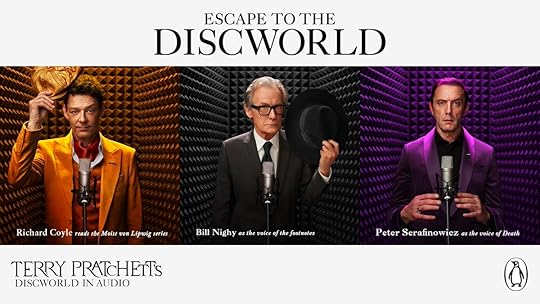
One reason why I decided to re-read the series is that I can never just indulge in one of the volumes. The other is that the audiobooks were newly produced and the casts looked amazing.

Reading this 40th book (in chronological order) are:


The future is here! Excitement and happy anticipation ... are not. *lol*
However, Lord Vetinari knows when not to stand in the way of progress or get trampled underfoot. Hence, why he doesn't stop nothing other than the locomotive being invented. Well, another reason might be that even Ankh-Morporkians would prefer their fish to stay fresh during the transport. ;)
Nevertheless, The Patrician wouldn't be the Patrician if he didn't make sure he could conrol this new invention and all it brings along. So he calls upon his favorite scoundrel-turned-respectable-business-man, Moist van Lipwig and makes him an offer he can't refuse. Again. And VOILÀ, the first ever Railway company on the Disc is officially in business! And what a booming business it can be what with all the possibilities (not just freight but also passenger transportation and all that entails).

There's more, though. This is dedicated to all the curious people out there. The engineers and inventors. The handymen and puzzlers. The ones that get and keep any world moving. And it's a warning about turning curiousity and inventiveness into "mercantile weapons".

Naturally, there are antagonists. In this case, religious nutters and other people who not only refuse to move with the times but actively sabotage society by hindering progress. Because Pratchett didn't have to invent supernatural threats - the real ones are dangerous enough.

To me, there is a certain magic to old trains and traditional train journeys. Nevertheless, this book will never not feel odd to me. Not because of Pratchett's declining mental state when he wrote it with Rob Wilkins, but because the Disc turning modern was so antagonistic to my favorite characters.

Regardless, I had a very good time, not least thanks to the great cast of this new audiobook version that was spearheaded (for this sub-series) by Richard Coyle. Like I said above: not the way I would have wanted this series to near its end (though I did appreciate the kitten torture technique and déjà-fu very much), but if this is the way it had to go, it was a good way.

One more to go. *deep breath*
Profile Image for James.
52 reviews16 followers
December 4, 2013
I wavered a bit on what score to give this book. In the end I compared it to the last couple of Discworld books: I enjoyed it a little more than Unseen Academicals and a lot more than Snuff, so let's say it's on the low end of three stars.

I wonder if all those three stars are earned, though, or if I'm just attached enough to the characters included in this book to be pretty lenient. I found reading this book a really odd experience; the pacing is pretty choppy, and sometimes makes the book hard to follow, and some of the prose and dialogue seems slightly... odd. Dialogue especially.

There's also not a huge amount of humour on display to be honest, which wouldn't actually be so much of a problem (you could say the same of Night Watch, which I love to pieces), but it doesn't feel like anything particularly fills the absence left. There don't seem to be any particularly strong overarching themes, which strikes me as criminal in a book supposedly about the industrial revolution. (In fact, the way the industrial revolution themes are basically neutered might be the problem: this is a very rosy-glasses kind of book in my opinion, when it could have been a lot more cutting. Maybe Moist wasn't the best choice of POV for Raising Steam.)

There is some nasty holdover stuff from Snuff that pissed me off, but I don't really have time to go into it here- but yeah, that was annoying. (...I really, REALLY hated Snuff, I'll say that now.)

And some of the characterization seemed off. I'll need more time to think about that, though.

On the other hand, there were certainly parts I liked. I like that it's an ambitious book and tries to tie together a lot of seemingly disparate elements, I like that it does what Pterry is so good at with Ankh-Morpork and makes it feel like a real, living place that continues existing when you put the book down, certain plot elements and character meetings really caught my eye and I really enjoyed all the interactions between Moist and Adora in particular. Though I do wish she had a bigger role overall. Some individual scenes brought me a lot of glee and I did enjoy seeing the whole element of technological process on the Disc being continued.

But at any rate, it's worth reading, which is more than I would say about the last Discworld book. I guess I spent a lot more time talking about the negatives, but I think it's because having read so much Discworld I kind of take the positives for granted, and the negatives stick out much more strongly.
Profile Image for Marc *Dark Reader with a Thousand Young! Iä!*.
1,500 reviews313 followers
September 8, 2022
The end of Discworld, or just the beginning?

This is the last Discworld novel. (Don't get me going on the posthumous The Shepherd's Crown which remained in a woefully, painfully unfinished state, direly more so than this book, and which I would recommend skipping entirely were it not for a pivotal, wrenching early scene that represents a true end to the series.)

It feels like an end. It's written with a clear sense of finality, with tips of the hat to many beloved characters, and even more so as it sets the Disc on an undeniable path of progress forevermore. The theme of progress versus tradition has pervaded the series, first clearly expressed in Equal Rites and Pyramids, chugging along in some fashion in almost every book since. This book caps multiple subseries and ongoing events: the city watch, the industrial revolution in general and Moist Lipwig in particular, the move towards racial tolerance and cooperation, Vetinari's tyrannical rule, with a minor appearance by the faculty of Unseen University, a feature role for Harry King, and a newcomer in engineer Dick Simnel, master of the sliding rule.

Raising Steam also stands out for covering the longest span of time in any single Discworld book, time travel or cosmic events notwithstanding, with years passing here from start to finish.

After the unfortunate state of the prior two books, Unseen Academicals and Snuff which can be 100% attributed to Pratchett's rare form of early-onset Alzheimer's disease, this was a notable improvement ... until it wasn't. The first half of the book was comparatively a relief. It remained different from all that came before, but was generally satisfying and well-developed, with some palpable degree of that old Discworld sublime flow, barring the occasional section that clearly cried out for further development. Sadly, the entire second half devolved to that latter state. Blame the disease, not the man, and I can't fault the editor for not being so heartless as to demand the cutting of 50-100 pages that would otherwise be warranted. This book is accurately representative of Sir Terry the man at that time. The parts that shine reveal a heroic effort to give this life's work the send-off it deserved; the rest yields to the woeful limitations that were thrust upon him, to the shared sadness of a decades-old worldwide audience.

Thus ends my three year, thirty-five book reread of the Discworld novels, saving the Tiffany Aching subseries for "younger readers" to revive joy at a later date. I could not have planned it better for the impending fall 2022 release of Terry Pratchett: A Life With Footnotes: The Official Biography, the biography by Rob Wilkins, Sir Terry's personal assistant and close friend who became increasingly invaluable in the final years of his life, lovingly typing out his novels when his disease limited him to dictation, overseeing his estate and carrying out his posthumous wishes including destroying all unfinished work by means of antique steamroller, and tweeting out the final goodbye with which I will shortly end this review.

RIP Sir Terry Pratchett: Englishman, journalist, author, protector of ourangutans, defender of the right to die, beloved worldwide forevermore.
AT LAST, SIR TERRY, WE MUST WALK TOGETHER.

Terry took Death's arm and followed him through the doors and onto the black desert under the endless night.

The End.
Profile Image for Igor Ljubuncic.
Author 19 books278 followers
September 19, 2014
Actually, DNF.

This is the first Terry Pratchett book I did not enjoy, and I've read the entire Discworld series, some of the books twice or even ten times. Things sort of started deteriorating when he discovered his disease, and since, he's been obsessed with darkness, rage and such.

In Raising Steam, it's rage for Moist, darkness for Vimes. But there's a bigger problem. Zero emotional involvement. To illustrate, there's a scene where Moist saves kids from a railways track, then he goes to Harry King, and says, you need to clean up your act, Harry, and Harry goes, ok. That's it. The whole incident, confrontation and resolution happens in three sentences with all the grace of a brick falling off a pile onto hard ground below.

I am sad that it has come to this. Monstrous Regiment was probably the last really fun one. Thud! and Making Money were ok. Unseen Academicals was a bit off. Snuff, meh. And this one, really bad. Simply not interesting. It's a report, not a book. No humor, no drama, no depth, just words upon words that describe the world and do not really throw you into it. I decided to stop and retain a good memory of what Terry once did in his earlier works. Best to end on a happy note. All good things must end.

Ergo, no limerick. Sad.

Igor
Profile Image for Lauren Stoolfire.
4,770 reviews296 followers
February 11, 2021
Raising Steam (Discworld #40) by Terry Pratchett was a welcome return to one of my favorite series. Moist von Lipwig is easily one of my favorite characters and it was great to see him back along with Adora Belle, Vetinari, Vimes, and company. There not quite back in top form, but all things considered all things considered it was just good to seem them. Comforting, if you know what I mean.
Profile Image for Nisha-Anne.
Author 2 books26 followers
December 11, 2022
2022 review: Realised through my last few Pratchett rereads that I had absolutely no memory of this book. So this really was like coming to it new, though again I never forgot the two details about Rhys Rhysson.

Really, it's quite thrilling how familiar characters come together in almost new and thrilling ways. And how very many callbacks there are, small and significant, to the other books. Even the mention of Twoshirts!

I found it less difficult this time, again contextualising it in light of the official biography and remembering what Pterry was dealing with at the time. It's good to reread these later books with that knowledge, brings a whole new appreciation of them.

And really the theme of boomers learning to evolve with the changing times and changing attitudes warms my goddamned heart. Makes me so proud that Pterry was the kind of human he was and that I've had him influencing me for so much of my life.

2013 review: This was a bit difficult at the start, mostly because I never really like the Moist/Industrial Revolution books and Pratchett seems to be tending more towards long paragraphed speeches, either verbal or internal. I miss the days when his narratives were powered almost entirely by dialogue and hilarious misunderstandings and clever puns, when the long paragraphs of insight were actually valuable and brilliant and were usually at the very start and then in the final act. I noticed this stylistic change in Snuff and seeing it here rather made my stomach drop.

So I struggled for a good long time, actually put the book down a fair few times and have read it over about four sittings which is highly unusual for me. Normally I'll read a new Pratchett in one fervent go, interrupted only by sleep and then not always.

Admittedly, it was rather sweet to see so many familiar characters pop up, so many references to other places and incidences which I suppose is inevitable in the fortieth novel of a series --- rather crowded, our Discworld, yes --- but it was still charming and lovely to see. While part of me did resist the cast of thousands, each new small bit proved quite valuable and often beautiful. The brutality did startle me --- there's a lot of blood and awfulness in this book. Now that I think about it, I suppose that's how the rage of Pratchett would manifest itself in a Moist novel since Moist himself is completely alien to rage.

But things change. And that was the wonderful thing about this novel, the excitement and joy of embracing change while still being careful to safeguard against horrible things.

I never forgot the little reveal from The Fifth Elephant so the first big reveal was no surprise and I had very quickly guessed at the second. Still the way the narrative itself changed was quite thrilling and made me so proud to be a Pratchett reader from way back.

And oh the little references to Brief Encounter and Downton Abbey and E Nesbitt made me laugh and love him more. Until that absolutely marvellous final act where, yeah, my love was totally vindicated and has left me all beaming and happy and very satisfied.
Profile Image for Trish.
2,386 reviews3,744 followers
September 30, 2020
What do religious (dwarf) fanatics have to do with the invention of the steam engine? Well, everything.

We are in Ankh-Morpork (sometimes) where the Patrician is not standing in the way of progress because, once again, he knows exactly when you have to get out of the way if you want to stay in power. Thus, instead of instigating „accidents“ to happen to the son of a certain inventor, he allows the boy to meet up with a certain Ankh-Morporkian business man and Iron Girder is born.
And if there is one man accustomed to revolutionizing the Disc, it’s our favorite con man: Moist von Lipwig. So it happens that after being the Postmaster General, the Deputy Chairman of the Royal Bank of Ankh-Morpork and Master of the Royal Mint (to say nothing of having a girlfriend who’s the boss of the Clacks), Moist now also becomes the boss of the first ever Railway company once the idea has been picking up steam if you’ll excuse the pun. *lol* Which means he also has to come up with the idea, then come up with the possibility of transporting not just goods but also people and that they might need nourishment along the way - all the nice ways you can make money off the railway and trains!

In short: the future is here and either you change with the times or you get left in the dust - which brings us back to the aforementioned religious nutters and the trouble they cause for Moist.

Funnily enough, I know from personal experience of the magic a train with a steam engine can exude on the onlooker and/or people who travel that way. It is therefore no surprise that this technology has also made it to Sir Terry’s most well-known book series to enchant the people and to enhance the way they travel or transport things on the Disc.


As such, the book is about progress, it’s about living in the past and refusing to accept change, it’s about the clash of generations, it’s about business/investments (and their impact on innovation and progress as „mercantile weapons“), it’s about everyone discriminating against anything other - in short, it’s about everyone being people.

No, this is not the best book in the series. It’s not the best book of Moist’s sub-series either. It might have to do with Sir Terry’s affliction. Or not. It doesn’t matter. There are still some important musings combined with sharp observations nonetheless and Sir-Terry-not-at-the-top-of-his-game is still miles better than most other authors on this planet. I mean, the kitten torture technique and déjà-fu! HA!

The turtle movies. For everyone. All the time. Like it or not.
Profile Image for Lightreads.
641 reviews594 followers
November 22, 2013
I've applied a lot of words to Discworld books over the years, not all of them good, but I'm pretty sure this is the first time I'm going to call one of them boring. Bo-ring. So boring.

He's written this book a good fifteen times already, and most of them were better. A new piece of technology confounds the Discworld (the railroad), there are arguments, protests, less than a handful of good jokes, and an allegedly feel-good interlude about social progress in which, in this case, we have yet another "I'm really female, so there!" revelation from a dwarf.* This is number twenty five, roughly.

*Which was actually the most interesting thing in the book for me, because it pissed me off enough to actually get my blood flowing again. Because, like, all dwarves live as men, which apparently means that women don't get to be women because….they don't wear skirts? So when they "rebel," what they do is have their armor recast to include breast molds. Because that's what being a lady is. No for real.
Profile Image for Kathleen.
1,375 reviews28 followers
August 6, 2015
It's like a miracle, this book. I read that Pratchett dictated it to his computer with text-to-speech software. Hoorah for assistive technology! Admittedly, I can tell that it wasn't solely created by the brilliant voice of Sir Terry — or not the Pratchett we know and love — but that's okay, because I sense that the ideas are his, if not the full execution. Plus, it's got my favorite characters (even though they aren't portrayed the same as in previous books). I just adore Sam Vimes, Lord Vetinari, and Moist Von Lipvig. And they are ALL here (minus Carrot).

But, still, this book has some problems, mentioned further below.

Ankh-Morpprk has been climbing out of the Middle Ages and undergoing modernization for some time, beginning with the invention of cinematography in Moving Pictures and the printing press in The Truth. Now comes the steam-powered locomotive, invented by an ingenious young artificer named Dick Simnel, who hails from the hicks of Sto Plain. With help from his deceased father's mechanical notebooks, he builds a train. When Dick steams his way into Ankh-Morpork it inspires a visionary interest in Sir Harry King, joy among the mechanically-inclined goblins, and great consternation among the dwarfs, especially the fundamentalist Luddite Grags in neighboring territories.

To keep Simnel’s invention safe and properly serving the City, Lord Vetinari dispatches Moist von Lipwig to supervise the "rail way" Iron Girder. Lipvig is Vetinari's trusted — and coerced — minister of the Postal Service (see Going Postal) and the Royal Bank and Mint (Making Money). Here's his first impression of the train:
"Moist suddenly noticed the crowd outside the compound fence, pressing up against every inch of wire netting, and felt their expectancy. As the coach stopped, he smelled the acrid scent of coal smoke cutting through the general fetor, and heard what sounded like a dragon having difficulty sleeping, a kind of chuffing noise, very repetitive, and then suddenly there was a scream, as if the biggest kettle in the world had got very, very angry.

Lord Vetinari tapped Moist on the shoulder and said, “Sir Harry tells me that the thing is quite docile if handled with care. Shall we go and have a look? You first, of course, Mister Lipwig.”

Let me say right now how much delight Sir Terry's Discworld books have given me. Some favorites are the City Watch subseries, including Guards! Guards!, The Fifth Elephant, Night Watch, and Thud!. I also loved Going Postal.

Some problems with this book:

The pace is too slow. Usually, well within the first quarter, Pratchett has set into place a serious problem: an evil, an injustice, a crime or mystery to solve. Not so here. At 33% into the book, there was still no major problem. Even though some Grags are vandalizing distant clacks towers and murdering the operators, those actions feel distant, off-stage, and secondary to the wonderful joy of the steam engine.

Tenor: The overwhelming feeling is positive, happy. Everyone is thrilled with the steam engine or with each other. Too much good will; compared to prequels it felt like sugar shock. Everyone (even Vetinari, Vimes, King Rhys) smiles, grins, cheers, laughs, etc. Often, characters laugh when there is nothing funny, as though laughter will somehow make the dialogue funny.

Not enough vivid plot. For example, fight scenes are too quickly brushed over (bandits, murderous grags) and derring-do scenes are mostly the applause and glad-handing afterwards (rescuing children). Another example: Moist was sent out to gain land access rights to lay the railway tracks. He had to negotiate with all the wealthy landowners between Ankh-Morpork and Sto Plain, but we didn't hear much at all about his negotiations. We heard only about one tricky landowner (Lord A) who tried to get Moist drunk to cut a better deal. Since wheeling and dealing and flimflammery is what Moist does best, these scenes should have been told in vivid detail. Instead, with no further ado, every landowner has agreed to allow the train to pass through their land, and an exhausted but satisfied Moist is riding his horse up the palace steps and directly into the oblong office to announce his success (no way would that happen in previous books).

There is some satire, parody, and punnery. Some of this is spot on, but some is lame. Still, much better than I could do. However, the social commentary again focuses on fundamentalism (Grags) and on gender (female dwarfs) and this goes on and on. It is repetitive. In this book, Pratchett tends towards long speeches, either verbalized or conveyed via silent internal reflection. This occurs too much. Not Sir Terry's usual style.

Biggest problem? The characterization in RAISING STEAM is off, as seen in the excerpt below. Lord Vetinari is never (ever) "breezy" and furthermore, his speech patterns are far too elegant and precise to include the word "thing":
"Vetinari seemed to be deep in thought, then he said breezily, “Very well done, Mister Simnel, an excellent demonstration! Am I to believe that many passengers and tons of freight could be carried by means of this … thing?”
In addition, Vetinari reveals his plans, thoughts, and feelings in this book. This contrasts strikingly with the prequels, wherein the Patrician is enigmatic, inscrutable, unreadable. It didn't even feel like the the same person I met in Guards! Guards!.

Nobby Nobbs sounds off, too ( saying "actually" and "as it were"):
"“Actually,” said Nobby, “it ain’t all that bad. When I was working the rota last week on the goods yard there were a load of cheeses that got broken open by accident, as it were."
This is a small thing, but collectively it portrays a different Nobby.


Then there was the scene where Moist let his beast off the leash. Really?? Only Vimes ever had a beast, a berserker side to his nature. Only Vimes dealt with the summoning dark and had his own guarding dark.

I felt the hurt of these deviations from the norm, but I appreciate the precious gift of this book.

PS. For Snuff
, I posted a 15-question quiz
Profile Image for John Connolly.
Author 220 books7,896 followers
February 8, 2014
Terry Pratchett writes while dealing with a debilitating illness (Alzheimer's), which seems to me a particularly cruel affliction with which to curse a novelist, given the importance of keeping a thousand small details in play from start to finish. Raising Steam, the latest Discworld novel, bears no trace of Pratchett’s illness. While it’s not the funniest of the series, it’s still a joy to enter that perfectly constructed world. I had the pleasure of interviewing Pratchett in Dublin some years ago, and I enjoyed his company. He’s on the board of trustees of the Orangutan Foundation, incidentally, in no small part because the Librarian of the Unseen University was transformed into an orangutan during an unfortunate magical incident and decided to stay that way, as it made it easier to get around the stacks.
Displaying 1 - 30 of 3,265 reviews

Can't find what you're looking for?

Get help and learn more about the design.