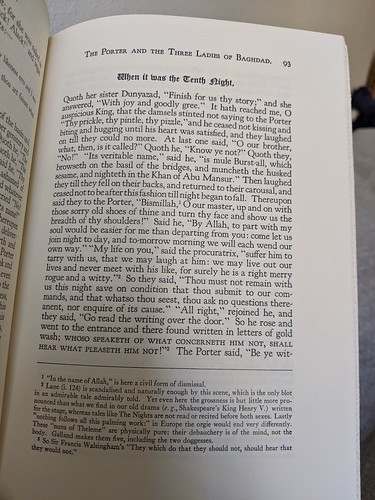
This is a huge book. 16 volumes may be one thing or another but here each volume is at least as large as an average novel. Not even my Kindle Paper White can manage it completely; on opening the book there is a pause of at least a minute before I can begin turning pages. I don't know what Ms Kindle is doing but once we get going we're off. I am marking this book as "read" to get it off my "Currently Reading" shelf but I have not read all of it – or even half of it.
I have read most of the first volume and part of the second. Mr Burton is a conscientious translator who scatters footnotes throughout his texts. These may refer to alternate translations, more often to cultural differences between the Arab world and the west, and sometimes they are personal reflections or refer to his own experiences or other writings. The text in the footnotes for each volume is somewhat less than the actual text, I believe.
Mr Burton was not Victorian in the sense of being a prude, nor were the authors of these tales. For example in the opening story – the one which sours King Shahryar on all women and forces Scheherazade to a lifetime of storytelling. Andrew Lang's explains, in his Tales from the Arabian Nights: "...It was therefore with the deepest shame and sorrow that he accidentally discovered, after several years, that she had deceived him completely, and her whole conduct turned out to have been so bad, that he felt himself obliged to carry out the law of the land, and order the grand-vizir to put her to death..." (Introduction)
In the present text:
"The lady laughed heartily, and all fell to satisfying their lusts, and remained so occupied for a couple of hours, when the white slaves rose up from the handmaidens' breasts and the blackamoor dismounted from the Queen's bosom: then they went into the basin and, after performing the Ghusl, or complete ablution, donned their dresses and retired as they had done before. When King Shahryar saw this infamy of his wife and concubines he became as one distraught and he cried out, "Only in utter solitude can man be safe from the doings of this vile world!" (Location 493)
I think it is worth noting that the king only cries out in distress after observing the goings on for "a couple of hours". In any case he was thoroughly enraged: "...On this wise he continued for the space of three years; marrying a maiden every night and killing her the next morning..." (Location 561)
In Footnote number 7 Burton explains: "[FN#7] Debauched women prefer negroes on account of the size of their parts. I measured one man in Somaliland who, when quiescent, numbered nearly six inches. This is a characteristic of the negro race and of African animals; e.g. the horse; whereas the pure Arab, man and beast, is below the average of Europe; one of the best proofs by the by, that the Egyptian is not an Asiatic, but a negro partially white-washed." (Location 567 in Footnotes)
While this is interesting, and funny – imagine the process of measuring a man's penis – it is also as politically incorrect as you can be. But it does explain why, in several stories, the "negro" slaves, often described as "ugly", are the preferred lovers of women.
I suspect that Mr Burton is not really racist. He seems to show respect for the people of each culture he encounters. He does not belittle any race, but he does make distinctions between them, mostly cultural.
"...Now I swear an oath by the velour and honour of blackamoor men (and deem not our manliness to be ; the poor manliness of white men)..." (Location 1447)
"velour" I suspect is a typo for "valour". There are many typos in this edition.
Nor does class-consciousness loom large in Mr Burton's world view: "
...This proceeding is thoroughly characteristic of the servile class; they conscientiously conceal everything from the master till he finds a clew; after which they tell him everything and something more... (Location 5899)
The perspective of the Arabian Nights is male. Even though our narrator is female, she can still say: "...she hung her head in shame to the ground and repeated the words of Him whose Name be exalted, "Men shall have the pre-eminence above women, because of those advantages wherein Allah hath caused the one of them to excel the other.[FN#387]" (Location 19111)
Mr Burton explains: "[FN#387] Koran iv. 38. The advantages are bodily strength, understanding and the high privilege of Holy War. Thus far, and thus far only, woman amongst Moslems is "lesser". (Location 20386)
Still we read in Tale of the Bull and the Ass: "...she kissed his hand and feet and he led her out of the room submissive as a wife should be. Her parents and all the company rejoiced and sadness and mourning were changed into joy and gladness." (Location 693)
"...Women are Satans made for woe o' men; * I fly to Allah from their devilish scathe: Source of whatever bale befel our kind, * In wordly matters and in things of Faith..." (Location 18888)
There is a lot of religious promotion, calling on Allah the wise and good and all powerful even in times of grief and loss; as when the sage Duban speaks to king Yunan: "Turn thee from grief nor care a jot! * Commit thy needs to Fate and Lot! Enjoy the Present passing well * And let the Past be clean forgot For whatso haply seemeth worse * Shall work thy weal as Allah wot Allah shall do whate'er He wills * And in His will oppose Him not. (Location 1208)
Mr Burton's language is generally readable, somewhat dated, difficult mostly in his use of very unusual words, some of which he seems to have invented:
"turpiloquium" Latin for "profanity" and, in the context used, apparently it can mean "ribaldry" as well. (Location 188)
"Badawi" is apparently the singular, for the more accepted term "Bedouin". (Location 270)
"amativeness" for "amorous". (Location 20085)
"Polissonerie" he tosses in for some reason; French for "mischief".
"futtering" is probably a word Mr Burton made up from the French "foutre" and with the same meaning, i.e. "fuck". (Location 528)
"...the citizens, who were of four different faiths, Moslem, Nazarene, Jew and Magian, she transformed by her enchantments into fishes; the Moslems are the white, the Magians red, the Christians blue and the Jews yellow. (Location 1506)
Magians are Zoroastrians – as explained elsewhere. The reader may wonder why these colours are chosen for these religions but Mr Burton explains:
[FN#131] Turbans in these colors were worn by practitioners of the various religions.
Having recently read The Hero with a Thousand Faces I jumped forward to volume two in this book to finish the story Mr Campbell began: Prince Kamar al-Zaman and Princess Budur which Mr Burton calls the Tale of Kamar Al Zaman.
"...Except thou obey me this very moment, O accursed, I will dart my sparks at thee with my fire and consume thee; yea, in pieces I will rend thee and into the deserts cast thee... (Location 17528) Harsh words from one Djinn to another.
While Mr Burton's prose is acceptable, in my humble opinion I cannot say the same for his poetry; of which there are at times considerable, particularly in this tale:
"Those glances, fell as plundering Turk, to heart such havoc deal As never havocked scymitar made keenest at the curve. On me thou layest load of love the heaviest while I feel So feeble grown that under weight of chemisette I swerve. (Location 17555)
"...Upon the lover's eyne high mysteries 'light: I'm blamed for love of her, nor pardon claim; * Eyes are not profiting which lack foresight: Heaven strip thee, blamer mine! unjust art thou; * Before this fawn must every eye low bow..." (Location 17865)
"...Thou present, in the Heaven of heavens I dwell; * Bearing thine absence is of hells my Hell..." (Location 18114) Says a father to his son.
"The penis smooth and round was made with anus best to match it, * Had it been made for cunnus' sake it had been formed like hatchet!" (Location 18666)
This is Princess Budur, masquerading as a man and a king, to her husband Kamar Al Zaman who has been missing for a couple of years, enticing him to gay sex.
Mr Burton regrets several of these couplets in what he regards otherwise as "a pretty tale".
It is a long tale, a very long tale. It could have ended: "...[Kamar Al Zaman] became King, he remitted the customs-dues and released all men who remained in gaol. Thus he abode a long while, ordering himself worthily towards his lieges; and he lived with his two wives in peace, happiness, constancy and content, lying the night with each of them in turn." (Location 18738)
And they lived happily ever after...
Unfortunately it does not end so but the tale of Kamar Al Zaman goes on to relate the adventures of his sons who suffer many slings and arrows of outrageous fortune. I don't remember if I gave up at last or indeed did finish the tale. In any case I have lost my taste for Arabian Nights and will put this book in the "read" pile. Maybe I will take it up again some day.
Gems of wisdom do shine through: "Oppression hideth in every heart: power revealeth it and weakness concealeth it." (Location 1092)