The Definitive Guide to Insects as a Sustainable Food Source
In The Insect Cookbook , two entomologists and a chef make the case for insects as a sustainable source of protein for humans and a necessary part of our future diet. They provide consumers and chefs with the essential facts about insects for culinary use, with recipes simple enough to make at home yet boasting the international flair of the world's most chic dishes.
"Invite politicians to dinner and let them tell the world how delicious it is.... They will proudly go around and say, 'I ate crickets, I ate locusts, and they were delicious.'"―Kofi Annan
The Insect Cookbook features delicious recipes and interviews with top chefs, insect farmers, political figures, and nutrition experts, including chef René Redzepi, whose establishment was elected three times as "best restaurant of the world"; Kofi Annan, former secretary-general of the United Nations; and Daniella Martin of Girl Meets Bug . The book contains all you need to know about cooking with insects, where to buy them, which ones are edible, and how to store and prepare them at home and in commercial spaces.
The Insect Cookbook is what it claims to be: a cookbook with insects as the primary ingredient, since we'll be needing more and more sources of protein as the human population continues to grow.
The book starts with an overview of insects and has some interesting bug facts. Did you know that in the tropics, insects cost more pound for pound than meat and that in some parts of Mexico, popped ants have become the preferred snack at movie theaters? Fascinating stuff.
Insects as a food source are widely discussed, from Australians marketing grasshoppers as sky prawns, the Dutch calling them Land Shrimp, to weaver ants, termites, and yellowjackets being roasted and consumed. Spiders are given a mention despite being arachnids and not insects, though both are arthropods. Really, would eating tarantula legs be that much different than eating crab legs?
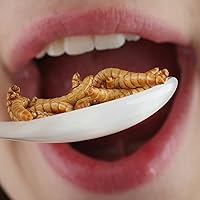
Many of the recipes in this book use either migratory locusts and two different types of mealworms, the insects most widely available to buy in the Netherlands, where the book was originally published. Others use termites and things of that nature. There are salads, soups, main courses, and desserts. Carmellized grasshopper, anyone?
This book does a great job at making the idea of eating insects more palatable. I've long thought that insects probably don't taste much different than shrimp or lobster. Aside from the box of chocolate covered insects someone at work gave me and that time I finished a bowl of cereal only to find there were weevils floating in my milk, my insect eating experience is minimal.
As I read this book, I found myself getting hungrier and hungrier. Thankfully, there is a list of insect suppliers in the back, right behind the chapter talking about how much less resources it would take to raise insects for food than it does cows or pigs.
Four out of five stars. I'm going to go scare up some grasshoppers to throw on my leftover pizza.
Edit: Forgot to mention this was a Netgalley find.
Ive been vegetarian for 30 years and you would THINK that insect cookery would be the ultimate ick factor. And it did have a bit of that "fear factor" appeal to me at first. But strangely it's really not that gross. I mean, I'm not salivating over pictures of roasted grasshoppers or anything but given the choice...I think I would eat mealy worms over chicken legs any day..
Isn't it funny though? I mean, people eat prawn cocktails all the time and when you think about it, I mean really think about it, prawns look rather insect like. It's kind of... well, icky. But we're used to it. And we eat honey which basically is bee vomit and love it. What's up with that?
I think what sealed it for me was the fact that we already eat bugs every day without even knowing it (it's in our peanut butter, chocolate, apple juice etc) and we haven't died yet, so it's not that big a deal. It's just a bit taboo. You know, like, eating bugs is for starving Ethiopians not "civilized" Americans (or some such nonsense). Fact is, in other countries people eat bugs NOT because theyre starving but because they actually taste good. Go figure. Us poor Americans are really missing out. Hey!
Anyway, I thought it was a pretty cool book. It explains the background of Entomophagy, how insects are used around the world in cooking, how they're making a showing in places like the Netherlands, San Francisco and New York, and it even has tons of recipes and full color pictures for your enjoyment. What's not to love?
Funny thing, I was with some friends today, one who is fairly open minded and a "mighty hunter" to boot. He has no problem butchering a deer or other animal and eating it. I mentioned this book and he thought it was totally gross. What a wus.
*I received this book free from Netgalley in exchange for my honest opinion.
A pro-insectivore manifesto for food sustainability.
Makes a compelling argument for how edible insects are a viable alternative protein source, highlighting the ease of production, economic advantages, and eco-friendliness, as well as their huge potential to reduce meat production and address global hunger issues.
“The Food and Agriculture Organization of the United Nations (FAO) estimates that livestock is responsible for 18 percent of all greenhouse gas emissions, and is, as such, an important contributor to global warming. Greenhouse gas emissions include methane (CH4) and nitrous oxide (N2O). Simply by burping and passing gas, cattle release more than one-third of all methane emissions worldwide. Methane contributes twenty-three times more to global warming than does carbon dioxide (CO2), the most important greenhouse gas emitted by cars. Livestock generates close to two-thirds of all nitrous oxide released; this gas is 289 times more damaging than CO2. Some insects, such as termites, also produce methane, releasing 4 percent of all emissions of this gas worldwide. By contrast, the edible insects mentioned in this cookbook, such as mealworms and migratory locusts, produce far less greenhouse gas per kilogram of product than do cows or pigs.”
More a collection of world chefs' and leaders' thoughts on introducing insect protein into Western diets, than a sizable collection of everyday recipes.
Okay, so while reading this book, I discovered something very disturbing: I have Entomophagophobia. This basically translates to ‘A fear of eating bugs’. Didn’t know I had it, but now I certainly do! I spent the first half of this book gagging at just the thought of eating the food described.
The authors have attempted to introduce a very interesting topic: how do we convince the world to eat more bugs? It’s a great idea, by doing so we could help famine stricken countries by giving them the protein they so desperately need – and in a dose that is both likely more readily available as well as containing more nutrients and iron per gram than more traditional protein sources. Added to the equation is the fact that less land will have to be cleared and there will be a significant lowering of the protein carbon footprint thanks to the consumption of insects over hamburgers.
Will the western world succumb though? The authors do their best to try and entice the reader into an entomo-enriched diet. There are plenty of recipes that cover many different cultures in an effort to tease people with their proclaimed culinary delight.
Will it work though? Honestly, I’m not so sure.
Yet something weird happened two thirds of the way through this book, once they mentioned the fact that people eat honey (which, in a nutshell, is bee vomit), I started to be okay with this concept. This probably should have been the main focal point for the authors if they want westerners to try bugs, rather than the ‘save the world‘ route they took.
At times it really felt like the authors were forcing insect cuisine on the reader. Then, at other times, there was a feeling that they were almost looking down on the readers, with their ‘we just need to trick the dumb humans into eating bugs and then we will be able to control the masses‘ attitude (at times). Yet, reading the interaction between the authors and the people they interviewed talk about their passion for bugs and treating them as a food source was inspiring.
Overall, I am giving The Insect Cookbook: Food for a Sustainable Planet by Arnold van Huis, Henk van Gurp and Marcel Dicke 3 out of 5 stars.
I wanted to preview this book before I bought it. I think it's an amazing concept and I am so excited to get a copy of this book for my son. There's a lot of information on using insects in cooking and explaining how insects could help create sustainable food for the planet. There's nothing weird about this book. Many cultures eat insects. My son is currently going to school in culinary arts but plans on moving on to a double major in entomology and culinary arts. He wants to open an insect restaurant. To me, the recipes in this book are fairly benign, showcasing how insects can easily be incorporated into ones diet. I appreciate the effort because it gives someone not familiar with the concept of insects as meat recipes that aren't so foreign.