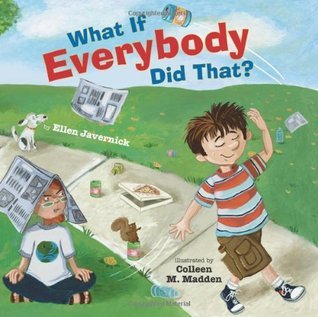
If you drop just one soda can out the window, it’s no big deal…right? But what if everybody did that? What if everybody broke the rules…and spoke during story time, didn’t wash up, or splashed too much at the pool? Then the world would be a mess. But what if everybody obeyed the rules so that the world would become a better place? Using humorous illustrations rendered in mixed media, these questions are answered in a child-friendly way and show the consequences of thoughtless behavior.
Ellen Javernick is the author of more than twenty books for children, including the Children's Choice Book Award finalist The Birthday Pet, illustrated by Kevin O'Malley. She has been an elementary school teacher for more than twenty years and currently teaches kindergarten. She lives in Loveland, Colorado.
I really did not like this one. The premise here is that this kid keeps doing stuff that adults tell him he shouldn't do and the reason is always because it would suck if everyone else did it too.
Many of the examples were just nonsense.
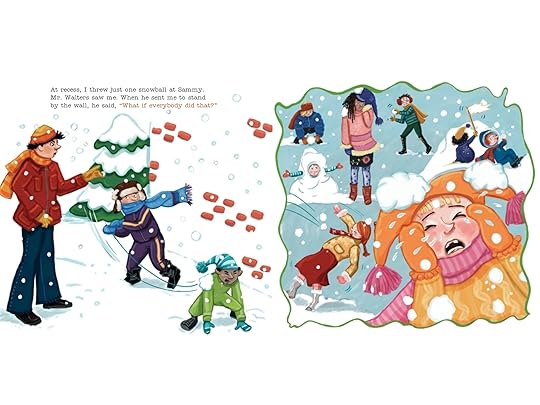
I mean isn't everyone throwing snowballs exactly how a good snowball fight works?
Blech. I suppose this might be useful to read to *some* children in *really specific circumstances*, but I struggle to think of who or when that may be.
I did not like this book partially because in each instance the boy was doing something he shouldn't the adult telling him to stop was scowling. Some of the things he was doing weren't that bad, such as rushing onto the field after a football game to get an autograph or splashing in the pool. Even though I agree they weren't things he should do, the reason for stopping wasn't "what if everybody did that?" For example: honking the horn in a car. That's obnoxious even if no one else does it. Do you really think that if everyone ran to one side of the school bus that the bus would tip over? I just thought that the examples were poorly chosen for my set of values and perceptions of the world.
That said, there were some examples I agreed with: go to the Reading Tub to see them.
My wish for this year: that What If Everybody Did That? would be mandatory reading, not just for kids, but for adults of the world too. We all need a reminder to step back and consider the potential cumulative impact of our actions: "What if everybody did that?"
I've always referred to the brand of selfishness/ignorance portrayed here as the "public bathroom" mindset. We all know this thoughtless type of person, the one who shows no consideration because it's not theirs and they assume someone else will take care of it.
One earth. We all live here, and it's up to all of us to at least try to keep it nice. Let's everybody find some positive things to do, and make the right kind of impact.
This book is a tool to get children talking or thinking about their choices/behavior and how that impacts others. For example, the boy races a cart at the grocery store to see how fast it can go and the store manager stops him and says, "What if everybody did that?" The next page is followed by a illustration of how a grocery store if everybody (young and old) were to run around racing their carts in the grocery store. The book offers many more examples of how poor choices could lead to undesirable situations if everybody were to do it. The ending grabs the reader's attention because the young boy making a good choice and shows how wonderful it would be if everybody made good choices.
My son thought many of the illustrations were ridiculous. Perhaps, so ridiculous that many children could miss the overall message of the book. On the other hand, I feel the humor makes the book less preachy which is appealing to most children. I would recommend reading this book with young children as a means to get them thinking how their choices/behavior impacts those around them.
Readers encounter a little boy who learns that his single actions can contribute to a larger problem. For example it shouldn't be such a big deal if he shares his popcorn with the bears at the zoo, right? But what if everyone did that?
There are many good lessons and the story ends on a positive note: what if I just give Mommy one hug? Well, everyone should do that!
The problem with this book is the illustrations. They are very well done technically. But the characterizations of the authority figures is extremely disappointing. Every person in an authority position is drawn with a sour and mean face when admonishing the child. These lessons can be taught effectively without making it a horrible experience.
I don't ever want to be (or perceived to be) the librarian who looks that horrible when she's taking control of a class (pg. 11).
I think the author of this book has been to my storytime, because in the image of what would happen if everyone talked in storytime I could see myself. I wish the author had cut out half of the examples and used something else to move the story forward. I also thought that several of the "what if everyone did this" examples looked like a lot of fun--like blowing straws and throwing snowballs, but the tone of the book made it seem not fun.
A little boy is questioned constantly about his actions with the phrase: "What if everybody did that?"
This would be a great beginning of the year or middle of the year book to review rules. Have listeners chime in in saying the phrase "what if everybody did that?" Make a class book or brainstorm what would happen if everybody broke our library rules, and then on the opposite page if everybody followed them (e.g. using shelf marker).
I really like the idea of this book, especially having just visit the New England area where litter is everywhere! However, some of the ideas of things we shouldn't do seem a little strict. For example, a teacher forbids throwing a snowball. That makes sense because snowball fights at school probably aren't going to happen without someone getting hurt. However, the line simply reads "What if everybody did that?". Hopefully it won't give kids the impression that a snowball fight is never okay. On the next spread a waitress forbids blowing a straw wrapper off a straw. Who hasn't done that? Is it really so bad to be mentioned in a book? Is it really reasonable to worry about everybody suddenly deciding to blow their straw wrappers around the room into each other's food? Not really. I'm hoping parents reading this with their children will explain that sometimes it is ok to be silly, as long as you aren't bothering those around you. My favorite spread, as a librarian, has to be the one of storytime. "What if everyone" talked during storytime? An exasperated librarian is shown in front of children asking random questions and saying random things (as they do so well). This spread I like. Hee hee.
A young child does some irresponsible things like interrupting the story time or dropping a soda can. The child is asked, "What if everybody did that?" and then there is a picture of what the world would be like if everyone acted so irresponsibly.
Good for teaching about being part of a community, being a good citizen, and about our rights and responsibilities.
I have Amazon Prime so each month I get to pick a free book out of the options they give me and I chose this book. It was very cute and I look forward reading it to my niece who is almost 2. This is a great book to make little ones think about their actions and how it can affect those around them negatively. This is a great book to read to our little ones and help them to be nice and friendly to all.
I read this to my second graders today and it kept them laughing. So many teachable moments in the books for impulse control, rule creation, and environmental lessons too!
This book shows children that their actions and words have consequences and can affect other people. A great book for helping to teach good manners and also a good reminder to be kind to others..
This story follows a young boy who's curiousity gets the best of him and he's forced to consider the consequences of his actions. To many children, throwing a snowball at a friend or not hanging up their jacket on the hook may seem like minor things. But when the adults in the story ask him, “What if everybody did that?”, he imagines children buried in snow and jackets cluttering the floor. The story is well written, giving an action and potential consequences. The illustrations are colorful and the facial structures show the reader the seriousness of not following the rules. When showing the consequences, there are no words, which causes the child to truly think about what the result would be.
In Writing Picture Books by Ann Whitford Paul, she mentions that each story should have a question and answer. These questions don't have to be blatantly obvious, but noticeable enough to teach the reader a lesson. In What if Everybody did That? I believe the question is not only what has been stated on each page, but also what if everybody misbehaved or broke the rules? This teaches the reader to think about his or her actions before they act out.
I really enjoyed this story, and the ending truly made me smile. The main character finally does something without breaking the rules by giving his mom a hug. The reader is then asked, “What if everybody did that?” The world would be a better place, full of love. Rules are in place for a reason and they must be followed. This story is twenty-eight pages long, and the message is clear on the first page.
What If... is written for the ages of 3-7 and it's one of the best children books that we have ever read. It is part of the What If Everybody? Series. The graphics are well done, colorful, interesting and vibrant. The point of the book can be ascertained from a simple title glance.
So, what's the big deal Ginae Reviews?
The big deal is that the book addresses negative thinking in an almost-overkill manner. However, it's not overkill. It's perfect. After having done this short read, we wish that there were children's books for adults.
Negative thinkers, Javernick and Madden are on to you. Just sayin'.
Very thought provoking! Everybody should be thinking about their actions and acting accordingly the way God intended us to be. We should be loving, caring, sharing and most of all Patience!!! I recommend this book to be in all school libraries (elementary, middle, High school, colleges and universities), private and public libraries.
What If Everybody Did That? is a great tool for parents to encourage their children to be more mindful of their behaviour and think about how it might affect others.
The book comprises a series of scenarios where a child does something thoughtless — as kids are apt to do — such as throwing a soda can out the car window, running down the supermarket aisle with a shopping cart, or needlessly sounding the horn of a car. Taken on its own, the consequence of each offence ranges from mildly inconsiderate to seemingly negligible, but, as the stern adult figures shown reprimanding the children in each scenarios remind us, “What if everybody did that?”
The brilliant part is, instead of answering the question in words, the author has chosen to let the illustrations do the talking, so on the facing pages, we see the consequences being multiplied manifold — to disastrous results. Thus, parents/teachers can use the illustrations to have an open-ended discussion with their children about what it means to be considerate; kids can also look at the illustrations and form their own conclusions.
Visit our website for more reviews on great children's books.
Moral of the story, if everyone didn't follow the rules it'd be chaos.
what if I throw my can on the ground. yes if everyone did that the ground would be covered in junk. but even one can is unsightly and takes forever to break down. because "if everyone did that" is not a good reason not to litter.
what if I splash in a pool? um, that's what kids do! and even if everyone did it , wouldn't empty a pool!
and let's not get into scaring my 4 year old that if everyone moved to one side of a bus it would tip!
what if I throw a snowball? well if it starts a snowball fight, what's wrong with that? what if I throw a snowball at someone and it hurts them or they didn't want to play? then yes, if everyone hit the poor kid with snowballs it'd be awful. but just cause you don't want the group to do it is not a reason to not to mean. because they don't want to be hit with snowballs is the reason to stop that one.
now, don't feed the bears was a good one. cause one snack really wouldn't be an issue. but if everyone does it, they could get fat or dependant on the human offerings.
While not particularly well written or illustrated, this is a helpful and important book for classroom management and for teaching students how to be good citizens and community members. It features a series of standalone vignettes, each with a cautionary tale of when someone did something they shouldn't have done and were asked "what if everybody did that?" From feeding animals at the zoo to running with a shopping cart at the supermarket, this book posits the idea that if an action isn't safe or appropriate for all people to do it, then maybe you should think twice before you yourself do it. I read this book during the first six-weeks of school each year and it helps kids realize that they are a part of a community and that they may not be allowed to do everything that they want to do when they want to do it. It quickly leads to kids helping each other curb bad habits with the familiar mantra, "What if everybody did that?" Even in the toughest of classrooms, it only takes 2-3 readings throughout the school year to help students be more mindful of the other people around them.
I highly recommend this book to all parents. Read this to your kids and once your kids are old enough to read, have them read it. Read it multiple times. It has good lessons, easy to understand and apply for a kid with great illustrations. For example, one of the "lessons" in the book is about a little boy who went to the zoo. "I only fed them a little bit of my popcorn". "What if everybody did that" asked the zookeeper and on the next page you see several very fat bears. This was especially topical last week as we caught our son in a lie and this book helped illustrate to his growing and maturing mind that something that seems small can be large.
I didn't pay much for the book but whatever I paid, it was worth whatever full price was. Add this to your library parents or parents to be.
This poor kid is exploring the world unsupervised, and keeps getting shamed and blamed as the adults get mad at him. There's nobody pre-emptively setting limits, no adults stopping him before it becomes an issue. There's no redirection to safer ways to explore. Everyone is making him responsible for their own limits rather than enforcing the limits themselves.
I like the idea of showing the consequences of our actions and why the "rules" are there, but the ownership of the limit is in the wrong hands, in my opinion. What if everybody grew up stifling their instincts, not exploring, prioritizing everyone else's needs over their own? We would end up with a population lacking in personal power and creativity.
I read this on Kindle Unlimited to see if I should buy it for my child, and whilst I appreciate the messages behind not littering, not standing on the bus, picking up your things etc, there were some things that I do not view as misbehavior. Namely, throwing a snowball and splashing in the pool. Snowball fights and water fights were special memories in my childhood, and I don't see why a child should get in trouble for either in the situations given. It would have made sense if splashing the water was on an infant or throwing the snowball was during instructions being given by the teacher, for example. I would have rated five stars if not for these examples.