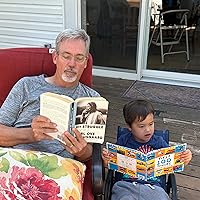
Thank you Pete, wherever you are, for getting this tarnished gem, out of your head.
Dexter never fails to disappointment me, and this was no different. I found myself needing to read it all the time, staying up too late, sneaking away during social gatherings, and bringing it clandestinely in my coat at inappropriate venues. Set in small town Florida, with forays into seedy Miami during the 1960s, it brings forth the worst of man’s inclinations to deception, obsession and hopelessness. Sounds great, right? What made it enjoyable to me is the utter lack of heroes, and honesty to the reader about what drives the darkness in our souls. Being interested in journalism, this is the best of its kind as to what drives investigative journalists: the protagonist observing his father the owner of a daily and his brother trying to work off his desire to get the story “right” at his own peril. The observed older brother is fearless, naïve, at search for the truth of life and ultimately destroyed by his inability to capture it. The main character Jack is deeply flawed, but genuine, and he commiserates and consoles his friendless brother in a way that is touching. They fight against their lonely father, who is afraid to get too close to either of his sons who are like him in ways that he cannot stomach. It is a coming of age story, to some extent, as the child discovers he horrors of adulthood lurking just behind the façade.
What makes this tale great is that it does not trivialize the raw characters in the swamp and they are even more terrible in their human-ness. These people are real, with foibles, contradictions and strange, random behaviors. There is no cleverness here, no tricks for the reader to uncode. The violence came late in this novel, as it inevitably does in a Dexter novel, but all the more shocking due to its build-in delay and lack of artifice. The characters are deluded in their views and ideas, and his ability to reveal this without preaching to the reader, is Dexter’s particular talent. Again, these are not propped up heroes, as in much of crime noir, and we know them by their actions and the way that others relate to them. This is ultimately tragic, but one gets that sense early in the story and the end comes as a form of relief, with some hope sprinkled in with the pathos. Race relations are always there, and Jim Crow aplenty, told in a manner that is not self-serving, but authentic and sad. Dexter is a journalist himself, so he knows of what he speaks here. I don’t believe he’s very popular (not a single tome in the Barnes and Nobles I visited last night), but he is a true American novelist, giving us more truth in his fiction than a hundred non-fiction tales and documentaries. For this reason, I’m going to stanch the urgent to watch the recent movie full of stars, though I would likely love it, to avoid the obliteration of my newly formed imagination of these characters and the visceral landscapes.
Jack, the protagonist 20 year old, observing his shy, unflappable, principled, older brother the journalist (p. 118/119): “It occurred to me that it didn’t matter that he was no good at this; what mattered was that he was willing to do it”.
On the tenacity of finishing a story, when the excitement and thrill is gone, his older brother Ward (p. 138) “…smiled politely, as if that were a joke. I supposed he’d heard the same thing from him before. A newspaper story, like anything else, is more attractive from a distance, when it first comes to you, than it is when you get in close and agonize over the details.”
Jack, upon visiting his dilapidated rooming house in Miami (p. 236): “I took the things from my car to the room, making two trips, walking past a thickset man with frog’s eyes who stood outside his door, smoking a tiny butt of a cigarette, staring at me as if he might be interested in asking for a date. I understood right away that Miami was not like the other two places I’d lived.”
On being a journalist (p. 240): “Too many of them were ‘journalists’ now, enamored with the importance of the calling and anxious to tell their readers what stories meant, not so enamored with the stories themselves”.