

What do you think?

Star Trek: The Original Series
STAR TREK: PROBE
Die Sonde, die schon einmal beinahe die Erde zerstört hätte, kehrt zurück
Der Romulanische Imperator ist tot, und damit stürzt das Empire ins Chaos. Auf einem kleinen Planeten in der neutralen Zone treffen sich Vertreter der Föderation und des Imperiums zu Friedensverhandlungen. Doch diese finden ein jähes Ende, als die Nachricht vom Wiedererscheinen jener mysteriösen Sonde eintrifft, die schon einmal beinahe die Erde zerstört hätte. Damals reiste die Enterprise-Crew "Zurück in die Gegenwart", um die Katastrophe abzuwenden. Jetzt sehen sich Captain Kirk, Mr. Spock und die restlichen Offiziere erneut der drohenden Gefahr gegenüber.
Der Romulanische Imperator ist tot, und damit stürzt das Empire ins Chaos. Auf einem kleinen Planeten in der neutralen Zone treffen sich Vertreter der Föderation und des Imperiums zu Friedensverhandlungen. Doch diese finden ein jähes Ende, als die Nachricht vom Wiedererscheinen jener mysteriösen Sonde eintrifft, die schon einmal beinahe die Erde zerstört hätte. Damals reiste die Enterprise-Crew "Zurück in die Gegenwart", um die Katastrophe abzuwenden. Jetzt sehen sich Captain Kirk, Mr. Spock und die restlichen Offiziere erneut der drohenden Gefahr gegenüber.
Audiobook
First published September 30, 1991
About the author
Margaret Wander Bonanno
31 books46 followersMargaret Wander Bonanno was an American science fiction writer, ghost writer and small press publisher. She was born in New York City. She wrote seven Star Trek novels, several science fiction novels set in her own worlds, including The Others, a collaborative novel with Nichelle Nichols, a biography, and other works.
Ratings & Reviews
Friends & Following
Create a free account to discover what your friends think of this book!
Community Reviews
Displaying 1 - 30 of 113 reviews

December 8, 2007
The sequel to "Star Trek IV: The Voyage Home"!
BEFORE ENGAGING THIS NOVEL...
This is a wonderful novel.
Probe is a direct sequel to the events portraited in the theatrical film Star Trek IV: The Voyage Home.
So, if you haven't watched that film yet, I suggest you to watch first that movie and/or reading the novelization.
To avoid to feel a little lost in the setting of this story, and being able to enjoy to the fullest the novel.
EARTH IS SAFE AGAIN BUT...
Earth is safe again thanks to the efforts of Captain James T. Kirk and his crew.
However, there are still many questions about the powerful probe that it was in a brink to destroy all life on Earth.
A probe that for some unknown reasons looked to communicate with the species of hunchback whales.
A probe that can left without energy any starship that tries to get near of it.
Who built it?
Why?
Is it a hostile weapon or a defensive system?
There are too many questions, so Starfleet orders Captain Kirk and the newly named USS Enterprise NCC-1701-A to investigate the origin and purpose of the deadly probe.
SHOCKING REVELATIONS!
This a really entertained book and a worthy sequel to the extraordinaire film The Voyage Home.
Developing an engaging process analyzing the clues left by the probe to solve this mystery.
Spock, once again proves (pun intended) his astonishing logical mind to analyze such mystery that will take the Enterprise-A to places...
...where no one has gone before!
At least no one from Earth, for not saying any other member of the Federation neither.
The solution to this great mystery will shock you...
...more that you can imagine!
Since it will make a subtle (or maybe not so subtle) to elements of The Next Generation...
...if you know how to read between lines in the development of this wonderful novel.
The Final Frontier is out there...
...waiting for you!
BEFORE ENGAGING THIS NOVEL...
This is a wonderful novel.
Probe is a direct sequel to the events portraited in the theatrical film Star Trek IV: The Voyage Home.
So, if you haven't watched that film yet, I suggest you to watch first that movie and/or reading the novelization.
To avoid to feel a little lost in the setting of this story, and being able to enjoy to the fullest the novel.
EARTH IS SAFE AGAIN BUT...
Earth is safe again thanks to the efforts of Captain James T. Kirk and his crew.
However, there are still many questions about the powerful probe that it was in a brink to destroy all life on Earth.
A probe that for some unknown reasons looked to communicate with the species of hunchback whales.
A probe that can left without energy any starship that tries to get near of it.
Who built it?
Why?
Is it a hostile weapon or a defensive system?
There are too many questions, so Starfleet orders Captain Kirk and the newly named USS Enterprise NCC-1701-A to investigate the origin and purpose of the deadly probe.
SHOCKING REVELATIONS!
This a really entertained book and a worthy sequel to the extraordinaire film The Voyage Home.
Developing an engaging process analyzing the clues left by the probe to solve this mystery.
Spock, once again proves (pun intended) his astonishing logical mind to analyze such mystery that will take the Enterprise-A to places...
...where no one has gone before!
At least no one from Earth, for not saying any other member of the Federation neither.
The solution to this great mystery will shock you...
...more that you can imagine!
Since it will make a subtle (or maybe not so subtle) to elements of The Next Generation...
...if you know how to read between lines in the development of this wonderful novel.
The Final Frontier is out there...
...waiting for you!

September 10, 2022
You would think that this sequel to one of the most successful Star Trek movies ever (Star Trek IV: The Voyage Home), would be easy. Clearly, there were some issues that convoluted a story that really seemed straightforward. To see the writer's interpretation of events (I'm going to usually side with the writer), she was asked to do too many rewrites and in the end, Gene DeWeese wound up having to complete the novel.
In this case, both the version published and the original written by Bonanno are needlessly complicated. This novel is meant to answer questions deliberately left vague in the movie, but with Star Trek audiences and an ongoing continuity, they're going to want some answers. The hardcore fan has questions about minutia, let alone when considering an essential plot point of who are the builders of the probe, and what do they look like.
I have to say, without revealing spoilers, that this novel fails to answer ALL of my questions, but I freely admit that some people will be satisfied with the story beats. There are some new characters introduced. There is the Romulan element of political intrigue that enhances some of the action and suspense, but still a little bit boring for me.
In this case, both the version published and the original written by Bonanno are needlessly complicated. This novel is meant to answer questions deliberately left vague in the movie, but with Star Trek audiences and an ongoing continuity, they're going to want some answers. The hardcore fan has questions about minutia, let alone when considering an essential plot point of who are the builders of the probe, and what do they look like.
I have to say, without revealing spoilers, that this novel fails to answer ALL of my questions, but I freely admit that some people will be satisfied with the story beats. There are some new characters introduced. There is the Romulan element of political intrigue that enhances some of the action and suspense, but still a little bit boring for me.

June 12, 2008
OK, full disclosure, I spent most of the early 90s camped out in the library reading Star Trek novels. When a few boxes of old ST paperbacks showed up at the bookstore yesterday, I told my boss to keep me away from them. He replied "Oh, I'm just going to recycle those, help yourself." Uh oh. As if I didn't have enough distraction from my to-read list, at that moment I knew I was destined to spiral downward into one of my Trekkie phases. It happens every few years.
Once I pawed through the boxes I knew this book would be my gateway drug. The author also penned Strangers From the Sky, one of my all-time favorite books, and the only trek novel I keep at hand to reread even between relapses. And best of all, this one is billed as a sequel to Star Trek IV, my favorite ST movie! (Yes, the one with the whales. See my blog.) Took it home and cracked it open immediately.
You can see from the 3 stars I was a bit disappointed. The book was entertaining enough, but a bit heavy-handed on the Romulan cold war intrigue. Bonanno usually writes deep, character driven novels, and I expected her to develop the themes of music and archeology further. Well, thank god for goodreads is all I can say. When I started to review this, I noticed a link to her website. Turns out, she didn't really write Probe at all! The victim of publishing politics, it was rewritten beyond recognition. But miracle of miracles, she has made a pdf copy of her original manuscript, Music of the Spheres, available! (Which she apprently used to auction off at cons to raise money for charity. I kind of love her.) So I got to email her and ask her for a copy! Squee!
Oh yes. I can feel that trekkie fire running through my veins again. This is bad, people.
Once I pawed through the boxes I knew this book would be my gateway drug. The author also penned Strangers From the Sky, one of my all-time favorite books, and the only trek novel I keep at hand to reread even between relapses. And best of all, this one is billed as a sequel to Star Trek IV, my favorite ST movie! (Yes, the one with the whales. See my blog.) Took it home and cracked it open immediately.
You can see from the 3 stars I was a bit disappointed. The book was entertaining enough, but a bit heavy-handed on the Romulan cold war intrigue. Bonanno usually writes deep, character driven novels, and I expected her to develop the themes of music and archeology further. Well, thank god for goodreads is all I can say. When I started to review this, I noticed a link to her website. Turns out, she didn't really write Probe at all! The victim of publishing politics, it was rewritten beyond recognition. But miracle of miracles, she has made a pdf copy of her original manuscript, Music of the Spheres, available! (Which she apprently used to auction off at cons to raise money for charity. I kind of love her.) So I got to email her and ask her for a copy! Squee!
Oh yes. I can feel that trekkie fire running through my veins again. This is bad, people.

February 22, 2023
I'm a Trekkie who has watched Star Trek since it first appeared on our black-and-white TV in '66. Needless to say, I was disappointed when the series was cancelled...and then the novels began coming out. I was eager to snap them up as they came out. Through the 70s and into the 80s, I kept up with the Star Trek novels but, since the 90s, I have read them only occasionally. "Probe" is one that I've had sitting around for years and was one I definitely wanted to read at some point. Published in 1992, it is the sequel to my favorite of all the Star Trek movies--Star Trek IV: The Voyage Home. We find out more about the probe that almost destroyed Earth--and we have peace talks between the United Federation of Planets and the Romulan Empire, the talks to be held on a planet in the Neutral Zone. Kirk & Spock & the Enterprise are there...and then the probe shows up too.
I was reading this one speedily and probably missed a lot of details--as the story turned out to be more complicated than I expected! Anyway, now I know what happened after The Voyage Home. By the way, it helps if you remember the movie. If you don't, you should review it before reading this book!
I was reading this one speedily and probably missed a lot of details--as the story turned out to be more complicated than I expected! Anyway, now I know what happened after The Voyage Home. By the way, it helps if you remember the movie. If you don't, you should review it before reading this book!

September 20, 2013
A Quickie Review
This book reminds me of my first experience with Star Trek...but that isn't a good thing. When I was in high school, I attempted to watch Star Trek V: The Final Frontier, and couldn't finish it because it was quite boring. It wasn't until I saw Nemesis that I became a fan of the franchise. Probe was also rather unexciting, and is likely to turn off potential readers of other Trek novels if this is their first experience with such literature.
Content Concerns: As usual, there is a bit of language.
Score: 2/5
This book reminds me of my first experience with Star Trek...but that isn't a good thing. When I was in high school, I attempted to watch Star Trek V: The Final Frontier, and couldn't finish it because it was quite boring. It wasn't until I saw Nemesis that I became a fan of the franchise. Probe was also rather unexciting, and is likely to turn off potential readers of other Trek novels if this is their first experience with such literature.
Content Concerns: As usual, there is a bit of language.
Score: 2/5

January 3, 2025
Margaret Wander Bonano established herself as a great writer for me personally, when I read Dwellers in the Crucible. However, if I recall it correctly, the majority of that story focused on newly minted characters and that was perhaps it's only real let down.
Continuing the story of Star Trek IV's whale-loving probe in both directions (before and after the events of the film), we now get a chance to see how the author's writing holds up around our established main TOS cast. You can tell by counting my stars that I was pleased with the result.
Continuing the story of Star Trek IV's whale-loving probe in both directions (before and after the events of the film), we now get a chance to see how the author's writing holds up around our established main TOS cast. You can tell by counting my stars that I was pleased with the result.

April 3, 2026
Continued from Star Trek IV: The Voyage Home
Purchase note, 1/19/25: I typed "Probe" into the AbeBooks search bar, and the first thing to pop up was Boffing Bigfoot which was "designed to be read with one hand free..." And since the rest of this section is a little tasteless and has nothing to do with the book, it behooves me to put it under a spoiler tag. Hop on in if you're feeling up to it. Otherwise, just proceed beyond it for the actual book review, such as it is.
Review:
This isn't my first run with this book, though it's the first I completed. Matt let me borrow it in ninth grade, and I'm afraid I didn't finish it. In fact, the only thing I remember from the experience is a scene where this one egotistical piano player puts on a show.[1]
At age 14, 100 pages with nothing but set up and no action was more than I could bear, but I've grown more tolerant in the past three decades. I also read Great Expectations that year and found it incredibly boring, but now it's one of my favorite books, and I've read it thrice. Tastes change over time. I had no problem getting to page 100 and beyond this this time, and I discovered that I had quit about a chapter before it started to get interesting. You live and you learn.
This is four star work, but I'm backing it to three due to a lot of pointlessness and improbabilities that even I have a hard time swallowing. The book is fine, but it's also a little wonky. Take Penalt, for example. There's a set-up with him as described above, but that's pretty much the end of it. I'm not even sure why he's in the book unless it's just to be an annoying character for a couple of scenes. Jandra is set-up to be a major character, or at least it seems that way, but the only thing the book really needs her for is to identify a pattern in the sounds the probe makes. There was a Romulan plot line and a probe plot line, and they didn't gel together well. Add in a Dickensian level coincidence involving a crystal orb they just happen to find at the very time the probe is running about, and Mr. Spock and friends discovering the language the probe speaks, and being able to respond... I don't know. Some of it was pretty far-fetched. That doesn't mean I didn't enjoy the story. Actually, I think my 14-year-old self would've been fine with the inanities and structural issues if he had been able to finish the book. Being a seasoned reader has its drawbacks.
A bit of research shows that the path to the printing press was quite a doozy for this, and apparently nobody knows exactly what happened because the people in on it all have a different take. Per Voyages of Imagination: The Star Trek Fiction Companion, "an objective report of Probe's bumpy road to publication is, unfortunately, impossible. All the parties involved have different recollections of those events, as well as different ways of interpreting them, and the various accounts are contradictory." This lists Margaret Wander Bonanno as the author, but she claims she didn't write it and wants nothing to do with it because she doesn't like it, and it contains only "seven percent" of what she wrote. She submitted a manuscript entitled The Music of the Spheres, but it was rejected because Roddenberry's office didn't like the characterizations, and they hauled in Gene DeWeese to polish it up. In fact, on that page at the front of the book normally reserved for a dedication, we find "the publisher wishes to thank Gene DeWeese who made significant creative and conceptual contributions to this book,"[2] by which they apparently mean he wrote the whole thing. I spot checked some of Bonanno's manuscript, and it's very different, so I imagine the only reason her name is on the thing is because she had had great success with other Star Trek novels, and the publishers knew that a good name sells books. I'm not interested enough to read the whole thing for comparison, but she's apparently a reputable author, and I bet her story is more structurally sound than this one.
Both books mention perestroika and glasnost which I found amusing since that was in the late 1980's/early 90's when this was written, and the story takes place in 2286. Apparently the Romulans are interested in trying a bit of P&G, and that's the main undercurrent to the novel. This was written in 1991, and I guess they were trying to make it relevant to the modern audience. Star Trek did that in the 60's with a lot of their plots that echoed the Cold War. But really, who in 2286 is going to know what perestroika is? (Except Spock, of course). Do you remember what it is? Has anyone under 40 ever heard of the term? Dropping it here is like me tossing out the 1731 Treaty of Vienna and expecting everyone to know what the hell I'm talking about.
I'm more familiar with Star Trek now than I was when I first tried to read this. Back in the early 90s, you didn't have complete TV series on VHS unless you taped them off the TV yourself or were a millionaire, and DVDs were still a few years in the future. As such, I picked up on things I certainly would've missed 3o+ years ago. Someone named Riley puts in an appearance, and as soon as he was mentioned I wondered if it was the I'll Take You Home Again, Kathleen guy from "The Naked Time," and it was...
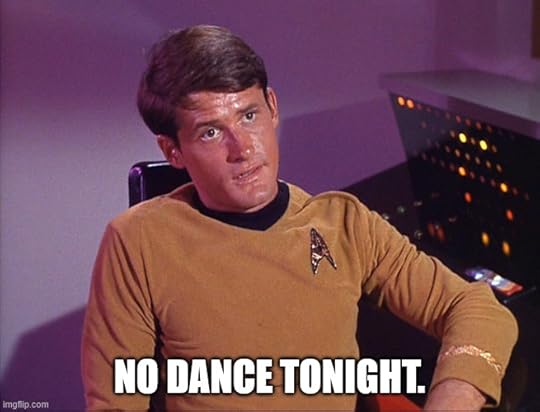
It's okay; I'll dance with you, Riley, since you're nowhere near as obnoxious as a diplomat as you were when you were a caterwauling lieutenant.
Riley's actually kind of a badass. It's pretty cool that he made it so far considering he came within a few seconds of killing everyone on the Enterprise back in the day, but if you fired everybody who did that, you wouldn't have anyone left to operate the ship. And Riley is actually a good case-in-point for the novel's unwieldiness. He finds himself in a coma about halfway through the book and remains that way until the penultimate chapter. We get his thoughts about his parents and a few other things, and Dr. McCoy, Dajan, and Sulu stay by him a lot, but I don't understand what the point of any of it was. There was no purpose for any of those scenes. Riley could've died, and it wouldn't have affected the main plot at all. That kind of thing happened a lot.
I don't know. This book is fine as long as you're not going to be too nit-picky about several needless elements. I'm glad I read it.
[1]: I wonder if Penalt was modeled after Liszt who, believe it or not, was the equivalent of a modern day rock star. The dude's playing was so energetic that he frequently broke piano strings and occasionally broke the piano! People were so wild about him that they'd collect the broken strings and make bracelets out of them. One woman even snagged a discarded cigar butt and had it put in a locket with diamonds spelling out "FL!" Yes, over a century before Jerry Lee Lewis and Beetlemania, there was Lisztomania. The man was a beast! Of course, Liszt was much better than Penalt even if he had a similar level of theatrical showmanship.
[2]: Something I found amusing: The "Historian's Note" on the page after the DeWeese blurb states "Probe takes place sometime prior to Star Trek VI: The Undiscovered Country. The events of Star Trek VI: The Voyage Home are also pivotal to this story, and the reader may wish to view it as a referent." See? Even the Star Trek movers and shakers recognized that Star Trek V: The Final Frontier sucks a Gorn's gonad. I suspect they would like to forget that it ever existed which is why I'll be skipping it and...
...continuing the trek in Star Trek VI: The Undiscovered Country
All Star Trek novelization reviews corralled here.
Purchase note, 1/19/25: I typed "Probe" into the AbeBooks search bar, and the first thing to pop up was Boffing Bigfoot which was "designed to be read with one hand free..." And since the rest of this section is a little tasteless and has nothing to do with the book, it behooves me to put it under a spoiler tag. Hop on in if you're feeling up to it. Otherwise, just proceed beyond it for the actual book review, such as it is.
Review:
This isn't my first run with this book, though it's the first I completed. Matt let me borrow it in ninth grade, and I'm afraid I didn't finish it. In fact, the only thing I remember from the experience is a scene where this one egotistical piano player puts on a show.[1]
Penalt seemed to be trying to display his physical strength and dexterity at least as much as he was trying to produce music. There were moments when Kirk wondered if the keys would stand up to the assault as Penalt's rigid fingers hammered down on them. Often--whenever the tempo allowed--his hands would arc up to shoulder level or higher and his whole upper body would aid them in crashing back down. Even when the tempo was too fast for such embellishments, his bobbing head and shoulders kept the action going, as if he were using their motion and the sometimes tortured looks that twisted his features to wring a more stirring performance out of the accompanying computer....Then a woman who is in a class all her own, though Penalt doesn't know that, is talked into playing.
As Penalt finished with the Mozart piece--full of pyrotechnics, all sparkle and dazzle and flying fingers--he stood with a flourish and bowed to the applause...
"At least he's good--isn't he?" Kirk glanced from Uhura to Sulu.
"He has to be pretty good," Uhura said with a grin, "to do all that flailing around and still hit most of the right notes."
"Good, but not as good as he thinks he is," Sulu added. "Nobody could be that good."
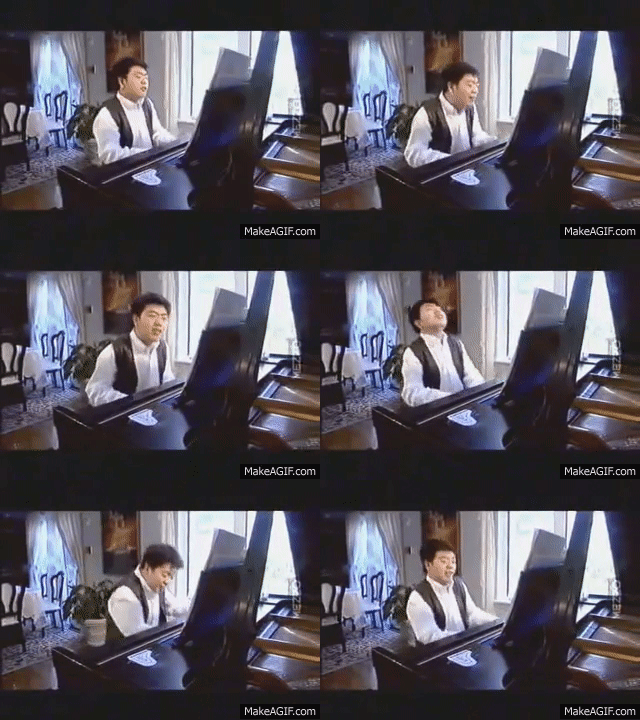
And Jandra played.All of this happens between pages 99 and 104. I reckon I remembered that part because during my teens and most of my 20s, I was all about playing the piano. I remembered nothing that preceded that scene and nothing following it. The reason for the latter is that I probably quit reading pretty soon after that part. The reason for the former is that, frankly, nothing happens for 100 pages and the probe is barely mentioned. Friend Matt read Jurassic Park around the same time, and he said Probe was pretty slow by comparison. I asked him "so, around page two hundred of Probe, it's 'the probe veered left and slowly sailed through space,' and you open Jurassic Park to page one and it's 'AND THE DINOSAUR BIT HIS HEAD OFF!'" And we laughed and laughed... I guess you had the be there.
Without a single false start or misstep, she played.
The contrast to Penalt could not have been greater.
Where he had thundered, she whispered.
Where he had thrown his entire body into the playing, as if physically ripping the sounds from the instrument, she remained almost eerily motionless as her fingers, as if possessed of an independent life, coaxed the sound from the keys, delicately shaping each and every note.
Where he had raced, she strolled languidly, poignantly through the adagio movement, letting the sound drift out and envelop her listeners and draw them in rather than hurling it at them in a desperate bid for attention.
At age 14, 100 pages with nothing but set up and no action was more than I could bear, but I've grown more tolerant in the past three decades. I also read Great Expectations that year and found it incredibly boring, but now it's one of my favorite books, and I've read it thrice. Tastes change over time. I had no problem getting to page 100 and beyond this this time, and I discovered that I had quit about a chapter before it started to get interesting. You live and you learn.
This is four star work, but I'm backing it to three due to a lot of pointlessness and improbabilities that even I have a hard time swallowing. The book is fine, but it's also a little wonky. Take Penalt, for example. There's a set-up with him as described above, but that's pretty much the end of it. I'm not even sure why he's in the book unless it's just to be an annoying character for a couple of scenes. Jandra is set-up to be a major character, or at least it seems that way, but the only thing the book really needs her for is to identify a pattern in the sounds the probe makes. There was a Romulan plot line and a probe plot line, and they didn't gel together well. Add in a Dickensian level coincidence involving a crystal orb they just happen to find at the very time the probe is running about, and Mr. Spock and friends discovering the language the probe speaks, and being able to respond... I don't know. Some of it was pretty far-fetched. That doesn't mean I didn't enjoy the story. Actually, I think my 14-year-old self would've been fine with the inanities and structural issues if he had been able to finish the book. Being a seasoned reader has its drawbacks.
A bit of research shows that the path to the printing press was quite a doozy for this, and apparently nobody knows exactly what happened because the people in on it all have a different take. Per Voyages of Imagination: The Star Trek Fiction Companion, "an objective report of Probe's bumpy road to publication is, unfortunately, impossible. All the parties involved have different recollections of those events, as well as different ways of interpreting them, and the various accounts are contradictory." This lists Margaret Wander Bonanno as the author, but she claims she didn't write it and wants nothing to do with it because she doesn't like it, and it contains only "seven percent" of what she wrote. She submitted a manuscript entitled The Music of the Spheres, but it was rejected because Roddenberry's office didn't like the characterizations, and they hauled in Gene DeWeese to polish it up. In fact, on that page at the front of the book normally reserved for a dedication, we find "the publisher wishes to thank Gene DeWeese who made significant creative and conceptual contributions to this book,"[2] by which they apparently mean he wrote the whole thing. I spot checked some of Bonanno's manuscript, and it's very different, so I imagine the only reason her name is on the thing is because she had had great success with other Star Trek novels, and the publishers knew that a good name sells books. I'm not interested enough to read the whole thing for comparison, but she's apparently a reputable author, and I bet her story is more structurally sound than this one.
Both books mention perestroika and glasnost which I found amusing since that was in the late 1980's/early 90's when this was written, and the story takes place in 2286. Apparently the Romulans are interested in trying a bit of P&G, and that's the main undercurrent to the novel. This was written in 1991, and I guess they were trying to make it relevant to the modern audience. Star Trek did that in the 60's with a lot of their plots that echoed the Cold War. But really, who in 2286 is going to know what perestroika is? (Except Spock, of course). Do you remember what it is? Has anyone under 40 ever heard of the term? Dropping it here is like me tossing out the 1731 Treaty of Vienna and expecting everyone to know what the hell I'm talking about.
I'm more familiar with Star Trek now than I was when I first tried to read this. Back in the early 90s, you didn't have complete TV series on VHS unless you taped them off the TV yourself or were a millionaire, and DVDs were still a few years in the future. As such, I picked up on things I certainly would've missed 3o+ years ago. Someone named Riley puts in an appearance, and as soon as he was mentioned I wondered if it was the I'll Take You Home Again, Kathleen guy from "The Naked Time," and it was...
It's okay; I'll dance with you, Riley, since you're nowhere near as obnoxious as a diplomat as you were when you were a caterwauling lieutenant.
Riley's actually kind of a badass. It's pretty cool that he made it so far considering he came within a few seconds of killing everyone on the Enterprise back in the day, but if you fired everybody who did that, you wouldn't have anyone left to operate the ship. And Riley is actually a good case-in-point for the novel's unwieldiness. He finds himself in a coma about halfway through the book and remains that way until the penultimate chapter. We get his thoughts about his parents and a few other things, and Dr. McCoy, Dajan, and Sulu stay by him a lot, but I don't understand what the point of any of it was. There was no purpose for any of those scenes. Riley could've died, and it wouldn't have affected the main plot at all. That kind of thing happened a lot.
I don't know. This book is fine as long as you're not going to be too nit-picky about several needless elements. I'm glad I read it.
[1]: I wonder if Penalt was modeled after Liszt who, believe it or not, was the equivalent of a modern day rock star. The dude's playing was so energetic that he frequently broke piano strings and occasionally broke the piano! People were so wild about him that they'd collect the broken strings and make bracelets out of them. One woman even snagged a discarded cigar butt and had it put in a locket with diamonds spelling out "FL!" Yes, over a century before Jerry Lee Lewis and Beetlemania, there was Lisztomania. The man was a beast! Of course, Liszt was much better than Penalt even if he had a similar level of theatrical showmanship.
[2]: Something I found amusing: The "Historian's Note" on the page after the DeWeese blurb states "Probe takes place sometime prior to Star Trek VI: The Undiscovered Country. The events of Star Trek VI: The Voyage Home are also pivotal to this story, and the reader may wish to view it as a referent." See? Even the Star Trek movers and shakers recognized that Star Trek V: The Final Frontier sucks a Gorn's gonad. I suspect they would like to forget that it ever existed which is why I'll be skipping it and...
...continuing the trek in Star Trek VI: The Undiscovered Country
All Star Trek novelization reviews corralled here.

February 8, 2020
Well it certainly makes Star Trek IV all the more enjoyable knowing more of the story of just what the Probe is aside from being a ship that speaks Whale. I quite enjoyed this story. McCoy was a great piece to inject comic relief at anytime. But I particularly liked the friendship that developed between Hiran and Kirk that was a highlight for me.
January 10, 2025
I didn't expect to be smiling/crying by the end of a Star Trek novel I picked up at random but this was surprisingly good

June 4, 2016
This book ended up being a "must read" for me. It is the "sequel" to the excellent movie Star Trek IV- A Voyage Home. This tells the story of the Probe and what it has been up to since nearly destroying the Earth (as seen in the movie). The Probe left earth at the end of the movie when the whales were returned to the sea. The book starts a few months after that. It seems the Probe left the Federation sector and was last seen heading towards the Neutral Zone.
At the same time Capt. Kirk and the Enterprise have been called to Temaris IV in the NZ to have a diplomatic conference with the Romulan Empire. As the story develops we find that the Romulans have noticed the Probe coming into their territory and when it does make contact with a Romulan world it manges to destroy two warbirds and the planet. This is unknown to the Federation as it sets up this peace conference.
While this is a huge opportunity for peace, no one really trusts the Romulan Empire. It seems the old Praetor has died and a new Committee is in charge. The Committee is truly interested in putting out peace feelers, but some in the Romulan High Command do not agree. Thus all is not as it seems with the delegation sent to negotiate. In the midst of all this the Probe reappears and both the Romulan ship and the Enterprise are captured by the Probe. The rest of the story fills in the details of the Probes mission and the creators of the Probe. I shall stop here since the rest would be spoilers.
This was an excellent Star Trek book and I am glad I read it. Well written and tackling the tricky situation with the Romulan Star Empire, as well as filling in the gaps about the Probe make this a must read for a Trekkie. The interactions of the crew and of Kirk with his Romulan counterpart are well done. It is also a good look inside the machinations of the Romulans.
But perhaps the best part of the story is the Probe and what its mission was. It closes the book on the tale from ST IV. For that reason alone, I am glad I took the time to read it-though it was so well written that I managed to devour it in a day. If you like Star Trek or enjoyed the movie I'm sure you will devour it as eagerly as I.
At the same time Capt. Kirk and the Enterprise have been called to Temaris IV in the NZ to have a diplomatic conference with the Romulan Empire. As the story develops we find that the Romulans have noticed the Probe coming into their territory and when it does make contact with a Romulan world it manges to destroy two warbirds and the planet. This is unknown to the Federation as it sets up this peace conference.
While this is a huge opportunity for peace, no one really trusts the Romulan Empire. It seems the old Praetor has died and a new Committee is in charge. The Committee is truly interested in putting out peace feelers, but some in the Romulan High Command do not agree. Thus all is not as it seems with the delegation sent to negotiate. In the midst of all this the Probe reappears and both the Romulan ship and the Enterprise are captured by the Probe. The rest of the story fills in the details of the Probes mission and the creators of the Probe. I shall stop here since the rest would be spoilers.
This was an excellent Star Trek book and I am glad I read it. Well written and tackling the tricky situation with the Romulan Star Empire, as well as filling in the gaps about the Probe make this a must read for a Trekkie. The interactions of the crew and of Kirk with his Romulan counterpart are well done. It is also a good look inside the machinations of the Romulans.
But perhaps the best part of the story is the Probe and what its mission was. It closes the book on the tale from ST IV. For that reason alone, I am glad I took the time to read it-though it was so well written that I managed to devour it in a day. If you like Star Trek or enjoyed the movie I'm sure you will devour it as eagerly as I.
September 4, 2020
From the title and time-frame, I expected this book to be a deep-dive into the "PROBE" from Star Trek IV, and why it does what it does, in the fun breezy tone of that movie. The book does not deliver on that. It feels padded out. There are about 300 pages of a low-wattage Romulan diplomacy story that feels bolted on to the 30 pages of "PROBE" exploration at the end.
The book was written around the time of Star Trek VI and TNG season 5. The story borrows some plot points from that era of TNG. The diplomacy element feels more like a focused dialogue-heavy TNG episode, than the epic scale of film-era TOS. For one thing, Romulans featured heavily in early TNG but were largely absent from the TOS films.
Other reviewers say that this was extensively rewritten without the author's involvement, and I don't doubt that.
The book was written around the time of Star Trek VI and TNG season 5. The story borrows some plot points from that era of TNG. The diplomacy element feels more like a focused dialogue-heavy TNG episode, than the epic scale of film-era TOS. For one thing, Romulans featured heavily in early TNG but were largely absent from the TOS films.
Other reviewers say that this was extensively rewritten without the author's involvement, and I don't doubt that.

May 23, 2021
Enjoyed story, if not corny at times. Good entertainment. I certainly liked the connection with my favorite StarTrek movie of all time. The book felt like a TOS episode.

October 3, 2026
As a musician and Trekkie, I’m in love. The author NAILS the characters & creates a great and unexpected political drama! It’s a tad wordy, perhaps but I love this book deeply.
February 15, 2021
Two authors, Two books, Both Good but I enjoyed one more.
I just finished reading “Music of the Spheres” written by Margaret Wander Monanno, then “Probe” written by Gene DeWeese. “Probe” has Ms. Monanno’s name on it because she was originally contracted to write the book, and “Music of the Spheres” is the original manuscript she submitted ( and is available by request to her via email, see http://www.margaretwanderbonanno.com/... for more info on this). After apparently endless rewrites, as detailed in Ms. Monanno’s website she left the project, and it was completed by Gene DeWeese, who is thanked for his contributions in a dedication by the publisher.
“Music of the Spheres” has complex, very well fleshed out characters and a somewhat complex plot that by mid-novel had me fully engaged. Of the two books it is overall the more cohesive and stronger story and I enjoyed reading most of it. However, the first quarter or so of the book is chaotic, with so many flashbacks and flashforwards and changes in venue that it was a bit hard to enjoy, perhaps partly because this was a first draft of the novel. Also, there is a somewhat dark theme running through the novel in places, the ending seemed a bit rushed, and while far from gloomy was still a bit darker than my tastes run to.
By contrast, “Probe” has characters that while engaging and interesting are not quite as well fleshed out as their “Music of the Spheres” counterparts, though at times this was hard to gauge since memories of the equivalent character in one book bled over in my mind at times to the other book. The plot is relatively straightforward and easy to follow, and while there are betrayals and diplomatic intrigue overall it is a more hopeful book with a more upbeat ending, which seems more consistent with the “flavor” of Star Trek novels of the time it was published.
I enjoyed reading both books and thought “Music of the Spheres” quite well written. However, “Probe” held together amazingly well for a book pulled together after so many rewrites. Between the two I enjoyed reading “Probe” more, as a bit simpler book for a relaxed read, with a more fleshed out ending and one that was more upbeat, which fits my tastes more. Others will like the “Music of the Spheres” more.
I just finished reading “Music of the Spheres” written by Margaret Wander Monanno, then “Probe” written by Gene DeWeese. “Probe” has Ms. Monanno’s name on it because she was originally contracted to write the book, and “Music of the Spheres” is the original manuscript she submitted ( and is available by request to her via email, see http://www.margaretwanderbonanno.com/... for more info on this). After apparently endless rewrites, as detailed in Ms. Monanno’s website she left the project, and it was completed by Gene DeWeese, who is thanked for his contributions in a dedication by the publisher.
“Music of the Spheres” has complex, very well fleshed out characters and a somewhat complex plot that by mid-novel had me fully engaged. Of the two books it is overall the more cohesive and stronger story and I enjoyed reading most of it. However, the first quarter or so of the book is chaotic, with so many flashbacks and flashforwards and changes in venue that it was a bit hard to enjoy, perhaps partly because this was a first draft of the novel. Also, there is a somewhat dark theme running through the novel in places, the ending seemed a bit rushed, and while far from gloomy was still a bit darker than my tastes run to.
By contrast, “Probe” has characters that while engaging and interesting are not quite as well fleshed out as their “Music of the Spheres” counterparts, though at times this was hard to gauge since memories of the equivalent character in one book bled over in my mind at times to the other book. The plot is relatively straightforward and easy to follow, and while there are betrayals and diplomatic intrigue overall it is a more hopeful book with a more upbeat ending, which seems more consistent with the “flavor” of Star Trek novels of the time it was published.
I enjoyed reading both books and thought “Music of the Spheres” quite well written. However, “Probe” held together amazingly well for a book pulled together after so many rewrites. Between the two I enjoyed reading “Probe” more, as a bit simpler book for a relaxed read, with a more fleshed out ending and one that was more upbeat, which fits my tastes more. Others will like the “Music of the Spheres” more.

January 17, 2011
This novel is apparently a bastardized child with many rewrites and many revisions...but I've always found it immensely satisfying, and the multiple cooks certainly don't make themselves known. There's some great Romulan politics on display (something Trek has always done exceedingly well), numerous fascinating & emotional personality conflicts, inter-galactic intrigue...and then the big old Whale Probe from "Star Trek IV" bounds onto the scene once more and throws everyone for a loop.
There's even a Borg reference...if you're paying attention. :)
It really IS the kind of Star Trek novel that sweeps you away on the kind of adventure every fan dreams of having on board the USS Enterprise...and it WILL leave a massive smile on your face upon completion.
There's even a Borg reference...if you're paying attention. :)
It really IS the kind of Star Trek novel that sweeps you away on the kind of adventure every fan dreams of having on board the USS Enterprise...and it WILL leave a massive smile on your face upon completion.

July 19, 2017
The second half of the book is okay, which is about as far as I can go. The first half is slow and full of characters and plots that are simply annoying and serve no purpose. Those largely disappear for the second half (until the epilogue) and the story gets a little faster paced and finally develops a clear plot. The second half is interesting enough to be worth reading, but it's not worth reading the first half to get there.

November 6, 2012
A pretty good sequeal the movie Star Trek IV: The Voyage Home. I like knowing what happened to the Probe and why it was sent.

February 2, 2026
Review: Star Trek: Probe – A Fascinating but Uneven Sequel
Star Trek: Probe is a direct literary sequel to Star Trek IV: The Voyage Home, and it takes on the ambitious task of answering a question that the film deliberately left open: what exactly was the Whale Probe, and where did it come from? Rather than turning that mystery into a simple explanation, the novel expands it into something much larger, stranger, and far more connected to the wider Star Trek universe than one might expect from a late-1980s tie-in novel.
Overall, I would rate Probe three stars. It is an interesting and sometimes genuinely bold book, but also one that struggles with pacing and consistency. It has moments of real insight and imagination, followed by sections that feel slower or less engaging. Still, when it works, it works very well.
The novel picks up after the events of The Voyage Home, with Starfleet trying to understand the true nature of the Probe that nearly destroyed Earth. At the same time, political changes on Romulus open the door to an unusual and fragile cooperation between the Federation and the Romulan Empire. This political subplot adds an extra layer to the story, grounding the mystery of the Probe in a broader galactic context and giving the novel a more “classic Trek” feel, focused on diplomacy, uncertainty, and cautious trust.
The strongest aspect of Probe is without question its exploration of the Probe’s origin and creators. Through Spock’s mind meld and later revelations, the book presents the Probe not as a mindless machine or a hostile entity, but as an artificial intelligence created by an ancient civilization with a very specific purpose: to seek out intelligence comparable to its makers. The tragedy is that most life forms it encounters are so fundamentally different that it categorizes them as insignificant—“mites”—and therefore ignores the damage it causes.
This concept alone would already make for an intriguing story, but Probe goes much further. The most striking revelation is the history of the Probe’s creators and their destruction during what they called the Second Winnowing. The novel describes an invasion by vast, cube-shaped machines filled with countless small beings—clearly recognizable to modern readers as the Borg, even though the term is never used. These invaders are immune to the creators’ “True Language” and respond only with devastating force. The creators manage to survive extinction only by fleeing their world, scattering across space, while their sun itself is extinguished as part of the attack.
What makes this revelation so effective is how subtly it is handled. The book does not treat this as a shocking twist for the characters, but as a tragic piece of ancient history uncovered through fragmented memory and alien perception. The Probe itself was damaged in its encounter with these invaders, losing parts of its memory and unknowingly leading the same enemies back to its creators’ homeworld. This adds a layer of guilt and existential confusion to the Probe that makes it far more compelling than a typical god-machine antagonist.
From a franchise perspective, this is where Probe becomes especially fascinating. Decades before The Next Generation formally introduced the Borg, this novel retroactively places them deep in the distant past of the galaxy. It implies that both the Federation and the Romulans have, without realizing it, stumbled upon fragments of Borg-related history. Even the discussion of Erisian ruins and memory crystals suggests that civilizations encountered in later eras may have indirect connections to this ancient cycle of destruction and survival.
Spock’s role in the story is another highlight. His interaction with the Probe is less about domination or control and more about redefining intelligence itself. By broadening the Probe’s rigid criteria and helping it understand humanoid life as worthy of consideration, Spock prevents it from repeating its past mistakes. At the same time, he is unable to restore its lost memories, reinforcing the idea that some damage—whether technological or historical—cannot simply be undone.
That said, the novel is not without flaws. The pacing can be uneven, with some sections feeling overly dense or slow, especially when the narrative leans heavily into exposition. The Romulan subplot, while interesting in concept, does not always receive the depth it deserves. These issues prevent Probe from reaching the level of a truly great Star Trek novel.
In the end, Star Trek: Probe is a book that earns its three-star rating through ambition rather than execution. It does not always succeed, but it dares to ask big questions about intelligence, responsibility, and the unintended consequences of survival. Most impressively, it quietly lays conceptual groundwork that later Star Trek stories—especially The Next Generation—would explore in far greater detail. For fans interested in deep lore connections and early hints of the Borg, Probe remains a flawed but genuinely rewarding read.

April 29, 2023
When I read Star Trek probe, the so called sequel to Star Trek four, as an afterthought, it lived in my mind for I don't know, 20 or 30 years. unread. unloved. As I was reading it, I did seem to recall, perhaps reading a Wikipedia entry, or a series of quotes from the book. And I believe the Wikipedia entry had a similar review to what I would say, a bunch of Romulan nonsense that I was not interested in and very little interaction with the probe and the probe creators themselves, which I was interested. I believe I read perhaps all the all the sections with the probe previously, in a summary document or wiki irregardless, I enjoyed getting the details about the not super whales, but perhaps super dolphins who created the probe that threatened the earth in the wonderfully humorous Star Trek for the voyage home. The probe interestingly enough, like Star Trek, The Motion Picture, Star Trek four, perhaps has a hint of the borg in there. Of course we all recall that in Star Trek one the Voyager or Voyager probe was enhanced by a mechanical species into a gigantic V juror cloud then threatened the Earth. Similarly, in probe, we learned that the probe was attacked by a small group of mechanical mites. It describes humans and other small things as mites, but it differentiated at these mechanical bites. It is presumed from this attack that the Borg locate the whole world of the super dolphins. The Super dolphins then drain all of the water from their world, taking the energy and the other dolphins to unknown worlds, leaving behind a confusing star map, mainly consisting of stars that had exploded, proving that the super dolphins knew which stars were going to explode. Or perhaps we're causing those stars to explode, perhaps leaving a trap for the Board, who it seems damage the probe to a great deal especially damaging its memory ball, the crystal ball that is exposed in the film and destroying the homeworld of the super dolphins, as Spock is able to mind meld with the probe, solving the problem and getting it back to exploring, teaching it that its voice can also damage might in their spacefaring ships and destroy planets, as we saw in Star Trek four with the oceans of the Earth, being ionized, as the probe used its voice to search for the whales, which speak the same language or a binary version of the language as the Super dolphins. So all in all, not a bad read a quick read a bunch of Romulan nonsense I don't bother telling you about but it was interesting that they attempted to use musicians, human and Romulan musicians to understand the call of the probe. All in all, I guess it was good that I read it to go back in time to a time when I was in high school and I devoured Star Trek novels by the week, maybe even by the day. This was another quick read. I wish it had been more about the probe or about the Super dolphins, less about the Romulans and their typical Romulan nonsense
Transcribed by https://otter.ai
Transcribed by https://otter.ai
This entire review has been hidden because of spoilers.
March 10, 2026
Hmmph. If you don't know the history, Bonanno wrote the first draft that was then handed to another writer whose draft was rejected, then Gene DeWeese was given way too little time to do a new version almost from scratch, and that's what the final book is. It is kind of a disaster. You can find the first draft as 'Music of the Spheres' online. Somewhere in between the two versions, there's a good book. After reading both back to back, I can't really review them separately!
DeWeese does provide a tighter, more linear story than the original draft. What he doesn't do is give us that much insight into the probe of the title. Which is odd. Bonanno spent a lot of the time with the probe, both in the "present" of the story, and in the culture of its origin. We understand its purpose. That may have been my favorite part of 'Spheres,' along with return of Bonanno's 'Dwellers in the Crucible' character T'Shael, who is totally removed from 'Probe,' and the character of Jandra, who is changed and minimized in 'Probe.'
'Probe' gives us better, less cheesy renditions of our main Enterprise characters. Bonanno's 'Strangers from the Sky' has some of my favorite work on the relationship of Kirk and Spock over the years, and showed some real depth of understanding of the characters. But in 'Spheres' and 'Dwellers' they all come off as pretty cheesy. She takes big liberties with the characters, Sulu in particular, that are thankfully removed from 'Probe.' But it does go on a little long with some not too interesting twists and turns.
So I don't know. Neither version is a great book. Both have great elements and lousy ones. I found it very interesting to read both and if you're interested, recommend you do the same. It all suggests a great thing that could have been. For the first 80 pages or so, you'll think, "hey, these aren't that different except for a few changed names," but they really diverge after that, so read on.
DeWeese does provide a tighter, more linear story than the original draft. What he doesn't do is give us that much insight into the probe of the title. Which is odd. Bonanno spent a lot of the time with the probe, both in the "present" of the story, and in the culture of its origin. We understand its purpose. That may have been my favorite part of 'Spheres,' along with return of Bonanno's 'Dwellers in the Crucible' character T'Shael, who is totally removed from 'Probe,' and the character of Jandra, who is changed and minimized in 'Probe.'
'Probe' gives us better, less cheesy renditions of our main Enterprise characters. Bonanno's 'Strangers from the Sky' has some of my favorite work on the relationship of Kirk and Spock over the years, and showed some real depth of understanding of the characters. But in 'Spheres' and 'Dwellers' they all come off as pretty cheesy. She takes big liberties with the characters, Sulu in particular, that are thankfully removed from 'Probe.' But it does go on a little long with some not too interesting twists and turns.
So I don't know. Neither version is a great book. Both have great elements and lousy ones. I found it very interesting to read both and if you're interested, recommend you do the same. It all suggests a great thing that could have been. For the first 80 pages or so, you'll think, "hey, these aren't that different except for a few changed names," but they really diverge after that, so read on.

August 23, 2017
This story picks up almost immediately after THE VOYAGE HOME. As such if anyone hasn't seen the movie it might help to watch and then read the book. I am glad that I picked this book up and read it. It is a fascinating story of the crew of the Enterprise trying to find a way to bring about peaceful relations with the Romulans. The Romulans, or some of them, want to sabotage the conference.
This whole thing starts with the death of the Praetor, the ruler of the Romulan people. His death leaves a vacuum that is filled by a moderate group wanting peace with the Federation. However it wouldn't be a Star Trek adventure if there wasn't a problem that could affect not just the Empire but the Federation as well. The Probe that nearly destroyed Earth is headed to the Romulan Empire. The Romulans are not listening to the Federation about the dangers of the Probe saying that it doesn't exist. There is also things happening on the planet that the conference is being held close to that could start a war at any time. Yes just another day for the Enterprise crew.
I enjoyed this story and added history that it provided to the Star Trek universe. There is something about the whole universe that is uplifting and enjoyable. Yes, I know that is a much romanticized universe but I think sometimes that it would be a nice place to live. I have enjoyed all the books that I have read linked to the STAR TREK: TOS every much.
This whole thing starts with the death of the Praetor, the ruler of the Romulan people. His death leaves a vacuum that is filled by a moderate group wanting peace with the Federation. However it wouldn't be a Star Trek adventure if there wasn't a problem that could affect not just the Empire but the Federation as well. The Probe that nearly destroyed Earth is headed to the Romulan Empire. The Romulans are not listening to the Federation about the dangers of the Probe saying that it doesn't exist. There is also things happening on the planet that the conference is being held close to that could start a war at any time. Yes just another day for the Enterprise crew.
I enjoyed this story and added history that it provided to the Star Trek universe. There is something about the whole universe that is uplifting and enjoyable. Yes, I know that is a much romanticized universe but I think sometimes that it would be a nice place to live. I have enjoyed all the books that I have read linked to the STAR TREK: TOS every much.

January 28, 2026
2026 Review 010. Star Trek The Original Series Probe by Margaret Wander Bonanno (Original), Gene DeWeese (Rewrite)
Page Count : 345
This is one of the strangest Star Trek books I have ever read and also one of the most boring.
Originally written by Margaret Wander Bonanno as Music of the Spheres, this book was then rewritten by Gene DeWeese as Probe. The book covers had already been printed with Margaret Wander Bonanno when the rewrite occurred so that is why it has her name still on the cover.
This book is the sequel to Star Trek IV The Voyage Home which is one of my favourite Star Trek films.
But unfortunately, this book which could have been so amazing and could have had such promise was a massive let down.
The Cetacean Probe despite being shown on the front cover of the book and also being the title of the book itself (Probe) is actually relegated to being at best a secondary character until the last 30% of the book.
This book's primary focus is about a peace conference with the Romulans.
The story in this book took way too long to get going and to focus on the subject which I expected to be the majority of the book.
This is not a book that I will read again and will be donating or selling.
Unfortunately, I cannot recommend this book to any Trekkies out there.
2*
**
Page Count : 345
This is one of the strangest Star Trek books I have ever read and also one of the most boring.
Originally written by Margaret Wander Bonanno as Music of the Spheres, this book was then rewritten by Gene DeWeese as Probe. The book covers had already been printed with Margaret Wander Bonanno when the rewrite occurred so that is why it has her name still on the cover.
This book is the sequel to Star Trek IV The Voyage Home which is one of my favourite Star Trek films.
But unfortunately, this book which could have been so amazing and could have had such promise was a massive let down.
The Cetacean Probe despite being shown on the front cover of the book and also being the title of the book itself (Probe) is actually relegated to being at best a secondary character until the last 30% of the book.
This book's primary focus is about a peace conference with the Romulans.
The story in this book took way too long to get going and to focus on the subject which I expected to be the majority of the book.
This is not a book that I will read again and will be donating or selling.
Unfortunately, I cannot recommend this book to any Trekkies out there.
2*
**

October 12, 2018
I listened to the audio version of this book. It was narrated by James Doohan, the actor who played Scotty on the original series. I loved that aspect of the book. It was fun to hear him act the character again, as well as Kirk, Bones, and all of the others.
This book takes place sometime between movie IV (The Voyage Home) and movie VI (The Undiscovered Country). It involves the mysterious probe that caused all the trouble in movie IV. Fans of that film will appreciate the explanation this book offers. One of the weaknesses of that film is that the antagonist (if it can really be called that) isn't explained very well. This book fills that gap.
Unfortunately, for my tastes, it's all a little boring. :( I love the banter and the humor among the original cast in movie IV. But the actual plot line--a mysterious probe that can only speak to whales from the 20th century?--isn't as strong as most of the other films.
Anyway, recommended only for the true fans of the Star Trek films featuring the original cast. If you haven't seen those films. Or if you think movie IV is weak (like I do), then this book is one to skip.
This book takes place sometime between movie IV (The Voyage Home) and movie VI (The Undiscovered Country). It involves the mysterious probe that caused all the trouble in movie IV. Fans of that film will appreciate the explanation this book offers. One of the weaknesses of that film is that the antagonist (if it can really be called that) isn't explained very well. This book fills that gap.
Unfortunately, for my tastes, it's all a little boring. :( I love the banter and the humor among the original cast in movie IV. But the actual plot line--a mysterious probe that can only speak to whales from the 20th century?--isn't as strong as most of the other films.
Anyway, recommended only for the true fans of the Star Trek films featuring the original cast. If you haven't seen those films. Or if you think movie IV is weak (like I do), then this book is one to skip.

June 20, 2024
TOS: Probe by Margaret Wander Bonanno
The only other Star Trek novel to have production problems besides Killing Time! I highly encourage to read about the history of this book as it’s an interesting read , but it’s been stated here many times.
This was a decent but confusing book. The Romulan stuff didn’t really add anything to the book and the book would have really benefited from just focusing on the Probe. The journey to get to the origin of the Probe was a little confusing but it was worth it in the end. There was just so many unanswered questions about the Probe after the VH, such as who created it and what the purpose of it and this book answers it, while keeping it vague enough. I very much enjoyed the part involving the Probe’s homeworld as it was really cool. Also, the tie in with the Borg was cool and a smart way to tie into the larger Trek universe. Overall, I very much enjoyed this book because of how it answers some questions about the Probe we have, but keeping it vague enough.
7.5/10
The only other Star Trek novel to have production problems besides Killing Time! I highly encourage to read about the history of this book as it’s an interesting read , but it’s been stated here many times.
This was a decent but confusing book. The Romulan stuff didn’t really add anything to the book and the book would have really benefited from just focusing on the Probe. The journey to get to the origin of the Probe was a little confusing but it was worth it in the end. There was just so many unanswered questions about the Probe after the VH, such as who created it and what the purpose of it and this book answers it, while keeping it vague enough. I very much enjoyed the part involving the Probe’s homeworld as it was really cool. Also, the tie in with the Borg was cool and a smart way to tie into the larger Trek universe. Overall, I very much enjoyed this book because of how it answers some questions about the Probe we have, but keeping it vague enough.
7.5/10

November 14, 2024
Surprisingly good! I had very low hopes for this book, daunted by its 344 pages, as it was clear it was going to break the commandment that made The One with the Whales so good: Don't explain the probe! I thought for sure it was going to ruin The Voyage Home and I'd be trying to forget it the moment the cover closed.
Not so! I loved the history of the probe! It all made perfect sense to me and, if anything, enriched the memories of ST:IV for me even further.
I liked the thread of music throughout the story (it made me think of the Rachni Queen from Mass Effect, which of course came much later), despite not being a musician myself. I enjoyed the play of relationships between the various Romulan characters. I loved the complexity of the plot and the tantalizing little bits left mysterious, giving room for the imagination to wander.
I can see why some would find it too boring, plodding, or pedantic, but I thoroughly enjoyed the way the story unfolded and would happily read it again sometime.
Not so! I loved the history of the probe! It all made perfect sense to me and, if anything, enriched the memories of ST:IV for me even further.
I liked the thread of music throughout the story (it made me think of the Rachni Queen from Mass Effect, which of course came much later), despite not being a musician myself. I enjoyed the play of relationships between the various Romulan characters. I loved the complexity of the plot and the tantalizing little bits left mysterious, giving room for the imagination to wander.
I can see why some would find it too boring, plodding, or pedantic, but I thoroughly enjoyed the way the story unfolded and would happily read it again sometime.

Read
September 3, 2020I think this book shows some promise but falls a little short in terms of what ends up on the page. The beginning is a bit slow for me and I had a hard time staying engaged. There are moments I liked and when the plot picks up it definitely gets better. But overall I thought it should have been a book either about the Romulan situation or that of the probe. As it is there isn’t really enough of either. It might just be a product of when it was written but there’s an odd Cold War kind of vibe to a lot of the plot.
I was totally unaware of the issues surrounding this book and how much editing after the fact changed the final product. According to the author, what ended up being published was a far cry from what she wrote. If you look up her website you can get a pdf of her original manuscript. I have done so and will read it soon. I’m intrigued to see what her original vision for the book was.
I was totally unaware of the issues surrounding this book and how much editing after the fact changed the final product. According to the author, what ended up being published was a far cry from what she wrote. If you look up her website you can get a pdf of her original manuscript. I have done so and will read it soon. I’m intrigued to see what her original vision for the book was.

March 27, 2022
Star Trek 4 is my second favorite movie of the original cast, and I was eager to read the follow-up. There is a history with this book - the credited author did not write this, Gene DeWeese did. Ms. Bonanno wrote Music of the Spheres, of which only 7% ended up in this book. She gave away copies of that book to anyone who inquired, and I was fortunate to get one before she passed. I'd like to read that to see which is the superior version.
They frame the chase of the Probe with Romulan-Federation negotiations. Pretty engaging, the original crew was written well and I liked the Romulan characters.
They frame the chase of the Probe with Romulan-Federation negotiations. Pretty engaging, the original crew was written well and I liked the Romulan characters.

February 22, 2024
Die erste Romanhälfte weiß durchaus mit einer guten Figurenzeichnung und der schönen „Flügel-Szene“ zu punkten, jedoch wird schon hier auffällig, was zum Problem des Werkes wird: die Autorin dehnt ihre Geschichte in die Länge. Es geht nur sehr gemächlich voran, und teils werden mit langen Logbucheinträgen und Perspektivwechseln bekannte Inhalte nochmals kurz wiederholt. So wird der soliden Handlungsidee jeder Spannungsaufbau genommen. Es liest sich zwar meist ganz nett und flüssig dahin, ohne aber wirklich packend zu werden. Immerhin ist es ein recht niveauvoll geschriebener Star-Trek-Roman. Fazit: kann man lesen, muss man aber nicht.

September 25, 2024
Hate giving a Star Trek novel only 2 stars but that's all I could consciously give it. The first half of the book introduced a lot of characters which don't really do much in the second half. For example we are reintroduce to Reilly from the early Star Trek tv series. In this book he's a diplomat who spends most of his time in a coma in sickbay and wakes up only after the story has reached its conclusion. It was good to finally understand (barely) what the probe was doing to Earth but the rest was just filling as far as I'm concerned. Just not to my taste.
Next hardcover: "The Postman" by David Brin (1985).
Next hardcover: "The Postman" by David Brin (1985).

March 5, 2026
I recommend reading this shortly after reading or viewing Voyage Home, as other GR members say, but also shortly after reading all four Lost Years books, which, yes, should, imo, be read together even though that means skipping ahead in publication order.
I like the Romulans but I don't know if I believe them. They seem awfully incompetent compared to the danger they pose to the Federation. I like the Probe. I like that neither Bones nor Scotty had to work any miracles. Spock and Sulu had relatively few pages, but still key roles.
I'll blame the rewrite for the abandonment of the stories of the musicians and the archeologists.
I like the Romulans but I don't know if I believe them. They seem awfully incompetent compared to the danger they pose to the Federation. I like the Probe. I like that neither Bones nor Scotty had to work any miracles. Spock and Sulu had relatively few pages, but still key roles.
I'll blame the rewrite for the abandonment of the stories of the musicians and the archeologists.
Displaying 1 - 30 of 113 reviews