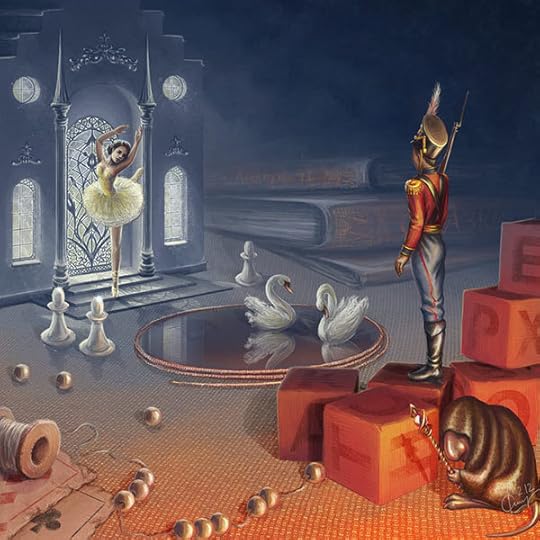
Yes indeed I was quite looking forward to Cynthia Rylant's picture book retelling of The Steadfast Tin Soldier, of Hans Christian Andersen's classic tale of love and loss, of toys that come alive and have feelings like everyone, like humans, even experiencing the nasty and destructive envy of potential rivals (and in particular since I have never much enjoyed the ending of the original Andersen tale, with the tin soldier after his many adventures and misadventures finally and once and for all being tossed by the jealous and I guess ultimately victorious goblin into the stove, into the fire, to perish, just as he had finally managed to make his way back home to the toy ballerina he loves, to a conclusion altered by Cynthia Rylant into a much more positive and cheering scenario and outcome, presenting the toy soldier both victoriously returning to his toy ballerina and also retaining and keeping her as his lover).
However and the above having been said, I actually and sadly, unfortunately have ended up finding Cynthia Rylant’s version of The Steadfast Tin Soldier only mildly entertaining at best as well as more than a bit mundanely recounted. For if truth be told, I really do not ever feel all that emotionally involved in Rylant's reimagined text, with the soldier's fate and his journey from the windowsill into the gutter/river and then finally back to his beloved and adored toy ballerina seeming rather banal (and this even though that the basic themes presented in The Steadfast Tin Soldier are obviously meant to be engaging and even adventurous), since the author's, since Cynthia Rylant’s writing style and narrative flow simply do not all that successfully mirror that desired sense of adventure, of possible peril and actually to and for my reading eyes coming off more like a dry non fiction account, with at times even reminding me somewhat of a catalogue of lists. And even the revised ending of The Steadfast Tin Soldier, the ending which I was so very much and eagerly anticipating, well, it also kind of falls flat, an annoying and unexpected deus ex machina of some random wind blowing into the stovepipe and catapulting the tin soldier straight from the inferno of his possible doom into the ballerina's arms so to speak (an alternative to Hans Christian Andersen's original negative ending that I do certainly very much appreciate, but which conceptualisation and modus operandi I find almost laughable and majorly silly, too run-of-the coincidental mill, too standard for my reading tastes and likes).
Now as to Jen Corace's accompanying illustrations, although by themselves, I would not consider them personal favourites, in conjunction with Rylant’s narrative, they are indeed a wonderful, descriptive and imaginative compliment (and actually present the danger and adventure, the possible threats the tin soldier faces on his journey back to his lady love, his ballerina, with both more excitement and emotionality than Cynthia Rylant's rather lacklustre and textually flat narrative). And while I certainly have been a bit disappointed with and by Rylant’s retelling of The Steadfast Tin Soldier, I still do recommend it, as even with my personal issues regarding narrative flow and the deus ex machina quality of the ending, I actually appreciate both text and images, and especially the salient fact that in this version, in this retelling of Hans Christian Andersen's classic tale, the steadfast tin soldier not only returns, but actually manages to both stay alive and get the girl.
Finally and furthermore, seeing that Cynthia Rylant's retelling does in many ways veer quite sharply and quite far from Hans Christian Andersen's original text for The Steadfast Tin Soldier, there also really should be an author's note included, explaining in particular why Cynthia Rylant has chosen to provide a very different and much more positive and optimistic sounding ending to her version. And while perhaps not absolutely and academically necessary in this particular case, as the original author, as Hans Christian Andersen's name, is indeed mentioned on the book cover, a supplemental author's note would at least for me, be like icing on a proverbial cake, as especially for fairy and folktales, author's notes on the origins of a given tale and why and how a translator or a reteller might have changed and altered the same are as important and as interesting for me and to me as the actual story itself (not to mention that an author's note would also show respect for Hans Christian Andersen and his literary legacy, and indeed, the lack of an author’s note is the main reason that I have rated this here version, that I have ranked Cynthia Rylant’s reimagined The Steadfast Tin Soldier with two and not with three stars).