Whilst holidaying in the principality, Mr. Satterthwaite watches as a young American man falls in love with a mystifying Countess. Soon after a bit of gambling at which he was not successful, he bumps into Harley Quin and they invite their new friends for an intimate dinner that reveals dark secrets about one of the guests…
Librarian's note #1: this short story was published in Flynn's Weekly (1926) and then in the print anthology The Mysterious Mr. Quin which was first published in 1930.
Librarian's note #2: the print anthology contains 12 Mr. Quin short stories. Besides those, there are two more found in other collections: The Love Detectives, and The Harlequin Tea Set. Mr. Satterthwaite also appears in Three Act Tragedy and Dead Man's Mirror. All by Agatha Christie, of course!
Librarian's note #3: the entries for all fourteen Mr. Quin short stories can be found on GR by searching for: a Harley Quin short story. Or for Harley Quin. Details such as characters and settings are included for each.
Dame Agatha Mary Clarissa Christie, Lady Mallowan, DBE (née Miller) was an English writer known for her 66 detective novels and 14 short story collections, particularly those revolving around fictional detectives Hercule Poirot and Miss Marple. She also wrote the world's longest-running play, the murder mystery The Mousetrap, which has been performed in the West End of London since 1952. A writer during the "Golden Age of Detective Fiction", Christie has been called the "Queen of Crime". She also wrote six novels under the pseudonym Mary Westmacott. In 1971, she was made a Dame (DBE) by Queen Elizabeth II for her contributions to literature. Guinness World Records lists Christie as the best-selling fiction writer of all time, her novels having sold more than two billion copies.
This best-selling author of all time wrote 66 crime novels and story collections, fourteen plays, and six novels under a pseudonym in romance. Her books sold more than a billion copies in the English language and a billion in translation. According to Index Translationum, people translated her works into 103 languages at least, the most for an individual author. Of the most enduring figures in crime literature, she created Hercule Poirot and Miss Jane Marple. She atuhored The Mousetrap, the longest-running play in the history of modern theater.
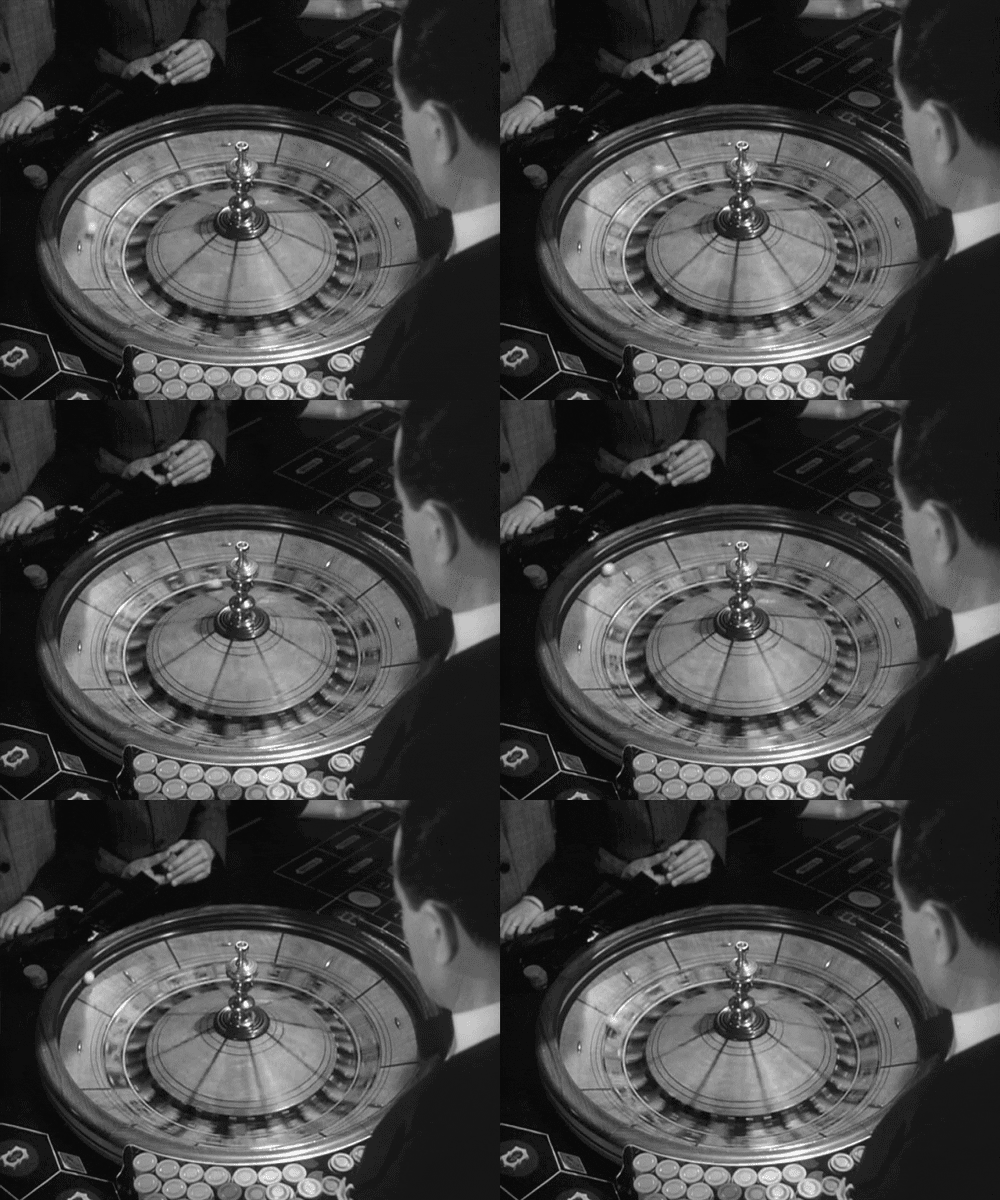
Mr. Satterthwaite is in Monte Carlo at a casino when Mr. Quin shows up to help him reunite a pair of lovers. But is there more than one couple whose future hangs on Lady Luck?
This one is about a grasping older woman who has targeted a younger man for his money. He's in awe of her worldliness and charm and has been ignoring the more sensible young woman he was originally in love with before they came to the casino. Satterthwaite is unconvinced that this Countess Czarnova is everything she portrays herself to be, but doesn't know why. And when a croupier seemingly gives his winnings to her accidentally, it sets off a chain of events that changes the course of all the lives involved in this love affair.
This one is ok. It has a somewhat ambiguous ending for the Countess, and I don't know if that's why it's not my favorite, or if it's just the fact that she was stupid enough to prove a point that annoyed me. Regardless, I liked it but didn't love it.
Originally published in 1926 in the magazine Flynn's Weekly. Read as part of the short story collection The Mysterious Mr. Quin.
3 Stars. Ultimately a story of changing times and, on an individual level, a story about each of our yesterdays and how they never really disappear. Here we learn a great deal about Mr. Satterthwaite. He's wealthy and plans his year like clockwork; he leaves for Monte Carlo on the Riviera in January and stays 3 months - for the blue Mediterranean, the lovely gardens, and a little gambling. But he misses the beautiful people of yesterday, the princes and ladies, now replaced with an "ill-dressed, shoddy crowd." That's a trend which continues to this day. There is one person of interest, Countess Czarnova. A woman of indeterminate age, but clearly one of special breeding. She was being escorted by a young American, Franklin Rudge who was enjoying, really enjoying, his first visit to the old world. A young woman also from the US, Elizabeth Martin, was upset. The story came out in Story-Teller in 1927 and was collected in The Mysterious Mr. Quin of 1930, reprinted in 2003. One evening a strange incident occurred at roulette with the Countess and Mr. S. And later Quin proposed a dinner game. His guest was the croupier. A sad dinner, a sad story. (Se2021/Se2025)
Mr Quin rocks up again and is able to untangle the ties that bind, one with another, In love.
Mr Satterthwaite is in Monte Carlo on his social travels around Europe and desiring the milder climate.
He is a people watcher but he bemoans the changes in his time, less of the people of wealth frequenting the South of France.
New visitors are coming including a young American couple whose own relationship is sidetracked as the young man becomes besotted by a Countess. The reader taking their lead from Satterthwaite wonder if she is all she presents herself to be.
Matters come to a head when Quin organises a magical super where events unfold and secrets are revealed.
Is it sufficient to rekindle love? Can a worse happening be avoided? Quin shows himself a little bit of a romantic and Satterthwaite more of a player than a simple observer.
Mr. Satterthwaite is now spending the winter months enjoying the mild temperatures of Monte Carlo, where he encounters his friend, Mr. Quin. The story revolves around a Countess, a croupier, and two American tourists. This is more of a character study than a mystery, although there's a surprise twist at the end. This short story is a little harder to follow than others I've read, but still well worth the read.
I'm trying but I'm starting to lose interest in these short stories and regretting buying the book when I could have just listening to the audiobook.
Anyway, in this story, Mr Satterthwaite is in Monte Carlo, relaxing and socializing as he does, when he runs into a young couple and a Countess. The young man seems quite taken with the Countess and the young woman is not happy about it. Mr Satterthwaite has his concerns but thinks it wise to keep his thoughts to himself as they may not be received well.
As he is pondering his dilemma, Mr Harley Quin shows up - coincidence or a supernatural intervention? - and agrees to help Mr Satterthwaite figure out the entangled relationships.
It didn't read like a mystery that needed solving, there were no crimes committed that needed clues to be found and theories to be discussed - it just seemed like an odd little encounter where the two older gentlemen helped the young couple see the truth of the Countess by luckily finding the croupier (casino dealer) who had known her a long time ago.
Mr. Satterthwaite is in Monte Carlo lamenting that too many young people can now afford to travel. Countess Czarnova is an old acquaintance who is also in town, losing badly at the casino and flirting with young men. Her background is mysterious and mostly built on rumors. One night at the roulette table, Mr. Satterthwaite and the Countess were both playing and the croupier mistakenly said the the countess won when it was really Mr. Satterthwaite. Later that night at dinner, Mr. Satterthwaite and the countess are joined by Mr. Quinn and the croupier who tells the story of how he had once been married to a young woman of questionable morals who left him for another man and has now fallen on hard times. This woman is the countess and that is why he named her the winner at the roulette table. Not much of a mystery in this one.
This entire review has been hidden because of spoilers.
This is probably the most pointless story in this whole collection. I don’t know why I read “this” one and not the last one, other than it has some nice character building for Mr. Satterthwaite as we find out that he is friends with a forun Countess. But other than that, there’s nothing, no mystery, no stakes, just more bull shit love troubles.
This is a very poor book by Agatha Christie. I couldn't really get into it. It is a story of life and times of the wealthy enjoying themselves. Very little substance to it.