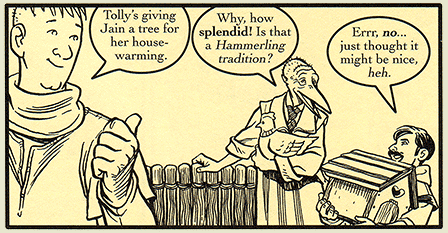
Castle Waiting graphic novel tells the story of an isolated, abandoned castle, and the eccentric inhabitants who bring it back to life. A fable for modern times, Castle Waiting is a fairy tale that's not about rescuing the princess, saving the kingdom, or fighting the ultimate war between Good and Evil, but about being a hero in your own home.
The opening story, "The Brambly Hedge," tells the origin of the castle itself, which is abandoned by its princess in a comic twist on "Sleeping Beauty" when she rides off into the sunset with her Prince Charming. The castle becomes a refuge for misfits, outcasts, and others seeking sanctuary, playing host to a lively and colorful cast of characters that inhabits the subsequent stories, including a talking anthropomorphic horse, a mysteriously pregnant Lady on the run, and a bearded nun.
Linda Medley is the author of the acclaimed Castle Waiting graphic novel, published by Fantagraphics Books. A freelance illustrator since 1985, Linda Medley has illustrated children's books for Putnam, Grosset & Dunlap, Houghton-Mifflin, and Western Publishing. Linda has worked in the comics industry as a penciller, inker, painter, colorist and sculptor. Her pencilling work includes stints on both Justice League and Doom Patrol for DC, as well as the Galactic Girl Guides for Tundra. Her paintings have appeared on the covers of Paradox Press' Family Man, Stuck Rubber Baby and TSR's Dragon magazine to name just a few. Born in Stockton, CA, and raised in “Steinbeck Country,” she now lives in Portland, OR, where she is working on the new Castle Waiting series, as well as a series of nine graphic novels based on L. Frank Baum’s Wizard of Oz series.
I bought this book on recommendation for my graphic novel education. When I was a kid I was obsessed with fairy tales, my guilty secret is that I tried to weasel my way in to folklore "major's only" classes in college. (never worked :( ) This is very folkloric in it's storytelling, and the drawings are charming.
"Castle Waiting" is presented in a beautiful edition and it's lovely to hold and look at, I am pleased to add it to my collection. The stories were very sweet and I loved reading about the misfit set of characters taking refuge in a strange castle.
The storyline in the last half of the book didn't engross me as much as the first half, but there was a loveliness to the stories that I really enjoyed. I loved the message of tolerance and the quirky characters.
Fairy tales and fantasy are not my usual genre, but with the feminine (or feminist if you prefer) touch of the author and illustrator Linda Medley, Castle Waiting is a fresh tale that surprised me and grabbed my attention, even though I didn't believe a word of it.
Aww! This was a sweet re-imagining of fairy tale settings and tropes with a decidedly feminist slant, in which everything ends happily but without the darkness or chance of real fairy tales. In the first half of the book, a pregnant Lady goes on a quest for the fabled "Castle Waiting," a safe haven for all who seek it. She finds it and essentially lives happily ever after with her baby, who takes after his (literally) ogreish father rather than the Lady's husband. The second half of the story follows the adventures of an order of bearded nuns who form an unconventional convent of progressively-minded rescuers. Awesome!
The second half of the story holds no real connection to the first half -- it's clearly two distinct storylines stuck back-to-back... in order to have an acceptably book-length graphic novel? I liked both storylines, but neither had a real buildup-climax-resolution, which makes sense as it was originally published in short issues. I would have liked to learn more about Lady Jain's life before Castle Waiting -- who was this ogre? How did they meet? -- and think that would have made more sense than launching into a whole other story, although I loved the characters and situations in the Solicitine storyline.
What really interests me is the question of whether I should consider this for my elementary collection. Pros: it's completely sweet, features strong heroines and generally good people, has very little darkness at all, very little violence, very few really bad guys, and everything works out fairly in the end. I know it's listed in the juvenile collection at a number of public libraries. Cons: we've got some very subtle sex jokes, some infidelity, and a more adult attitude than most elementary offerings. For a middle school, I'd definitely include it: for the very beginnings of a graphic novel at the elementary level, I'm on the fence. Suggestions? Input?
A magical tale of what happens after the happily-ever-after.
To save a young princess's life, a town is put to sleep for one hundred years. When the princess is awoken by a kiss, she wastes no time hurrying off to live with her charming prince, leaving the villagers, well, speechless...
The castle soon becomes a refuge for all sorts of "lost souls," both human and animal. We meet a host of wonderful characters, and magnificent tales are spun.
A convent full of bearded ladies and a green baby add to the fun.
[This is a review for both Fantagraphics volumes.]
One of the great, nearly insurmountable problems of genre literature is that it has a need to follow after the conventions of its genre. This can be fine if all one wants is more of what one has already read. More hard-boiled detectives down on their luck who come up against the jealous or crooked police force in order to solve the case but ultimately lose the fight. More unsuspecting lads who flee their home villages to get caught up in a prophesied battle for the fate of the world. More intergalactic political drama. More beautiful, youthful vampires to throb the hearts of self-important minors. More Westerns, more superheroes, more romances, more magical girls, more Amish spanking fiction.
The parade of derivative sameness seems an unceasing tide. If that's what you're looking for—something comfortable, predictable, and safe—then you're in luck because there's piles of the stuff out there. Personally, while a little bit of literary comfort food can hit the spot when I'm in just the right mood, I'm not usually super jazzed on the idea of indulging one more iteration of a book I've already read or already own. So while those piles of genre-steeped rehashes of copies do nothing for me, I too am fortunate because there are rare individuals working within genres in ways that seem ignorant of convention—and come off absolutely fresh for it.
In Castle Waiting, Linda Medley accomplishes something unique by proposing a medieval fantasy setting and then using it mostly to set stage for a series of character-driven episodes of people who mostly just talk about their lives. The castle at Brambly Hedge is the product of a sleeping beauty-style curse. For a hundred years, the fortress was grown up with a forest of thorns dangerous enough to end the lives of any adventurers who set out to discover the mystery of the place. Generations later, a charming prince finds his way through unscathed, wakes the princess, and the two of them leave the castle (and its servants) behind for a bright and ego-tastic future somewhere less provincial. A generation after that, the only ones left in the castle are the princess' three handmaidens (now old), and they elect to turn the castle into a sanctuary for those in need.
That was all prologue and at the book's real beginning, a pregnant Lady Jain arrives seeking safety inside the castle's walls. She is fleeing from her husband lest he discover her pregnancy by another man and kill her for jealousy. Of course, all of this sounds not exactly untypical of the standard fantasy work. Maybe it's rare to have a female protagonist open an epic adventure by running away with a baby in the belly, but everything else sounds pretty standard. It's just that when I said this is where the book begins, it's also pretty much where the story (in any grand sense of the term) ends.
The moment Jain enters into the Castle Waiting, all larger plot movement halts entirely and nearly all focus homes in upon the development of the relationships between Jain and those who make their home in the castle. Beyond the three handmaidens, there's the rambunctious bearded nun, the plague-masked Doctor Fell, Sir Chess (the horse-headed knight gallant), Rackham (the werestork fashionista), simple Simon and his widowed mother, and the silent, aloof Iron Henry (the adopted son of dwarves). Each member of the community has a unique and compelling personal history and the simmering of their persons and circumstances makes for enjoyable reading.
After Jain gives birth to a strange-looking child (the very image of his father apparently), most of the two available volumes (comprising a mighty 856 pages) involve Jain hearing the histories of her new friends. Some of these stories are funny (e.g. that of the convent of bearded nuns) while others such as Doctor Fell's are just plain tragic. While it may be at some point that Medley plans to bring some danger into the current situation (we get occasional glimpses into Jain's own past), the most climactic event thus far was the advent of a Leaky Roof.
As with any book that puts the interpersonal dynamic on the front shelf, Castle Waiting stands or falls on its characters. Medley puts a lot of heart into each of these, giving them each their opportunity to win the affections of readers. She approaches their interactions with wit and humour. Those in search of dour characters bemoaning the lot their life has drawn will be disappointed, for everyone approaches life with a certain optimism and joie de vivre—save perhaps Henry (who is still working through things) and Doctor Fell (who's really just kind of gone around the bend due his own grave circumstances). Castle Waiting is, almost more than anything else, a happy book. And one that I am happy to recommend.
Additional Note There is some curiosity with the second volume. By agreement with the book's publisher, Fantagraphics, Linda Medley's name has been struck from the volume. It only appears in indicia and as a sticker affixed to the book's rear cover. For whatever reason, Medley seems to have cut ties with either her product or with the publisher. As well, the final chapter of volume 2 ends abruptly. Not only does volume two leave the story in a kind of limbo, it doesn't even quite seem that the page on which the book ends was intended to be that chapter's final page.
As a fan of the series, this is a nerve-wracking development. Of course I care about Medley and wish her the best and hope that her relationship with Fantagraphics can be repaired (if it was ever even damaged), but really, as any fan, I am selfish and my concern is primarily for the work. I am invested in Medley's welfare primarily because of what she is able to provide for me in terms of this wonderful genre-flaunting story and I want very much to see it continue to completion.
I'm not sure where things began to go funny, but volume 2 does experience the unhappy loss of letterer Todd Klein after two chapters (after Klein's departure, Medley employs a serifed font in all her dialogue and it's never not an awkward choice). There also seem to be some attempts at working with new page sizes that add some hiccoughs to the flow of the second volume. Fortunately, Medley's strong hand as an author is evident throughout and her writing suffers no diminishment.
In any case, here's hoping that all is well in Medley's life and that she will return to the beautiful world she's created once more.
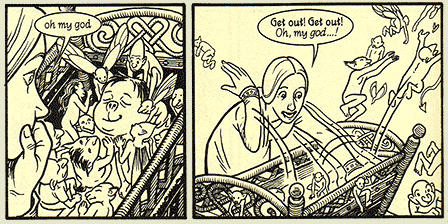
This is an amazing fantasy graphic novel. It features anthropomorphic animals, an order of bearded nuns, a pregnant lady seeking sanctuary, and mischievous little sprites.
Medley does a great job of combining fairy tales with something a lot weirder and more sarcastic. However, this is no dark exploration of the seedy underbelly of our beloved stories. Instead, this volume has an overall happy, upbeat, positive message - true love triumphs, good wins over evil, slaves are freed, and virtue is rewarded.
The drawings are also a delight. I hate looking at ugly pictures, and luckily these are not ugly. They're not BEAUTIFUL, but they are pretty enough that you won't be looking to gouge your eyes out.
There's nothing I didn't enjoy about this book, it was a delight all the way through. I highly recommend it.
I’m not sure how to describe this book! Other than to say that I fell head-over-heels in love with the crazy, quirky, and yet comforting world in this one-of-a-kind story.
The book opens with a sassy but pretty standard version of Sleeping Beauty, which left me going “Meh. If the rest of the book is just fairy tale retellings, I’m not that interested.”
But then it starts a whole new story, still set in a Grimm-type fairy tale land and time but otherwise very different, which got weirder and yet more wonderful with the turn of every page. I hardly dare try to describe it, partly because it’s a little complex, with much meandering off into backstories, but it’s also just so surprising that I don’t want to ruin any of that surprise for anyone else. Let’s just say that it’s beautifully all-inclusive and accepting of people, and completely charming and delightful.
The art is terrific, and the book is a really nice package, hardcover with its own green ribbon bookmark bound in. My only complaint about it is that it should be bigger! I kept using a magnifying glass so I could really appreciate the detail in all the drawings.
Highly recommended if you want to read a feel-good fairy tale where love always wins the day.
(Reprinted from the Chicago Center for Literature and Photography [cclapcenter.com]. I am the original author of this essay, as well as the owner of CCLaP; it is not being reprinted here illegally.)
Like any self-respecting obsessive book nerd, at any given moment I'm actually in the process of reading three or four books simultaneously; there is the deeper and more complex novel, for example, that I will read only at a cafe during the day, a less complex one I read in more distracting environments like the bus, some giant nonfiction book that I will read only a page or two at a time in the bathroom, and then of course whatever book I'm reading in bed those days, which by definition tends to usually be the lightest and least consequential of them all, since I'm always falling asleep while reading it. And thus have I found myself reading more and more graphic novels these days, especially since the Chicago Public Library system started making them more of an acquisitional priority, although admittedly I don't write reviews for most of them, simply because most aren't weighty enough to justify a full analytical write-up.
Ah, but I did want to mention a delightful title I recently made my way through, comics-industry veteran Linda Medley's postmodern fairytale Castle Waiting, a self-published personal project of hers throughout the '90s that once won her the prestigious Xeric Grant. See, turns out that Medley actually studied folklore as well as illustration when in college, and so has spent a lot of time in her life asking weird questions of these old tales that other people usually don't; for example, what happened to Sleeping Beauty's kingdom once she got whisked away by Prince Charming? Turns out that this mammoth (500-page) book is what happened; the "Castle Waiting" mentioned in the title is no less than Sleeping Beauty's old castle fallen into disrepair, a semi-abandoned and semi-mythical place on the edge of the known world where all of folklore's most lovable losers have gathered, making a funky alternative life for themselves there and sharing their backstories Canterbury-Tales style.
And in fact, it's important to understand that Medley means for this entire situation to be a highly metaphorical one, reflecting her time when younger as part of the radical feminist circles of the San Francisco Bay area; these stories are not just cute and smart twists on traditional fairytales, but also a celebration of uniqueness, of alternative families, of women who don't fit the usual stereotypical feminine norms of mainstream society. (In fact, the entire last half of this book is dedicated to a story about a group of nuns who all have beards, and how they have built themselves a fortress to protect them from the abusive men they all ran away from; and if that's not a grand metaphor for a lot of what you see within radical-feminist circles in the Bay area, I don't know what is.) Sadly, financial burdens originally shut this self-published title down in 2001; happily, our friends at Fantagraphics have picked it up again as a regular series, and decided to put out this compendium of the self-published issues first to get everyone up to steam. It's a bit pricey, also a bit preachy at times; in general, though, it gets a solid recommendation from me, and especially to all you smart female genre fans who have always wanted to read a funny, warm fantasy tale written to exactly suit your particular sensibilities.
I'm not quite sure how to rate Castle Waiting. On one hand the presentation and art inside are excellent. The premise sounds interesting and it kept my attention for the first third or so of it. But after that it was just like.... nothing was happening at all. Just a bunch of strange occurrences and introductions to more strange characters. I wanted to know what had happened with the pregnant lady and how she got there but it wasn't really explained. And when I flipped through to the end to see if there was any kind of resolution I didn't really find anything related. Castle Waiting is presented in a way, or at the very least it seems that way to me, like it's some kind of offbeat fairytale or some kind of strange mishmash retelling of fairy tales. But really the first few pages have a sleeping beauty retelling, and there are fairy tale related characters within it, but besides that it didn't really feel like a fairy tale. Almost more of a strange 'slice-of-life' kind of story within a fairy tale land. Sometimes that kind of story works for a book but here, for me at least, it really didn't.
Fans of Fables (the comic book) and fables (the genre) alike will enjoy this wonderful comic book compilation of fairy tale-like stories. In fact, even though I'm an enthusiastic fan of Fables, I'd have to actually rank this one as even better, in my estimation. The characters leap off of the page with their charm and fascinating stories. And the author, while alluding to fairy tales frequently, tells her own new stories with magnificent talent!
The book ends abruptly, and I sincerely hope that more volumes will follow. We need to know more about all the fascinating characters!
I came to Castle Waiting knowing that it would be low-stakes slice-of-life human drama in a fairytale setting, and I was totally down for that concept. What I wasn’t prepared for was it being so damn twee.
“Twee” is a word that in my experience only British people use and fully understand. It’s a concept with fairly complex layers of nuances and associations, so looking it up in a dictionary isn’t very helpful in grasping what it means. The closest thing to a synonym would be “quaint”, though “twee” is generally a negative word. Other concepts that to my mind overlap with tweeness are corniness, hokeyness, old-fashionedness, whimsy, daintiness, uncoolness, banality, sentimentality, inoffensiveness, pandering, light-heartedness, optimism, sweetness and wholesomeness. Perhaps the best way to explain it is to say that “twee” is a kind of opposite to “edgy” and “gritty”.
All of this is to say that something about the tone of Castle Waiting rubs me the wrong way. The sense of humour reminds me of insipid family-friendly TV series that I watched in my childhood, and I guess it’s all just too wholesome and uncynical for my jaded tastes. I’ll be the first to admit that I have a particularly low tolerance for (what I perceive as) tweeness, and that’s totally on me; I’m clearly just not this comic’s target audience.
To close this review on a more positive note, I’ll emphasize that I didn’t hate this comic. Indeed, for the first hundred pages or so I was largely able to repress my gut reaction to the tweeness and to rather enjoy the pleasant story and charming setting. After that, there’s very little story and even more tweeness, but even then there’s attractive artwork, some amusingly quirky concepts, and a general niceness that pervades it all.
I L-O-V-E-D this book. I think I might have to read it again right now (something I haven't done since being the youngest of younglings). Had I the money, I would buy a 100 copies of this book to give to friends, and yes, even to throw at enemies - because it might hurt them, tome that it is, but then again, it might also do them some good if they picked it up and read it. I really don't have any enemies but if I did, that's what I'd do. Just letting y'all know.
Oh in the best of books, you see truth everywhere, and you see yourself embedded in it. This book does it for me. It has all the elements of story that I am instantly drawn to: Arcadia, adventure, comedy, lore, magic, miracles, mystery, Justice, happiness, with moments of sadness too. It's the kind of world I would jump right into, even if the book closed upon me, if I could.
The cameraderie of the oddball collection of characters (again, something that is close to my heart - being an oddball myself) in Castle Waiting are endearing, and you see that family can be defined by common purpose and mutual aid, not necessarily by blood relations - a theme which has surfaced in my life. Their back stories are not all clear, and yet there they are, together, taking care of each other, sharing adventures, happiness and love together. It helps quite a bit that there are plenty of kick-arse, strong, feminist characters taking care of themselve and each other. And doing good by the world while at it.
Oh, it's such a good book. Now I have to get my hands on the next one! Enjoy reading this book - you won't regret it.
one warning: unfortunately (I assume due to being from 1996) it uses the slur word for the Romani people--not AS a slur, but as their name. The characters themselves have two different presentations, one highly negative and one positive.
original review: I picked this up on a whim at the library. There were people in wimples and looked like a fairytale retelling! It looked whimsical, and I do love whimsy. I read it mostly in one go late evening/early morning and I feel I might not be done processing it. It was the strangest thing I'd read in a long time. And I think I also really liked it. Loved the illustrations. Sometimes got a little mixed up with the stories-within-stories-within-stories. I appreciated the fact that this is totally a fantasy, and yet there is non-snide references to a medieval-style Christianity. This is hard enough to find in straight hisfic sometimes, I was pleasantly surprised to find it in fantasy.
I have no idea what the re-read value will be. But. For now, I feel 4-stars.
This graphic novel which, in vaguely Chaucer-like structure, tells stories set in a fairy tale world and thick with feminist sensibilities, is clever and engaging, but painfully disjointed, with odd, often disappoint emphasis and an ending that isn't really an ending. I enjoyed Linda Medley's characters and some of her concepts, but I think that practice will give her a better sense of what her readers what in the denouement of a novel - namely, a conflict and resolution for her protaganist rather than an extended side plot concerning a minor character and taking place far before the actual beginning of the story.
Cons: certain themes (the romani, the Middle Eastern people being saved by Christianity), the art (very clean - a bit too clean), the animal characters (I'm not sure how they work in-universe), the meandering story line (the main character got lost into a stream of side-characters halfway through).
Pros: certain themes (overcoming difficulties by sticking together), the art (very consistent, the style fits the fairy tale theme pretty well), the animal characters (add a flair of whimsy and fairy-taleness), the meandering story line (flows very naturally and brings up a host of colourful side characters).
(4.5) this was such a joy to read! i am not normally a big graphic novel person but i loveeeeed this one so much. the characters and story are so endearing and fun to read about. shoutout to cat for telling me about this one!!
"Castle Waiting is a marvelous comic in how it has wide appeal. The black and white line-drawing is pleasing and expressive. There is a great deal of humor and the bizarre. The stories, both over arcing and small, are interesting. The most novice reader of tales will be entertained and intrigued. The veteran tale reader will enjoy the scavenger hunt as Medley honors traditional storylines and figures even as she uses them at will—up-cycling, repurposing. Castle Waiting isn’t just feminist, its also green. I think the hipster (?) “mustache club” crowd** should get into it just fine as well—facial hair is in: female’s not excluded." "As the publisher’s comments shared, the opening chapters are about Brambly Hedge (Sleeping Beauty). There is a great deal of humor and general silliness in these chapters; this creates a harmless sensibility that will capture and trap the reader." [...] "The effect of some of the more serious topics or situations addressed in Castle Waiting really depends upon the age and experience of the reader. The daughter of 10 3/4s didn’t blink at some of the frames that I mulled over or was moved to sadness by. She found a light-hearted humor over details I skimmed past, partly because she knows more tales than I do, but also because the story can be read with an eye for only adventure and humor." [...] "The daughter was curious why the second half spent the majority of its length on the bearded women, but she was fascinated and entertained. I’m not sure how attuned politically she is,or metaphorically savvy she can be, but Peace’s antics are witty and wild regardless. Highly charged reads can be daunting and alienating to certain ages, but Medley pulls it off. Regardless of how you choose to approach the stories, or with what you have to approach the stories, Medley entertains and provokes, both through written and illustrated renderings." [...] "It is an enchantment of the book that so many oddities or social outcasts are portrayed as normal; if not acceptable, certainly not judged. Medley draws eccentricity in more human, and thus accessible, terms. Her compassionate gaze has a humored perspective that is not keen to humiliate; which is such a wonderful and refreshing part of the experience of reading Castle Waiting. If you believe books can be refuges, this one is an unusually engaging one."
I really enjoyed parts of this. But the part near the beginning — about how gypsies steal and/or buy babies — really?! It kind of ruined this for me. I saw a big pile of remaindered copies of this at a Half Price books and remembered how someone (but not who) had gushed about the setup in my hearing. (Sleeping Beauty is awakened, then rides off into the sunset with the prince, leaving the other denizens of the castle saying "What?") But the "gypsies steal babies" thing kind of ruined it for me.
This is a pretty nice edition — it has a ribbon bookmark. Who doesn't love books with bound-in ribbon bookmarks? But my library's copy has worn a bit around the edges of the spine, so I can't really speak for the production values. It is a few years old, and I have no idea how much it's circulated. But I figured I'd throw that out there.
Sometimes I wasn't very keen on the art style. But there were a few moments when the artist drew a panel as if it were a medieval manuscript, and I liked those.
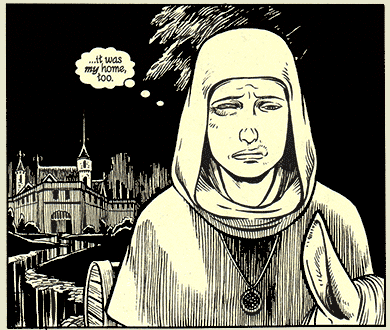
"Castle Waiting" tells the story of the inhabitants of Sleeping Beauty's castle, after she has been woken and long ago left. An isolated castle surrounded by the ruin of a town and a high briar hedge, it is a place which has become a sanctuary.
This thick volume is divided into three main portions. A swift retelling of Sleeping Beauty's tale. The arrival of Jain, fleeing her brutal husband so she can bear another man's baby (the baby entertainingly resembles Shrek). Then the story of Peaceful, a Solicitine nun.
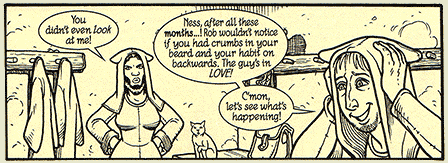
The Solicitines, who are all bearded women, are awesome and I enjoyed this part of the book by far the most (with a little discomfort for the story of the origin of the Solicitines, which involved "woman unfriendly Middle-Eastern background").
The art style is pleasant, there's a lot of quiet humour, and gentle cameraderie (if a little too much smirking ), and I'm looking forward to the next volume of this.
Hands down one of my favorite graphic novels I have ever read. It is witty, smart and wonderful with a great fantasy story underneath. Linda Medley needs to be on more best-of lists for this great bit of writing and graphics.
When I was in high school and college, manga was my mainstay, albeit peripheral to a literary scene that still viewed any sort of picture/comic/graphic highly askance. That experience continues to imbue the proliferation of graphic novels in libraries and beyond a surreal tinge for me, and so when I finally got my hands on this work, it seemed fitting that this piece added so long ago would only show up after I had relocated far enough to make the author local. Outside of my usual natterings on my literary memory road, this is an interesting graphic novel to come back to during what can be argued are the heydays (if not the complete acceptance) of the form; indeed, once could easily see Medley as a vanguard of the genre, turning as she does her comic book experience into a sustained 'novel' form. In terms of the content, this work certainly was an easy enough read and does a great deal of admirable things in the feminist realm (enough for me to be pleased to see it in the young adult genre), but man is the latter insufferably white enough to bleed into flat out racism once in a while. As such, I won't be following up on the series ending sequel any time soon, but if the local library keeps a copy long enough for me to be willing to risk some Christocentric nonsense for the sake of reader closure, there are worse ways I could spend my time.
Lovely and heartwarming. Starts with a Sleeping Beauty retelling but it's just the prologue to a vastly more interesting story. Most of the later half is character-driven episodes, and I delighted in the characters talking about their pre-Castle lives.
I was a little skeptical when I picked this book up at my local library. The cover was beautiful but art really did not intrigue me at first. Nevertheless, the world of fairy tales and folk tales has always drawn me in and so I decided to give it a go.
Of course, having Fantagraphics as a publisher did not hurt its reputation as well.
Linda Medley definitely does show a master storyteller's finesse in working with already existing concepts and turning them onto a side that is comfortable and familiar yet completely new and original.
At times whimsical, at times seriously tackling grave issues, and at times satirical, "Castle Waiting" definitely went after my heart with the writing, i must also in fairness admit, in the end with the artwork.
Drawing inspiration from tales such as Sleeping Beauty, John Henry, Three little pigs and also characters such as an ex-baby-delivering stork take on Arthur Rackham to a relative of the Count of Carrabas, "Castle Waiting" gobbles all of this up and blends it into a harmonious whole.
it also posits a few original characters such as the Sisterhood of the bearded nuns and draws into the story with true compassion to the blundering, kind, courageous characters. Of course there are a whole gamut of emotions that each character embodies and displays so that above line is not a fair representative of the book or Medley's talent.
It is only the first volume of the story and another is soon to be published so do not be discouraged if things are left unresolved.
Although I know this has absolutely nothing to do with the content of the book, this collection of Castle Waiting is served up in a really lovely hardcover edition that screams to be read. My fiancee normally gives most of my comics a pass, but she picked up the book and loved it, and I daresay that she wouldn't have done that if it hadn't looked so swell.
A revisionist fairy tale, Castle Waiting is a treat. Creator Linda Medley's artwork is wonderful to behold; I don't really get into this sort of thing when I read a grapic novel, but I couldn't help marveling over her use of black- it's sparingly employed, but to great effect.
The story suffers a little at being utterly incomplete. This is fine enough if you know that the series is still being published and the various plot threads interspersed throughout this first volume will likely be addressed... but I'm a decently informed comic guy and I had NO idea that there was more story out there. That sort of colored my opinion of the last few chapters focused on Sister Peace- where I should have been enjoying the story, I was getting annoyed that in no way was there enough book left to answer all the nagging plot threads left hanging throughout the story.
Of course, that's also part of the charm of Castle Waiting- the story doesn't seem to be in any great hurry to move itself along. This is the kind of book that stops for two issues to illustrate a shopping expedition in a most entertaining fashion.
I really enjoyed reading this, and I swept through it pretty quickly. It was not at all what I expected it to be when I picked it up to start reading. It starts out as sort of a fractured fairy tale, but then turns into a medium for telling the stories of anyone the author feels like. It's pretty brilliant, really. She's not tied to any plotline or set of central characters--Linda Medley uses the storied Castle Waiting to freely introduce characters and tales as she wishes. There are even stories within stories, and it never becomes confusing.
Also of note--these are not your typical fantasy stories of quests and journeys. At their heart, each tale is about human relationships and the inclination we all have to help one another out. It's about community and friendship and watching out for one another.
Maybe that makes it sound soft or weak... Maybe I'll write a better review sometime, then. It's a delightful and entertaining book.
I'm not sure about the comparisons to Tolkien's LotR -- it's a bit too whimsical and episodic for that -- but it certainly does portray the world of women. It's not a quest story, it's a fairytale, and it pilfers indiscriminately from fairytales and literature. I liked the slant put on some of these stories, the gentle humour of them, and the community that forms at Castle Waiting. It's not really a story in which things happen -- it's a story in which people happen.
I don't feel a huge compulsion to read more, but at the same time I'd like to know more about the characters. I liked the art; so often it captured the moment exactly right.
Except for the emphasis on the lives of women, there's not much groundbreaking here, but I did enjoy it.