Warren Ellis (THE AUTHORITY) y John Cassaday (THE ASTONISHING X-MEN, YO SOY LEGION) realizan una obra maestra, un verdadero homenaje a los grandes géneros populares del s.XX. A caballo entre dos milenios, un grupo de arqueólogos del s.XX están dispuestos a desentrañar los secretos del pasado para entender el presente y poder afrontar el futuro. Juntos forman Planetary. Incluye Planetary #1-12.
Warren Ellis is the award-winning writer of graphic novels like TRANSMETROPOLITAN, FELL, MINISTRY OF SPACE and PLANETARY, and the author of the NYT-bestselling GUN MACHINE and the “underground classic” novel CROOKED LITTLE VEIN, as well as the digital short-story single DEAD PIG COLLECTOR. His newest book is the novella NORMAL, from FSG Originals, listed as one of Amazon’s Best 100 Books Of 2016.
The movie RED is based on his graphic novel of the same name, its sequel having been released in summer 2013. IRON MAN 3 is based on his Marvel Comics graphic novel IRON MAN: EXTREMIS. He is currently developing his graphic novel sequence with Jason Howard, TREES, for television, in concert with HardySonBaker and NBCU, and continues to work as a screenwriter and producer in film and television, represented by Angela Cheng Caplan and Cheng Caplan Company. He is the creator, writer and co-producer of the Netflix series CASTLEVANIA, recently renewed for its third season, and of the recently-announced Netflix series HEAVEN’S FOREST.
He’s written extensively for VICE, WIRED UK and Reuters on technological and cultural matters, and given keynote speeches and lectures at events like dConstruct, ThingsCon, Improving Reality, SxSW, How The Light Gets In, Haunted Machines and Cognitive Cities.
Warren Ellis has recently developed and curated the revival of the Wildstorm creative library for DC Entertainment with the series THE WILD STORM, and is currently working on the serialising of new graphic novel works TREES: THREE FATES and INJECTION at Image Comics, and the serialised graphic novel THE BATMAN’S GRAVE for DC Comics, while working as a Consulting Producer on another television series.
A documentary about his work, CAPTURED GHOSTS, was released in 2012.
Recognitions include the NUIG Literary and Debating Society’s President’s Medal for service to freedom of speech, the EAGLE AWARDS Roll Of Honour for lifetime achievement in the field of comics & graphic novels, the Grand Prix de l’Imaginaire 2010, the Sidewise Award for Alternate History and the International Horror Guild Award for illustrated narrative. He is a Patron of Humanists UK. He holds an honorary doctorate from the University of Essex.
Warren Ellis lives outside London, on the south-east coast of England, in case he needs to make a quick getaway.
For years, I've been digging through the extensive back catalogs of the comics world, reading "the greats". Part of that has been because I've always been a fan of the DC Occult universe, and there has not been much new in the way of that recently. Another, much bigger part, is that I feel too many things are unoriginal and uninspired. This book made me realize something, albeit unintentionally, but I'll get to that in a moment.
Planetary is amazing. It's not amazing because right from the start I was hooked and blown away, but rather, because it started the way all good things start: from the seemingly mundane. An old man in a diner, drinking shitty coffee. Also like all good things, the seemingly mundane is chuckling at us, eager to spill it's secrets. But it waits, patiently, and slowly trickles us out information. Slow enough to keep us jittering with anticipation, but not so slow that we lose interest. There is a real power in the delivery of this entire story. The pace is some of the best (if not THE best) that I have read in anything, let alone comics. As the story builds, pieces come together, and the first handful of seemingly stand-alone issues come to have great meaning and great purpose to the story as a whole. As the pieces fall into place and the plot thickens, the pace quickens and you find yourself flipping pages like a madman. I liken the experience to standing on a shoreline, watching a tiny wave form in the distance, only to see it gain speed and size. Eventually this wave is towering over everything you know and love, laughing in it's face. What happens after this point? Well, read Planetary and you'll know, I'm not spoiling anything.
I read Planetary more than a decade after it was published, and it has shown it's teeth as a truly iconic piece. But more than that, it's a testament to the times we live in now. Always on the cusp of something bigger, pushing our way closer to singularity. Information is the core of this story. Sure, information plays a big part of what the story itself is about, but I'm not talking about that. I'm talking about how information plays a role in the creation of something like this. There is just SO much to take in in the story, pulling from so many different places and using so much varying information. The cutting edge of quantum theory today theorizes that all of our world, everything we know and see, is a hologram. A series of two dimensional projections, overlaying each other, interwoven and intertwined to create what we know as three dimensions. Today, this is still a vastly foreign subject. A decade ago, it was bleeding edge. It was so foreign it was science fiction. A decade before that, anyone other than a writer would have been ridiculed for bringing it up (and even then, that author would probably have still been ridiculed). It is just too complex and strange an idea to us. We can barely even imagine it. But Warren Ellis did. He took everything he could find and made it work in the context of the story. For it to still be relevant today, hell, even more relevant, is a feat in itself. Planetary has aged well, indeed.
One of my favorite moments throughout the whole series was when Ellis riffed on my beloved DC occult figures (and he's no stranger to Constantine). I would expect such a thing from Grant Morrison, but from Ellis it truly surprised me (in the best of ways). It was done with the exacting humor that Vertigo is famous for; the quirky look and the single line that makes you literally laugh out loud. There were lots of really great Vertigo moments throughout the series, always done appropriately and never overdone. I think the ability for a creative team to jump around from genre to genre, hitting every mood, every feeling and every tonal peak is a truly rare thing. When I finish a book, I always immediately know whether it was there or not, and in this case, it most certainly was. This series has jumped a lot of things to get to the upper echelons of my comic ranks.
So, getting back to this book making me realize something. A little more than a decade ago, Planetary was poised between looking back at the past and looking forward to the future. In the past, a myriad of figures and stories and styles that were shown tried and true. In the future, a bold new world, ready to explore. This most definitely plays a part in the story itself, but this book got me thinking about my own reading patterns. It seems that I so rarely venture into the new, unproven territory, that I have forgotten what it's like to explore. We have barely entered into this decade, and while the first decade of this century was drab and dull, that doesn't mean the creative well is dry. Let those back catalogs get some dust! There is an entirely new world to explore in comics. But first, read Planetary.
Really interesting novel. A group of explorers/archaeologists set off on different adventures around earth for strange artifacts and occurrences. Planetary is their name. I found the art quite nice throughout, and sometimes an older feel to it. The story wasnt that linear. It felt like a series of short stories with a very feint main overall story arc. Some stories were 4 star quality and some 2 stars. I never really felt like any of the characters were engaging to the point where I wanted to know more about them. Some cool twists and historical background though.
7/10 Me ha encantado este 1° volumen de Planetary. El misterio y la fantasy-scify de cada capítulo ha sido a cada cual mejor... ¡Pero me dejaban con ganas de más! Se hacen cortas, pero como también hay una trama principal en torno al nuevo investigador de estos fenómenos de los multiversos, hay que ir viendo qué nos depara.
I had forgotten how much fun this book was. I gave up buying the singles and trades since Ellis & Cassaday couldn't seem to get an issue out but once a year. It reads so much better in collected form anyway.
This first act is sets the stage for what's revolutionary about PLANETARY: the genre-bending links to the main mystery. Ellis uses analogues for everything from the Justice League to Godzilla in showing how the secret history of the world can be unearthed by a team of weird archaeologists. Character analogues abound: The Shadow, Doc Savage, John Constantine. Many of these provide vehicles for Ellis to comment on the replicated genre itself, which can be fun. But overall, it's just cool to watch Planetary uncover all of these awesome homages.
At the time PLANETARY was being published, it wasn't uncommon to see such genre-commenting storytelling. Everyone from Alan Moore to Mark Millar was raiding the linen closets of prior genre history and creating crazy mashups. But there's something unique about PLANETARY that I can't put my finger on. Perhaps it's Ellis' sparse but punctuated writing style, leaving the heavy lifting o the storytelling to Cassaday's astonishing art and Dupuy's amazing colors.
This was Ellis at his best, I think. He used PLANETARY to great effect in redefining the language of science. I love how he combines strings of words into mad, unpossible lyrics of awesome. When matched with Cassaday's incredible art, it's just such a unique experience that it's impossible to wrap your head around it at times.
Finalmente le pude dar una chance a este neoclásico y me enganché de tal forma que no pude largar el tomo aunque se hicieron las seis de la mañana. Historia y dibujo no sólo son buenísimos sino que forman un todo mayor que no hace más que prometer un final apoteósico para el siguiente. Además, siempre está el bonus de ir pescando trasunto en cada uno de los personajes que van apareciendo. Si mañana me da el cuero, seguro amplie la reseña poniendo un par, aunque más no sea por joder. Eso sí, la historia de cómo conseguí el tomo la dejo intacta, a continuación, así los likes que me gané en su momento siguen siendo válidos:
Al principio lo vi a 200$ y me pareció un afano. Después a 140$ y me seguía pareciendo caro, pero ya estaba dispuesto a comprarlo. Al final, cuando lo quise comprar me dijeron que no estaba, pero revolviendo y revolviendo lo encontré, y me terminó saliendo 90$. Algo me dice que cuando lo termine leyendo me va a gustar.
Me gusta el argumento, el dibujo, las tramas están muy bien pensadas y la verdad es que Ellis tiene muy buenas ideas, pero no dejo de pensar que esta colección está desaprovechada.
Obviamente me falta por leer la mitad, pero la sensación es que se dejan caer muchas cosas, se muestran muchas ideas, hay grandes giros en la trama... pero al final queda todo un poco vacio, que hay una isla junto a Japón con bestias gigantes?... no pasa nada, que encontramos un contenedor de almas en taiwan?... nada, nada, pasemos a lo siguiente... y así todo, mientras se va descubriendo el pasado de Snow y la trama principal parece que nada más importa y se quedan grandes ideas desaprovechadas por el camino.
Me ha dejado muy buena impresión y por supuesto terminaré la colección, pero espero que además de la trama principal se resuelva algún otro cabo suelto.
If I could give this six stars, I would. Ennis (ably assisted by Cassaday's gorgeous artwork) examines, deconstructs, remixes, pays homage to, and plays delightfully with comic book (and other media) tropes and genres, enabling even the longest fan to see old material with new eyes. That he does so within the framework of a world-changing mystery, and a world-investigating secretive agency, is just icing on the cake.
This is one I should be rereading every few years. So should everyone else. It's that good.
The first half of Planetary is a collection of short stories that present the characters to the reader, but not really.
It's... odd. Superheroes, but instead of saving the world they go around talking to ghosts that lived an American Unit 731. Or maybe they go to Godzilla island, or talk to Sherlock Holmes, or pass through Dream and Death from the Sandman series. Yes there are plenty of references within the comic but they never feel lazy or out of place. There's an intertextual richness at place here, as if it was proving to acknowledge its sources or something. Very..."unique".
So, Ellis would have gotten bored if he just simply wrote the comic and for that to have been it, and instead the odd structure feels like a trap, like when in Madoka Magica you can tell that it's not some of the characters first rodeo, if you know what I mean. And in this comic everyone *knows* but doesn't really *know*, you know?
Well. There is no "heartwarming tale of friendship" going on here. And the second part, I imagine, will get bloody and go hard on plot for once.
I don't know what to make out of it, but uh, great job Ellis at getting there???
This entire review has been hidden because of spoilers.
I'm not sure what I think. I recognize (almost?) all the characters (pulp fiction heroes, kaiju, thinly disguised DC and Marvel comic heroes, etc.) included and woven into the stories. However, the whole point of using these things escapes me. Sure, I've seen Ellis use the shtick more recently in his reimagining of the WildStorm universe for DC, especially in the Michael Cray series. Is it more than just a shtick, though?
For the first half of the book is just a litany of one-shot stories as the Planetary crew explores different situations without spinning any sustained narrative. The only common thread is the exploration of these situations and the introduction of, for example, an evil version of the Justice League from another dimension in the multiverse that is quickly vanquished and sealed back behind the multiverse door. (This multiverse "snowflake" does seem to permeate several of the stories within this volume. And I did get the reference to the Monster group from the dimensionality of the snowflake.)
There's a mystery in the second half about the identity of the Fourth Man that is resolved in current and flashback issues. This part of the story does thread back into some of scenes from the first half, which made me appreciate those issues more and gave me hope that Ellis was putting together a more complete story across the entire run than just seeing how many different ideas or fictional (comics and literary) characters he can incorporate (and added a star to my rating).
Art by John Cassady was superb. Huge panels with cinematic scope and tight pacing during action scenes. Fabulous colors, too.
There is one mystery left hanging that seemed to have great import to those that unleashed it, but wasn't explored further by the end of the book. Maybe it's dealt with in the second half of the series? I want to find out.
John Cassaday's art is absolutely stellar. Ellis gives him some great set pieces, but in so many of these issues, the plot loops back on itself in a way that is obviously meant to awe the reader but leaves me wondering why that issue was written at all.
Planetary Vol. 1-4 written by Warren Ellis and illustrated by John Cassaday
Ever since Allan Moore and Frank Miller re-suited up superheroes with Watchmen and The Dark Knight Returns, comics and writers have been playing catch up. Some have done this well, but most have either drown in their basically soap opera ways or strangled themselves with the reality Moore and Miller brought. Not too many comics have matched what they did in the 80’s but Planetary is one of those comics that built something good on the foundation Moore and Miller laid. This isn’t so much a comic book as it is just a really good story that happens to be told in a comic book format. That’s one of the things many writers trying to emulate Moore and Miller’s realism forgot along the way. Realism wasn’t the focal point of the comic. The focal point was telling a good story that just happened to be in the comic book format. Ellis and Cassaday’s Planetary is totally story driven. It doesn’t get caught up with the standard Marvel and DC comic book hijinks; it treats storytelling just as if you’re reading a book, only this book happens to have pictures.
I’ve read some other works by Ellis and this is by far the best thing I’ve read that he’s written. The story line is laser focused, as he builds the story arc with each issue, while also laying the ground work to come with subtle hints at foreshadowing. There isn’t an issue where the storyline isn’t pushed forward or some characters are developed better. Nothing is wasted. The ideas Ellis brings to light in each issue are simply mind blowing. They combine everything from Star Trek, Star Wars, Fringe, and every science article or sci-fi movie known to man, and Ellis did all of this with, surprising, only 27 issues. Whereas Marvel and DC can’t even do a single good idea with 100 plodding issues. Ellis treats this series like it’s his own dissertation on comics as he combines all sorts of nerd ingredients from Tarzan, Doc Savage, The Lone Ranger, The Fantastic Four, Green Lantern, Superman, Wonder Woman, to The Shadow (to name just a few). He combines them in a way that doesn’t feel gimmicky because a lot of them are built into the mythology of the story. They aren’t just there for the nerds to goo goo and gaga over. They actually serve a purpose. Into this world, and story line, Ellis drops three good characters Elijah Snow, Jakita Wagner, and the Drummer and then with each issue he builds on their history and character. Ellis also isn’t afraid to let this characters change either, when circumstances dictate some kind of change, his characters change. Another curve ball is thrown into the mix as Ellis and Cassaday create an actual female character that goes against all Marvel and DC stereotypes of women. She actually wears normally clothes and isn’t over sexuality. Believe it or not she’s a real type of female character. I think this is one of greatest things about this series because so often women in comics are completely treated like a piece of meat: over large breasts, pouty expressions, skimpy/revealing clothing, and over sexualized poses, thankfully Jakita goes against every stereotype in comics.
Cassaday is a blessing to have drawn every issue of this series. His panels move the story along with a great pace and his splash pages serve their purpose: to enhance a situation or an idea with the extreme largeness of it. It’s like watching a mini movie only with still pictures. His style is distinctly his; there’s no one else out there that is anywhere near his style. It’s realistic without being too detailed but yet has enough comic touches that will help to establish it as a superhero book.
Just finished my second time through both books. Want to give it a second chance to see if my feeling would change on it. Well it has not. The artwork is amazing. The characters are amazing. The individual issues are great and the writing in each is great. It is not even a slow read the pacing is good. My problem with it is each is issue is like a individual story and you just jump from one to the next with sometimes no tie to the last one. So half the time I spent thinking what the hell is going on. Later things start to tie together but even then I did not care. Made it a little better but way to loose with the bigger story of the universe. The character stories tied together nice. Some one else review mentioned that there is so much in each individual issue that they could be there own story. That is my issue with it. I would have like explanation and depth on the world with the characters. Make it 3 books would have been better.
This mammoth series featuring Elijah Snow, the Creepy Old Goat, got better with each episode. Echoes of “Injection” & “East of West”, with some hints of Doctor Who. ****
PLANETARY #1 – Archaeologists of the Impossible. All Over the World “Coffee tastes like your dog took a leak in it.” Unconventional start to an original tale that has depth to its backstory.
PLANETARY #2 – Action! Terror! Fun! “The cold and isolation free us.” Ghastly fanaticism!
PLANETARY #3 – Dead Gunfighters “Hong Kong is so kind to me.”
PLANETARY #4 – Strange Harbours “It was like Satan farted, that’s what it was like.”
PLANETARY #5 – The Good Doctor “He died as unknown as he lived, as I understand it – vaporized, trying to bring down a United Nations space platform.”
PLANETARY #6 – It’s a Strange World “Learning curve’s steep on this one, so keep focused.”
PLANETARY #7 – To Be In England, In The Summertime “You know what they say: if you’re tired of London, you’re tired of life.” .. “Herod. Kill the firstborn. Get the baby Jesus, all that.”
PLANETARY #8 – The Day the Earth Turned Slower “You’re not going to get rid of them alone..”
PLANETARY #9 – Planet Fiction “We’re in a strange relationship with our fiction, you see.”
PLANETARY #10 – Magic & Loss “Yes, they’ll hate you. You’ll frighten them.”.. - Mother
PLANETARY #11 – Cold War “I’ve got holes in my memory you could throw a damn nuke through.”
PLANETARY #12 – Memory Cloud “Your memory is incomplete. You don’t know what you’re setting off.”
PLANETARY Preview – Nuclear Spring “You come on in, boys. Have a drink on me. Been a long day.”
I actually have the original floppies for this series, and re-read it after finally completing the collection (was missing issue #12 for some time).
It holds up rather well overall, I think. Some of what Ellis and Casaday are doing is taking you on an alt version of many literary legends (Brass is an analogue for Doc Savage, etc) and it's generally quite fun. The conceit of "It's a strange world out there. Let's keep it that way." is a terrific mission statement that lets the Field Team go wandering about the globe, getting into trouble, but mostly solving problems with aplomb.
If there's one thing that stick out a bit on re-read is that the team rarely seems to be really challenged or in danger, but more operating on a "everything will be fine as long as we get to the problem in time". That's ok, but it probably limits what you can do and where you could go with this series. Snow's amnesia helps adds some mystery and confusion to the whole bit and it's a smart choice that allows the reader to learn things along with Snow.
Casaday's art is a major star here: it's absolutely gorgeous, whether he's doing dynamic action sequences or fantastical splash pages, and he does better than anyone this side of adam hughes at drawing great facial expressions on a group of fairly cynical and smart-assed characters.
Este para mí es el Watchmen de Warren Ellis. Rindiéndole honor a la historia de los superhéroes. El superhéroe como lo conocemos hoy, tiene un origen en las novelas "pulp" y partiendo desde ahí, toma en cuenta todos los acontecimientos y personajes que marcaron el género hasta hoy. Pero apenas vamos por la mitad del viaje.
Como de costumbre, los diálogos de Ellis son un manjar de lectura junto con las excelentes secuencias de Cassaday. Muchas veces un capítulo no es nada más que diálogo, más incluso cuando es el caso, el libro hace pausas para disfrutar del hermoso dibujo.
Me gustó mucho como Ellis explicó algunos conceptos de principio del siglo (1900) con ciencia moderna y así, conceptos que sonaban fantásticos en ese entonces, suenan más posibles, dando a demostrar que la ciencia-ficción de hoy es la ciencia del mañana. Como futurista, Ellis echa un vistazo al pasado para ver qué tan lejos hemos llegado tanto en arte como en ciencia.
3.5 en realidad. Mi tolerancia para aguantar la violencia gráfica es bastante bajo, y Warren Ellis ha resultado ser uno de los pocos autores cuya escritura supera mi reticencia. Pero hasta más de la mitad del libro no había una historia clara y eran un montón de buenas ideas presentadas de forma entretenida mezcladas con múltiples referencias a los cómics de superhéroes.
LEAGUE OF EXTRAORDINARY GENTLEMEN for pop culture junkies of the 70's, 80's and 90's with a bunch of classic pulp thrown in for good measures. Nothing is too hard to spot, it's all cleanly drawn, and while the pace is decompressed, this particular collection builds to a perfect endpoint.
Nie od razu, ale opowieść za opowieścią ta historia staje się coraz bardziej intrygująca. Oby nie skończyła zaskakiwać również w drugiej, ostatniej części.
I wanted to like this graphic novel more. The characters were fairly interesting and the plot line had potential, but the deliberately disjointed presentation left me wanting more continuity. Perhaps some might like the gaping holes in the story timeline, but for me it made the whole quite indigestible.
A very monster of the week feeling comic, where every chapter is introducing and resolving the main mystery. A lot of them feel like pretty stereotypical DC plotlines. Good but not great. Still waiting for the author I loved in Transmetropolitan to shine through.
Reading Injection, Vol. 1 reminded me a bit of this series, and I recalled that while I had read some of it around when it was first written, its slow production resulted in me never finishing it. This volume seemed like a good choice, since it includes the first half of the series, but I actually rather disliked it. It is way too large of a book and quite awkward to handle, especially as a library copy with the plastic-covered slipcover taped to the book, allowing the too-heavy inner book to shift about awkwardly. Possibly this contributed to my mixed feelings on the story, or maybe it was just disappointing relative to my memory/expectations. For one, I realized I forgot just how much it is about reusing 20th century (primarily) popular culture, mostly comics, but also movies, fiction, etc., just with the serial numbers filed off. Maybe I didn't fully understand this when I first read it, but now I find I know enough to recognize the material being referenced, though perhaps without knowing the material well enough to fully appreciate its use. This is worst in Chapter Seven, which reads in large parts like people having a discussion about 1980's British comics and culture, to the point that the fictional framework feels for the conversation feels completely irrelevant. The series also suffers from pacing issues and each chapter feels completely separate from the others, less like a story and more like a series of snapshots. And not enough happens, especially in the early chapters; I don't think a comic needs to be about action, but it feels too much like each chapter is a chance for the author to appear clever by repurposing a bit of popculture (Japanese giant monster movies, two-fisted pulp heroes, major DC superheroes, 1980's British comics, etc.), but not really having anything happen. And to distract you from the lack of even new developments in information and understanding, let along action, there is the refrain to "secret history" and the sense that this is all very Important and Mysterious. The story picks up a bit in the later chapters of this volume, and there are some good ideas scattered throughout, but I still felt it to be a very frustrating read. And actually, the real mystery is where Planetary gets its funding from, and how they manage to employ as many people as they do without their information leaking all over the place.
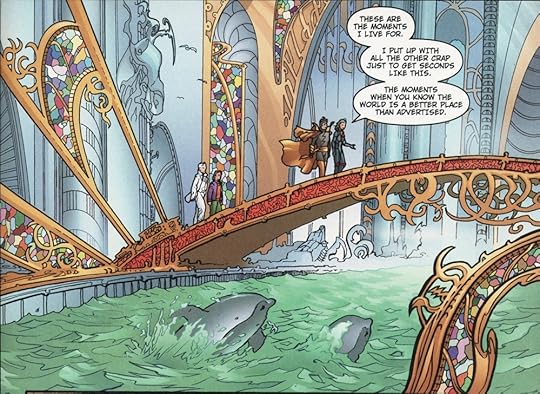
A comic of the "secret history" of the 20th century. Does what "secret history" stories should do: give you a shivery peek at what's rotten beneath the skin of the world, while also offering a few moments of something transcendent, the sustaining glimpse at the glimmer of possibility that there's more to life than we know: that the world can be "a better place than advertised."
Planetary is also an affectionate tour through a hundred years of pulp detritus, as well as a critique and investigation of five or six decades of comics, but all of that is secondary to characters I gradually found myself caring about, and the subtle assemblage of a larger mystery and conflict I found myself caught up in.
You gotta give props to a writer who casually tosses out the tidbit that the real U.S. government goes about 30 odd levels deeper than the government and gets his audience to lap it up like dogs at feeding time. A history book for those who thought the most significant development of the last fifty years was the gov.'s abandonment of radical super soldier experiments. I just wanted a little less Ellis and a little more Woodward. But why do I dare second guess a hundred year old man in an all white suit cavorting with an Amazon who can only be broken and tamed by none other than a dimension-hopping Bruce Wayne. Feels like what would result if a bursting teenager took a red marker and wrote all over his comic books to show his younger, skinner brother the way things really are.
Genial cómic de Warren Ellis. Ya con el primer número pone muchas cartas sobre la mesa, mostrando un cómic elaborado y complicado no recomendado para el gran público. Poco a poco, aún cuando cada número es en cierta manera autoconclusivo, se van poniendo las piezas para lo que nos espera al final del tomo, con todas sus revelaciones y ese gran giro que nos hará ver a algún personaje de diferente manera de cómo le veíamos hasta ese momento. Su mezcla de estilos, dentro siempre de la ciencia ficción pero jugando con la fantasía, la imaginación, el espionaje, en cine negro, hace que te enganches a seguir leyendo y ver qué nos depara en el siguiente número.
Excelente novela gráfica donde tres arqueólogos con diversos poderes recorren mundos alternativos descubriendo realidades y seres de otras dimensiones.
Elijah Snow, tiene poderes relacionados con el frío; Jakita Wagner (telequinesis), superfuerza y supervelocidad; The Drummer, absorve y procesa información, cualquier tipo de información. Controla cualquier maquina o resto de artefacto...
Forman la cara visible de Planetary una sociedad secreta que apoya y castiga a seres y realidades paranormales.
John Cassaday me parece un dibujante excepcional. Warren Ellis tiene una mente brillante. Han sabido introducir algo innovador en un momento donde es muy difícil sorprenderse.
Etrange lecture que ce Planetary. Je n'avais pas forcément apprécié la Preview du premier single. Mais plusieurs critiques fort élogieuses m'ont fait craquer. Et le début de lecture m'a conforté dans mon premier avis : bof.
Et puis, au fur et à mesure, les histoires indépendantes se lient, un semblant de fil rouge émerge, et tout ça devient passionnant et foisonnant. Même s'il y a de grosses baisses de régime, mais qu'en fait ça permet de relancer la machine.
Et le final donne envie d'avoir la suite. Rapidement !
Pour les deux extras, le Authority m'a laissé froid. Mais je ne connais pas bien The Authority, ça doit pas aider. Le Batman m'a beaucoup plus dans sa folie, par contre.
I read all of Planetary in one sitting. There is a lot about this series that is awesome. Each issue has a crazy idea in it that could probably support a whole series on its own, the art is really good, and the writing is very tight.
However, for me, the story never came together in such a way that I truly cared about what was happening. The ideas were more than enough to pull me through, but while I appreciate Planetary's deconstructive take on the elements and history of comics (which makes this a worthwhile read to any comic fan), I came from this series feeling a little cold.