Jump to ratings and reviews
Rate this book

Sector General #1

Hospital Station

Rate this book
Hospital Station [mass_market] White, James [Dec 12, 1984]

192 pages, Mass Market Paperback

First published January 1, 1962

43 people are currently reading
2840 people want to read

About the author

James White

94 books134 followers
Librarian Note:
There is more than one author in the Goodreads database with this name.


James White was a Northern Irish author of science fiction novellas, short stories and novels. He was born in Belfast and returned there after spending some early years in Canada. He became a fan of science fiction in 1941 and co-wrote two fan magazines, from 1948 to 1953 and 1952 to 1965. Encouraged by other fans, White began publishing short stories in 1953, and his first novel was published in 1957. His best-known novels were the twelve of the Sector General series, the first published in 1962 and the last after his death. White also published nine other novels, two of which were nominated for major awards, unsuccessfully.

White abhorred violence, and medical and other emergencies were the sources of dramatic tension in his stories. The "Sector General" series is regarded as defining the genre of medical science fiction, and as introducing a memorable crew of aliens. Although missing winning the most prestigious honours four times, White gained other awards for specific works and for contributions to science fiction. He was also Guest-of-Honour of several conventions.

Ratings & Reviews

What do you think?
Rate this book

Friends & Following

Create a free account to discover what your friends think of this book!

Community Reviews

5 stars
796 (34%)
4 stars
882 (37%)
3 stars
505 (21%)
2 stars
120 (5%)
1 star
24 (1%)
Displaying 1 - 30 of 196 reviews
Profile Image for Vit Babenco.
1,781 reviews5,775 followers
February 11, 2025
Aliens of mercy… Intergalactic clemency…
The vast structure which was slowly taking shape in Galactic Sector Twelve, midway between the rim of the parent galaxy and the densely populated systems of the Greater Magellan Cloud, was to be a hospital – a hospital to end all hospitals. Hundreds of different environments would be accurately reproduced here, any extreme of heat, cold, pressure, gravity, radiation or atmosphere necessary for the patients and staff it y would contain. Such a tremendous and complex structure was far beyond the resources of any one planet, so that hundreds of worlds had each fabricated sections of it and transported them to the assembly point.

In the first chapter a hero has to nurse an alien infant weighing half a ton… It isn’t fun… But he is up to his task and despite all the troubles he even gets a kind of promotion…
Now the hospital is functioning… And thousands of incredible alien physiologies, psychologies and minds must be done with…
His patients had been part of a Telfi gestalt engaged in operating an interstellar cruiser when there had been an accident in one of the power piles. The small, beetle-like and – individually – very stupid beings were radiation eaters, but that flare-up had been too much even for them.


The mammoth structure of the hospital witnesses a lot of accidents and the doctors must be ready to deal with all kinds of emergencies…
Even alien medics must possess humanity.
Profile Image for Stephen.
1,516 reviews12.4k followers
October 13, 2011
Good-natured, high quality, pacifist SF that is ideal comfort food when looking to elevate your mood into the upper range of the happy scale.

This was just what I needed.

After my recent sojourn down the depraved, uber-violent pages of Crossed, Volume 1 and the beautiful, but deeply evocative entries of Loath Letters, I was in direwolf need of a major mood lift to replenish my joy reserves and Hospital Station, along with a big, fat glass of wine, was the perfect prescription.

This is the first of the Sector General novels revolving around the Milky Way's largest, space-based, multi-environment medical facility. Megagiganticallyenormously huge, SG is miles long, almost 400 levels high, and contains hundreds of different alien environments, allowing it cater to the 68 varieties of intelligent forms of life that comprise the peaceful galactic federation. The staff of the hospital includes doctors from dozens of species and the author does a terrific job of creating fun, interesting aliens that are significantly different from humans.

The book is best described as a series of interconnected novelettes (each approximately 40 pages long) that each play out like an episode of “House” in space without the limping, pill-popping crankiness (I know, I wouldn’t mind that either, but this is feel good fiction). Each plot revolves around an unknown or unusual alien whose mysterious medical condition has the Doctors and Diagnosticians (i.e., super docs) racing against time to piece together clues and come up with a proper treatment for the patient.

Historically, this series is regarded as defining the sub-genre of medical science fiction and is noteworthy both for its central source of dramatic tension (i.e., medical diagnosis rather than war/fighting) and for the broad range of imaginative alien physiologies encountered in the stories. The prose is good but nothing that will wow the reader, but the plots are interesting and the variety of alien life is wonderful.

Mostly, these stories are just a heckuva lotta fun.

PLOT SUMMARY:

Here’s a brief run down making up this collection:

Medic: In this piece we meet one of series main characters, O’Mara (soon to be Major O’Mara, Chief Psychologist for Sector General). O’Mara finds himself in serious alien cah cah after being accused of negligently causing the death of two ET workers in a construction accident. Worse, the two dead aliens left behind a 6 month old baby that O’Mara must now care for until representatives from the baby’s home world arrive. Worser, the baby is a 1000 pound Hudlarian with thick armor plating that absorbs its food through the skin making for interesting feedings. Worsest, the baby has become sick and O’Mara has no idea what is wrong with it.

This was a really fun story and a great introduction to the series. The tone is light and playful without being silly and there is an underlying seriousness, a genuine sense of compassion and growing warmth as O’Mara cleverly stumbles his way through diagnosing and treating the half-ton toddler back to health. Very well done.

Sector General: This second story introduces us to Doctor Conway and we get to learn a lot about the technology and procedures employed at Sector General. Given the vast number alien physiologies and the impossibility of retaining expertise on such a wide number of species, the doctors make use of “education tapes” which temporarily imprint onto the brain complete medical knowledge of a particular species allowing them to treat aliens of that race. The catch is that the tape not only contains the knowledge, but also the personality of the alien medical expert whose memories created the tape. This causes some unusual (and often funny) side effects.

We also learn in the story about the senior medical researchers known as “Diagnosticians” who keep up to 10 different alien “tapes” imprinted on their minds permanently so they can combine knowledge from different fields to use in dealing complex and unusual medical issues. The process leaves these doctors with a form of self-induced multiple personality disorder that results in their being a socially awkward bunch.

Trouble with Emily: Dr. Conway is paired with a high advanced, telepathic alien that looks like a dried prune in a snow globe to perform a mysterious set of treatments on a massive alien “brontosaurus” that appears to be in perfect health. The reason for the treatments…ah, that’s the point of the story.

Visitor-At-Large: The staff of Sector General is confronted with a serious security problem when an extremely unusual species (i.e., a giant, shape changing amoeba) begins to slowly “melt” and Dr. Conway and the whole team of Diagnosticians can’t find a way to stop the weight loss. Things go from bad to “up the creek” when the alien’s child shows up and starts tearing up the station looking for mom. This was a wonderful story and I thought the resolution was very interesting.

Out Patient: Conway, O’Mara and the gang are in a race against time to diagnose a strange alien whose physiology seems to include characteristics that are medically and scientifically impossible. This was a great medical mystery and expands the background of the series considerably.

Overall, this book caught me at the right time and was the perfect sorbet to cleanse the palate. I had a lot of fun visiting this universe and will certainly be back when I am again in need of a humorous, light pick me up full of interesting aliens.

4.0 stars. Highly Recommended!!
Profile Image for Richard Derus.
4,165 reviews2,263 followers
October 15, 2020
This book's 1960s roots are showing. Since those roots are also my roots, I am thoroughly in sync with the ideology on display; the read itself probably only merits three stars because less a novel than a fix-up seldom rates high on my personal literary scale. So the remaining star is awarded for nostalgia and wistful pleasure.

I'm not going to encourage modern readers to shed their addiction to billion-page nonillionologies like that stupid one just finished up on TV to grab this modestly sized midlist marvy from a half-century ago. I'll merely comment that, should y'all come up for air and need something less grimdark and cynical, this could cleanse y'all's mental palates.

And as a 2020 aside, I'd like to say that the medicine-for-profit and disease-as-political-weapon age we live in comes off decidedly the worse for comparison to this fix-up book of stories where these vile, reprehensible attitudes are not on display.

I would like a one-way trip back to that reality for any holiday you care to name.
Profile Image for Metodi Markov.
1,726 reviews434 followers
February 15, 2025
Страхотна фантастика, неостаряваща през годините!

Интересната концепция за създаването и финкционирането на общогалактическа болница е развита чудесно от Уайт в серия от новели, всяка от които ни сблъсква с нови същества и медицинските им проблеми.

Уникална е и системата за класификация на живота предложена от автора - с четири букви се описват най-общите особености и нужди на съответното същество и а това е жизнено важна информация за действията на космическите лечители.

Забавно четиво, което с удоволствие препрочетох!
Profile Image for George Kaslov.
105 reviews172 followers
December 27, 2017
This review basically covers Sector General books #1-#6.

Now I am a very cynical and skeptical person, to the point that I lowered my ratings for books such as Long way to a small and angry planet, Binti, and others like it simply because I saw their optimistic and pacifist messages as naive, unrealistic and sometimes simply because they had a happy ending. But James White with his 50s optimism managed to melt my cynical heart. He managed to create a truly pacifist sci-fi story, that I like to describe it as more Star Trek than Star Trek itself. This was managed by creating a medical drama in space, to the point that everyone would describe this series as Doctor House in space. I only partially agree with this description, yes, the stories center around real medical puzzles but they don't include Dr House's famous cynical line: "Everybody lies". Everyone involved is truly good and our protagonist Dr Convey is a medical genius and a bit full of himself but without major character flaws of Dr House. Also the technology he mentions is charming in it's obsolescence, just imagine putting a complete recording of someones mind on a single reel of magnetic tape.

Now, because these books are reprints of his original stories that were published in SF magazines over a period of a few years. One might get tired of reading the same descriptions quite fast. But this and other typical 50s SF tropes didn't present any problems for me. It just added to its charm and gave me a dream for the future I truly want to live in.
Profile Image for Warren Fournier.
842 reviews152 followers
February 13, 2023
"Sector General" is truly unusual series, but one which "Star Trek" fans will likely appreciate, as instead of seeking out new life and new civilizations, the Sector General stories focus on saving life and civilization throughout the universe. In a series of adventures, this uplifting and inspiring twist on Golden-Age science fiction aims to have no villains in their stories, the violence of battle or invasion replaced with invasive medical procedures and the gore of surgery as an interspecies team fights disease and even mental illness across the stars from a giant hospital base.

The first book, "Hospital Station," appeared in 1957 and is a medley of five stories that originally appeared separately in various magazines. It is the first collection of the "Sector General" saga, part of a subgenre of science fiction that grew popular in the Golden-Age, inspired by Murray Leinster's Medship series, and contemporary with Alan E. Nourse's "Star Surgeon."

Now, this book isn't perfect. The opening chapters were probably not the best way to hook someone into this fictional world. It details the very beginnings of the great hospital base, which is still under construction when we join the narrative. The building of the huge hospital in space is a dangerous operation in itself, and two alien technicians are crushed while chasing their offspring through a restricted construction zone. It seems everyone involved in the investigation of this work-related fatality is kind of a nasty personality, an immediate turnoff. At the center of suspicion of negligence is a character named O'Mara. In retribution, he is placed in charge of the care of the surviving infant of the two killed technicians. He is forced to keep the baby in his quarters. The catch is that the baby weighs half a ton and requires outrageous means of care due to its unusual physiology, pushing O'Mara to the brink of insanity trying to come up with ingenious ways to keep the alien healthy and happy.

On the surface, this seems like a touching and comedic morality parable that sets the tone for dedicated service to others. However, it rubbed me the wrong way because I didn't like how the baby alien was just dumped off on O'Mara with instructions that he better not let anything bad happen to it. But if the organization really cared about the baby, it seems they wouldn't put it in the care of someone accused of killing it's parents in the first place. Secondly, this was a construction site, so what the hell was a baby doing there?! To me, this seemed to be an artificial way of setting up the story that was not very plausible considering these are actions of a supposedly advanced interplanetary operation. Perhaps author James White intentionally had the characters respond to negligence with negligence to point out that the builders really did not care about life, thus setting up a chronicle of growth for the organization and the people involved.

Because "Hospital Station" is not really a novel and more of a series of vignettes, the second story takes place years later, and O'Mara is no longer a construction worker but a military doctor. I think he's supposed to be a psychiatrist, but they call him a psychologist. They still don't seem to know the difference in the umpteenth century. Whatever. O'Mara now takes second fiddle as the boss and advisor to the new main protagonist, Dr. Conway, who is prejudiced against the military, calling them murderers, and so doesn't believe you can be a doctor and a soldier at the same time. The rest of the book concerns how the two come to trust each other over a series of episodic trials and tribulations that each push characters to the limits of their intelligence and endurance.

And believe me, this book gets nuts! The episodes get more chaotic and challenging to the point of leaving you breathless, and we are introduced to increasingly weirder life forms in the role of both patient and physician. The fourth episode in the book even has a shape shifting creature highly reminiscent of the Thing. No little green men here, that's for sure. When White was creating his aliens, he studied various planetary environments and thought about what features a living being might need to evolve for survival. His Darwinian application really paid off with some of the most imaginative creations ever realized in science fiction.

"Hospital Station" is the product of the 1950s, and geared largely to a young male audience. As such, despite the diverse crew aboard Sector General, there really are no female characters discussed at any length. O'Mara teases Dr. Conway for not showing much interest in women, but since administration doesn't seem to give their doctors much of a break to pursue a social life, the only romance he could get, if O'Mara is not misjudging Conway's sexual preference, is through female colleagues on staff. But as enlightened as the author tried to be with his not-so-subtle antiracist and pacifist messages, he seems to have little to say about women characters. This oversight does leave a kind of emptiness in the overall dynamics between the cast, which is largely limited to good ol' boys teasing each other and getting flabbergasted by humorless aliens speaking through autistic digital voice translators.

But these stories DO have a lot to say about dedication and loyalty in one's profession, as well as being on-the-nose by never judging people by their appearance. It also has a surprising focus on mental health issues. There are quite a few very thoughtful themes here, some handled with more finesse than others.

Overall, I do recommend this book, especially if you enjoy Star Trek. It's a fun medical thriller and melodrama set in space, and though it tends to not age well in some areas, I hear that the series gets even better over time. I, for one, will be eager to check out further entries, which you can be sure I'll review here.

You can buy these stories in omnibus collections introduced by various great writers in the genre, like John Clute and David Langford. My copy of "Hospital Station" was included in the "Beginning Operations" omnibus introduced by my favorite sci-fi scholar Brian Stableford. The man seems to write forewords to everything! Give it a try and see what you think.
Profile Image for Nate.
588 reviews49 followers
May 29, 2024
Really great collection of episodic stories from the 1960s.
This really reminds me of Star Trek if they’d set a series on a medical station. It has recurring characters and each story features a different medical emergency/mystery centred around an alien patient.
It’s really interesting because there aren’t any villains and the human characters have to work with a very imaginative cast of alien doctors all with very different physiologies and mentalities. The hospital space station (sector general) is split up into different atmospheres and gravitational fields to support each different alien ward. There are multiples of all the hallways connecting them for ease of use by the staff and patients.

There’s a whole universe of these well done stories, I’m pretty sure there’s at leas five of these books and there’s quite a bit of lovingly done world building just in the first one. White created a plethora of imaginative aliens and a whole lettered classification system to identify them. At the end of this book there’s a glossary of what they all mean.

I can tell the author enjoyed writing these stories and took care to do it well, do it with a PG rating and still managed to be entertaining. I’ll definitely read some more of these.
Profile Image for Michael.
982 reviews175 followers
March 8, 2013
This book was something of a mixed experience for me, with both good and bad elements; ultimately I felt that the "good" parts were underdeveloped enough to prevent it from getting a 4th star. Like other novels of the time (I’m especially thinking of Isaac Asimov) it consists of short vignettes which are almost stories in themselves, although with a common Universe and theme. It is a science fiction novel set in the far future, when access to hyperspace travel has allowed humans to explore most of the Galaxy, along the way joining (or creating, it is not clear) a vast Federation of many intelligent space-faring species. What keeps this rather cliché setting interesting is that we see this Universe, not through the eyes of some hardy explorer or rugged military leader ala Captain Kirk, but from the perspective of doctors running “Sector General,” the major one-stop shop in the Galaxy for medical services.

Now, not minding the fact that it would be incredibly inconvenient to transport wounded or sick individuals thousands of light years to get necessary medical treatment, this does give us a rather unusual setup for original problems for the characters to solve. This Universe does not consist of mostly humanoid “forehead aliens” of the Star Trek model, but instead of incredibly diverse lifeforms, with entirely different needs in terms of gravity, atmosphere, pressure, radiation, food, etc. The diversity of the aliens (or “e-t’s”) is easily the novel’s strongest point. White has clearly considered the possibility of life adapting to almost any conceivable environment, and imagined what an intelligent species might be like in those environments. We get floating blobs of go, shapeshifters, giant dinosaurs, caterpillar-creatures, spindly insectoid surgeons, giant tentacled crabs that can live in vacuum, tiny beetles that eat hard radiation, and even squat red teddy bears (which seem to be the most humanoid of the non-human species).

Which brings me to one of the weaknesses of the novel, although I’m not sure everyone will mind it as much as I did: most of the descriptions of the appearance of the aliens is pretty much limited to the couple-of-words I gave out above. We don’t often get much more of a sense of what they look like, although White is at pains to express their medical needs. And maybe that’s because his characters “see” like doctors: they aren’t seeing people (or monsters) they are seeing symptoms. To make it even more clinical, the aliens are described using four-letter codes that express their physiognomy in general terms (humans are DBDG, so you know that a DBLF is fairly close, but an SRTT is a “real weirdie”).

But their very detachment leads to another problem, for me. A lot of the stories have a basic outline: a new medical problem is encountered, the “usual” stuff doesn’t work, but the brilliant protagonist figures out that doing exactly the opposite of what usually works will solve the problem. Then he proceeds to tell no one, including the audience, why he is doing this, so everyone thinks he’s crazy, and the tension is built as we wonder if they will manage to halt his crazy course. Then the issue is resolved by his bold move and he explains haughtily in the conclusion what he should have told everyone in the first place.

I think all of this derives from the fact that, although he tried to break with cliché by setting his book in a hospital, James White still suffers from many of the hangups of pre-feminist sci fi. In particular, his characters are not collaborators, they are basically the rugged individuals of the exploration novels, only in a different setting. In reality, such an attitude wouldn’t last long in the medical world, particularly when you would need to consult so frequently with experts on alien anatomy. His attitude also leads to the disturbing lack of female characters in the novel. The aliens are uniformly called “it” and since there aren’t that many humans around, this isn’t obvious at first, but it becomes obvious as you come to realize how lop-sided the “its” seem to be. For a while, our protagonist even works in a nursery, but never encounters any of the mothers. The one point in which we get a sense that maybe there are some females around is a not-quite-off-color remark about one of the “nurses,” without a specific gender even being mentioned, giving the impression that even in this far future, all doctors are men and all nurses must logically be female. None of this is explicit, of course (and maybe our protagonist is gay, so maybe the nurse in question is male), but it speaks to the limitations of White’s imagination.
Profile Image for Andrew.
2,539 reviews
August 15, 2014
Ok I may have over reacted but I think this book is amazing - the storyline is good, the characters were great and the concept amazing- ok I am sure with all those others out there quick to reply - but I think this book was ahead of its time. A story about a massive hospital (ok not so special) that is in space and deals with aliens (ok thats different but hardly award winning) but which treats them all with equal respect and consideration where the aliens predicament and situation is the story now how bad they are or what hidden agenda they are working on (ok that shifts the focus) and for me makes James White and his sector general series so special - there are so many ways that the story can turn and so many cul de sac's it disappear down yet it does not. I guess like ER and House the story is the patient and the situation - and that is what is paramount.
I first came across this series years ago - I guess yes I will admit it, it was the artwork which first got my attention. But I have followed the series ever since and have been a fan of James White not long after.
Profile Image for Whitney (SecretSauceofStorycraft).
706 reviews117 followers
September 10, 2025
I loved this one. Delightful and hopeful.

This is a fixup novel of episodic stories of those who work at hospital station and interstellar space station hospital, whose goal is is to treat everyone or everything that comes to its doors. Each section follows one particular character task with the care of a particularly difficult usually alien patient in one way or another.

I’m convinced that deep space nine was inspired by the stories and took part of the section sections.
convince me otherwise!


I wish this was a TV series—- it would do soooo well!
Profile Image for Cathy .
1,927 reviews294 followers
December 26, 2022
Medical science fiction. A massive hospital in space, catering to a multitude of aliens with different needs.

“Each section has a different atmosphere and habitat to cater for the many different species... how to design a spacesuit for a surgeon with eight legs?“

A bit very dated and conservative in terms of gender roles. Human characters are male, all aliens are „it“. Eventually a female nurse is mentioned and pursued by the MC in the off. Bizarrely she is not really considered a person nor a member of the staff. Very odd. It made me wonder about the personal life of the author, it feels very immature. Or just very, very old-fashioned, even for the early sixties. If you can get past that, this is an entertaining enough read.

Conway, the MC of all but the first story, is a doctor on the station. He generally does not show a lot of respect or trust for his fellow humans and alien colleagues, does not communicate well with others and is pretty worried about his own career and sense of importance. Not a very likable fellow.

The lack of communication and withholding of information feels like a gadget to increase suspense. Something seen a lot in contemporary romcoms, where I also don‘t like it. There is also quite a bit of information sharing happening in the off, leaving the reader in the dark. Not very satisfying.

I read somewhere that the author was a pretty influential figure in SF in his time, although he did not win any major awards, as far as I can tell. There is definitely a Hard SF vibe going on. It shows in the different habitats he describes in his hospital. The whole thing is a little dry though. I had hoped for more emotions and drama, more ER and House, M.D. in Space… there is plenty of action with all kinds of odd aliens, but it all remains a little one-dimensional.

Read as part of the omnibus Beginning Operations. The individual parts seem to be collections of novellas and shorter works, that were bundled into books eventually. I am pretty sure that I will continue with the omnibus, as I am interested to see how the author and his style will develop.

Still to read: Star Surgeon, copyright © 1963, and Major Operation, copyright © 1971.

Further reading: Murray Leinster’s Med Ship series was mentioned somewhere.
Profile Image for Kiril Valchev.
206 reviews4 followers
January 4, 2018
Поредицата за "Галактическата болница" на Джеймс Уайт е приятна, оптимистична и пацифистка фантастика. Смес от "Спешно отделение" и "Вавилон 5". Огромна станция, побрала в себе си десетки хиляди лекари и пациенти (от десетки разумни форми на живот) и разделена на сектори, всеки със свой собствен микроклимат, за нуждите на менажерията от физиологии. Освен с лекуването на травми и болести, специалистите постоянно са заети и с отстраняването на фобии и предразсъдъци- свои и чужди.
Profile Image for Volodymyr Yatsevsky.
72 reviews3 followers
October 12, 2018
Wow, where do I start. Unlike common sci-fi, this book is about humanity and ways to extend it beyond limits. I felt reminiscent of Babylon-5 and Star Trek in a positive way, they were 99% inspired by this book. Inside you find loosely coupled five stories, but together they build a whole universe with loveable creatures and heroes. I’m sold to read the whole series.
Profile Image for Mark.
1,272 reviews147 followers
December 25, 2022
Recently I discovered that the science fiction author Robert J. Sawyer has a TikTok account on which he posts videos consisting of his ruminations on the genre. In one of them, he rhapsodizes about the works of James White, in particular his 12-volume “Sector General” series of novels. Intrigued by Sawyer’s enthusiastic endorsement of them as “optimistic science fiction,” as well as Brian M. Stableford’s description of it “the first explicitly pacifist space opera” series, as I decided to give the series a try and began tracking down used copies of the books to read.

Though the inaugural volume was not among my initial acquisitions, I started reading it almost as soon as I acquired a copy. The further I got into it, the more it invoked for me memories of Isaac Asimov’s original Foundation trilogy, for a variety of reasons. Like Asimov’s classic works, White’s book is a collection of five short stories, all of which had been published previously in the British science fiction magazine New World in the late 1950s. Though each is a self-contained tale, they are linked by a handful of common characters, as well as the setting of the Galactic Sector Twelve General Hospital, a vast medical complex floating amongst the stars.

From them, a picture is gradually assembled of an interstellar community that has come together for the greater good. Humanity is one of the three major races in a coalition that maintains peace in the galaxy through a force of green-uniformed Monitors. Yet the galaxy itself is extraordinarily diverse, and caring for such a diverse population is the concern of the staff of Sector General. White’s stories are set amidst the establishment of the hospital, as a team of problem-solvers is assembled over time to care for the variety of lifeforms that exist. Their ranks include diagnosticians, nurses, corpsmen, psychologists, and chaplains of several species, all of whom share a common desire to heal the sick and make the broken whole once again. To do this, a new kind of hospital is needed, one that can adjust to the enormous range of environments in which sentient creatures exist and has the tools to diagnose unknown maladies and provide the needed cures.

This premise provides White with the opportunity to tell a wide range of stories from a perspective unusual for the science fiction genre. From a construction worker tasked with caring for an orphaned alien baby to a doctor trying to diagnose the illness of a previously unknown species, he describes how his characters work through the challenges before them to aid their charges. As with Asimov’s series, some of the technology of this far-future existence seems dated today, while the appearance of the first identifiable female character only near the end of the book only highlights the overwhelmingly masculine nature of his human protagonists. Yet these flaws do not negate the core achievement of White’s stories, which is to offer a refreshingly positive vision of what the future might hold. That it continues to stand out from other series of its type over six decades after its first appearance makes it all the more worth reading today.
Profile Image for Ab.
291 reviews
July 8, 2015
This is one of the most undervalued and overlooked gems in the science fiction genre.

Dr. House and ER in space.

Welcome to the Sector 12 General Hospital, the first intergalactic hospital where a multitude of species are employed and treated.

hospital

Meet the team of devoted specialists, nurses, technicians, and...

team

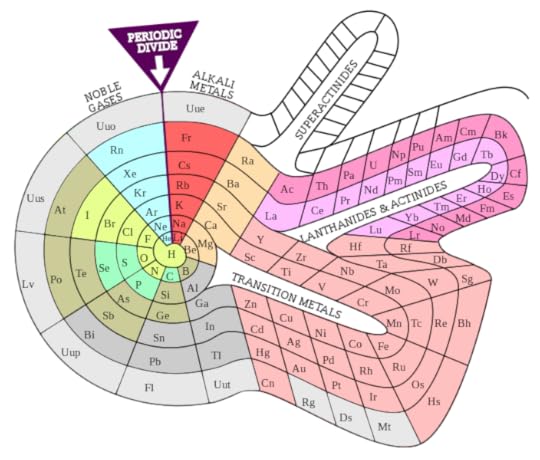
diagnosticians. (Actually, the picture is not accurate; the hospital employs not only human species). Here, all species are classified by a four-letter system, according to their natural habitat and physical characteristics. (Reminds me of the periodic table.)

periodic table

The department of diagnostics is very famous, and is a dream career step for ambitious medics. But only the most bright and mentally strong ones can eventually make it to this department. No, there is no sociopath, drug addict House leading this deparment. Diagnosicians carry multiple Educator tapes (memories) to facilitate treatment of patients of the respective species. But the tapes cause funny personality issues and turn their host into a sociopath.

Most of the books in the Sector General series is a collection of interrelated novellas in the spirit of “House, MD” episodes. Each story evolves around a mysterious medical condition that the medics and diagnosticians have to diagnose under time pressure, and come up with a proper treatment.

Everybody lies

And, of course, this book has awesome characters.

Major O'Mara

"Are you having a problem with Prilicla?" O'Mara asked.
"No! No," Conway said, startled into looking up at O'Mara briefly.
"That would be yes, then," O'Mara said drily.



foreman

Earth-ling, male, the mysterious administrator of this giant hospital and, most importantly, head of the Psychology department. He observes mental health of the personnel to ensure that different species can work together. No one knows what he does in his spare time (and if he has any), and everyone fears to end up in his office, if only because of the famously inconvenient seats.

The first novelleta of this book gives a hint on how millitary officer O'Mara ended up in charge of this giant hospital.

Dr. Conway

house

Very intellegent, ambitious Earth-human, male. Like House character, he is addicted to medical mysteries. Not a drug abuser, he dislikes humans, but gets along with other species.

Dr. Prilicla

cameron mosquito


Don't worry, there is no interracial romance. Dr. Prilicla is similar in spirit to the character of Dr. Cameron due to his emphatic nature. He feels emotions of others, which is invaluable for the diagnostic deparment. But this and his fragile physical appearance create a lot of trouble for his well-being.

Dr. Thornnastor (aka Thorny)

chase manny


Thorny, native to Traltha planet, is not an average alien-looking-like-elephant. He is the gossip of the hospital, beloved by nurses. He is also in charge of Pathology section of the hospital and often assists the diagnostic department. Loves Earth humor, and despite his menacing weight, a well-tempered guy.


Nurse Naydrad

nurse caterpillar


Smart but cranky nurse of Kelgian species is incapable of lying, and does not fear to voice her opinions to the doctors. Often works with the diagnostics deparment and is one of the highly esteemed nurses of the hospital.

Murchison

murchison

Sexy nurse in the Pathology department, female Earth-ling. She is the right hand of Thorny, and often helps the diagnostics department. 
Profile Image for Stephan.
284 reviews7 followers
May 25, 2022
The Sector General series by James White is idea science fiction in the best possible way. Most of it is set in a giant space hospital, which provides home-like conditions for dozens of extremely different species all working together to cure diseases no man has cured before.

Hospital Station is the first novel of the series, and, to a certain degree, White is still finding his feet. The novel is composed of several short stories and novellas, and one can see the ideas developing over time. Especially the first story, while excellent in itself, is a bit different in tone, and the main protagonist seems to magically change not just into the supporting cast for the rest of the novel, but also changes his character quite a bit. Still, the book is griping, the ideas are excellent, and it has aged reasonably well - not in all aspects, but in most. I strongly recommend it (and it is available as part of a cheap e-book omnibus, Beginning Operations).

I'm docking one star because of the slight inconsistencies and the fact that the incredible diversity in this first volume includes just one woman (human or otherwise), and that very briefly. Both of these problems go away in future volumes...
Profile Image for Matt Shaw.
269 reviews9 followers
December 27, 2019
After years of being told I should read the Sector General tales, I dove in. The premise here is pretty brilliant: a vast, inter-species, galactic hospital as a venue for Babylon 5 meets MASH stories. The pace is brisk, the aliens (or "e-ts") cover a wide spectrum of non-humanoid types, and the nature of the stories is far more optimistic and life-affirming than military or about hostilities.

But there are problems and it hasn't aged too well in a couple of ways. Damn, this is chauvinistic; there's only one identified female character in this book and she's a nurse presented only for cheap sex appeal. All the male humans are of the old-school manly-men, arrogant, selfish, and career-men. NOBODY has a family here! Really....full-time residents on a station in inter-galactic space never marry, have children, date....or have time off? No one has leisure activities, hobbies, books, porn, or music? C'mon.

And to ice it, the real problem in HS is that, in a society overseen by the Monitor Corps (sort of a cross between Star Fleet and Stasi) we are shown a hospital ordered by strict protocols that NO ONE FOLLOWS. Doctors don't confer or explain what they're doing, marching orders are given without background briefing, superiors assume their charges are f*cking up so yell first and ask later. Everyone is a jerk to everyone else, and then they all laugh at the end because it all worked out.

Meh. Maybe this read fine in 1962, but now it's just retro pulp.
Profile Image for Little Timmy.
7,388 reviews61 followers
February 12, 2016
Very nice SiFi series. Interesting concept and good main characters. Recommended
Profile Image for LG (A Library Girl's Familiar Diversions).
1,263 reviews25 followers
October 24, 2017
Alien Emergencies was my introduction to the Sector General series. It contained books 6 through 8, so I could have opted to read Book 9 next but instead decided to go back to the beginning, Hospital Station. Although several of the stories do reference each other, Hospital Station is basically an anthology containing five short stories, so I'll be reviewing it as one.

All in all this was...okay. “Medic” and “Out-patient” were good, but the other stories all disappointed me a bit, for various reasons. I'm kind of glad that this wasn't my first experience with the Sector General series. I missed getting to see the full cast of characters I'd gotten to know in Alien Emergencies.

“Medic”

This story introduces O'Mara, the man who later becomes Sector General's Chief Psychologist. Sector General is still in the process of being built, and O'Mara is one of the people helping to put it together. Although he's well-educated in both psychology and electronics, he hasn't yet found an employer willing to look past his craggy face and tough build. Everyone figures that manual labor is all he's good for.

After a Hudlar couple is killed in an accident at the construction site, O'Mara is forced to take care of their baby until an investigation is completed and someone comes to take the baby away. Unfortunately O'Mara knows next to nothing about Hudlarian childcare, and his boss and coworkers, who blame him for the accident, aren't willing to provide much help.

It was kind of weird, considering how they all felt about him, that everyone was okay with O'Mara being solely in charge of a possibly traumatized infant. Yes, there were a few “if anything happens to that child” threats, but why not remove the possibility of anything happening to the baby by putting it in the care of someone people actually trusted?

Anyway, aside from that and some issues I had with the way a stuttering human character was handled, I thought this was one of the two best stories in the collection. I really enjoyed reading about O'Mara's efforts to provide the best Hudlarian childcare he could. All his information came from a book, he didn't have anywhere near the strength of an adult Hudlar, and the baby was too young to give him much feedback. Even so, he did pretty well.

“Sector General”

Sector General is now a functioning hospital. Here we have Dr. Conway's introduction, as well as the introduction of Educator tapes. Dr. Conway has to use an Educator tape for the first time in order to treat Telfi patients. The Telfi are a radiation-eating group-mind, and the Educator tape wreaks all kinds of havoc with Conway's thoughts. Unfortunately, his biases and assumptions about Monitors (space police officers, sort of) keep him from getting help until it's almost too late. This continues to be an issue after a ship crash lands into Sector General and a possibly confused and injured alien causes serious problems with the gravity all over the hospital.

I wonder if this was originally published as two stories? The part with the Educator tape and the part with the crash definitely worked nicely together, but they were distinct enough from each other to confuse me a little. I kept expecting the Telfi and/or the Educator tapes to come up again during the crash portion.

This story was a bit of a mess, to be honest. It felt like White was trying to say something complicated about pacifism and violence, but then it just sort of petered out. I also felt like White took the easy way out with the way he handled the details surrounding Conway's actions at the end.

Conway, a pacifist, was faced with a terrible decision. He tried to go for a middle ground option and ended up doing more than he'd intended. Instead of dealing with the repercussions of this decision, White scaled things back until it turned out that none of it was really all that bad after all. Except that it should have been, because no matter how things turned out in the end, at the time Conway thought he'd done something that went against everything he'd believed and had been taught. There should have been more emotional fallout.

I could sort of see what White was trying to say about Monitors and their work, but it felt like he just tossed a few things out there without properly trying to connect most of it. It was disappointing.

“Trouble with Emily”

In this story, Conway acts as an assistant and guide for a VUXG doctor (the letters refer to the series' being classification system – humans are DBDG). Dr. Arretapec has psi abilities (telepathy, telekinesis, a bit of precognition) and has for some reason chosen a seemingly healthy dinosaur as its patient.

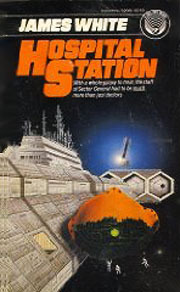
This was the story that inspired the book's cover art, which was actually pretty accurate. The dinosaur did indeed look like a brontosaurus with a spiky tail (one thing I didn't quite understand at first: although it looked similar to Earth's brontosaurus, it was actually a being from a completely different planet). Also, if you look closely you can see a little ball strapped to the man's shoulder. The man is Conway and the little ball is Dr. Arretapec.

Dinosaur lover that I am, I was looking forward to this one. Sadly, it wasn't quite as good as I had hoped. Watching Conway try to deal with Dr. Arretapec's condescending attitude was fun, but Dr. Arretapec's goal turned out to be a bit too big and lofty for my tastes. I also wondered about the ethics of it. On the one hand, the final goal was admirable. On the other hand, those were some pretty major changes Dr. Arretapec and its people were trying to bring about.

“Visitor at Large”

Dr. Conway gains a new assistant, the physically fragile and empathic Dr. Prilicla. Their tour of Sector General becomes more complicated when a young and frightened shapeshifting visitor runs loose through the hospital.

Dr. Prilicla is my favorite Sector General character, so I was really looking forward to this story. I enjoyed seeing Conway gradually adjust to his new assistant, who looked likely to get squashed at any minute but was actually very capable. Unfortunately, although Prilicla did get a chance to show off a little of what it could do, I felt that the character's appeal wasn't as apparent here as it was in the later stories I'd read. Its personality didn't really get a chance to shine.

As far as the visitor went, I had issues with the way that played out. It was during this story that I realized that White has a tendency to present problems with a psychological basis as something patients can get over just by really wanting to do so, or by having the proper motivation to do so. It came up in the first story, in the way O'Mara treated the stuttering human character, and it was the primary justification for Conway's incredibly cruel treatment of the young hospital visitor. It worked out in the end, but it made me very uncomfortable.

“Out-patient”

Conway is now a Senior Physician, which means he has a great deal more responsibility on his shoulders. In this story, he has to treat an unknown being rescued from a wrecked spaceship. He has to use clues from the wreck to try to figure out the being's atmospheric and gravity requirements, and the information doesn't make sense. The patient doesn't have long, either. Although it appears to be relatively uninjured, its whole body is gradually being covered by a tough malignant growth of some sort.

Like “Medic,” this was one of the better stories in the book. It was an intriguing medical mystery that tested Conway's trust in his own judgment and his willingness to make unpopular decisions.

I really enjoyed the medical mystery aspect of it, but I was a bit put off by Conway's behavior. He had only just become a Senior Physician, so his lack of willingness to talk to anyone seemed like an overreaction to his newly increased level of responsibility. I (and the characters) worried that he was so determined to prove himself that he'd accidentally kill his patient because he was afraid to ask for help. Just like in the previous story, it all worked out in the end. The only reason it worked for me this time around was because I felt that Conway had slightly better justifications for his actions here than he did in the previous story, but it still made for harrowing reading.

Additional Comments:

Just like in the Alien Emergencies omnibus, when O'Mara told Murchison that she couldn't use an Educator tape because female minds can't handle them, I was annoyed with the way female medical staff were written about in this book. For one thing, there was really only one confirmed female character, Murchison. For another, at the end of “Trouble with Emily” there was this exchange:

“O'Mara had paused then, shook his head wonderingly and went on, 'Not only do you get on exceptionally well with e-ts, but I don't hear a single whisper on the grapevine of you chasing the females of our species...'

'I don't have the time,' said Conway seriously. 'I doubt if I ever will.'

'Oh, well, misogyny is an allowable neurosis,' O'Mara had replied, then had gone on to discuss the new assistant.” (112)


This conversation made me raise my eyebrows for multiple reasons. Sector General is a place with extremely diverse patients and staff members - even unconscious biases could get a staff member transferred elsewhere. O'Mara is one of the primary people who'd be evaluating staff members and their ability to work well with others. And yet he thinks “misogyny is an allowable neurosis”? Also, Conway's statement didn't strike me as being particularly misogynistic. Unless that was supposed to be a bad joke?

This stuff seems to happen most often with O'Mara, so maybe it's just a part of his character. The problem is that, at least in what I've read so far, not one male character calls him out for it, or even thinks about doing so.

All right, there was one last thing I wanted to bring up: the editing. This book's editing was terrible, with typos and misused words everywhere. It became particularly noticeable in the second half. Dr. Mannon's relationship with his beloved dog was viewed by aliens as a possibly “symbolic relationship” (53) or “symbiotic reassuringly” (103) rather than as a “symbiotic relationship,” Conway “talkeed” (134), plus a few other embarrassing mistakes.

(Original review posted on A Library Girl's Familiar Diversions.)
Profile Image for birdbassador.
251 reviews13 followers
Read
July 8, 2025
i mean very slight but interesting in a way (kind of reminiscent of the first dune) the extent to which only the bare minimum technologies are present in order to afford the story (gotta have interstellar travel and universal translators and good plumbing if you want to have an alien hospital where the problems are about diagnostics and not logistics!), and the extent to which every aspect of the book from its various covers to its prose style to its characters screams "this is a 1960s sci fi novel" in a way that makes me even more smug about people who say they read sf/f for "escapism": sf/f is maybe the most beholden to the material conditions that produced it, because the author wants you to escape from something, and because you never actually can.
Profile Image for Gosia.
5 reviews10 followers
June 1, 2022
A fun read.

PS There is only one female character and she is, unsurprisingly, a human nurse. A sci-fi book 'Mars Chronicles' published about 30 years before this one has lots of them so it's not really about how old the book is.
Profile Image for Kam.
413 reviews37 followers
May 31, 2011
I have not been into medical fiction - not in a long, long, long time, at any rate. The first time I attempted to read medical fiction, I'd grabbed the first Robin Cook novel I laid eyes on, and after three chapters I gave up on it. It could simply have been that I picked the wrong book, or that I picked the wrong author, but it kind of turned me off of medical-related fiction for a good long while. To be fair, it might have just been because I was twelve or thirteen at the time, and hence really not all that appreciative of medical fiction in the first place - despite a (slowly-fading) desire to be a doctor at the time.

Recently, though, I discovered James White's Sector General series, mostly because I stumbled on the short story collection Hospital Station. I'd just gotten back into old-school sci-fi thanks to reading Ender's Game, so I was already on the lookout for relatively similar material, and also the idea behind the series intrigued me: a giant space hospital staffed by a wide (and I do mean wide) variety of doctors and other medical staff, who service an equally wide variety of patients.

Hospital Station isn't precisely a novel: in fact, it's a collection of five short stories set in the Sector General world, which White published in New Worlds magazine. It might seem odd to start a series with a collection of short stories, but I think there could be no better way to do it - or at least in the case of the Sector General series, White uses the short story form to great advantage to introduce his world to the reader without dumping too much information on the reader's head. There is so much to learn, after all, about how the world of Sector General works, that a novel that explains the whole thing might get bogged down in too many explanations. A handful of short stories offering insight into the inner workings of this new world seems a lot more comfortable to the reader than one whole novel.

And a fine, intriguing introduction it is. The sheer variety of doctors, patients, and corresponding habits and habitats is so wide and interesting that the reader just wants to keep on going, if only to find out what sort of "strange beastie" (to quote Major O'Mara, a crucial character in the series) will come through the hospital's space locks next, and how the doctors of Sector General will respond. Although the hospital's population of both doctors and patients covers a wide range of species, entirely new species will often come through the locks looking for medical help, and then the doctors have to go in blind, trying to figure out how to help a species they know nothing about.

Another hallmark of this book (and of the rest of the series, apparently) is the deep dedication to pacifism that many of the characters adhere to. Many real-life doctors are opposed to the idea of war on principle, but it's how Sector General seems willing to open its locks to absolutely anyone that really fascinates me. As I mentioned earlier, it doesn't matter to the doctors of Sector General what species the patient is; what matters more to them is saving the patient's life.

The main character for most of the stories except for "Medic" (which is headlined by O'Mara) is Dr. Conway, who is interesting for his ability to think quickly in many tight situations. My main problem with him, though, is that I think his leaps of logic are simply too large, and there are no proper explanations made for why he makes the conclusions that he arrives at. This could be a problem of the copy I'm reading, or it could be my lack of medical knowledge - though the latter really shouldn't be a problem, since most good sci-fi will explain things enough that the whole thing is comprehensible enough for someone who has even a basic understanding of the concept being used.

At this stage, my favorite character, hands-down, has to be O'Mara. He reminds me so much of Bones from Star Trek it makes me giggle sometimes. He's Chief Psychologist at Sector General, and is known for his blunt, abrasive, and supremely sarcastic manner when dealing with the people under his charge (meaning, the hospital's entire staff). He claims his primary job is "to shrink heads, not expand them," and the rest of the staff liken him to "a modern-day Torquemada" (or at least those races that have an equivalent for Torquemada do so), but I think that's hardly complimentary, given who Torquemada was and what his role was in the creation and implementation of the Inquisition. Then again, those likening him to Torquemada probably weren't being complimentary.

All in all, this is an incredibly promising intro to a new series. I'm about to start on the second book (and first novel), Star Surgeon, and already I'm looking forward to how Dr. Conway, Major O'Mara and the rest of the people at Sector General handle the cases headed their way. Hopefully the experience will be just as much fun as this first one.
Profile Image for Adi.
977 reviews
April 25, 2024
ER meets Star Wars. And it is indeed as good as it sounds. Such an amazing idea - a hospital somewhere in the universe, which is aiming to heal patients from known and unknown species. I was really impressed by the author's imagination and creativity, and I will definitely read more of his works.
Profile Image for Gibson.
690 reviews
August 14, 2018
Fratelli Galattici

Da giovane, White voleva studiare medicina. Ma la Vita non la pensava come lui. E allora, affaccendato in altre faccende, decide ugualmente di dare sfogo a questa sua aspirazione convogliando idee e concetti verso la parola scritta, partorendo racconti e romanzi, scegliendo l'Universo come unico limite e portando sulle pagine le sue idee pacifiste e scientifiche.

Qui, in Stazione Ospedale, siamo a tutti gli effetti spettatori di un contesto di vita ospedaliera sotto l'egida di una Federazione galattica.
I pazienti però non sono i soliti pazienti, alcuni di loro sono molto molto particolari, con forme e necessità completamente diverse dalle nostre — da quelle di noi terrestri, per capirci.

Arrivando da tutto lo spazio, queste creature mettono a dura prova le capacità dei Dottori preposti alla loro cura, dando vita a situazioni sfidanti e per forza di cose aperte al non conosciuto, all'accettazione della diversità come valore aggiunto, a quell'innata sensazione di fratellanza che chiunque dovrebbe portare nel cuore. Perché della Vita siamo tutti figli.

Nonostante l'autore ricorra spesso a termini scientifici, il romanzo arriva comunque al cuore e alla testa del lettore, e quasi sempre fa centro in modo intelligente; quella di White è una Fantascienza che punta più sul senso che sugli effetti speciali.

Mi ha divertito leggerlo, e se spenderete qualche ora tra le corsie di questo ospedale, alla mercé di razze tutte da scoprire, sono certo divertirà anche voi.
Profile Image for Emperador Spock.
153 reviews13 followers
November 22, 2013
This book (and the series) was suggested to me as an excellent example of pacifist soft science fiction. And indeed it is: pacifist and excellent. Though war kind of lingers in the background throughout the novel, and there are some flaws.

The stories in the novel present a very detailed view of the non-human species, which are actually quite distinct, and markedly non-human (so no 'humans with pointy ears or hairy faces or green tits' here) — the author invested a lot of imagination into this aspect of the novel, and it's probably its best quality. The details in the book largely resemble the descriptions of extraterrestrials in 'Memoirs of a Spacewoman' (although this novel is much softer sci-fi than Mitchison's work).

The age of 'Hospital Station' excuses its more technical fallacies, like using a syringe more than once for vaccination (until, and it says so explicitly, the needle becomes dull), or very poorly thought out Universal Translators, or the inclusion of the rather magicky telepathy and heightened empathy. While the last bit is still excusable due to age (the possibility of either shrinks like a pair of bollocks in the neuroscientific frost), James White relies so much on them in the last two stories (keyword: Prilicla) that it becomes tiresome.

In short, this novel makes me very excited about the rest of the series, I almost regret not giving it five stars.
Profile Image for James Hoff.
Author 1 book5 followers
March 16, 2016
2.5 stars for this classic. I really wanted to like this one, but it never really improved for me. I thought the aliens were fairly well realized, but then I found myself comparing to another great early creator of aliens, A.E. van Vogt. I found myself comparing both the writing style and aliens to van Vogt, particularly Voyage of the Space Beagle or War Against the Rull, and neither White's style or aliens compared favorably for me. I know this review isn't about van Vogt, but he the ability to get inside his aliens' heads and give you their unique perspective, something that is lacking here.

And I found myself irritated with the characters and their ethics at times. They frankly seemed questionable.

On the plus side, their was plenty of color and fun, and I liked the way the station was built around different environments to accommodate a wide variety of sapients. This made up for some of its shortcomings, but not enough.

Personally, I just found it disappointing.
235 reviews11 followers
November 18, 2011
This has some really fascinating ideas in it-- a hospital for many kinds of aliens (and their various gravity, atmosphere, etc. needs, to say nothing of the needs of the various medical personnel) would be fascinatingly complex. White does a good job of exploring physiological and, to some extent, cultural differences, but largely ignores gender. All of the major characters are male, and there's one insectoid supporting character who's an "it." There are a few female nurses, barely mentioned. Not surprising with a copyright date in the 1960s, but still frustrating. The writing quality is also a bit uneven-- there were a few points where some better editing was needed. A fun, quick read, but I'd be more interested in an updated take on the alien hospital.
Profile Image for Philipp.
701 reviews225 followers
March 30, 2017
A hospital in space, home to many species, often unknown or mysterious. Each chapter is one short story of a case, you could say it's House in space, but without drugs. In theme and content it's very similar to The Voyage of the Space Beagle, both deal with using knowledge and intelligence to solve an alien problem. Unlike Space Beagle this one just isn't as much fun: the solutions work because the reader is withhold information, and then pages on pages are spent to explain the solution, the characters are boring.
Profile Image for stormhawk.
1,384 reviews32 followers
January 23, 2020
The writing is a little uneven, but the overall concept, a space station hospital that treats a variety of life-forms, is solid and interestingly presented. Each chapter is a short story linked to the previous one, rather that a novel presenting a single plot. Each story starts with a problem and ends with a unique solution, often requiring major out of the box thinking by the main character.

2020.01.23 - still good.
Profile Image for Jamesboggie.
299 reviews21 followers
November 18, 2019
I read Hospital Station as a buddy read with my mother. James White’s childhood dreams of studying medicine were thwarted, so he decided to do the next best thing: write science fiction stories about xenomedicine. The result is a series of unique medical dramas set in a Star Trek like universe. These stories were fascinating, and I would give just about anything for a modern take on the concept.

Hospital Station is a fix-up of five short stories about the early days of Sector General. This format works, because each story focuses on a new case in the same setting. The first story follows O’Mara caring for a giant alien baby during the hospital’s construction, but the rest follow Dr. Conway. I would like to describe the cases, but discovery is a major element of the stories. The stories each center on a unique and mysterious case that the doctor has to figure out as he goes along, like House MD in space. I enjoyed watching a medical professional use his knowledge and experience to solve these enigmatic medical puzzles.

The book unfortunately only provides fleeting glimpses into the world outside Sector General, but those glimpses revealed a fantastic universe. Sector General is a prestigious (possibly the premiere) hospital in the Galactic Federation, able to treat all ailments of the 68 currently known forms of intelligent life in a sprawling 384 level space station. Those 68 species are not humans with different skin colors or forehead ridges either. Sector General must accommodate patients with wildly different atmospheres, temperatures, gravities, food sources, communication methods, and cultures. Seriously, the patients range from a giant hypochondriac space crocodile to a collective of psychic radiation eating beetles. An equally diverse medical staff responds to the myriad challenges presented with technology (like educator tapes and artificial gravity), utopian values (respect for life, pacifism, collaboration, respect and understanding for different lifeforms), and ingenuity. Another review called the Sector General series more Star Trek than Star Trek, and I have to agree. Hospital Station seems to embody the best parts of Roddenberry’s vision four years before TOS premiered.

As great as the concept is, the writing is somewhat dated. Thankfully, I think it avoided the worst aspects of 1960s sci fi; I did not notice overt racism or sexism, and only one clear example of homophobia. Still, it is obviously a product of its time. The writing is stiff. The characters tend toward the flat end of the spectrum. The action sometimes makes logical leaps in a way that seemed common back when most sci fi novels could not much exceed 200 pages. I’m also not sure how much Hospital Station reflects modern medical practice. Hospital Station is certainly an example of good 1960s sci fi writing, but it shows its age.

I definitely intend to continue reading the Sector General series. The concept is just too good. It really makes me want not just more modern takes on xenomedicine, but also just any profession like law or education. As great as space battles and dystopian futures can be, I have a soft spot for stories that use less violent, more mundane opportunities to explore the future. I welcome recommendations to that effect.

NAMED ALIEN RACES (most aliens mentioned are not named):
Hudlarian
Tralthan
Telfi
Chalder
Illensan
Creppelian octopoid
Nidian

CHARACTER LIST (abridged)
Displaying 1 - 30 of 196 reviews

Join the discussion

Can't find what you're looking for?

Get help and learn more about the design.