

What do you think?
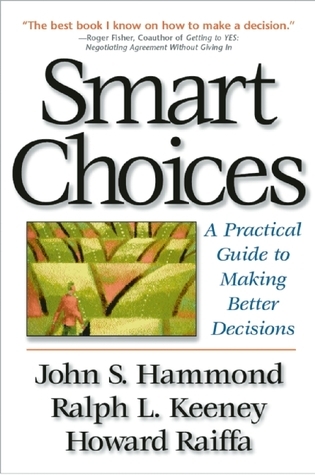
Smart Choices: A Practical Guide to Making Better Decisions
Making smart choices is a fundamental life skill, relevant to managers, doctors, lawyers, teachers, students, parents, young, old. Your decisions will shape and influence the course of your professional career and the quality of your personal life—the ability to make good decisions is a key factor in determining whether you achieve your goals. To help you increase your chances of finding satisfying solutions, Smart Choices blends the art and science of decision making into a straightforward, proven approach for making tough choices. Smart Choices doesn't tell you what to decide; it tells you how. Authors Hammond, Keeney, and Raiffa, among the world's best-known experts on resolving complex decision problems, blend the art and the science of decision making into accessible steps that lead you to consider your choices both intuitively and analytically. Here, for the first time, is a flexible system that can be applied to business decisions, to personal decisions, to family decisions—to any decision you make.
256 pages, Hardcover
First published September 1, 1998
Ratings & Reviews
Friends & Following
Create a free account to discover what your friends think of this book!
Community Reviews
Displaying 1 - 30 of 107 reviews
August 28, 2012
either
a.) cut out all the crap canned examples, stop saying the same thing over and over again, and republish this as a pamphlet, or
b.) amp up the math and the science, and get some real case studies in there.
a.) cut out all the crap canned examples, stop saying the same thing over and over again, and republish this as a pamphlet, or
b.) amp up the math and the science, and get some real case studies in there.

November 27, 2019
loved it! great for understanding the steps of decisional processes and decisional strategies.
it was very helpful for the clarification of a complex decision.
concise, effective, smart & fun to read.
very highly recommended
it was very helpful for the clarification of a complex decision.
concise, effective, smart & fun to read.
very highly recommended

August 30, 2017
I thought the model was sound and there were some good examples of application. However, there were instances where it got overly repetitive and some of the theories could have been better outlined and simpler to understand. I had to read the chapter on trade-offs twice before it sunk in.
I doubt most readers will be able to finish the book, because it does get rather dry. I also agree with another reader's assessment that there should have been better research and case studies to substantiate their thought process. Fifty pages less would have made it more compelling. I subscribe to the "Less is More" theory.
Just my 2cents.
I doubt most readers will be able to finish the book, because it does get rather dry. I also agree with another reader's assessment that there should have been better research and case studies to substantiate their thought process. Fifty pages less would have made it more compelling. I subscribe to the "Less is More" theory.
Just my 2cents.

April 15, 2018
Предлагаемый метод не выглядит жизненным для большинства людей. Мало кто способен выписывать древо вариантов даже в очень важных решениях.

July 6, 2021
I had high hopes for this book as a practical guide for good decisions from experts.
My expectations were partly disappointed, though maybe that's coming from a background of economics and some knowledge of formal decision theory.
The book essentially breaks down rational choice/decision theory into key components: the problem, objectives, choice alternatives, consequences. It adds uncertainty, risk attitudes and future interactions with other choices only at the end, even though for approximately all key life choices these aspects are significant and unavoidable.
Most of the advice here is basically various forms of: think carefully about the objectives, alternative choices and consequences. The main aids in the book besides common sense and whatever data one can find e.g on the web or from experts are the recommendation to do a consequences table (matrix of alternatives and consequences for key objectives of each alternative), and maybe attempting an expected utility/value calculation for important decisions. The authors explicitly reject as a bias any tendency to assign higher probabilities to negative events as a precaution, but the more recent decision theory literature suggests this could be a good practice to account for rational ambiguity or robustness. The most recent theories of rational choice suggest robust multiple priors models as maybe more rational than expected utility using a single probability distribution or Bayesian model combination.
The authors suggest the even swap method as a way of systematising comparisons of trade-offs across different objectives, but I didn't get a sense from their examples that this is something that systematically works across different situations. It seems like a half-measure somehow between trying to specify some sort of numeric utility/value function across different objectives which is the official recommendation of decision theory, versus just following your feelings/intuitions for integrating across conflicting objectives. I wasn't fully convinced that it's worth trying to apply this in actual decisions on a regular basis.
I suspect for non-experts, the presentation and ideas could be worth 4 stars for providing a more systematic approach to decision making. If you already know rational choice and expected utility theories, this book serves more as a simplified reminder of how to systematically structure your decision making process. Start with clarifying the problem and objectives, search for alternative choices, then evaluate consequences. When possible use some sort of table and even do a spreadsheet to help rank alternatives numerically. The level of informality in explaining things like expected utility/value calculations made the presentation seem less clear and compelling for me, as if you have to search for the main idea between the words. But again, maybe this is better for complete non-experts in decision theory.
The fact of the matter is that making good decisions for key life choices is hard. Assigning probabilities, picking a few good choice options/alternatives to evaluate, comparing the value of options explicitly across different objectives and tradeoffs, assessing consequences in a consistently comparable way are all difficult tasks. Yet most choices by most people most times seem OK/reasonable enough for contributing to an OK or even great life for most people (at least in advanced societies). It's just that we have to rely a lot on bounded rationality and mostly unconscious thinking and mental shortcuts/heuristics to simplify things (which sometimes causes big decision errors).
Some of the ideas in this book can robustify decisions and reinforce common sense while reducing the role of more unreliable intuitions and instincts when people are not experts in a specific type of decisions (for experts in a specific decision type, intuitions/instincts are much more likely to be valid). But a lot of the book seemed like just an admonition to think more carefully about all key components of a decision, which has some value but was less than I expected somehow.
And there's a tradeoff for most decisions in life that need to be made relatively fast and the opportunity cost of spending a long time on decisions as opposed to implementing decisions and enjoying life. Or long decision times may cause certain alternatives to disappear (e.g waiting too long to pick an apartment means some desirable apartments are already rented) This may limit the ability to be too systematic in applying the authors' recommendations beyond the basic review of a decision through their process (what they call a fir drill version of the decision). The authors themselves acknowledge this tradeoff, though I think they could emphasize it more as a reason for why people often use heuristics and other mental shortcuts like relying on intuitions.
I guess, the book does give an idea about 'state of the art' decision advice for non experts at the end of the 20th century, before the further evolution of IT and AI. From an early 21st century perspective, it's conceivable that maybe in 2030 we'll have easier access to more systematic decision support software/algos/systems that will implement more systematically a rational choice approach. But we're not there yet, so for now decisions are still somewhere between trusting intuition and doing an excel table of the consequences of various choice alternatives.
My expectations were partly disappointed, though maybe that's coming from a background of economics and some knowledge of formal decision theory.
The book essentially breaks down rational choice/decision theory into key components: the problem, objectives, choice alternatives, consequences. It adds uncertainty, risk attitudes and future interactions with other choices only at the end, even though for approximately all key life choices these aspects are significant and unavoidable.
Most of the advice here is basically various forms of: think carefully about the objectives, alternative choices and consequences. The main aids in the book besides common sense and whatever data one can find e.g on the web or from experts are the recommendation to do a consequences table (matrix of alternatives and consequences for key objectives of each alternative), and maybe attempting an expected utility/value calculation for important decisions. The authors explicitly reject as a bias any tendency to assign higher probabilities to negative events as a precaution, but the more recent decision theory literature suggests this could be a good practice to account for rational ambiguity or robustness. The most recent theories of rational choice suggest robust multiple priors models as maybe more rational than expected utility using a single probability distribution or Bayesian model combination.
The authors suggest the even swap method as a way of systematising comparisons of trade-offs across different objectives, but I didn't get a sense from their examples that this is something that systematically works across different situations. It seems like a half-measure somehow between trying to specify some sort of numeric utility/value function across different objectives which is the official recommendation of decision theory, versus just following your feelings/intuitions for integrating across conflicting objectives. I wasn't fully convinced that it's worth trying to apply this in actual decisions on a regular basis.
I suspect for non-experts, the presentation and ideas could be worth 4 stars for providing a more systematic approach to decision making. If you already know rational choice and expected utility theories, this book serves more as a simplified reminder of how to systematically structure your decision making process. Start with clarifying the problem and objectives, search for alternative choices, then evaluate consequences. When possible use some sort of table and even do a spreadsheet to help rank alternatives numerically. The level of informality in explaining things like expected utility/value calculations made the presentation seem less clear and compelling for me, as if you have to search for the main idea between the words. But again, maybe this is better for complete non-experts in decision theory.
The fact of the matter is that making good decisions for key life choices is hard. Assigning probabilities, picking a few good choice options/alternatives to evaluate, comparing the value of options explicitly across different objectives and tradeoffs, assessing consequences in a consistently comparable way are all difficult tasks. Yet most choices by most people most times seem OK/reasonable enough for contributing to an OK or even great life for most people (at least in advanced societies). It's just that we have to rely a lot on bounded rationality and mostly unconscious thinking and mental shortcuts/heuristics to simplify things (which sometimes causes big decision errors).
Some of the ideas in this book can robustify decisions and reinforce common sense while reducing the role of more unreliable intuitions and instincts when people are not experts in a specific type of decisions (for experts in a specific decision type, intuitions/instincts are much more likely to be valid). But a lot of the book seemed like just an admonition to think more carefully about all key components of a decision, which has some value but was less than I expected somehow.
And there's a tradeoff for most decisions in life that need to be made relatively fast and the opportunity cost of spending a long time on decisions as opposed to implementing decisions and enjoying life. Or long decision times may cause certain alternatives to disappear (e.g waiting too long to pick an apartment means some desirable apartments are already rented) This may limit the ability to be too systematic in applying the authors' recommendations beyond the basic review of a decision through their process (what they call a fir drill version of the decision). The authors themselves acknowledge this tradeoff, though I think they could emphasize it more as a reason for why people often use heuristics and other mental shortcuts like relying on intuitions.
I guess, the book does give an idea about 'state of the art' decision advice for non experts at the end of the 20th century, before the further evolution of IT and AI. From an early 21st century perspective, it's conceivable that maybe in 2030 we'll have easier access to more systematic decision support software/algos/systems that will implement more systematically a rational choice approach. But we're not there yet, so for now decisions are still somewhere between trusting intuition and doing an excel table of the consequences of various choice alternatives.
Read
December 2, 2021What this book is about?
Most people never stop to wonder:
How did I make this decision?
Why am I unable to take this decision?
How can I take such an unfavorable decision?
Should I listen to my heart or to my head?
What if I do this and things don’t work out?
Why was I so impulsive?
Why do I have so many regrets in my life?
Why is someone so much happier and successful?
This book gives the framework to take the best possible decisions in the quickest possible time. The authors gives a 5 step process that correspond the the flow of chapters of the book: PrOACT.
Pr - define the problem
O - Clarify Objectives
A - Create Alternatives
C - Describe Consequences for Each Alternative
T - Make Tradeoffs by:
Considering Uncertainties
Accounting for Risk Tolerance
Coordinating Current and Future Decisions
Avoiding Psychological Traps (Heuristics)
The Chapters are thus as below:
1. Making Smart Choices
2. Problem
3. Objectives
4. Alternatives
5. Consequences
6. Tradeoffs
7. Uncertainty
8. Risk Tolerance
9. Linked Decisions
10. Psychological Traps
11. The Wise Decision Maker
Despite books like this being in the market, even for free on the internet, people are still groping in the darkness of life trying in vain to get the best possible outcomes. However great outcomes such as success, wealth, peace come from decisions. This book explains to us that the many times we:
try to find right solutions of the wrong problems.
We actually don’t know what we really want out of a decision
We are not creative enough to explore options
We don’t weigh the advantage / disadvantages of each alternative. Because even the best option has a disadvantage and the worst option has an advantage.
We don’t extrapolate into possible scenarios of each options
We are not willing to make tradeoffs because we can’t have both the cake and eat it too
We have to accept that there is still much information we don’t know and can’t ever know until the outcome of any option
We don’t factor in the concept of probability in each option
We don’t realize every option has a risk of failure and we don’t know how much we can tolerate
We think one decision is enough. Instead every decision leads to other linked decision requiring equally rigorous algorithm to solve.
Finally we take decisions based on mental shortcuts called heuristics. Rising above them is a big thing and requires lots of deliberation because a bias of heuristics always flaws the above steps of PrOACT. Today there are many books on psychological traps of which Thinking, Fast and Slow, by Daniel Kahneman is the pioneer.
Finally after this book lots of book have been published on the neuroscience of decision making like How we decide , by Jonah Lehrer that taking decision is even harder that what is being discussed here and combining the concepts like PrOACT with knowledge of neuroscience will produce the best decisions.
How is it useful to you in your :
Life-
Life decisions:
To study or take a job?
I hate my job, what to do?
I am late to work, what to do?
Emotional decisions:
I feel so unhappy, what’s wrong with me?
I am always angry, what to do?
Mental decisions:
This issue is eating me up, what to do?
I overthink, why?
Spiritual decisions:
I feel like quitting everything and running away, why?
Who am I?
Using the framework, PrOACT, you can find the workable solution to these problems in the form of right decisions.
Business-
To invest in this project or not?
To sell out or continue?
Whom to retrench in order to save the company?
Whom to listen to? HR, marketing or finance?
Career-
To take the opportunity or not?
To complain about the office politics in the meeting or not?
How to meet my targets this quarter?
Most people never stop to wonder:
How did I make this decision?
Why am I unable to take this decision?
How can I take such an unfavorable decision?
Should I listen to my heart or to my head?
What if I do this and things don’t work out?
Why was I so impulsive?
Why do I have so many regrets in my life?
Why is someone so much happier and successful?
This book gives the framework to take the best possible decisions in the quickest possible time. The authors gives a 5 step process that correspond the the flow of chapters of the book: PrOACT.
Pr - define the problem
O - Clarify Objectives
A - Create Alternatives
C - Describe Consequences for Each Alternative
T - Make Tradeoffs by:
Considering Uncertainties
Accounting for Risk Tolerance
Coordinating Current and Future Decisions
Avoiding Psychological Traps (Heuristics)
The Chapters are thus as below:
1. Making Smart Choices
2. Problem
3. Objectives
4. Alternatives
5. Consequences
6. Tradeoffs
7. Uncertainty
8. Risk Tolerance
9. Linked Decisions
10. Psychological Traps
11. The Wise Decision Maker
Despite books like this being in the market, even for free on the internet, people are still groping in the darkness of life trying in vain to get the best possible outcomes. However great outcomes such as success, wealth, peace come from decisions. This book explains to us that the many times we:
try to find right solutions of the wrong problems.
We actually don’t know what we really want out of a decision
We are not creative enough to explore options
We don’t weigh the advantage / disadvantages of each alternative. Because even the best option has a disadvantage and the worst option has an advantage.
We don’t extrapolate into possible scenarios of each options
We are not willing to make tradeoffs because we can’t have both the cake and eat it too
We have to accept that there is still much information we don’t know and can’t ever know until the outcome of any option
We don’t factor in the concept of probability in each option
We don’t realize every option has a risk of failure and we don’t know how much we can tolerate
We think one decision is enough. Instead every decision leads to other linked decision requiring equally rigorous algorithm to solve.
Finally we take decisions based on mental shortcuts called heuristics. Rising above them is a big thing and requires lots of deliberation because a bias of heuristics always flaws the above steps of PrOACT. Today there are many books on psychological traps of which Thinking, Fast and Slow, by Daniel Kahneman is the pioneer.
Finally after this book lots of book have been published on the neuroscience of decision making like How we decide , by Jonah Lehrer that taking decision is even harder that what is being discussed here and combining the concepts like PrOACT with knowledge of neuroscience will produce the best decisions.
How is it useful to you in your :
Life-
Life decisions:
To study or take a job?
I hate my job, what to do?
I am late to work, what to do?
Emotional decisions:
I feel so unhappy, what’s wrong with me?
I am always angry, what to do?
Mental decisions:
This issue is eating me up, what to do?
I overthink, why?
Spiritual decisions:
I feel like quitting everything and running away, why?
Who am I?
Using the framework, PrOACT, you can find the workable solution to these problems in the form of right decisions.
Business-
To invest in this project or not?
To sell out or continue?
Whom to retrench in order to save the company?
Whom to listen to? HR, marketing or finance?
Career-
To take the opportunity or not?
To complain about the office politics in the meeting or not?
How to meet my targets this quarter?

February 4, 2014
The concepts were still not groundbreaking, but the various methods they proposed for making tradeoff decisions demonstrated a concrete way to deal with discrete factors in a decision. A lot of it still comes down to gut feeling, but by laying all of the data points out and making tradeoffs, it still feels good to have seemingly accounted for all of the known variables.
Phase 3: Stoic Completion. After the trade-off chapter I was back to the "just think really hard" style of answers and I had to force myself to finish it. I gulped it down like a handful of horse pill-sized vitamins.
Phase 4: Unconscious Application. So about a week after finishing the book, I found myself buying a car from a private party. I found myself analyzing my decision in terms of defining my real problem and stating my objectives before I rushed to solve what I felt was the immediate need. I found myself criticizing my limited efforts to collect data (is a Carfax report really necessary? Do I really need a mechanic to look at it?) I like to think that these were all common sense internal reminders, but the sheepish truth is that I WASN'T DOING MOST OF THEM. Bummer. I guess it is good I read it.
So while I do think this book had some value in the end, I can't bring myself to give it very many stars. Even if the content is useful, the delivery was somehow not compelling enough to make me start realizing the value of the information as I read it. It reminds me of the quote by Charlie 'Tremendous' Jones: “Five years from today, you will be the same person that you are today, except for the books you read and the people you meet.” I guess that this is one of the books I read, and in a small way, I am changed [for the better.]
Phase 3: Stoic Completion. After the trade-off chapter I was back to the "just think really hard" style of answers and I had to force myself to finish it. I gulped it down like a handful of horse pill-sized vitamins.
Phase 4: Unconscious Application. So about a week after finishing the book, I found myself buying a car from a private party. I found myself analyzing my decision in terms of defining my real problem and stating my objectives before I rushed to solve what I felt was the immediate need. I found myself criticizing my limited efforts to collect data (is a Carfax report really necessary? Do I really need a mechanic to look at it?) I like to think that these were all common sense internal reminders, but the sheepish truth is that I WASN'T DOING MOST OF THEM. Bummer. I guess it is good I read it.
So while I do think this book had some value in the end, I can't bring myself to give it very many stars. Even if the content is useful, the delivery was somehow not compelling enough to make me start realizing the value of the information as I read it. It reminds me of the quote by Charlie 'Tremendous' Jones: “Five years from today, you will be the same person that you are today, except for the books you read and the people you meet.” I guess that this is one of the books I read, and in a small way, I am changed [for the better.]

February 15, 2022
This Book is one of the best book one can get on improving Decisions. The Step By Step Process on How we should make a decision using the PROACT method to make a smart decision.
Pr- Defining the problem statement
O - Writing down our Objectives
A - Listing The Alternatives
C - The Consequences of Each Alternatives
T - The Trade-offs we are ready to Make
This Method would help in making Everyday small Decisions to Major Ones.
It's a must read.
Pr- Defining the problem statement
O - Writing down our Objectives
A - Listing The Alternatives
C - The Consequences of Each Alternatives
T - The Trade-offs we are ready to Make
This Method would help in making Everyday small Decisions to Major Ones.
It's a must read.

August 12, 2018
Although I only read part of this book, I found it very helpful when I was faced with some important life changing decisions. I wasn't sure which direction to go and this book helped me to approach the situation and make the right choices for myself, and feel like I made the right choice.

March 29, 2013
A must-read book on decision making and problem solving, which are two critical competencies in business life.

June 19, 2018
This book is most interesting in the world

October 21, 2018
This book is like a textbook, slightly hard to understand, one day i might come back to read these, to ensure i get grasp of everything!

Read
November 21, 2025read it for class so it’s counting towards the reading goal duh

September 18, 2025
Technically didn't read the whole thing but prof said I can be done🙌🙌🙌
January 12, 2017
Read this book on kindle..some books are just not to be read on kindle..you can't do justice on that platform. Another reason, a book like this needs to be more interactive..it discusses all the right things on decision making but post reading you never felt like going back to it..suggest making notes when u r reading this one..best read in hard copy

July 19, 2023
“What do you really want? What do you really need? What are your hopes? Your goals? Answering these questions honestly, clearly, and fully puts you on track to making the smart choice.”
Decision making is a skill. We are not born as great decision makers, we learn through our experiences. It’s hard to believe that such an essential skill that creates our lives is not taught as a separate subject at school. Decisions shape everything we do, from trivial ones like where we shop for groceries to buying a house or deciding on a job.
The book has three authors: John S. Hammond, Ralph L. Keeney, and Howard Raiffa. They based it on 50 years of research, combined with their experiences and common sense. Through this book they want to help us make important decisions. The ones that shape our lives the most are the ones that require more deliberate consideration.
It is a comprehensive guide on the process of making decisions, with use of a framework called ‘PrOACT’ - which stands for Problem, Objectives, Alternatives, Consequences and Tradeoffs. Each step is described by a separate chapter and we have to go through all the steps to make sure that we are not missing anything important. In addition to the PrOACT approach with the framework we explore topics of uncertainty, risk tolerance, how to deal with more complicated decisions, and our biases and psychological traps.
The framework was not just theoretical as throughout the book we explore real world applications of it. Among others we go through examples of buying a house, selling a company, or changing a job. What stayed with me as well as the PrOACT approach was the strong distinction between decisions and their outcomes - a bad outcome does not necessarily mean that the initial decision was bad. However, we tend to assume that bad outcomes result from bad decisions which is not always the case.
What I did not particularly like was its tendency to repeat itself. It could have been distilled to a shorter version. Thanks to its structure where each chapter is a step from the framework, looking at just the table of contents serves as a valuable reminder of how to approach decision making. Due to the fact that three different authors wrote it together, its style is an average of three voices, which makes it quite dry and lacking a personal touch.
I read this book thanks to a recommendation from The Rational Reminder Podcast, where Ralph Keeney was the guest in one of their episodes.
this-review@PoczwardowskiNotes
Decision making is a skill. We are not born as great decision makers, we learn through our experiences. It’s hard to believe that such an essential skill that creates our lives is not taught as a separate subject at school. Decisions shape everything we do, from trivial ones like where we shop for groceries to buying a house or deciding on a job.
The book has three authors: John S. Hammond, Ralph L. Keeney, and Howard Raiffa. They based it on 50 years of research, combined with their experiences and common sense. Through this book they want to help us make important decisions. The ones that shape our lives the most are the ones that require more deliberate consideration.
It is a comprehensive guide on the process of making decisions, with use of a framework called ‘PrOACT’ - which stands for Problem, Objectives, Alternatives, Consequences and Tradeoffs. Each step is described by a separate chapter and we have to go through all the steps to make sure that we are not missing anything important. In addition to the PrOACT approach with the framework we explore topics of uncertainty, risk tolerance, how to deal with more complicated decisions, and our biases and psychological traps.
The framework was not just theoretical as throughout the book we explore real world applications of it. Among others we go through examples of buying a house, selling a company, or changing a job. What stayed with me as well as the PrOACT approach was the strong distinction between decisions and their outcomes - a bad outcome does not necessarily mean that the initial decision was bad. However, we tend to assume that bad outcomes result from bad decisions which is not always the case.
What I did not particularly like was its tendency to repeat itself. It could have been distilled to a shorter version. Thanks to its structure where each chapter is a step from the framework, looking at just the table of contents serves as a valuable reminder of how to approach decision making. Due to the fact that three different authors wrote it together, its style is an average of three voices, which makes it quite dry and lacking a personal touch.
I read this book thanks to a recommendation from The Rational Reminder Podcast, where Ralph Keeney was the guest in one of their episodes.
this-review@PoczwardowskiNotes

March 9, 2020
As with any other good books, need to practice the tips suggested in this book as well. Any major decisions can be crystallized if you put it into writing and come up with solutions based on a PrOACT method described.
Pr-Problem, O-Objective, A-Alternatives, C-Consequences, T-TradeOffs and think off Uncertainties, and Risk Tolerance.
If we can make a mental map of Ranking each of these with a chance of outcomes for each consequence, we could come up with the Smart choice in the current context.
Pr-Problem, O-Objective, A-Alternatives, C-Consequences, T-TradeOffs and think off Uncertainties, and Risk Tolerance.
If we can make a mental map of Ranking each of these with a chance of outcomes for each consequence, we could come up with the Smart choice in the current context.

June 21, 2017
Well, some might argue that the techniques provided in this book are basics and nothing phenomenal. But I disagree with them, since in most of the decision making process the techniques provided here are the fundamental things that we must do but we don't. And that leads everything haywire.
This is not like many books in genre, with "learning by examples" kind of thing. But this is actually a manual of steps that you can use to make smart choices. This is definitely a worthy investment.
This is not like many books in genre, with "learning by examples" kind of thing. But this is actually a manual of steps that you can use to make smart choices. This is definitely a worthy investment.

November 9, 2010
Good and logical process for making decisions. It focuses on generating the right question and then eliminating options. There are some examples in the book to help you understand the concepts and overall it works well in presenting its information.
The book did not contain any startling breakthroughs or quick fixes but it did present its methodology in an easy to understand process.
The book did not contain any startling breakthroughs or quick fixes but it did present its methodology in an easy to understand process.

July 27, 2010
The book seemed to be a lot of common sense. I found a few things that would be useful, but mostly nothing that I had not already heard/read/seen somewhere else.

March 19, 2015
I found this book at the right time. It is helpful for me in my decision making process.

June 28, 2016
If you are an analytical thinker who has trouble making decisions, read it, but be forewarned - very dry.

September 10, 2020
Great starting point to increase your decision-making skills!
"Smart Choices", cooperatively written by authors John S. Hammond, Ralph L. Keeney, and Howard Raiffa, is an excellent book that teaches readers the essential ways of making effective decisions in their personal and business lives. Each section of the book provides helpful information on the decision making process, ranging from choosing alternatives to the primary decision, to using flowcharts to help decide between more complex choices.
To my surprise, I found "Smart Choices" to be pleasantly easy to read and the steps so simple to follow. At first I expected a more academic and monotonous approach to the topic of decision-making from this book, since it is a Harvard Business Review Press publication. The books published under that publication company tend to be filled with business jargon that can only be understood by people already familiar with business-related areas of study. However, "Smart Choices" is the type of book that avoids the mentioned trend by reaching out to readers whom simply wish to seek out and improve their skills in decision-making.
The authors provide case studies featuring people, in both personal and business settings, that use various tactics to make their choices in their lives. The tactics used are then elaborated and described very well so that readers may use them in their own situations. The more complex case studies are explained with ease via a series of flowcharts called "Decision Trees", which I found to be very useful in understanding how to decide between difficult and confusing choices. Many other strategies are featured throughout the book which can be utilized easily in daily life.
Overall a great book for all who seek to improve themselves in how to make choices in life, whether the choices are big or small, significant or miniscule. Highly recommended!
"Smart Choices", cooperatively written by authors John S. Hammond, Ralph L. Keeney, and Howard Raiffa, is an excellent book that teaches readers the essential ways of making effective decisions in their personal and business lives. Each section of the book provides helpful information on the decision making process, ranging from choosing alternatives to the primary decision, to using flowcharts to help decide between more complex choices.
To my surprise, I found "Smart Choices" to be pleasantly easy to read and the steps so simple to follow. At first I expected a more academic and monotonous approach to the topic of decision-making from this book, since it is a Harvard Business Review Press publication. The books published under that publication company tend to be filled with business jargon that can only be understood by people already familiar with business-related areas of study. However, "Smart Choices" is the type of book that avoids the mentioned trend by reaching out to readers whom simply wish to seek out and improve their skills in decision-making.
The authors provide case studies featuring people, in both personal and business settings, that use various tactics to make their choices in their lives. The tactics used are then elaborated and described very well so that readers may use them in their own situations. The more complex case studies are explained with ease via a series of flowcharts called "Decision Trees", which I found to be very useful in understanding how to decide between difficult and confusing choices. Many other strategies are featured throughout the book which can be utilized easily in daily life.
Overall a great book for all who seek to improve themselves in how to make choices in life, whether the choices are big or small, significant or miniscule. Highly recommended!

August 11, 2020
Why read?
This book is used as course material and has a clear model called PROACT.
The PrOACT decision making model provides a systematic approach for making decisions. It consists of eight elements that will help you make better decisions when worked through systematically.
The PrOACT decision making model was developed by John S. Hammond, Ralph L. Keeney, and Howard Raiffa. They described how to make a decision using the PrOACT model in the book Smart Choices: A Practical Guide to Making Better Decisions.
The term PrOACT is an acronym of the five core elements of the decision model...
Problem
Objectives
Alternatives
Consequences
Tradeoffs
About the Author
John Hammond, Ph.D., is a renowned management consultant and a former professor at both Harvard and MIT. Also the coauthor of Strategic Market Planning, he lives in Lincoln, Massachusetts. Ralph Keeney, Ph.D., is the author of Value-Focused Thinking and runs a consulting practice in San Francisco, where he lives. He is also a professor at the University of Southern California. Howard Raiffa, Ph.D., now professor emeritus , has taught the art and science of decision making and negotiations in the Schools of Business, Public Policy, Law, and Medicine at Harvard University for almost five decades. He is widely recognized as one of the founders of the field of decision sciences. He lives in Belmont, Massachusetts.
This book is used as course material and has a clear model called PROACT.
The PrOACT decision making model provides a systematic approach for making decisions. It consists of eight elements that will help you make better decisions when worked through systematically.
The PrOACT decision making model was developed by John S. Hammond, Ralph L. Keeney, and Howard Raiffa. They described how to make a decision using the PrOACT model in the book Smart Choices: A Practical Guide to Making Better Decisions.
The term PrOACT is an acronym of the five core elements of the decision model...
Problem
Objectives
Alternatives
Consequences
Tradeoffs
About the Author
John Hammond, Ph.D., is a renowned management consultant and a former professor at both Harvard and MIT. Also the coauthor of Strategic Market Planning, he lives in Lincoln, Massachusetts. Ralph Keeney, Ph.D., is the author of Value-Focused Thinking and runs a consulting practice in San Francisco, where he lives. He is also a professor at the University of Southern California. Howard Raiffa, Ph.D., now professor emeritus , has taught the art and science of decision making and negotiations in the Schools of Business, Public Policy, Law, and Medicine at Harvard University for almost five decades. He is widely recognized as one of the founders of the field of decision sciences. He lives in Belmont, Massachusetts.

October 29, 2021
smart choices is a book written by authors from academic origination. John S. Hammond is a former professor at Harvard business school. He is a Decision-making consultant in the field of negotiation and corporate strategy. Ralph L. Keeney is a professor in Marshall School of business at the University of Southern California. A decision-making consultant and a member of the National Academy of Engineering. Howard raffia is a professor emeritus at Harvard business school . He is a pioneer in developing decision and negotiating analysis.
We can see from the author’s background this book is mainly for high-level education people as it is concentrated on decision making. As a reader and upon completing the book, you will realize various things. The book, in its simplicity not only in the language written but also in the content examples and explanations is targeted to any type of reader regardless his/her educational background. High school student, university student, new graduates, Architects, engineers, planners, marketers, salespeople and even people with limited education can benefit from the content of this book. In many areas, it comprises high-level knowledge simplified for the readers.
for full review:
https://husamtalib.com/smart-choicesa...
We can see from the author’s background this book is mainly for high-level education people as it is concentrated on decision making. As a reader and upon completing the book, you will realize various things. The book, in its simplicity not only in the language written but also in the content examples and explanations is targeted to any type of reader regardless his/her educational background. High school student, university student, new graduates, Architects, engineers, planners, marketers, salespeople and even people with limited education can benefit from the content of this book. In many areas, it comprises high-level knowledge simplified for the readers.
for full review:
https://husamtalib.com/smart-choicesa...

February 6, 2018
This text was required reading for a course titled "Decision Tools and Project Planning" in my Public Policy graduate studies program. It has many interesting points, and the author illustrated their techniques with storylines. I found it a fairly easy read, but some chapters were a bit daunting and difficult to understand, especially related to drawing out problems and the needed elements for making "smart choices". Without the illustrative narratives, it would have been challenging to understand their recommended actions. Ideally, the information should be clear without a short story to accompany it, but this is also a difficult subject to tackle so I appreciate the effort and care given by the authors.

July 8, 2025
This could've been an email a brochure, an infographic. I don't feel like I've learned enough from made up examples that were there to illustrate the approach but didn't serve as any indication of the practice's success rate. A lot of good ideas still, though not unique if you've read similar professional literature before. It does get more interesting and insightful in the last third when it talks more about linked decisions and psychological traps and biases we have when making a decision. Might be a good read if you want to use it as a checkbox list, but there is probably a good article/summary somewhere already doing exactly that.
April 4, 2026
An interesting read and useful for anyone wanting to improve their decision-making skills. I particularly like the way they make risk preference tangible and a legitimate part of the process. It is a very logical approach however and I thought paid insufficient attention to the behavioural side of decision making. In many situations, people make decisions based on emotion and then use logic to justify. I would have preferred if they made the emotional aspects more explicit, but then again, there are probably other texts that better deal with this. Maybe just use this to get a mechanistic view of decision making.

January 2, 2019
لحد الفصل الثالث فالكتاب لطيف
بعده يبدأ بالإعادة والتكرار وحشر القصص المملة
عموماً هكذا كتب لا يُطمع منها سوى بالخروج بفكرة أو اثنتين لذا فالسقف ليس عالياً أساساً
8 خطوات رئيسية لاتخاذ القرارت الصائبة
1- تحديد المشكلة
2- وضع الأهداف
3- إيجاد البدائل
4- تحمّل التبعات
5- المفاضلات
6- عدم اليقين
7- تقبّل المخاطرة
8- القرارات المتصلة
أجمل الفصول هو الفصل المعني بالمصائد النفسية لاتخاذ القرار
كتاب لطيف ومفيد
بعده يبدأ بالإعادة والتكرار وحشر القصص المملة
عموماً هكذا كتب لا يُطمع منها سوى بالخروج بفكرة أو اثنتين لذا فالسقف ليس عالياً أساساً
8 خطوات رئيسية لاتخاذ القرارت الصائبة
1- تحديد المشكلة
2- وضع الأهداف
3- إيجاد البدائل
4- تحمّل التبعات
5- المفاضلات
6- عدم اليقين
7- تقبّل المخاطرة
8- القرارات المتصلة
أجمل الفصول هو الفصل المعني بالمصائد النفسية لاتخاذ القرار
كتاب لطيف ومفيد

April 29, 2019
Found this book on my younger sister’s (limited) bookshelf, clearly high school-assigned. Although a bit dry at times, Smart Choices offers numerous practical guidelines and exercises to help make important decisions wisely. Not one to simply read and absorb (unless you have a photographic memory), you’ll need to take the time to analyze your own decisions in order to reap the benefits of this material.
Displaying 1 - 30 of 107 reviews