Jump to ratings and reviews
Rate this book

Crisis and Leviathan: Critical Episodes in the Growth of American Government

Rate this book
Few topics are as timely as the growth of government. To understand why government has grown, Robert Higgs asserts, one must understand how it has grown. This book offers a coherent, multi-causal explanation, guided by a novel analytical framework firmly grounded in historical evidence.
More than a study of trends in governmental spending, taxation, and employment, Crisis and Leviathan is a thorough analysis of the actual occasions when and the specific means by which Big Government developed in the United States. Naming names and highlighting the actions of significant
individuals, Higgs examines how twentieth-century national emergencies--mainly wars, depressions, and labor disturbances--have prompted federal officials to take over previously private rights and activities. When the crises passed, a residue of new governmental powers remained. Even more
significantly, each great crisis and the subsequent governmental measures have gone hand in hand with reinforcing shifts in public beliefs and attitudes toward the government's proper role in American life.
Integrating the contributions of scholars in diverse disciplines, including history, law, political philosophy, and the social sciences, Crisis and Leviathan makes compelling reading for all those who seek to understand the transformation of America's political economy over the past century.

350 pages, Paperback

First published November 1, 2012

87 people are currently reading
1469 people want to read

About the author

Robert Higgs

63 books70 followers
Robert Higgs is an American economic historian and economist combining material from Public Choice, the New Institutional economics, and the Austrian school of economics; and a libertarian anarchist in political and legal theory and public policy. His writings in economics and economic history have most often focused on the causes, means, and effects of government power and growth.

Ratings & Reviews

What do you think?
Rate this book

Friends & Following

Create a free account to discover what your friends think of this book!

Community Reviews

5 stars
157 (50%)
4 stars
108 (34%)
3 stars
40 (12%)
2 stars
6 (1%)
1 star
2 (<1%)
Displaying 1 - 29 of 29 reviews
Profile Image for Jerry.
Author 10 books27 followers
June 23, 2020
If I had read this book a few months ago, I would have considered it an example of seventies conservative pessimism, slightly modified to discount the Reagan revolution. The author doesn’t yet have the hindsight that we do to recognize that the long march toward full federal control of wages and ostensible prices, and the resulting depressions, stagflation, gas lines, whatever, was gone with Reagan. A technique that had been embraced by Democrats and Republicans, in war and out of war, all the way up to Nixon and Carter, hasn’t been resorted to since.

The author also misses opportunities for greater insight, such as when he has to make the caveat that the black market that invariably erupts under government controlled economies does not make the overall system a capitalist one. This is superficially true, but it assumes that capitalism is a system that can be chosen, rather than the laws under which all economies work. It’s a little like saying that just because airplanes occasionally fall from the sky does not mean that we are living in a gravity-based system. Which is true only given the assumptions; it is in forgetting that we are bound by the laws of gravity that results in building vehicles, bridges, and other things that end up falling disastrously.

But while the analysis is sometimes lacking (and I should point out that the author’s new introduction to this 2012 edition is a good summary of the book’s faults), it is a fascinating historical summary of several crises and our response to them, and how those responses shaped our modern economy.

It’s a story of elected officials wanting to intervene in what they think are market failures, while at the same time doing their best to hide the inconvenient costs of the intervention. While government intervention is often said to be necessary to keep businesses from offloading external costs, government itself is even more prone to ignoring inconvenient costs.

Often, as in, for example, forcing nursing homes to accept COVID-19 patients in our own current crisis, those inconvenient costs are very difficult to hide. In the Great Depression, for example, people were going hungry and food prices were falling. It sounds more like a solution than a problem, as if some invisible hand were working to feed the poor and hungry. But that wasn’t the way FDR’s administration saw it, nor the businessmen he worked with, nor the farmers petitioning congress for help.


At the time, many people—including virtually all businessmen and farmers—had cause and effect reversed. Not recognizing that prices had fallen because of the depression, they believed instead that depression prevailed because prices had fallen. The obvious remedy: raise prices… Hence arose the anomalous but widely supported policy proposal to cure the depression… by cutting back on production… The scheme is so patently self-defeating that one has difficulty nowadays in accepting that anyone seriously entertained it as a general theory of recovery. (Maybe no one did; maybe it was only an apology mouthed by each interested party seeking higher prices for his own product.)


Perhaps the millions who could hardly feed and clothe their families should be forgiven for questioning the nobility of a program designed to make food and fiber more expensive.


The story is also one of big companies realizing that big government hamstrings their smaller competition. Throughout the book the form that the interventions take is to lay on burdens more easily borne by larger businesses than small ones—something that has continued to be true since this book was written and is especially obvious today.

In describing this, the author falls prey to a common failing of scientists, which is to take a word that everyone knows, provide a definition for it that differs considerably from the common definition, and then apply it in a way that colors the thing being described with the old definition while hiding behind the new definition. Economists seem especially prone to this, as when they define recessions without regard to causes, or austerity without regard to behavior.

In this case, he quotes Charlotte Twight’s watered-down economic definition of fascism (a system that allows private property as long as it feels like it) to create a new, contradictory term, “participatory fascism”, to describe our current system. I don’t think this is necessary, and since the book’s stated aim was to be accessible to the layman, using a restrictive, non-obvious redefinition harms the book’s conclusions.

On the other hand, he does do a good job of defining “Big Government”, a term that gets thrown around a lot without any sense of a specific meaning. Without a definition, we might focus too much on when the government spends more to implement existing powers, and completely miss when the government takes on new powers while successfully hiding the costs of those powers.


“If the provisions of the Constitution be not upheld when they pinch as well as when they comfort, they may as well be abandoned.”—Home Building and Loan Association v. Blaisdell, Justice George Sutherland, dissenting

There are many other examples of the federal government taking on new powers that are well-explained. This book has the first understandable description of the populism of William Jennings Bryan, for example, and a summary of the constitutionality, as argued, of the income tax before the constitutional amendment allowing one. The implications of President Wilson’s takeover of the railroad industry are also interesting.

I would have preferred more analysis of Korematsu, when the Supreme Court (then comprised mostly of FDR appointees, approved FDR’s executive order “herding… some 110,000 innocent men, women, and children of Japanese descent—two-thirds of them U.S. citizens—into concentration camps.” The court found this “not wholly beyond the limits of the Constitution.”

It’s the most striking example of a crisis enabling an egregious increase in the power of government in the book, but it only gets about half of a page. While widely disparaged, it has never specifically been overturned; instead, like wage and price controls, it has simply fallen away as a viable option. But also like those measures, the ratchet—the logic behind the case, if not the case itself—still remains as something to be used in some future crisis.

This is a fascinating book; it is marred by some of the flaws of its time, especially the tendency of conservative/libertarians to attempt to assume the assumptions of the left (and the author is aware of this; he notes it in the new introduction). But as a history of the various ratchets that have increased the assumed powers of the government and reduced the liberties of individuals, it is well worth reading.
Profile Image for Joshua.
274 reviews58 followers
April 26, 2021
Of all of the books I have read on libertarian philosophy and economics, this is the one I can most easily recommend as we trudge through the COVID-19 pandemic. Higgs explores past crises and the government's response - identifying a "ratchet effect" whereby "temporary" emergency measures are transformed into permanent extensions of state authority. As ideology shifts during times of crisis (e.g., wars, recessions, etc.), people become more amenable to government actions that would previously be considered outrageous (e.g., peacetime conscription, economically illiterate wage and price controls, cronyist protectionism, etc.). Despite begin written in 1983, Higgs's book remains a timely warning against giving up freedom in times of emergency. The Constitution is not suspended during a crisis. In fact, because an opportunistic state uses times of crisis to allocate more power to itself, it is during these times that constitutional freedoms should be most vigorously and jealously defended.
Profile Image for Richard Daniel Baris.
Author 1 book4 followers
June 2, 2013
I have read many books that attempted to account for the growth of government in the United States, but Mr. Higgs, takes home the award. The latest revised edition is great as well, adding updated information. Amazing how the fundamentals never change. I will honestly tell whomever may endeavor to read this seminal work, that it will not be easy to digest, but Mr. Higgs speaks layman academic fluently, thus anyone can properly understand the "ratchet effect." I originally read the first edition years ago, but had to read the latest as well. I drew on him myself in my own work "Our Virtuous Republic" and future academics will never be able to ignore his thesis - or rather I should say, they can't if they wish to be taken seriously. One of my favorites by far, and probably will always be.
54 reviews
December 23, 2020
I skimmed/skipped the first few chapters, which describe the author’s framework for analyzing growth in govt., and I would’ve given that part of the book 1 star, but I’m excluding it from this rating, since I didn’t really read it. The rest of the book describes the history of the growth of the US federal government, and it is a pretty fascinating angle on American history. According to his Wikipedia page, the author is a self-described “libertarian anarchist”, and his views are pure - he is at least as critical of military-related interventions as economic ones (his deepest disdain is for the military drafts), and he is more critical of Nixon and Reagan (“represented the complete acceptance of the New Deal welfare state”) than any Democrat. But his purpose isn’t really to convince the reader that Big Government is bad, he seems to assume his audience already agrees with him. His history, once he gets into it, is very substantive, with very little fluff, and includes a lot of ground that’s often overlooked. The author has plenty of interesting insights - to give one example, comparing Grover Cleveland (who once vetoed a bill that would send a “trifling” amount of aid to destitute farmers in Texas suffering from a drought, believing it was not the role of the federal government) to Herbert Hoover (who oversaw/lobbied for a series of major bills to combat the Great Depression, including the Reconstruction Finance Corporation Act to create the RFC and Glass-Steagall to break up the banks).
Profile Image for Larry  Guthrie.
127 reviews1 follower
November 20, 2024
If you have an interest in how our government has become so entrenched in our economy and eroded our private rights, this is your book. It is eye opening to see how they've done it and how so many went along.
Profile Image for Todd.
420 reviews
December 19, 2020
In some ways, Higgs' work reads almost like a book review, but of an excellent reading list, not just one book. His basic premise is that the expansion of government, not just in degree, but in its basic legitimate level of intrusion into personal and economic life, was caused by three prongs. The first is ideology and ideological change, the second by historical events (path-dependency), and the third by a ratchet effect, whereby expansions in response to crises don't ever come back down to the pre-crisis level.
Higgs explains that "Ideologies--telling their adherents what was going on, whether it was good or bad, what ought to be done about it, and how one could maintain his identity by solidary action with like-minded comrades--helped to determine the amount and kind of political action." (p 259) Higgs points out that there are only a small number of relevant ideologies in play among the general public at any one time, and that there are a small number of people who form the core of determining what that ideology says and how it is promoted generally. By ruling in (or out) the permissible range of actions, largely through the assumptions inherent to the respective ideologies (and the mass of adherents generally don't reflect often or deeply, if at all, on those assumptions), the prevailing ideologies narrow the scope of realistic action when crisis happens (or is manufactured).
Enter the path dependency, the fact that "important 'accidents' do happen," and "whatever happens alters the likelihoods of particular further developments." (p 259) Therefore, "the development of Big Government was a matter not of logic, however complicated and multidimensional, but of history." (p 259) This leads to the outcome that "real political and socioeconomic dynamics are 'messier,' more open to exogenous influences or shocks and less determinate in their outcomes than the theorists suppose." (p 259) This almost makes Higgs sound like he is taking an anti-theoretical approach, though, of course, he has a theory with three prongs.
The third prong being what he describes as a ratchet effect, the fact that "Once undertaken, governmental programs are hard to terminate...each time the government expands its effective authority over economic decision-making, it sets in motion a variety of economic, institutional, and ideological adjustments whose common denominator is a diminished resistance to Big Government." (p 261)
Probably the single most important historical "accident" or event to act as a lever to magnify the ratchets when utilized in the hands of those holding the properly-inclined ideology was World War I and the institution of the draft. Once citizens (and courts) accepted the premise that their government could dispense with the lives of the citizens, all other sacrifices paled in comparison. Therefore there was no end to the intrusion of legitimate government intrusion into personal and economic space during crises like the Great Depression or later wars. Invariably, the maximum crisis powers and authorities would be scaled back at some point, but often agencies were renamed or subsumed into others, while continuing to function at some level and in a way novel to the status quo ante. Likewise, reinstituting emergency powers, etc., became much easier with precedents to point toward.
Higgs reveals in the preface to this anniversary edition that when he wrote the original, he believed in limited government, but now he is a convert to Anarchism. I applaud his belief in limited government and understand his disenchantment with the apparent inability of it to remain limited (for all the reasons the Founders foresaw and along the lines of other once-Liberal systems ossifying into more authoritarian molds, such as Holland). But as always, most Anarchists take an assumption of the human animal as solitary vice social (and are probably mirror-imaging when they do, failing to realize what an exception many of them are from the mainstream). In other words, in the history of the human race since the first adoption of settled agriculture, when or where can one point to a true "system" of Anarchy in place over a significant number of people for any real length of time? Even those places without recognized "government" have government, that is, the use or threat of violence and coercion considered legitimate by enough of the group to make it effective over most of the group most of the time.
Higgs presaged his own disenchantment in the original work, joining Joseph Schumpeter and a very small handful of other Liberal thinkers who were not overly sanguine about Liberalism's prospects, with the realization that it most likely was self-annihilating (I use the term "Liberal" and "Liberalism" according to their original meaning, as in "Liberty," and not in the more contemporary American usage of anti-Liberal "liberal" Progressivism). In his own words:

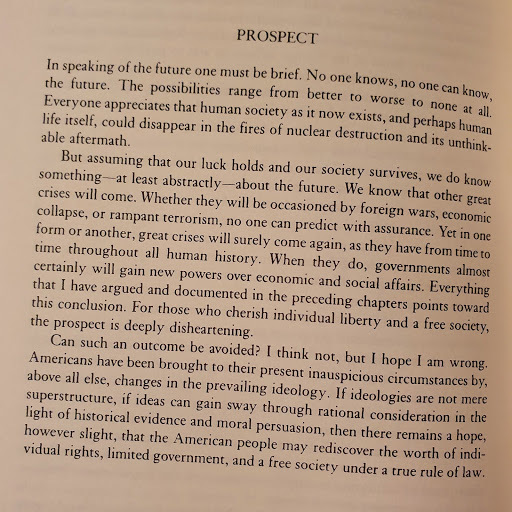
In one form or another, great crises will surely come again, as they have from time to time throughout all human history. When they do, governments almost certainly will gain new powers over economic and social affairs. Everything that I have argued and documented in the preceding chapters points toward this conclusion. For those who cherish individual liberty and a free society, the prospect is deeply disheartening. (p 262)

Indeed, the intervening years have confirmed Higgs' dark forecast, as the U.S. system, along with most of the rest of the (formerly) Liberal world, have embraced ever more Statist solutions and become full-on participatory Fascist systems, as Higgs suggested (and cited Charlotte Twight in reaching this conclusion). So is this the unavoidable fate of all free societies? At some point, when the Statism reaches the point noted by Margaret Thatcher, where you run out of other people's money, it will incinerate itself as well, though it is more than likely that a strongman (or woman) will rise from such ashes than a principled advocate for individuals. Still, as Higgs held out hope:

if ideas can gain sway through rational consideration in the light of historical evidence and moral persuasion, then there remains a hope, however slight, that the American people may rediscover the worth of individual rights, limited government, and a free society under a true rule of law. (p 262)

Higgs asks the question why crises prior to World War I did not lead to the same dramatic ratchet effect as WWI and later crises, and answers it mainly by suggesting the the prevailing ideologies changed during the "Progressive Era" and this opened the door, then highlighted the draft as a monumental lever in pushing through so much else. I would have gone a slightly different way. Once the national-level of the federal system began to refer to national institutions as "federal" vice "U.S." or "national," this represented a peaceful coup d'etat and overturning of the Constitution. The Federal Bureau of Investigations (established 1908) was not at all federal. It did not enforce a combination of local, state, and national laws, nor was it staffed with a mixture of local, state, and national personnel, nor was it funded as some kind of multi-level hybrid, etc. It was quite simply the National Bureau of Investigations, but by naming it "Federal," those behind it deliberately deceived their fellow Americans into thinking this was nothing new. After all, we've always been a "federal" system, right? Just so pretty much every other agency with the word "federal" found in its name. Once the national-level Leviathan successfully encroached on state authority, the rest of the subsequent growth was much easier, if not necessarily determined.

Higgs' marshaling of evidence is impressive and he scrupulously cites his sources, as well as provides numerous appendices. His assault on the field of econometrics is even more comprehensive than that of Murray Rothbard and worth reviewing on its own. However, his frequent citations leave one with a nagging feeling that maybe the reader could have skipped this and gone to the more frequently-cited sources to get it first-hand. Nonetheless, Higgs packages it all up in a very readable and not too-drawn-out format and it is well worth reading. If one seeks to understand why government, society, and life in the United States is so different today than in the 1890s or before, Higgs' work makes an excellent starting point. It is also a good source for insight into economics and Liberalism generally. Perhaps its greatest asset is its Bibliography, as Higgs goes over some terrific sources, and not all of them are in agreement with his thesis. A very good read, though not a must-read.
Profile Image for Daniel Moss.
181 reviews9 followers
July 6, 2018
I don't want to spoil all the fun of reading this amazing work so I'll keep it simple.

Times of crises require (at least this is the general assumption) the government to assume additional power over the economy. During these times there is an ideological change that occurs in the public and private sectors. This ideological change is one of the main factors preventing the government from contracting back to it pre-crisis size.
Profile Image for Tom Fleming.
32 reviews
June 30, 2020
In this classic book, Higgs provides contributions to the understanding of why crises tend to result in the growth of government. His contributions include: bureaucratic interests alone cannot explain the effect and a change in the general ideology of the public plays a role; context matters to how the public and governments react to crises; and that no single popular preceding theory can fully explain the phenomenon.

In the second half of the book, he provides an insightful and detailed history of how the US government and people, through different presidential administrations spanning from Cleveland to Reagan, dealt with crises, as well as how their responses were similar or different.


It took me while to finish this book, not because it was particularly long (though the text was dense), but because the history’s tragic nature, going into great detail as to precisely how laissez-faire capitalism- a staple of American society- was discarded starting in WWI and never recovered, made it hard to get through.
Profile Image for Eric Chevlen.
181 reviews2 followers
June 17, 2021
The author wrote this paragraph in 1987:

“But assuming that our luck holds and our society survives, we do know something—at least abstractly—about the future. We know that other great crises will come. Whether they will be occasioned by foreign wars, economic collapse, or rampant terrorism, no one can predict with assurance. Yet in one form or another, great crises will surely come again, as they have from time to time throughout all human history. When they do, governments almost certainly will gain new powers over economic and social affairs. Everything that I have argued and documented in the preceding chapters points toward this conclusion. For those who cherish individual liberty and a free society, the prospect is deeply disheartening.”

Unfortunately, he was correct. Government has but two powers, to forbid and to compel. As government authority over our lives grows, our individual authority over our lives perforce shrinks. For details, see the book.
Profile Image for Jeff Russo.
323 reviews22 followers
February 8, 2021
Considering we're living through a "ratchet" expansion of government power right now, I figured this was a good time to read a classic on the topic. The first section, "Framework", is a little on the wonky side. The real meat is the history and analysis stuff that follows.

This was written in the mid 1980s, and sadly the last three paragraphs of the book predicted the future (seeing if I can attach a screen shot of that).


67 reviews3 followers
August 26, 2021
A decent and worthwhile examination of a few periods in American history that breaks down the sociological and political means of ratcheting our society in a one way direction. Unfortunately the author chose not to update the book to include the last few decades but he explains why. It's really all the same episode isn't it? Government either creates a crisis and takes advantage of it. Or they just take advantage of a non-imposed crisis. Either way, the cathedral gets more power and control. Definitely worth checking this book out.
Profile Image for Dio Mavroyannis.
169 reviews13 followers
July 3, 2020
This is a great little book that talks about the rise of the state, where at every point the left-wing encroaches more and more until the state becomes involved in more domains than anyone would have wanted a priori. It's exceedingly interesting, I just don't know WHO I would recommend this to exactly. It seems like this is a nail in the coffin kind of book, people would not be interested in learning about this without first being very skeptical of the state itself.
2 reviews
June 8, 2021
Well documented history of growth of US Federal Government

This was a bit more challenging for a casual reader than anticipated but provides ample supporting evidence regarding the mechanism of steadily growing government control and restrictions on personal liberty. Sobering to read but well worth the effort in learning about our society
Profile Image for Dave Benner.
71 reviews9 followers
November 3, 2018
Groundbreaking study in the growth of leviathan government during war and crisis.
Profile Image for Jim.
100 reviews1 follower
April 26, 2020
Very scholarly and thorough study of how a government can grow despite laws and a constitution. A definite explanation about how propel lusting power never let a good crisis go to waste.
Profile Image for Clay Grossman.
4 reviews1 follower
June 12, 2020
Very good and information. It's pretty academic at times, but overall a great book.
4 reviews
January 3, 2022
Excellent explanation of how the works has come to be

The book, when read after the year 2020, sheds light on how governments make policy decisions regarding potential crises .
Profile Image for Sherria.
6 reviews1 follower
November 16, 2022
It's very interesting how protest is able to move along cogs in politics
Profile Image for Kyle Macleod.
119 reviews1 follower
April 28, 2023
Ideological but never pretends to be otherwise. Gave me a new perspective on FDR.
Profile Image for Didier "Dirac Ghost" Gaulin.
102 reviews26 followers
August 17, 2022
A great text that showcase the inescapable link between government, finance, corporate cartels, the judiciary and academia, that of which occurs during moments of existential crisis such as wars and financial depressions. Higgs display the pernicious tendency of crisis-born institutions to find new life after the crises and the long term effect it has on the liberty of all citizens.
Profile Image for Liberté.
342 reviews
September 18, 2021
A staple of economic history, Higgs' exploration of ideology and emergency as the forces that created Big Government in the twentieth century deserves the accolades it has already received. Particularly for students unfamiliar with the growth of big government, the first section lays out a clear thesis of how ideology can make or break a political movement. The second half of the book builds upon that thesis with historical evidence, contrasting the ideology and emergency of the 1890s (and the lack of Big Government programs as we now know them) with the later crises of the two world wars and the Great Depression. While the book is somewhat dated now - it was published in 1987 and so misses the crises of the last decade - it is an illustrative starting point for those curious about how the U.S. federal government just got to be so big in the first place, from its spending to its scope.
Profile Image for Frank Stein.
1,094 reviews169 followers
December 14, 2010


The book demonstrates some of the dangers of economists doing history. The book is mainly a collection of fairly well-known events in American history, events that have been more extensively and more clearly described elsewhere, but with a libertarian spin.

A few of the stories here, such as the potential railroad strike that led to the nation's first 8 hour law (the Adamson Act in 1916), and the debate behind the Sixteenth Amendment (making an income tax constitutional) are fairly interesting, and I had not encountered them elsewhere. Other parts go into more detailed political economic history than is typical for such a broad text (such as the section on WWII), and that's worthwhile. But most of the book is take it or leave it.

Profile Image for Douglas.
57 reviews36 followers
May 7, 2008
Robert Higgs is a meticulous researcher and digger into data. What many suspect as true about the growth of government, he documents. It's a valuable resource to put in front of people who think we're as free as we've always been. It complicates the story of the growth of government somewhat by showing such growth is not simply based on modern Liberalism. Rather, it is Liberalism compounded with the universal tendency of all governments to increase their power by using crises. It allows us to generalize the addage, "War is the health of the state." to "Crises are the health of the state."
39 reviews4 followers
February 10, 2013
This is really an excellent book and the only reason I gave it only 3 stars is that it's so damn depressing - we can never roll back Leviathan, it seems, only watch it grow until it finally bankrupts the nation. I hope that's an unfair summary of the author's position, but since he comes up with no plan on a rollback I have to wait for a later edition.
Profile Image for Michael Connolly.
233 reviews43 followers
April 17, 2025
A libertarian perspective on U.S. history. During each war or domestic economic crisis, the size of the federal government increases. It does not decrease after the crisis has passed. Over time the size of the federal government keeps getting bigger and bigger.
Profile Image for Craig Bolton.
1,195 reviews86 followers
Read
September 23, 2010
Crisis and leviathan : critical episodes in the growth of American government by Robert Higgs (1987)
Profile Image for Brandon.
196 reviews49 followers
September 21, 2012
The same ol' shit's been going on for years and years.
Displaying 1 - 29 of 29 reviews

Can't find what you're looking for?

Get help and learn more about the design.