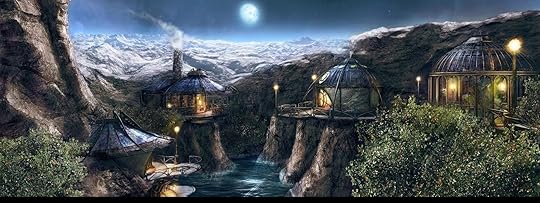
Based on the best-selling CD-ROM game, a fantasy novel fills out the lives of the game's characters, tracing the strange apprenticeship of Atrus to his father, Gehn, who wields the power to create worlds.
Rand Miller (born January 17, 1959 in Philadelphia, Pennsylvania, U.S.) co-founded Cyan (now Cyan Worlds) with brother Robyn Miller and became famous from the unexpected success of their computer game Myst, which remained the number one–selling game for the remainder of the 1990s. Rand also worked on the game's sequel, Riven, and later Myst III: Exile, Myst IV: Revelation, Myst V: End of Ages, realMyst, and Uru. The brothers also acted out parts in the game, with Robyn as Sirrus and Rand as Achenar and Atrus.
There’s a type of writing that opens the door to different worlds, you only need a special kind of paper, the right ingredients, and the perfect technique. The possibilities, infinite. Amazingly beautiful worlds, decadent and ruined ones, and even worlds that defy the impossible.
This is the story of Atrus, raised by his grandmother Anna, learning from childhood the ancient art and culture of the D’ni that enables travelling between worlds, his first encounter with Catherine, and the terrible battle against his unscrupulous father Ghen, who would stop at nothing to abuse his power.
I loved little Atrus investing and taking notes about every single thing around him, earth, minerals, animals; his insatiable quest for knowledge, and everything else that followed.
I have very fond memories of my childhood playing the Myst games, loved them all, specially #3 and #4. Visiting all those beautiful varied worlds, the lore, the plot, the near impossible puzzles. Gaming perfection, they don’t make them like that anymore.
This book was a great novelization, working as a prequel to Myst 1, with the background story of Atrus, Catherine and Ghen. Excellent. I don’t think you need to play the games beforehand to understand the books, but sure helps appreciating them a lot more. Recommendable, for the right audience.
----------------------------------------------- PERSONAL NOTE: [1995] [422p] [Fantasy] [Recommendable] -----------------------------------------------
Hay un tipo de escritura que abre las puertas a diferentes mundos, sólo necesitás un tipo especial de papel, los ingredientes correctos, y la técnica perfecta. Las posibilidades, infinitas. Mundos asombrosamente hermosos, otros decadentes y en ruinas, y hasta mundos que desafían lo imposible.
Esta es la historia de Atrus, criado por su abuela Anna, aprendiendo desde niño el antiguo arte y cultura de los D’ni que permite viajar entre mundos, su primer encuentro con Catherine, y la terrible batalla contra su padre inescrupuloso Ghen, que no se detiene en nada para abusar de su poder.
Amé el pequeño Atrus, investigando y tomando notas sobre cualquier cosa alrededor de él, tierra, minerales, animales; su insaciable búsqueda de conocimiento, y todo lo que después siguió.
Tengo muy preciados recuerdos de mi niñez jugando los juegos Myst, me encantaron todos, especialmente el #3 y #4. Visitando todos esos hermosos y variados mundos, el lore, la trama, los casi imposibles rompecabezas. Perfección gamer, ya no los hacen como antes.
Este libro fue una gran novelización, funcionando como precuela a Myst 1, con la historia detrás Atrus, Catherine y Ghen. Excelente. No creo haga falta jugar los juegos antes para entender los libros, pero seguro ayuda para apreciarlos mucho más. Recomendable, para la audiencia correcta.
----------------------------------------------- NOTA PERSONAL: [1995] [422p] [Fantasía] [Recomendable] -----------------------------------------------
3.5 stars, but I'm happy to round up for this obscure little book that's been mostly forgotten.
Readers and writers of sci-fi and fantasy will often mention "worldbuilding": the process of developing a world that is different from the one we live in. It's less common to see fictional characters grappling with those issues themselves, but that's exactly what this novel is about.
Atrus was raised by his grandmother, in an isolated dwelling in the desert. He spends his time studying the environment, growing food, and generally being content with life until the day his father, Gehn, arrives to claim him as an apprentice. Gehn is obsessed with reviving a practice known simply as the Art: the writing of magical books that form portals to other worlds. Atrus, however, has more questions than Gehn is willing to answer. Is the writer creating worlds, or simply creating bridges to worlds that already exist? And what responsibility does the writer owe to those who inhabit these worlds? Gehn uses his powers to play god, while Atrus uses his powers to try to repair the damage, causing the relationship between father and son to fray. In some ways it's the usual bildungsroman, but unique in the way that entire parallel worlds mature alongside our main character.
The reason I picked up this book is that it's based on the Myst videogame, which was one of my best-loved games as a kid. Part of what made the game so addictive was the worldbuilding: by solving puzzles, you discover portal books that transport you to worlds that are eerie, enchanting, and mostly empty of other humans. In that atmosphere of isolation, the slightest trace of any other character would make my heart pound. So, it was hard to resist a book about what those characters had been up to, but I was still skeptical about whether a book based on a videogame could possibly be any good.
I was pleasantly surprised. The writing, at first, seems a little too detailed in its descriptiveness, but it was easy enough to get used to and I think it's somewhat meta: when Atrus starts writing his own books, there are many discussions about how much detail a writer needs to use when crafting a stable, functioning world. I also think it's a trait inherited from the book's videogame predecessor; when playing a game, one is acutely aware of what's visible from each vantage point of an island, and how many steps it takes to get from point A to point B. And even though the book deals with the art of worldbuilding, there's science involved too - gravity, soil composition, and temperature all influence whether a world is habitable, and the story doesn't shy away from taking these technicalities into consideration.
Character-wise, the contrast between Atrus and Gehn highlights different modes of learning and creativity. Gehn is all about rote learning and collecting pieces from pre-existing works, whereas Atrus is more concerned with uncovering underlying principles and looking at a system as a whole. Finally, I really enjoyed the little twist on gender roles. Much of the book is about men engaged in manly activities of pioneering, engineering, and wrangling for power, while women play the role of caretakers, and are kept on the sidelines lest they get hurt. When we discover that these women are actually pioneers and engineers to at least the same extent as the men are, I pretty much clapped with glee. This is one of the few cases where I wouldn't mind reading a companion novel that covers the same timeframe but from a different point of view, because there's a lot going on that I would have liked to learn more about.
I love this book not only for the story behind it but for the splendid moral integrity of two of the characters. The book is essentially about Atrus--about what it means to grow up, to be a man, and to be a responsible and good person. One of my favorite passages (and quotes, really) is this poignant moment where Anna sends her grandson into the unknown with his unstable (and ultimately sociopathic) father:
"You must remember what you have learned here, Atrus. I have tried to teach you the mechanics of the earth and stars; the ways of science and the workings of nature. I have tried to teach you what is good and what is to be valued, truths which cannot be shaken or changed. This knowledge is from the Maker. Take it with you and weigh everything your father teaches you against it . . . I no longer know him, but I know you, Atrus. Measure your own deeds against the truths I have taught you. If you act for self-gain then no good can come of it. If you act selflessly, then you act well for all and you must not be afraid."
Atrus's upbringing is the perfect guide on How to Raise a Beautifully Well Adjusted Abandoned Granchild in the Middle of the Desert with No Friends and No Money. Anna is my hero. And one of the reasons I love the whole premise behind "Myst" is the idea that the fantasy bit--the books that link to different worlds--are created through thoughtful analysis and an understanding of nature. How many books (fantasy or otherwise) are there that focus on geologists, after all?
Honestly, I think this is one of the most underrated science fiction books out there. The computer game that inspired the books was hugely successful, but the books never really caught on despite the deep characters and fascinating world. I go back to this book when I want to feel inspired by a world of limitless creativity and possibility.
Once again I find myself drawn to the series of Myst. Its lore, its wonder and the shear, mind bending thought of how someone thought of this in the first place. The book opens in the sandy deserts and the life of a young Atrus, still a boy and far from the happenings of the first Myst game. After a loving, peaceful life in the desert presided over by his grandmother, Anna, a strange figure appears at their quiet desert home. A tall, pale man who claims to be Atrus's father, Gehn. After 14 years, he has come to take Atrus to the fabled city of his heritage,D'ni. After Atrus's first impression of his father he decides to descend into the earth with this man, leaving all hes known behind. Once in the great city all Atrus knows is replaced with the lost culture. The language, the alphabet even the day cycle. It is then that his father reveals the real purpose of bringing him here. He is to learn the Art of Writing, a powerful and incredible art of writing worlds(known as Ages) into existence! Amazed by this science, Atrus begins to learn his father's ways, "to become gods" as he says. But its all to soon the Atrus realizes that What his father knows is a corrupt and evil shadow of what the art is. Instead of writhing Ages that he envisions, he takes phrases he likes from ancient D'ni text and tacks them together, creating worlds that are unstable and doomed to destruction. The "Mad God" Gehn, is not what Atrus wanted him to be. So with the help of a girl named Cathrine, a local of one of Gehn's Ages, he plots to trap Gehn and rid the world of his disregard for what the Art stands for.
Atrus, weather he knows it at the time or not, gets puled into a man vs. man conflict, centering on his problems with his father. While Gehn wants Atrus to rule by him as a god and rebuild the D'ni empire as an empire of 1,000 slave worlds, he is unsure of how it goes against what his grandmother had taught him. While he tries to understand his father and learn what he teaches, what he teaches is evil and soulless. When Atrus comes to the realization that bis father's knowledge is corrupt he attempts to fix what he has done, only to find that he was being used all along, a tool to save Gehn time. With Atrus's struggle comes the importance of his observations, and the way the Miller writes the scenes is spot on. You imagine it just as he draws it every few pages. His vision instilled on the whiteness of the page as if it were the window in a Linking Book. As with the other books in the series the point of view changes can be confusing at points, but overall it is an flawless crafted series. I completely recommend it to anyone who wants to swim among the stars or be lord of a thousand worlds.
I read this book as a kid and I barely remember the gist of the story. I'm glad I re-read it, because the story is great. The antagonist is delightfully bad and well crafted. Wonderful read. I will be reading the other books in the series soon.
I am a HUGE fan of the Myst video game series, and being such, I decided to delve into the novels for the first time this year. Book of Atrus is the first of (currently) three books out giving some background and insight into the world of Myst, specifically Atrus' childhood and early adult life.
As a stand alone story, this does well! Characters are well developed and there is a full story within this one book that has a lovely finish. You could easily pick this up one day at a bookstore without knowing a thing about Myst and be just fine reading it (and enjoying it as well).
As someone who adores the Myst series this helps us see a piece of Atrus and his life we had not seen before. This book helps piece together his past that we all had questions about when playing through the games. If you are a fan of Myst I would recommend reading this just to get the FULL history of events past.
All in all, a lovely book as a stand alone OR as it was intended: for the Myst series! I can't wait to read the next one!
What sparks an interest in a book? It’s different for everyone. I love it when a story that begins one way morphs into something completely different and unexpected. This is not to say I like a story that’s unbelievable or has leaps in logic. No, I’m talking about characters who do something that make your eyes pop out of your head or the author that takes a hard right turn and destroys all your expectations, but in a good way.
Myst: The Book of Atrus is one of those books. For me at least. It is admittedly a tie-in to a one time juggernaut video game series that redefined PC gaming in the 1990s. We’re talking huge. But I never played a single minute of the game.
So, I knew nothing about this book coming in. I thought it was a simple story of survival, growing up in a harsh environment where our young Atrus, from our book’s title, is going to have to face Darwin’s theory of evolution in an unforgiving desert where only the strong survive.
The book goes way beyond this, and creates a coming of age story that tests Atrus’s strength of character. We see critical decisions he makes that will shape the kind of man he will become and also shape the destiny of worlds.
One let down was that none of the worlds he visits that he has the power to actually shape are especially amazing. I call them Class M planets like on Star Trek. The kind that you can breathe on, with blue skies, green rolling hills. Nothing, like, wow.
But the narrative makes up for it with one really cool planet. We’re talking waterfall goes through the planet and shoots out on the other side in a huge jet stream right into outerspace. Totally cool and better than any flying islands.
The story is a small epic, yes, a small epic. It’s self contained with a likeable lead character who we see put in extreme situations and he keeps a level head. There are some tantalizing details that don’t go anywhere and I’m still left wondering what exactly is the extent of the power he wields. But the book’s veil of mystery here is actually what this universe is based on, so not all the questions could be answered through this one character.
One of the book’s achievements are the conflicted characters that stand at the center of the story. They’re real. We could be any of these characters; conflicted, flawed, courageous, selfless. One character in particular is a tragic figure who can see his destiny right in front of him, yet he cannot reach it and he lashes out, creating chaos that has implications for countless worlds. The characters each have their fates in their own hands - it’s a question of what they will choose to do.
Myst: The Book of Atrus is a hugely entertaining read, quick and easy and teases the imagination with what life holds if you just step out the door for a little adventure. 4 out of 5 stars. Check out more reviews on youtube.com/reignofbooks.
I feel like this book will only make sense to those that have played both the Myst and Riven computer games. If you liked the games, you'll love the books. If you've never played the games, you'll probably feel very under-whelmed.
Now after re-reading this I feel that I need to dig out my cd-rom of Myst. Some of the timelines don't seem to make sense in this trilogy, especially in relation to the plot of the videogames. (Wasn't the plot of Myst based on Atrus' two sons? And you play as Catherine in the game? I can't even remember the storyline of Riven...best boot up the games then ey?). But, good background info and extra plot material for those of us who love the D'Ni world.
1 book in myst series. awsome, awsome, awsome. i just checked it out from the onterio library because the cover looked good but wow did it ever turn out to be good. the imagination that went into this is simply amazing i recomend it to anybody!
It's only recently that I've come around to enjoying the Myst computer games. They are fantastically rich with their worlds and stories (and fantastically frustrating with their puzzles). The backstory that was hinted at in them was fully mapped out by the game's creators, and eventually published in this series of books.
This first book could be a lot better. Overwritten is the word that springs to mind. Why use one sentence when you could use five? It's exhausting. It reminded me of Lord of the Rings with its excessive use of descriptions of environments. And sadly most of the environments here are caves. The writing doesn't do much better with the characters or dialogue either (some confusing dialogue passages that mix up who is speaking when), resulting in a book that's difficult to read.
But the core story of Atrus here is one that I found myself eager to discover. We follow him from birth to the point where the first game begins, more or less. There's something kind of thrilling about it, about the characters writing books that become gateways to worlds of their own creation. I'm just quite disappointed at how poorly the story is told, to the point where I reached the end with a fair bit of confusion.
If you're invested in the games then this book feels like an essential part of the narrative.
There are fantasies that contain entire worlds; geography, character backgrounds, and invented language syntax are all accounted for and invented in regards to the story. All are meticulously crafted and engineered by Rand Miller. Myst is one such story; the sheer depth of the story and the characters is astonishing; this is a case of the iceberg principle where the vast majority of the interactions between the characters involve aspects of them that the reader doesn't even know. Miller has fleshed out the character and knows why the character acts or speaks a certain way, and the reader only ever sees the product of all this character work, not necessarily why. Entire governments, systems of organization, even machinery and engineering concepts are included behind the scenes of the book. You as a reader do not need to see all the background research that went into making the book so detailed, but you as a writer need to take a page out of Miller's book and create your world thoroughly. It may seem like too much work with too little gained for it, but your readers will notice that there is more than meets the eye, and this is the mark of a truly imaginative and detailed book.
Re-reading Book of Atrus as an adult has felt like a piece of my childhood was lost. I own the first edition hardcovers of this series, and remember loving it as a young teenager. But this re-read was so disappointing.
- The writing is stilted and flows poorly. I struggled to continue reading because it's just not written well.
- Repetition, repetition, repetition. In the first arc with his grandmother, Atrus "adjusts his lenses" more goddamned times than I can remember. It's literally several times on a single page off and on.
- Eventually, there's classic YA instalove. Just like this trope elsewhere, it's unbelievable and cringey, with no merit. Plenty of unpleasant sexist vibes as well that I didn't really get as a kid.
- I just stopped caring after awhile and couldn't wait for it to be over.
UGH. I wish I hadn't bothered because at least I could have remembered fondly and admired the books on my shelf. I'll probably read the other two (which I'm guessing will be terrible, as apparently this is the "best' one of the three?) and then will donate them to the ether :(
Maybe I would have liked it slightly better, this time around, had I played the game recently? Haven't played that since around that time period, as well.
Ποσο αντικειμενικος μπορω να ειμαι σε ενα βιβλιο βασισμενο στην αγαπημενη μου σειρα adventure games.Myst,Riven, Myst III: Exile,Myst IV: Revelation, Myst V: End of Ages, οι τιτλοι των επικων αυτων παιχνιδιων,που οσοι εχουν ασχοληθει πιστευω οτι με καταλαβαινουν.5 αστερακια για το βιβλιο,105 για τα παιχνιδια, συνολο 5 γεματα αστερια για τους μοναδικους κοσμους του Myst. Atrus rules!!!!!!!
I loved this! It took a while to get going, but once it did, it was incredible! Atrus and his father are two of the last few D'Ni people. They have the ability to travel to other worlds as well as create them through writing books in an ancient language. But with the ability to create other worlds, they also have the ability destroy them. The world building in this book is absolutely astounding and really captures the imagination. Atrus grows throughout the story and really found myself rooting for him as the story unfolded. I would most definitely recommend taking the time to read this book.
The game looked cool so I grabbed this book from the free box. Well, you know how those free books can be: in need of an editor. Might be okay, but I wasn't willing to risk it. Looked like the work of an amateur.
A bit slow, but picked up pace towards the end. I haven't actually played the game, and I'm sure I would have gotten a lot more out of it if I had. Wasn't sure I would persist with the other two in the series, but I think I'll give them a go.
Relectura perfecta. Sigue siendo tan original y diferente como la primera vez. El mundo q describen y los que creen son realmente impresionantes en cuanto a la narración y los personajes están muy bien traídos. Distopía juvenil altamente recomendable que nadie lee (no sé por qué)
I’m invested in young Atrus. Abandoned as a baby by his father Gehn and raised by his grandmother in the cleft of a desert canyon after his mother dies in childbirth, she raises Atrus to be a boy of science and reason. His first experience with rain, and the death of his pet cat, ground him as a human being.
And then at age 14, his stern and overbearing father returns and takes him into the underground civilization of D’ni. His grandmother told him stories of the great kings and wonderful deeds his ancestors achieved. Now he’s been taken to where they lived. The ruins of a great civilization.
The D’ni: an ancient culture that lived underground in immense caverns. Their knowledge was so great they figured out how to create new worlds just by writing about them. D’ni writing was so profound it had the power to create Ages.
Gehn believes this made the D’ni gods, but even as he asserts his divinity on the people of the Thirty-Seventh age, he clearly has no idea what he is doing. The Age he wrote is unstable, and right before his son’s eyes, his attempt to fix it goes horribly wrong, and his father does not care. The people who inhabit this reality, created by Gehn’s own pen—are dying because of a mistake his father clearly made, and Atrus realizes that his teacher, his mentor, does not know best. His father is not divine. His father is in fact incompetent, and wants to raise his son to write more ages to rule over.
A son coming to realize his father is not someone to look up to.
That hits home, and it grounds these events in reality.
While the narrative style is often clunky and too matter-of-fact in its descriptions, the story it tells is a page-turner from the start. Atrus learning about the world under the teachings of his grandmother, and then coming to realize his father is not a good person, even as his goal of restoring D’ni culture from its ruins is noble.
Such awesome power the D’ni once had, but why did their civilization fall apart? If Gehn is an accurate sample, we can guess, and Atrus’s test of manhood is challenging his father’s views. Do the D’ni deserve to be gods of the Ages they create? Are they creating worlds, or are they merely linking to places that already exist? Does it even matter? Who should wield this power, and what happens to the people at the mercy of it?—the people who inhabit the Ages they write? His father does not care about them. They are all part of his experiments in writing Ages to rule. He is raising his son to write new Ages purely so the D’ni can rebuild as gods of thousands of worlds. Is this what Atrus should believe?
Atrus sees his father for what he truly is, and he becomes determined to stop his father. The best way to do that is to trap him somewhere he can’t harm anyone else. He finds help from an unlikely place: a woman from one of Gehn’s earlier Ages. A woman who despises living at the mercy of Gehn as much as Atrus does.
It makes for a compelling read, once you get used to the style. The reader sees Gehn for the man he really is alongside Atrus, and I gleefully watched Atrus turn away from such a man. It is not merely fanfiction, or a corporate book. This is the backstory behind Myst and Riven, the story the player jumps into the middle of, and it puts everything into perspective.
It stands very well apart from the games. You need not play Myst to enjoy it, and reading it makes the games more interesting in hindsight because the player’s intuition is correct. There really is a strong foundation holding the games up. A fully-realized world with solid rules and developed characters.
It really seems only fitting that a video game about books would have a series of books published in its name. For some reason when such books were first coming out I was sort of skeptical about their quality. I truly am glad I overcame this and decided to pick up the Myst books. I was an early enough adopter to be able to get all the hardcover texts and they are all beautifully designed. It's strange that a lot of books don't adopt this kind of method, because it really is eye catching and I'm glad the makers of Myst picked up on that. In terms of binding, it technically is rather cheaply done to support the mass market interest in this series. Rather than have a truly older styled binding, they have the typical style with embossed paper wrapped over the hard cover. The paper is of excellent quality and is embossed in sections, which adds a tinge of making it feel artificially handmade. I've had mine for many years now and there is barely any wear on it. However, when one inspects the design you can tell it is merely paper glued over the normal hardcover pressing and it is merely there for aesthetic appeal. The books in the game have a very old styled feel, which they should since they're all handmade books, but the makers wanted to keep that atmosphere alive with printing these books. Despite my inspection of the edition, I must say it was a great marketing idea and wish more publishers would do this rather than just adopt the typical dust jacket. That being said, the current editions more readily available to readers are the regular paperback and now the collected edition which was recently printed.
I wasn't sure what to really expect from this book when I first got it. I had beaten the game "Myst" and the game was pretty well written. However, the game had a lot of unknown elements in its story, and I'm sad to report that "The Book of Atrus" doesn't fill in all the gaps. It certainly fills in quite a bit, but not everything. This book acts as both a prequel to "Myst" and a bridge to "Riven". It's an interesting story in that regard because it tells about Atrus' childhood and goes into why the age of Riven is in dire need of our help!
At the end of Myst we find Atrus sitting at a desk in a deep cavern in place known as D'ni. We are transported there with him once we escape the island of Myst, but we are never told why he is there; just that he needs to make a decision concerning his sons. This is all well and good, but there are so many holes and questions, thus the novelization seeks to explain them. At one time Atrus lived with his grandmother, Ana, in a desert region. "The Book of Atrus" goes into detail about his life and learning there. It's almost an ideal childhood until one day his father, Gehn, returns and seeks to take him back to D'ni. See they are from a race of people who lived underground until they were all of a sudden destroyed. Ana, Gehn, and Atrus are the only decedents we are made aware of from this great society. So when Gehn was old enough he returned to the world of D'ni in search of its secrets, to see if he could find it and possibly rebuild it. Needless to say he sort of succeeded.
Gehn understands how to write in the books and knows the secret D'ni language to make different ages to create portal links between his world and others. However, he does not wield this power intelligently, but he doesn't want the knowledge to die with him, so he seeks out his son. He teaches Atrus everything, but Atrus has a keener mind for creating ages. Most of Gehn's worlds are unstable and if a world has inhabitants Gehn insists on be treated as a God. Needless to say Atrus' kindly nature has the better of him and he seeks to change this.
In this we get to see the bridge to Riven's story line. Riven had been an age linked to by Gehn, but the world was vastly unstable. So he and Atrus sought to fix it if they could. Gehn, being the overbearing man that he is, did not think most of Atrus' ideas were good ones. However, one thing would change Atrus' life forever when he got to Riven, he met Catherine there. Yes, the girl he references frequently in the first "Myst" game. Eventually she would bear his two sons Sirrus and Akenar, so as you can tell, I knew Atrus would succeed even during reading this, so I don't feel I am giving anything away. The book doesn't go into detail about the two sons growing up, so you never really know how everything started with them. Anyway, there is a solution to Atrus' problem, but I'll let the readers find that out for themselves. When we get to "Riven", the video game, there are further complications based around this story... I'll leave these mysteries to be discovered for yourself.
I don't feel I am spoiling very much of the book because it is riveting in itself. Most people who read this will undoubtedly have played the video games and already know the stories' outcomes before reading this. As any Myst player knows the interesting factor is in the details, I have left every part of these out. The book is a fascinating page turner and I really couldn't put it down at all. This book leaves a lot more mystery to the reader in the end and left us looking forward to the follow up text, "The Book of Ti'ana." I especially recommend this to any Myst fan who wants to delve deeper into the story line and world of Myst. I don't think many people would pick up Myst if they didn't already enjoy reading books to find out what new worlds they would be brought to. In that spirit these books are clearly written!
The ending was sudden and told, not shown, but the character development of Atrus and his father Ghen is excellent. Atrus definitely changes after meeting his father and again as he gets to know Ghen better. I wish Catherine and Anna had been in the book more, but I love the continuity of how the book ends with the quote from the beginning of the game.
As Howard Cosell titled his autobiography, “I never played the game.” I don’t even have a CD-ROM drive yet. But I would have had to have been living in a fissure in the earth to be totally clueless about MYST, the phenomenally popular CD-ROM game that has become multimedia’s first bestseller and first classic. From people who have played it, I know that MYST is more than a game, it is an experience–an immersion into another world, where things are strange and wonderful. The game works, they say, because it is as rich in its complex storyline as it is in its state-of-the-art graphics.
MYST is more than a game in another respect as well now, with the publication of Myst: The Book of Atrus written by the game’s authors, Rand and Robyn Miller, in collaboration with David Wingrove (author of the Chung Kuo series of science fiction novels). A novel based on the game was inevitable, given the rich source material. The fact that the Millers chose to write the book themselves rather than sharecrop it to a third party showed an extreme level of hubris. Doubtless they realized this, and approached Wingrove as an expert novelist, to help them accomplish a seamless transition from computer game to novel.
Myst: The Book of Atrus is a story that details the background behind the story of the CD-ROM, much like J.R.R. Tolkien’s The Silmarillion is the background behind The Lord of the Rings. The comparison is particularly apt–the brothers Miller, like Tolkien, are meticulous craftsmen and took the time to build the myths and legends of their world, creating a much more complex and involving tale in the process. Atrus, the protagonist of this novel, is the father of the two brothers upon which the story of the CD-ROM is based. The story itself is not that unusual for fantasy–a young boy is orphaned by the death of his mother and the disappearance of his father. Raised by his grandmother, he comes to value her teaching but longs for more than the simple life that she has made for herself. Then the father returns, demanding his son to follow him to help reestablish their noble race, the D’Ni.
But as any reader knows, it is not the simple plot that defines a book, but the details that embellish a novel, and the Millers and Wingrove have provided not only the embellishment, but the exhilaration of wonder necessary for a genre novel. The conflict between authoritarian parents and inquisitive children, between goals and means, are the basic building blocks of any good work of fiction, and the authors do not neglect it. But it is in the description and workings of The Art, the “science” behind the world creation of the D’Ni, that brings to the book its driving interest and captivation. I am sure it is no accident that The Art, with its emphasis on the power of the written word, of the proper placement of description, also describes the process of novel creation itself; in academic circles, this self-reflection is called metafiction, and the authors here carry it off with panache if not subtlety. What is interesting is that this description of The Art can be broadened to include any act of creation, with a special nod to the creation of an artificial world such as those portrayed in novels, movies, and multimedia computer games.
I thought it would be interesting to read Myst: The Book of Atrus and see if it was a self-contained piece of fiction that could be enjoyed by those of use who remain CD-ROM challenged. Does Myst: The Story of Atrus stand alone? Yes, and surprisingly well. I have no doubt that this would have been well received without the phenomena of the game behind it. And, unlike Tolkien’s The Silmarillion, this was a book that the authors had the opportunity to polish and prepare for their audience. Tolkien’s masterpiece spawned the modern fantasy industry, of which some novels barely masked their inspiration. Myst has already inspired several productions similar in nature–as well as a couple of parodies, the next sincerest form of flattery. The publication of this pre-history will only further cement its seminal nature on the burgeoning multimedia industry.
This book is simply gorgeous. The lush descriptions, heavily tinged with earnest science-fiction, give it such an inspiring sense of place. It feels dreamlike, an intense story of madness and desire balanced with a respect for the natural order of life, and how it can be bent and broken for good or ill. And the concept of education and what it means to really absorb what you're learning, as compared to simply spitting out what you've been told with no actual comprehension behind it. The idea of seeing the Whole, as compared to the narrowmindedness of the now.
The illustrations that intersperse the pages are wonderful charcoal renditions of landscapes and scenes and insects and structures--it's as though the reader has found one of the books of the ages and is inspecting some of the details and maps. They're powerful images able to convey quite a lot with a few strokes of the pencil. Like the notebook of a scientist inspecting the land.
I can't believe this is based on a video game. I can't believe the thought that's gone into it. The sheer description and mental paintings this book builds. It's a book about world building, and it itself is a prime example of an excellently built landscape.
I can't fawn over these lush details enough. About the things I've seen. This book is going to stay with me for a very, very long time. The caves. The island ages. The cleft in the desert.
It is a slower book, and I confess that Katran (why does he insist on calling her the wrong name, like--Atrus, learn a li'l respect, even your FATHER gets her name right) gave it a weird third act flavor, but it all wrapped back up together nicely. Except for the strange seemingly missing paragraph where Atrus is apparently attacked and knocked unconscious and captured. I flipped back and forth a few times to see if I'd missed a page--one minute we're walking around and the next, caught and tied up and I was horribly confused for a second. As transitions go...eh.
I want to boot up my copy of the game. I never beat it...but now, I really want to.
If you've ever enjoyed the Myst games, you will appreciate this book, which tells the background of how the Myst island came to be. The authors go very in-depth as to how world writing works, the mistakes that can be made, and the incredible stable worlds that can exist beyond what you can imagine.
I really enjoyed the fantastical idea of writing worlds into existence. The way they linked back and forth also has a touch of digital aspect, although that probably wasn't intended. The descriptions of the worlds were very in depth, so if you like detailed descriptions of the surrounding areas, you'll enjoy this.
Gehn was an easily hatable character, while Atrus maintains the good morals and ideals instilled in him by Anna. Even with poor leadership, he determines for himself what's right and what's wrong instead of being manipulated by Gehn. Gehn sort of represents the outside world that can taint a person who grew up with a very happy childhood and in idyllic but controlled surroundings.
In the end, everything is brought full circle, but I did find that some implausibility had to be used to make that happen. I'm sure not everyone felt that way, but I did.
Another slight weak point to me was that there was SO much description in some places that wasn't necessary, at least for me, and then too little focus on some emotional areas of the book, which left a bit of emptiness in the character and relationship development, especially toward the end.
All in all, I would read the next book in the series and I would recommend this book to anyone who liked the Myst games or who enjoys fantastical worldbuilding.
(By the way the hardcover is gorgeous and well worth purchasing!)
Myst is a series of PC games that I played as a teenager, and completely lost myself in- I only wish I had known these books were around back then. I still find myself drawn to the world of Myst, as there is something very magical and immersive about the world. The world-building is just spectacular, with deep characters, gorgeous magical landscapes and fascinating lore. This is a world where you can LITERALLY escape into books.
The story was a little slow to start, and I have to say Rand and Robyn Miller are definitely better game developers than they are writers - but again, it's the world building that is so impressive and really captures my imagination. Eventually, the book becomes just as immersive as the games and I very much enjoyed my time in the world of Myst. The story here adds so much to the games, and like a puzzle, everything seems to slot into place and make sense.
The story here is of Atrus and his father, Gehn, who are two of the last surviving D'ni people. They have the ability to travel to other worlds as well as create them through writing books in an ancient language. With this, however, also comes the power to destroy worlds. Atrus grows from childhood through to adulthood within the story, and we see him wrestle with the knowledge that his father's intentions and morals may be corrupt. The story then ends where the games begin.
Creative, imaginative, and immersive. I'm looking forward to reading the rest of the series. Not a book I'd recommend to anyone who hasn't played the games, though. It may be a tad too confusing otherwise.
I bought this book because I enjoyed the Myst computer game and thought it might be fun to read more about the world. Unfortunately, several years passed between playing the game and reading the book, so the connections are a bit fuzzy.
I enjoyed the book enough to want to play the game again, and to want to read the other books in the Myst series.
However, as a fantasy book on its own, there are too many unanswered questions and too many gaps in the story for it to really succeed.
I found Anna and Atrus to be interesting characters, although the reader gets to know Atrus more fully than Anna. Gehn is intriguing but, again, not fleshed out as completely as I would have liked. And Katran/Catherine is so mysterious... Like the story as a whole, the characters captured my interest but did not satisfy my curiosity (except Atrus). Too much missing information.
I love the concept of "writing" an Age (a world) into existence, and the authors do a credible job of describing both the intricacies and the pitfalls of the process.
This book is a quick read. I hope the other books in the series are better, but for now, I'd have to say that the Millers (Rand & Robyn) are better game developers than novelists.
I enjoyed reading The Book of Atrus and am moving right along to the Book of Ti'ana. The Book of Atrus was a little slow moving, but I think that's what the entire world of Myst is: explore, experiment, discover. The book really on ever involved two characters at one time which I think contributed to the slowness: Atrus and Anna; Atrus and Ghen; Atrus and Catherine.
I love the world of Myst and so was determined to get through the book. I don't' think that people who are not familiar with Myst and Riven would understand what was going on and, therefore, might put the book down, but for those who have played the games, it is a wonderful insight to the world and the events leading up to the game.