Touching on the themes of the popular FX series Justified featuring U.S. Marshall Raylan Givens, Valdez Is Coming is New York Times bestselling author Elmore Leonard's classic western tale of corruption, justice, and vengeance. Forced to gun down an innocent man, part-time sheriff Roberto Valdez is nearly killed and run out of town when he seeks justice for the dead man’s family. But the same townsfolk who laughed at Valdez’s dark skin, mocked his decency, and tied him to a cross will find themselves on the wrong side of a gun when the lawman comes back to deliver his own brand of justice.
Elmore John Leonard lived in Dallas, Oklahoma City and Memphis before settling in Detroit in 1935. After serving in the navy, he studied English literature at the University of Detroit where he entered a short story competition. His earliest published novels in the 1950s were westerns, but Leonard went on to specialize in crime fiction and suspense thrillers, many of which have been adapted into motion pictures.
A simple tale told well. A straight forward and honest Roberto Valdez witnesses a crass injustice and takes it upon himself to extract compensation from the perpetrators… Valdez is coming. Great tone, I really felt the sparsity of the Wild West in this near-perfect little Western. 8 out of 12 Four Stars. 2013 read
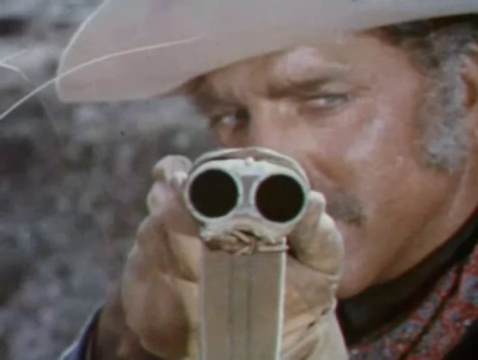
Roberto “Bob” Valdez e la sua doppietta a canne mozze.
C’era una volta i buoni contro i cattivi. Cappelli bianchi contro cappelli neri, manco fosse una partita a scacchi. In realtà, bianchi (occidentali) contro tutti (nativi americani, neri, messicani…). Cioè, il Bene contro il Male. Poi le divisioni si sono in qualche modo sfumate, i confini mischiati: il Mucchio Selvaggio era un gruppo di cattivi meno cattivi dei veri cattivi. Una differenza che li faceva sembrare buoni. Dopo che i movimenti per i diritti civili hanno seminato il terreno, e quindi latini, nativi, afroamericani, prostitute, donne in genere, riescono a ottenere un minimo d’attenzione e vengono identificati come parti lese, arrivano storie come questa.
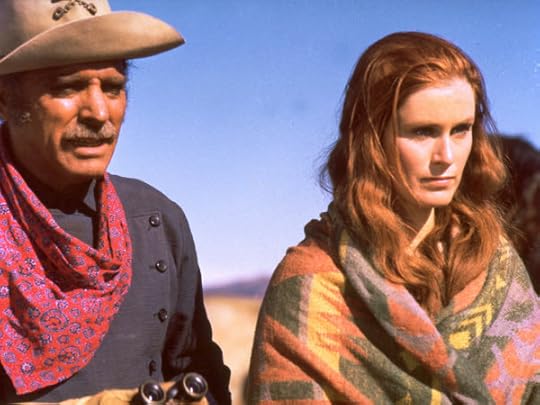
Susan Clark è la donna che Valdez prima rapisce e poi finisce col proteggere.
Storie western come questa dove il maschio bianco s’identifica col cattivo senza se e senza ma: mentre il buono è l’oppresso. E quindi, qui, nell’ordine, i buoni, e oppressi, sono l’afroamericano ammazzato nel primo capitolo, la donna indiana che porta in pancia suo figlio, il messicano Valdez, la donna bianca e bionda che la società e la realtà del tempo rende totalmente dipendente dell’uomo, in pratica sua schiava.
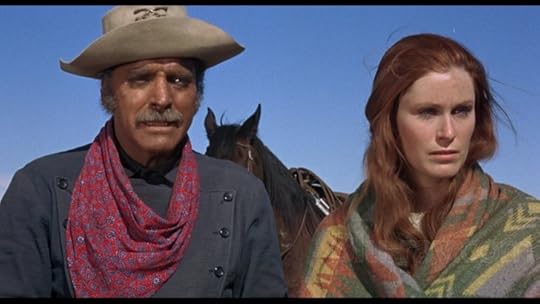
Nel romanzo Valdez ha quarant’anni: Burt Lancaster ne ha palesemente di più. Ma è comunque dannatamente efficace nel ruolo.
Leonard parte subito forte. Infatti è possibile che il romanzo sia lo sviluppo di un racconto e che quel racconto sia in pratica questo primo capitolo. Ma non ne sono sicuro. E anche nel film l’inizio è forte e insolito. Una specie di sagra, di festa paesana, con abbondanza di libagioni e soprattutto d’alcolici. I caporioni della zona, tutti ovviamente maschi bianchi, hanno messo in piedi una specie di tiro-a-segno: sparano tutti dall’alto della collina in basso su una casupola che il sole potrebbe mettere a fuoco da un momento all’altro. Dentro il micro tugurio è rintanato un nero che qualcuno dei caporioni ha definito assassino e disertore: sparano per spaventare, per stanare, ferire, uccidere, vattelapesca. La donna indiana esce e imperterrita va a prendere un secchio d’acqua al pozzo: la circondano di proiettili. Valdez è il locale vicesceriffo (che la maldestra traduzione a mia disposizione definisce invece guardia giurata) che si sente responsabile della situazione e cerca di intervenire per risolverla. Vorrebbe farlo alla sua maniera, quella pacifica, quella ragionevole. Starebbe per riuscirci: ma tra alcol e testosterone, i tiratori sulla collina combinano un pasticcio, e Valdez è costretto a sparare a sua volta.
Da qui in avanti, Valdez cerca di rimediare al pasticcio: pensa che la donna vada ricompensata economicamente perché le è stato ucciso l’uomo, per giunta padre del figlio che sta per partorire. Tra l’altro, una volta morto si scopre che chi lo accusava non lo riconosce, non l’aveva mai visto, s’è sbagliato. Amen. Ma nella sua colletta, Valdez viene umiliato e ferito da Tanner, il potente e il violento della zona: prima lo mettono al muro e lo usano da bersaglio – Valdez non batte ciglio, e loro avrebbero dovuto capire con chi hanno a che fare. La seconda volta lo legano a una croce e lo mandano a spasso per la prateria con l’alto rischio di morire.
La tortura della croce.
Valdez è un ex scout che ha imparato dai migliori, quelli a cui dava la caccia: gli apache. Conosce il territorio, sa come muovercisi, è un ottimo tiratore, ha pazienza intelligenza e sangue freddo. Tanner e i suoi lo sottovalutano e non capiscono d’essersi fatto il nemico sbagliato. Ma lo capiranno alla fine. Valdez subisce un torto e si ribella. Contro chi detiene il potere. Il potere economico, ma ancora di più quello delle armi, della forza. Non si tratta di vendetta, ma di ribellione. Non c’è nulla di mitico, di eccezionale in Valdez, e in nessun altro dei personaggi: Leonard non sceglie gli eroi, punta all’umano, ed è quello che racconta, che regala al lettore.
PS Elvis Cole, il detective creato da Robert Crais, legge e rilegge il breve romanzo di Elmore Leonard. Questo e “Hombre”.
This was first a short story, then a novel and then a movie. Often considered to be one of Leonard's best westerns, it is a classic little guy vs big guy tale. Valdez is a humble, inoffensive, seemingly more or less harmless fellow. Tanner is a rich, powerful, criminal who believes he can just brush Valdez aside and ignore him. But Valdez has a past and is much more than he seems.
It is an error to judge the toughness, the potential danger of a person based on harmless appearance, age and mild mannerisms. I once met a short, quiet, polite, harmless appearing elderly gentleman who, after lengthy conversation and polite questions, was revealed as David Sterling's sergeant major of the original, WW2 SAS in North Africa.
Great novel and one of my favorite movies as well.
Note: the description of the book posted on Goodreads is but vaguely accurate.
🏜️ The writing is not quite where McMurtry and McCarthy are with their westerns but it’s not far off and sometimes is definitely right there. It’s pithy, lean and rife with reality.
Everyone thinks Valdez is one sort of man. But when he’s beaten and abused, and those that help him are also beaten and abused, a different man emerges from the ashes.
He appeared to be a docile man when they beat him and left him for dead. But a decade before he had been a tough army scout who fought alongside the Apache, and against the Apache, and survived.
This is the man who is coming after his tormentors.
This is Valdez.
The story can put you on edge until it’s finally over.
This entire review has been hidden because of spoilers.
"No, that was your time. You get one time, mister, to prove who you are." - Elmore Leonard, Valdez is Coming
'Valdez is Coming', published in 1970, is the third book in Library of America's Westerns: Last Stand at Saber River / Hombre / Valdez Is Coming / Forty Lashes Less One / Stories. It is also one of my favorites. It is essentially a quest/revenge novel (quest if you think Valdez is coming for the widow, revenge if you think Valdez is coming for payback). The knight in this book is town constable Bob Valdez, who is put into an unfortunate situation where he shoots an innocent man (because of the misdeeds and racism of others). When he tries to put things right with the woman of the dead man, he sets the stage for a confrontation with Frank Tanner (a rich rancher/smuggler) who thinks he owns the town.
It wasn't a perfect novel, but it was great for what it was. You don't ride into a Elmore Leonard western not knowing basically what you WANT and what you are going to get. Leonard delivers both to you with more accuracy than you thought possible and quicker than you were expecting. LIke most of the novels (and some of the stories) in the Library of America collection, this one too was made into a move. I'm not sure I would have cast Burt Lancaster as Bob Valdez, but the movie came out in 1971. Hopefully, if this were remade today, it would star Brad Pitt.
Bob Valdez is a small-town constable who also rides shotgun for a stage coach company. He arrives home one Saturday afternoon to find that much of the town has gathered around a shack on the outskirts of town. The wealthiest man around--a Mr. Tanner--has identified a man he saw in town as an Army deserter and murderer. The accused has taken refuge in the shack along with his Indian woman who is pregnant.
Valdez attempts to defuse the situation but is forced to kill the accused man when one of the townspeople stupidly fires a shot and the accused man reacts by raising his gun against Valdez. Then Mr. Tanner says, "Oops, wrong guy!"
Valdez believes that the town and Mr. Tanner in particular should pay a little money to the Indian woman to compensate her for the loss of her man. But Mr. Tanner and virtually everyone else in town thinks that Indians are scum and that Valdez is an idiot for wanting to help her. Twice Valdez asks Mr. Tanner nicely for a little money. Each time Tanner refuses, the second time in somewhat spectacular fashion. The third time, Valdez will not ask politely. Valdez is coming, and the bad guys in his way had better start running for cover.
Elmore Leonard is much better known these days for his crime novels and for his work on the television show, "Justified." But he made his bones writing western novels, and this is an excellent example of his work in that genre. Bob Valdez is not as funny or as ironic as Raylan Givens, but he's just as compelling a character, and those who have enjoyed "Justified" and Leonard's other novels would probably enjoy this book as well.
I have been reading Elmore Leonard books for 35 years and enjoyed each and every book. I have read all but a few of his books and decided to read this one after watching the 1971 movie version with Burt Lancaster as Bob Valdez a few nights ago. Bob Valdez is a quiet Mexican American, part time deputy and part time stagecoach shotgun rider. He comes upon a bunch of men in front of a cabin, shooting at the cabin. He asks what is going on. He is told that there is a man in the cabin suspected of killing another man, James Erin. Frank Tanner claims that this man is an army deserter wanted for killing Erin. Valdez decides to talk to the man in the cabin. He gets the man to talk to him, but then one of Tanner's men shoots at him and he is about to shoot Valdez when Valdez fires first. Tanner looks at the dead body and says it isn't him.
Valdez feels guilty that the man's pregnant woman now has no one to care for her and asks Tanner for money. Tanner and his men laugh at him and drive him away, twice. But Valdez is also a retired US Calvary scout and they have made a serious mistake. Elmore Leonard started by writing crime fiction and then turned to writing westerns. He prepared very deliberately by subscribing to magazines about western history/guns/horses and equipment used from post Civil War to turn of the century. His books are very authentic. His prose is very lean. The characters are very real.
"You ride to Mr. Tanner, all right? Tell him Valdez is coming. You hear what I said? Valdez is coming."
He is two men.
First, there was Roberto Valdez, born of Mexican parents in the United States Territory of Arizona. He was an Apache tracker and worked for a stagecoach company.
Then there is Bob Valdez, a part-time constable who wears a suit and knows his place.
He will need to be both men when a pissing contest with a wealthy local escalates into a war.
"Roberto Valdez returned," she said. He smiled back at her. "Bob is easier." "Bob wears a starched collar," Inez said. "Roberto makes war." "Just a little war, if he wants it," Valdez said.
This was an interesting examination of two strong-willed characters, both determined to get what they want . . . or else.
I went through a period in my late-20s where I read a ridiculous amount of what I call “masculinist fiction”. I believe it started in college when I read a nonfiction book by poet Robert Bly called “Iron John”, which posited that men had become sensitive pussies and needed to get back their “warrior/protector” instincts that had become stifled by feminism. As ridiculous and horrific as this sounds now, this book actually meant a lot to me then. I began to read a slew of “masculinist” writers like Norman Mailer, Philip Roth, and John Updike.
I was also reading a lot of crime/noir and westerns at the time. Writers like Robert B. Parker, Donald Westlake, Lawrence Block, Louis L’Amour, Zane Grey, and Elmore Leonard. It’s not coincidental.
I was attracted to the hard-core badassery of the predominantly male protagonists, mainly as a way to boost my own self-esteem and self-confidence when it came to women. My militant masculinism, in retrospect, wasn’t healthy (I was spending an inordinate amount of time in strip clubs and bars, smoking like a fiend, and thinking that telling a woman that she had a “great ass” was a perfectly normal ice-breaker), but it helped me, in a way, to shape the man that I am today. If only by helping to realize the kind of man that I wasn’t nor that I wanted to be.
This is why I haven’t picked up books by many of these writers for almost 20 years. In some cases, they belong to a different me that existed in a different time, a period that I call my long, dark 20s.
Not that I’m opposed to re-reading these authors. Many of them still hold a special place in my heart, most notably Parker, L’Amour, and Leonard: three authors, especially, that I felt exhibited a unique brand of contemporary chivalry in their male protagonists, one that wasn’t antithetical to the feminism that I believed in. Their heroes were tough and, occasionally, violent, but they weren’t dicks. (“Dicks” in the sense of callous assholes toward women as well as literal walking phalluses who had to insert themselves into any given situation just to show off their awesomeness.)
I recently picked up a paperback copy of Leonard’s “Valdez is Coming”, one of his many westerns that he wrote early in his career.
The hero of the novel, a lawman named Roberto Valdez, is a vintage Leonard hero: soft-spoken, contemplative, compassionate, but possessing a violent edge that isn’t immediately noticeable. It only manifests itself when he or someone that he believes is an innocent has been wronged.
When Valdez is called in to take down a murder suspect, he kills the man, only to find out afterwards that the man was innocent. Guilt-ridden, Valdez attempts to take up a collection of money as compensation for the dead man’s pregnant wife.
The townspeople, including the cattle magnate, Frank Tanner, ridicule him for the preposterous idea. They aren’t going to help the woman, and they certainly aren’t going to take orders from a dumb Mexican.
As with nearly all Leonard antagonists, the villains seriously underestimate the hero.
After Tanner’s men beat Valdez and leave him for dead in the middle of the desert, Valdez starts to get pissed off. In an act of desperation, Valdez kidnaps Tanner’s fiancee, a beautiful young woman named Gay Erin, as leverage to get the money for the pregnant woman. In the process, Valdez and Gay fall in love (also a common element in Leonard’s fiction), as Gay realizes that Valdez is a man of honor, as opposed to her fiancee, who is just an asshole.
And, of course, there is plenty of guns a’blazin’ in this one. Shootouts galore, with a final showdown—-as is de rigueur for any decent western.
“Valdez is Coming” also exhibits another common element in Leonard’s fiction: not-so-subtle commentary on race and racism. It was quite common for Leonard’s heroes to be Hispanic, Latino, or a Person of Color. His villains were often blatantly racist and often committed racially-motivated crimes.
This is only the second Elmore Leonard novel I’ve read. I really enjoyed the previous one but for some reason didn’t get around to reading another until now. I imagine most people will know something of the plot of this revenge western set in southern Arizona, even if only through the film adaptation that starred Burt Lancaster.
Elmore Leonard had the reputation of writing very pared-back prose, and on the evidence of this novel I would say that reputation was fully justified. The narrative here is as lean and wiry as its central character. There’s not much introspection going on amongst the characters. The men have a code to live by and they act according to it. I especially loved their spare dialogue. There’s only one significant female character (it’s a short novel) and she is mostly passive, although she has a backstory that suggests anything but passivity. It’s noticeable that most of the sympathetic characters are from the Mexican-American community, and that generally they are drawn more favourably than the Anglophone Americans. In the book the Mexican-Americans are treated very much as second-class citizens, and of course that portrayal would have been accurate for the period.
There’s a clear division here between the guy with the white hat and the guy with the black hat, and there’s nothing wrong with that. It’s an exciting read with a great ending. I really enjoyed it.
Sparseness dominates this modern Western. Sparseness of landscape and geography, dialog and thought, as well as motivation. Except that the sparseness is all illusory. For beneath the surface exists an intense conversation between Bob Valdez, the forty-something constable who also rides shotgun on a wagon, and Roberto Valdez, the violent Apache Indian scout of some ten years earlier who was awash in blood. In between them comes a woman, Erin Gay, the mistress of an unsavory cattle and gunrunner, Frank Tanner. Will Valdez' civilized virtues blend with and settle his vengeful savagery? At the end, it's all about doing the right thing, which is paying an Indian widow $500 for the wrongful killing of her husband, which both Valdez and Tanner are complicit in. One thing is for certain. At the end the landscape is no longer sparse. It has moved into the high country, mainly consisting of pine and brush. Clarity of vision is as much changed as is the geography from barren rock, grass pastures, and open sky to the shadows of timberland.
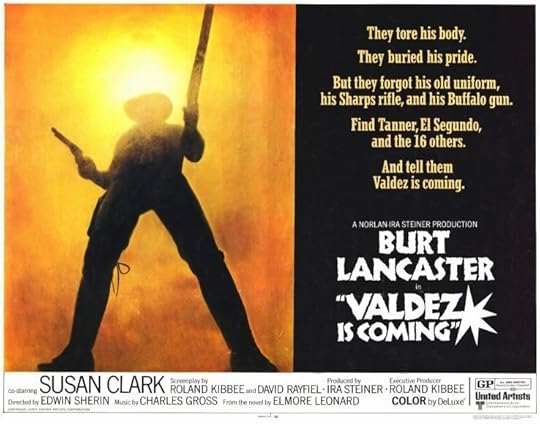
I must mention the film adaptation with Burt Lancaster before finishing. It was impossible to dismiss Lancaster's Valdez from my mind while reading this novel. I could see him moving as Valdez moves, hear him speaking as Valdez speaks. The film is an underrated masterpiece that follows the novel quite closely. And the two are inseparable to me.
I've been a longtime fan of Mr. Leonard's early westerns rather than his later crime novels. His Valdez Is Coming really shines. The ending was a bit disappointing, but he checks all the other boxes for a sturdy, character-driven western. I see there is a 1971 movie with Burt Lancaster and Susan Clark, which I haven't watched and should sometime soon. Recommended for fans of the genre.
“You tell him I’m coming! You tell him I’m fucking comiiiing!”
Terence Stamp in The Limey is my favourite example of the type of character Bob Valdez becomes. He doesn't care about the odds, he will do what it takes to ensure those responsible do what is right or die trying. It's this certainty that he is right whilst having no fear of dying in its pursuit that makes Bob Valdez such an interesting character. The fact that he is constantly underestimated by everyone around him only serves to heighten what has become a genre cliche.
If this hadn't been an Elmore Leonard novel or part of the pulp fiction book club group read I almost certainly wouldn't have finished this book. In general I like Leonard, I've enjoyed his westerns in the past and I like the type of character his protagonist is but from the very first page I just did not care about the story or the outcome and as much as I wanted to enjoy it I just couldn't force myself to be impressed or enthralled.
That's why I'd rather discuss Terence Stamp in Steven Soderbergh's The Limey than review the book.
The Library of America has recently published a volume of westerns by Elmore Leonard (1925 -- 2013) to accompany its earlier three volumes of Leonard's crime fiction. The LOA collection is an excellent way to get to know Leonard's writings in the western genre.
The LOA volume includes this novel, "Valdez is Coming", published as a paperback original in 1970 and made into a 1971 movie starring Burt Lancaster. Set in the Arizona territory in the 1880s, Leonard's novel combines a tale of revenge and violence with character analysis. The book is told by an omnipotent third person narrator with highly introspective flashbacks into the lives of its main characters. The novel is replete with religious symbolism as its main character, Bob/Roberto Valdez is pinned to a cross under orders from the book's villain, Frank Tanner, and subsequently engages in a lengthy meditation on St. Francis of Assisi, the "kindest man who ever lived".
The conflict between Valdez and Tanner is set up in the novel's early chapters. Tanner runs a large illegal business selling weapons to rebels in Mexico. He believes that an African American man has killed his friend, the husband of his mistress. The unfortunate target and his pregnant wife are surrounded in a shack by a posse Tanner has assembled which includes Valdez, the town constable. Valdez reluctantly shoots and kills the man only to find, by Tanner's own admission, that it is the wrong person. With a sense of remorse and responsibility, Valdez tries to collect money for the victim's pregnant widow. He approaches Tanner twice for a contribution but is violently turned away, the second time painfully tied with a metal cross on his back. The long, violent feud and denouement between Valdez and Tanner and his men follows.
Much of the book is a character study of the reserved and taciturn Valdez. The narrator observes that "a man can be in two different places and he will be two different men". In his earlier years, Roberto Valdez had been part of the violence of the West. He had developed great skills with weapons and the use of terrain in the process of hunting down the Apache. Later in life, as Bob Valdez, he became a man of peace and law serving as the town constable and as rider on stagecoaches. Bob Valdez acts from compassion for the widow of the man he had wrongly killed. In the process, Roberto Valdez uses the skills of fighting and maneuver he had learned earlier as the feud with Tanner intensifies.
Leonard also explores the inner lives of several other characters, including Tanner's mistress, the local madam, some of Tanner's men, and Tanner himself. With its character development and religious overtones, the book offers more than violent, Western melodrama. After setting the stage for the story, and even with the strong characterizations, the novel moves quickly and effectively, with a strong build-up of dramatic tension and violence to the surprising but appropriate conclusion.
"Valdez is Coming" is an excellent novel for readers interested in Leonard or in the American western.
I listened to this as a short story in The Complete Western Stories of Elmore Leonard. The first chapter of this book is a cut down version of that & the rest of the book has a totally different tone.
The setup of the situation in the first chapter was masterful as was the portrayal of Tanner. The way Valdez & Tanner got Valdez into the situation was a devilishly clever by Leonard. The more I think about it, the better I like it.
It had a lot of pretty good action, but the motivations didn't work for me at different times. Valdez's character was erratic & didn't seem complete. Everyone seemed to know everyone, so the dichotomy of the perception of Valdez was tough to swallow. The innkeeper knew who he was. Part of the problem is that too much was taken out of the short story, I think.
A few more issues off the top of my head:
With all that, how could I still give this 3 stars? Because the rest of it was so well written. It's pretty easy to look past the problems when the story sucked me along at warp speed & it did.
Roberto Valdez is serving as a peacekeeper of sorts, clearly ignored by most of the range-living white population but ably and respectfully handling minor problems among the Mexican crowd. At the start of "Valdez is Coming" he finds himself trying to calm a standoff; a local bigwig named Tanner saw a black murder suspect in town and then gathered a posse to chase him down to a sod home that they're now keeping under fire. When Valdez steps in to try and resolve the situation peaceably the suspect is killed and now Valdez feels that his widow should receive a monetary handout for the trouble.
Leonard's biting prose and dialogue keep the story moving along some standard western threads, and his treatment of the evil Tanner is also interestingly done. It reminded me of how Melville showed us Ahab in "Moby Dick." We don't know exactly what is driving this Tanner bully; we don't get narrative from his point of view like we do Valdez and a few other characters, or even a whole lot of dialogue from him, no lengthy exposition or definition of purpose. We're seeing his forceful drive, high-handed manipulation of those he has power over, and motives only from those around him. When our Valdez protagonist crosses Tanner in even a minor way, Tanner's response is frightening and evil.
"Valdez is Coming" (1970) has a final chase that recalls Leonard's own "Mr. Majestyk" (1974) but in an old west setting instead of a modern crime one; the two protagonists are also very similar now that I think about it.
Verdict: A sharp and short western justice tale.
Jeff's Rating: 3 / 5 (Good) movie rating if made into a movie: R
Quiet, part-time town constable Roberto Valdez is called in when a mob has tracked down a black man who is accused by Tanner, a rich businessman in town, of being an Army deserter and murderer. Roberto tries to diffuse the situation and is forced to shoot the man, who was holed up in a house with his pregnant girlfriend and turned out to be totally innocent. When Valdez goes to Tanner to ask for reparations for the man's wife, Tanner's crew beats Roberto and tries to crucify him, leaving him for dead. They should have made sure they finished the job. Because everyone in town underestimated him. And only a few remember that Bob Valdez used to be a real badass back in the day, and when he comes for you, he comes strong. He's already tried to talk to them as civilized men but they wouldn't listen. But this time, maybe they'll listen to bullets.
This early Elmore Leonard western showcases the same lean and witty prose that eventually made his later crime novels so popular. Sparse and direct writing work so well with Western fiction, and Leonard was one of the best writers in the genre. There are not many wasted pages in the book and I love the classic tale of a man who has shelved his violent past, but must bring it back in order to right a major wrong. A fast and enjoyable read.
5 stars because it's Elmore Leonard at his best. Roberto "Bob" Valdez is one more El hombre. Hated I finished it. Could read it again, on second thought I think I will.
Roberto Valdez is a Quiet, part-time constable,stagehand trying live a simple life when Tanner, a rich businessman leads a mob consisting of his hired guns,other wealthy men in town to accuse a black army deserter of murder.
The strenghts of the novel was the way Valdez hunted down his enemies, used the desert,mountains against the superior numbers. Also the characther study of who Valdes really is made this book great read. He tried to be the man they thought he was. I liked the fact they looked down on him because he is mexican,not a white lawman, felt like a realistic historical novel. Tanner as a villain you know from many similar stories but that didnt matter.
Leonard's portrayals of American Indians, African Americans, and Latinos are unusually stereotype-free for the time the book was written, the genre. This book is an excellent example of how his best westerns can be as good as his best later works.
I finished this about eleven last night and sure enjoyed it but I believe I liked the movie better so I will watch it again maybe today. The end of it annoyed me a little which is why I didn't give it 5 stars. I believe I liked the movie ending better but have forgotten most of it. I recommend for anyone who likes westerns.
Valdez Is Coming, by Elmore Leonard is a very good western. While I’ve read a few others by Leonard, it’s been years. More of a fan of his crime fiction which is quite different. This one grabbed hold.
Bob (Roberto) Valdez is the town constable, hired to keep drunken Mexicans in-line. He learns of a vigilante party outside town after a “killer & deserter”, identified by Frank Tanner… bad rich -“the man there in the dark suit: thin and bony, not big especially, but looking like he was made of gristle and hard to kill, with a moustache and a thin nose and a dark dusty hat worn over his eyes. That was him. They had heard about Frank Tanner, but not many had ever seen him”.
They’ve got him surrounded and firing rounds “he could picture the man inside the line shack, said, “There was something peculiar about him. I mean having a name like Orlando Rincón. -hired him two, three times,” Mr. Malson said. “For heavy work. When I had work you couldn’t pay a white man to do.” - “If someone was going to arrest Orlando Rincón or Johnson or whatever his name was, then he should be the one to do it; he was a town constable.”
Rincón(or Johnson)… “the Negro was in the doorway filling it, standing there in pants and boots but without a shirt in that hot place, and holding a long-barreled dragoon that was already cocked. They stood twelve feet apart looking at each other, close enough so that no one could fire from the slope. “There’s a man there said you killed somebody a year ago.” “Said your name is Johnson.” “You know my name.” “I’m telling you what he said.” “Where’d I kill this man?” “Huachuca.” Shit happens… Valdez kills him, Tanner has identified the wrong man. “Constable,” - “You went and killed the wrong coon.”
“Bob Valdez washing his hands in the creek and resting in the willows after digging the hole and lowering Orlando Rincón into it and covering him with dirt and stones, resting and watching the Lipan Apache woman who sat in silence by the grave of the man whose child she would have in a month.” - “The woman’s gaze rose from the fire, her dark face glistening in the light, the shapeless, flat-faced Lipan Apache woman looking at him.” Valdez decides. “Mr. Malson, the manager of Maricopa, looked at Mr. Beaudry, the government land agent, and Mr. Beaudry said, “I never heard of anything like that before.” “I suppose we could do it.” “I was thinking of more than ten dollars,” Valdez said. Mr. Malson looked up at him. “How much more?” Bob Valdez cleared his throat. He said, “I was thinking five hundred dollars.”
Go talk to Frank Tanner. — Tell him Valdez is coming. The story unfolds, action ensues…
Reading this is like watching an episode of, say, "Breaking Bad" Season 4, Episode 6 and knowing nothing about previous seasons/episodes. The characters just ARE: motivations in "Valdez" feel odd at times. But a great artist knows when to stop and Elmore delivers a sensational, perfect final line without which I'd have rated this novel two stars.
Been a fan of Leonard for years, but only recently started reading his westerns for some reason. Hombre honestly wasn’t all that great, but it was an okay read. I enjoyed Three-Ten to Yuma (and other short stories) quite a bit. But this one blows both of those out of the water.
It IS a fairly simple tale, as many western novels were. But it’s more layered than I was expecting at the same time. Valdez himself is a very interesting character. He’s this town constable that everyone gets along with or at least thinks highly of, and his sincere, respectful personality.
Yet, after he is put in a morally tight place and tested several times by a Frank Tanner, Valdez makes a promise to come back one last time. It’s a turn that one may not have expected, but it’s pretty believable honestly. We eventually learn why this guy is good at what he does and so well-respected, and it all just ties up together very nicely. Seeing him gain the respect of people you probably wouldn’t have guessed in this book was very satisfying.
And I like that he isn’t invincible just because he’s such a pro and a badass. He gets knocked down time and time and time again, and still manages to make so risky choices and mistakes. The stakes are honestly felt in this novel. Valdez is easily one of my favorite characters from Leonard.
I did enjoy all of the side characters to varying degrees as well. Frank Tanner does a lot more standing around than I had hoped, but he was at least an interesting antagonist, and what ends up becoming of him was more thanks satisfactory. Diego was very likable and a true friend, and I really enjoyed the Segundo fella as well.
Gay Erin was also written pretty well in my opinion. She never came off as one-dimensional, nor was she ever objectified despite being the only main character who is a woman (the other female characters fine too they just aren’t in it as much). I give Leonard credit. He writes good female characters in my opinion.
I also give him credit for writing racist and misogynist characters without ever coming off as racist or misogynist himself.
But as a western, the book really immerses you in the hopelessness of this hot desert, and Leonard’s knowledge of this time period and how people lived and operated in it is so detailed you not only feel as if you’re there, but you feel like he may have been as well.
It’s a short, relatively straight-forward tale, but man, he did such an excellent job with these characters and the setting, revealing just enough about each of them to keep my interest AND still manage to surprise me.
Breezy, gritty, whippy fun. I could see myself easily picking it up again at some point. If you’re a fan of this author or westerns as a whole, I wouldn’t hesitate to call this essential reading. It’s one of my new favorites from him.
This was the first time I've ever read a Western novel. I've had a few on my to-read list but never gotten around to them. Set somewhere along the US-Mexico border this is a classic story of revenge. After rich local crime boss Tanner causes Valdez to kill an innocent man. Valdez seeks retribution money for the dead man's wife and unborn child. Tanner declines Valdez by almost killing him. That's the wrong thing to do to Valdez.
I was looking for a bit more in this book though. It just seemed to be missing something and the ending was a let-down. I think it could have been much better than it was. Most of the characters were poorly fleshed out. This is one of Leonard's earlier books so maybe next time I'll try something newer.
I've read a ton of Elmore Leonard. I love his dialogue, his authority and his wit. I like his spare style. This is the first western that I've read of his, and if it were by anyone other than Elmore Leonard or Cormac McCarthy I wouldn't have tried it. To my surprise I liked it even more than his crime novels.
There's more of the landscape in this novel than is typical of his crime novels: "A mile across the grazing land and then up into the foothills, following a gully and angling out of it, climbing the side of a brush slope, not finding the trail and taking a long way to the top..."
His characters really sold the book for me. His protagonist, Roberto Valdez, is a good and decent man on a worthy quest. He's trying to collect money for a pregnant woman whose husband was wrongfully killed. What makes this quest especially interesting is that it's not clear to any of the characters in the book whether the widow will know what to do with the money. The love interest, Gay Erin, is a different kind of woman than I'm used to reading. That is another thing about Elmore Leonard: he writes good female characters. I get the feeling he gets women and likes us on the whole.
Then there's the ending, which can kill a book if it's done badly. This ending is so elegant it makes me swoon.
Failure was all but certain and violence possible when seemingly-quixotic, small-town constable Valdez looked for virtue in the shady syndicate boss. Failure was certain, as was violence, when Valdez went looking a second time. On the third pass, Valdez seems, at the start, intent on vengeance. But as his plan unfolds, it is virtue that guides him, not revenge. From the clash with the boss, Valdez's character emerges, and the early, seemingly-quixotic choices take on a different hue. Such a well crafted story, but I still feel that all Westerns are telling the same story, and yet I keep coming back for more, from the good ones.
Read this for a book club. First of Leonard's westerns I've read. Pulls you in right from the start as Valdez gets caught up in the persecution and death of an innocent man. Valdez attempts at a civil restitution are rebuffed, again and again, until it's time to pull out the guns.
Everything Leonard ever wrote is worth reading. This particular book is an excellent example of an Elmore Leonard Western novel. As engaging as any of his Detroit or Miami based crime novels, this book should be less than it is. The plot is of the "hardheaded old west guy gets his revenge against powerful, rich rancher guy" variety that is the base of seemingly one third of the Western novels and movies ever produced. Despite this fatal flaw, or flaw one would think would be fatal, this book is quite engrossing, with decently drawn characters and crackling dialog.








![Profile Image for Ed [Redacted].](/_next/image?url=https%3A%2F%2Fi.gr-assets.com%2Fimages%2FS%2Fcompressed.photo.goodreads.com%2Fusers%2F1429513592i%2F3968676.jpg&w=128&q=75)