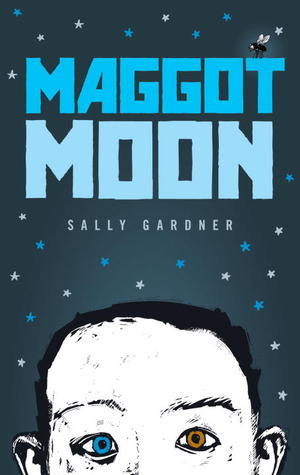
In Sally Gardner’s stunning novel, set in a ruthless regime, an unlikely teenager risks all to expose the truth about a heralded moon landing.
What if the football hadn’t gone over the wall. On the other side of the wall there is a dark secret. And the devil. And the Moon Man. And the Motherland doesn’t want anyone to know. But Standish Treadwell — who has different-colored eyes, who can’t read, can’t write, Standish Treadwell isn’t bright — sees things differently than the rest of the “train-track thinkers.” So when Standish and his only friend and neighbor, Hector, make their way to the other side of the wall, they see what the Motherland has been hiding. And it’s big...One hundred very short chapters, told in an utterly original first-person voice, propel readers through a narrative that is by turns gripping and darkly humorous, bleak and chilling, tender and transporting.
Sally Gardner grew up and still lives in London. Being dyslexic, she did not learn to read or write until she was fourteen and had been thrown out of several schools, labeled unteachable, and sent to a school for maladjusted children. Despite this, she gained a degree with highest honors at a leading London art college, followed by a scholarship to a theater school, and then went on to become a very successful costume designer, working on some notable productions.
After the births of twin daughters and a son, she started first to illustrate and then to write picture books and chapter books, usually with fairytale- or otherwise magical subject matter. She has been called 'an idiosyncratic genius' by London’s Sunday Times.
This could possibly be my very first review on GRs. I hope that many of you understand my predicament by now: I've been quite caught up in the alternate universe of Amazon. Thus, this is where at least two hundred of my previous reviews are stored. I've found the GR community to be quite forgiving and generous to a fault. I love you all so much for putting up with my non sensical diatribes about not finding the review button on my glow kindle. Mark Monday was one of the first to enlighten me and be friends. God bless you Mark. Many soon came to my aid, and here is a first time review experience. Now, to get to the book! I feel so many mixed emotions about Stanlish and his beloved grandfather. It is all he has, you see, as his parents were brutally taken from him along with everyone else. It is an alternate universe, like I'd described earlier for me, in 1957, in a sort of right wing fascist state. The author Sally Gardner know how to propel properly a pregnant pause, akin to a great comedian's comic pause. We don't know exactly where or what we are in the beginning, however quickly siding with Standish. They do meet another family and he makes a friend. I'm really afraid of revealing too much here, but will tell you this: much of what we dream of and want in life, is of our own imagination, creating a reality of it's own. Please look for this book at your local library and or download a digital copy. I've suffered great loss and pain in my own personal life. I don't wish to unload it all on this site. I was in a coma for four month and woke up paralyzed you see. Like Standish, we mustn't take each other or our families for granted. I'll consider writing my own tome about it someday. Maggot Moon showed me that our genetics show up who we SHOULD be related to by way of family, town, district or country. However, our real families are our own creation you see. Standish will show you the way. Like he, me and you, we'll all have our illustrious epiphany someday. And, I dearly hope that day coming is not too late. Please let me know how you've liked my first review on GRs, Murf
This story is as disturbing as it is multi-faceted.
Set in an alternative 1950s past in a dystopian England after World War II, reigned by a totalitarian regime which seems to follow a mixture of Stalinist and Nazi dogma, it tells the story of a young boy called Standish Treadwell.
Starting out as a bleak school boy story, featuring dyslexia and bullying issues, along with teacher abuse and authoritarian methods of teaching, it slowly reveals darker, and more dangerous elements, challenging the reader to double-check the easily flowing language. Did the teacher just beat a student TO DEATH? Is that what the text says?
Bits and pieces of propaganda make an appearance, a meta plot is taking shape: there are good and evil forces at work, the Motherland and its invisible, secret enemies. To prove eternal superiority, the Motherland is about to land a scientific coup: the first moon landing, years before enemy states are ready. That, the propaganda tells the citizens of the Motherland, will make it all-powerful. But Standish and his family happen to come across the horrible truth: it is all a hoax, and people are working on a fake show, only to be killed afterwards to avoid dangerous witnesses.
In a political landscape of absolutely no hope at all, Standish decides to make a difference, to spoil the show, to hold up a sign in full view of the cameras of the world, to tell the world about the hoax. Knowing full well from experience that torture and death are the definitive consequences ...
If you think this sounds harsh for a young adult novel, it is actually even more brutal than this. For in addition to the adventure and thrill of the action, there are pitiless philosophical questions built into the story line, starting with the sad introduction, Standish's thought experiment of turning back time to a point before his drama unfolded:
"I'm wondering what if. What if the football hadn't gone over the wall. What if Hector had never gone looking for it. What if he hadn't kept the dark secret to himself. What if... Then I suppose I would be telling myself another story. You see, the what ifs are as boundless as the stars."
For the reader, the list of moments when Standish could have been saved is incredibly painful. But at the same time, it is a story of the infinite number of choices you have, even in an oppressive, abusive environment. It is a story of the value of family, of love, of human dignity, as symbolised in Standish's old grandfather:
"He stood tall and proud, always told me he owned nothing but his dignity and he wasn't about to give that away to no one. To no creed, to no church, to no dogma."
It is a story telling us about the horrific effectiveness of terror, and the threat it poses to human dignity, first introduced when Standish's grandfather kills rats in the cellar, later to be shown with young boys as victims, parents as hostages:
"Seven dead rats was something the king of rats would respect. Shoot one rat and all his relatives will come looking for you; shoot seven and they understand you mean business."
The rats are a disgusting element of the society in decay, but they also are part of a sub plot told only in pictures, in a comic strip at the bottom of each page, slowly unfolding a truth of a different kind, giving subtle clues to the title of the book. It shows the curiosity of a rat, sniffing out a bottle that human beings immediately recognise as poisonous, reading the sign with the skull. It is an analogy to the optimistic, curious scientist experimenting without knowledge of the dangerous political environment he moves in. An accident ("What if...") makes the bottle tip over, and the rat poisons itself. What follows over hundreds of pages is a graphic illustration of the death and decomposition of the rat, until it is completely taken over by maggots and disappears. A fly hatches from a maggot and indicates a new life form, similar to the old one, but with new possibilities in store: What if...
There is not only despair in that reflection, there is hope as well. What if one action made all the difference?
When Standish sacrifices his life to make a difference for the future, he sums it up:
"This is my moment. Not even one minute, just a moment. But maybe all it needs is a moment to change the course of history. I am on the moon. I am the stone. The plug is pulled on the maggot moon."
What if you you read this book... What if it makes you see things clearly... What if it causes you pain and reading pleasure... What if it makes you hope and despair... What if it makes you imagine that one boy, one moment, one act can make a difference...
I originally bought this book for my younger brother, thinking it might get him into reading as it has very short chapters and a cool cover. He didn't read it, because he hates to read books. So I thought I'd give it a go instead.
Maggot Moon reminded me of The Book Thief, except it's one billion times better (and I adore The Book Thief). It's on an entirely different playing field. I think the main thing that makes it so amazing is its startling originality. But I can't fault anything about this book.
I've never read a dystopian book like it. It manages to confront this particular world without needing to explain at any point what has happened - this is what makes the book so wonderfully abstract. The language is utterly beautiful, the characters and relationships are heartbreaking, and the story manages to cross genres and themes and create something so filmic and powerful that you are not going to forget about it for a very long time.
This book deserves every prize it has won. Whatever sort of a reader you are, you need to read it.
Quite simply, I did not GET this book. I don't get the hype and rave reviews it has received, but more significantly I don't get WHO it was written for or what it's trying to say or achieve.
I was expecting it to be a good crossover text, written for young adults, but very much easily enjoyed and appreciated by adult readers alike. Not so. If this was written for young adults, it's WAY off the mark in my opinion. I teach teenagers - I WANT books to be written for them which will challenge them and open their minds, but I fail to see how "Maggot Moon" hopes to do this. Historical allegory? Maybe so, but novels such as "Boy in the Striped Pyjamas" do that far better. Maybe I simply prefer realism?
It's not the disturbing subject matter which grates if the intended audience is young adults, it's the clumsiness of it - the sudden introduction of profanities towards the end, the brief (as in one paragraph) foray into homosexuality...it's just all over the place, and thus impossible to take seriously - if that's what it wants?
One of the most jarring things as a reader was the occasional glitch in spelling or incorrect use of words...at first I thought this was an editorial error, but then after a few times realised it must be intentional. I understand the narrator is dyslexic, and this is probably supposed to demonstrate this, but for me this simply didn't work. To go from "the proganda-perfect face paint" to the word "propoganda" (and far more complex words) being spelt perfectly throughout the rest of the novel is just irritating. 130 pages later we get "the figures I saw last night march pass us" - stylistically it's not consistent enough for it to take effect. Similarly towards the end Standish has a Mrs Malaprop moment when he says "It's quite a rigor mortis to place it exactly at the right spot", presumably meaning "rigmarole" - again, if consistently used this could be an effective device. It isn't.
But, plenty of people are loving this book, so maybe it's just me and I am completely missing something.
Imagine living in an alternative universe, but one eerily similar to Nazi Germany. Is this historical fantasy? Historical science fiction? It's like nothing I've read before, but that's the thrill of it. Standish Treadwell and his grandfather – Gramps – live in Zone Seven, where outcasts and political anarchists are sent. They have nothing except some scraps of food to get them through the winter and contraband television. We all know about Nazi Germany. But do the citizens in Maggot Moon fare the same?
Maggot Moon is an example of compelling, inventive and truly great storytelling. Although some chapters are only a mere half a page, by the end of the book you've become immersed in Standish's world, and genuinely understand what he has gone through. And what he goes through is horrific. It's a book you'll finish the same day you pick it up. There is no need for overly long and detailed descriptions – Standish lives in a brutal, harsh place where people are blinded by propaganda. There's no time for lyrics and poetry.
You see, Standish also has dyslexia, meaning that people underestimate him. (It also doesn't help that he has one brown eye and one blue eye!). He's intelligent yet perceived to have the mind of a young child, so he's constantly running from bullies – students and teachers alike. And then there's the soldiers – Greenflies – who are the eyes and ears of those at the top of the social ladder, making sure that everybody sticks to the rules. It's set in bleak 1956 where the Motherland want to demonstrate ultimate supremacy and be the first nation to land on the moon. But Standish and Gramps have an inkling that something is not quite right, and are determined to reveal the truth.
Narrated by a unique voice and with a host of characters you cannot help but fight for, the brilliantly haunting and highly compelling Maggot Moon, winner of the 2012 Costa Children's Book Award, is definitely one you won't want to miss!
Thank you Hot Key Books for providing this book for review!
Thanks to Goodreads member Ellen Lee for recommending this delightful book. Set in a dystopian past reminiscent of Nazi-era Germany, this story chronicles the slow disintegration of a family by a totalitarian regime.
At first read the tale seemed simplistic, but over the course of the novel I was able to become engrossed in it. The book also features an interesting graphic vignette of other creatures associated with despair such as flies and rats.
4.5 Es unos de esos estilos que hacen volar las páginas sin que te des cuenta, y que te describen un estado, una situación, unos sentimientos, una mentalidad, más que una trama en sí. Y aunque precisamente he encontrado algunos «agujeros» en esa trama, no importa demasiado, porque leerlo, escuchar sus palabras en tu cabeza, merece la pena por sí mismo.
Introduced in 1939, The Carnegie Medal is perhaps the most prestigious of children’s/YA book awards, with any winner (or even shortlisted title) gaining a bank account buckling sales boost. The latest winner (2013) is Maggot Moon by Sally Gardener, a dystopian fable which follows dyslexic protagonist, Standish Tredwell.
Standish lives in a kind of alternate realty in which the ‘Motherland’ has taken control of 1950’s England. Surveillance, disappearances and capital punishment are the daily norm, and the rat-infested streets are virtually an inhabitable ruin. It’s a pretty grim existence and Standish’s dyslexia, fierce imagination, as well as his one blue and one brown eye, make him a prime target for the regime and it’s hierarchy of violent bullies.
Fending off starvation thanks to a couple of hens and a meagre vegetable patch, Standish lives with his Gramps in a modest Zone 7 house not far from his brutish school. His parents have been taken by the regime, and he and his grandfather tread the fine line between surviving and subverting their totalitarian oppressors. However, a secret hidden below Standish’s house could hold the key to toppling the Motherland. That, or certain death of course.
Maggot Moon is presented in one hundred concise chapters and the writing, particularly the use of metaphor, is stunning – one particular sentence describes Standish’s beating heart as ‘an egg bumping against the side of a pan of boiling water’. Throughout the novel, Gardner’s pros are deceptively simplistic and, in many ways, bear more than a passing resemblance to 2012’s Carnegie winner, A Monster Calls by Patrick Ness.
In Standish’s world, the only person he can call a friend him is newcomer to Zone 7, Hector. Even though the pair forge a strong bond, and friendship in the face of adversity is an important theme here, this is no fairy tale and the conclusion has serious emotional clout. A worthy winner indeed.
Sin palabras me quedé cuando terminé de leer este libro. Tengo que reconocer que pensaba que todos exagerabais un poco al hablar de él, pero ha sido una gran sorpresa. Y muy grata, he de decir también. Porque Las tres caras de la Luna se ha convertido ya en uno de mis libros favoritos. Con una narración inocente y desgarradora, nos transmite un mensaje muy importante. La carga emotiva y la carga reflexiva son palpables en cada una de las páginas. La narración es deliciosa, directa y clara. Los capítulos cortos facilitan y agilizan mucho la lectura, y sinceramente, esperaba que no se acabara nunca. Intenté alargar la lectura todo lo posible, porque no quería despedirme de Standish, ni de Hector, ni del abuelo… Y al mismo tiempo estaba deseando llegar a casa, acabar de estudiar y hacer lo que tuviera que hacer, para ponerme a leer. Es una historia que sirve para recordar el pasado y pensar en el futuro. Pone en nuestras manos la invitación a la reflexión.
Sin duda, es un libro único, inolvidable y completamente imprescindible, que ha dejado el listón muy alto. Una piedra lanzada a la humanidad.
This is the strangest book I've ever read but very beautiful. The writing enchanted me. The story was moving and heartbreaking despite its short length. I just loved everything about this book!
CN. Authoritarian Regime, Death, Violence, Imprisonment, and Starvation of Children, Violence from a Teacher to a Child
I woke up at 0500 and was physically awake, but bleary eyed, so I randomly threw on the audiobook of this and ended listening to the whole thing in one sitting.
This is an interesting mix of elements and tone that seems to be intended for an adolescent audience, which I absolutely respect the author going as dark as it gets.
It's Soviet Union authoritarian 'communism' coded with classic sci-fi and young adult standards, such as the different zones that are reminiscent of the Hunger Games' districts, and moon landing hoax conspiracy mixed in for good measure.
The blurb promises a lot and, personally, I think oversells what is a good mashup of the classics with an interesting and engaging for it's reality and imagination confusing child perspective, though I think calling it "unique" is a stretch. There's references to subtly off recognisable North American fizzy drinks and cars...or rather the same drink and car repeatedly. The strange, almost twee use of language and the warping of familiar words didn't work for me more than it did.
I was entertained and genuinely shocked at the brutality of certain moments, and there are some good stuff in here, but the emotions didn't really land for me (and I usually cry at the drop of a hat), and, regardless of the age this is intended for, I didn't really feel as if the ideas and themes were fully fleshed out and effective. Although, I was listening to this early in the morning, so perhaps that's on me.
I just think there was the feel that this was a work early in the author's career (I don't know how factual that actually is) and that it could have been improved with a bit more drafting.
I have talked myself down from a barely passing 4/5 to an OK 3/5 in the course of writing this review.
I will be honest that using big, serious, real world topics, like authoritarianism, but using it more for aesthetics and vaguely waving 'bad' sign at it, something 'young adult' books and Pierce Brown are particularly guilty of, are real bugbears of mine as I feel it desensitises and often fails to suggest or discuss any of the issues or solutions, making readers less likely to be engaged, even when the intent is likely the opposite.
I definitely liked this enough, but I don't know if I would have stuck with it without being in the situation I was this morning and having the audiobook.
What an amazing read! I re-read this as soon as I'd finished it - first time I've ever done that. This is like reading '1984' narrated by Christopher from 'The Curious Incident...' It is set in a 1956 in which the Nazis won the war (this is not explicitly stated, but the clues are there, I think) and Standish and his grandfather live in Zone Seven - where the 'impure' are sent. Standish is dyslexic (maybe, again never stated explicitly) and it is his use of language that makes this such an incredible read - he is not a 'train track thinker' and twists everyday adages which creates startling new images ("a hare's breath" for example). The story is rooted in Standish's friendship with Hector, which is so beautifully evoked that the ending is unbearably sad. The illustrations of rats, flies and maggots baffled me at first, but on the second reading I could see how they run as a harmony to the prose, as well as personifying (if that's what it is with an animal) the corruption, decay and rot at the heart of the Motherland. This is a really short book (100 chapters, some of which are only a paragraph long) and deceptively simple, but as the author does not spell everything out for the reader it is a densely rich,intense and rewarding read. (Just as a caution, there is some brutal violence which is made worse by the apparent everyday casualness of its occurrence - it is not Hollywood movie violence but is imaginably real)
Φανταστείτε πως ζείτε σε ένα εναλλακτικό σύμπαν. Ένα παράξενα παρόμοιο με τη ναζιστική Γερμανία , εναλλακτικό σύμπαν . Είναι αυτό το βιβλίο μια παράδοξη ιστορία επιστημονικής φαντασίας ; Ότι και να είναι, δεν μοιάζει με τίποτα από όλα όσα έχω διαβάσει στο παρελθόν, όμως αυτή είναι η μαγεία του όλου θέματος.
Όλοι σε γενικές γραμμές γνωρίζουμε για τη Γερμανία την περίοδο του Ναζισμού. Όμως οι πολίτες του Σάπιου Φεγγαριού βιώνουν τα ίδια ;Κάτι που πρέπει να απαντήσετε μόνοι.
Ο Στάντις Τρέντγουελ και ο παππούς του ζουν στη ζώνη Επτά, μια δυστοπική κοινωνία όπου οι απόβλητοι και πολιτικά αναρχικοί έχουν αποσταλεί. Ένα χρόνο νωρίτερα , οι γονείς του εξαφανίστηκαν αμέσως μετά την αρπαγή της μητέρα του από την κυβέρνηση. Εκείνη όταν επέστρεψε , είχε αλλάξει.Και μετά από εκείνη άλλαξαν όλα…Πλέον δεν έχουν τίποτα , εκτός από ορισμένα μισοκαταστρεμένα αντικείμενα που θα μπορούσες να τα χαρακτηρίσεις και σκουπίδια , ελάχιστα τρόφιμα για να περάσουν το χειμώνα και μια τηλεόραση η οποία είναι φυσικά παράνομη.
Και σα να μην έφταναν όλα αυτά ο Στάντις έχει προβλήματα στο σχολείο. Βλέπετε , έχει δυσλεξία , πράγμα που σημαίνει ότι οι άνθρωποι τον υποτιμούν. Επίσης, δεν βοηθά το γεγονός ότι έχει ένα καφέ και ένα μπλε μάτι ! Είναι έξυπνος αλλά για το περίγυρο του θεωρείται ότι έχει το μυαλό ενός μικρού παιδιού. Όμως, αν και ο ίδιος δεν μπορεί να διαβάσει ή να γράψει , δεν είναι ανόητος . Καταλαβαίνει ότι τα πράγματα δεν είναι ακριβώς αυτό που φαίνονται στην κοινωνία , έτσι έχει μάθει να μην δημιουργεί ποτέ πρόβλημα με τις αρχές , να περνά πάντα απαρατήρητος.
Αλλά η ρουτίνα του θα αλλάξει όταν στη στη ζωή τους θα μπει η οικογένεια Λας. Ο Έκτορας και ο Στάντις είναι γείτονες , θα γίνουν φίλοι , θα αναπτύξουν έναν ισχυρό δεσμό παρά τις αντιξοότητες και θα καταφέρουν να γίνουν “αδέρφια”. “Αδέρφια” σε ένα κόσμο που θέλει τους ανθρώπους δυστυχισμένους και μόνους.
Ο καιρός περνά αλλά στη κοινωνία της Επτά τα πράγματα δεν μένουν ήρεμα για πολύ…Άνθρωποι χάνονται…οικογένειες διαλύονται…και οι επιλογές εξαφανίζονται.
Στο Σάπιο Φεγγάρι, ο Στάντις μας λέει την ιστορία του. Αλλά φοβάται . Ο Έκτορας και η οικογένειά του έχουν εξαφανιστεί , και ούτε καν ο παππούς του, δεν θα απαντήσει στις ερωτήσεις του. Γιατί εξαφανίστηκαν ; Τι είδε ο Έκτορας όταν πήγε να φέρει μπάλα ; Τι συμβαίνει πίσω από τον τοίχο ; Και πόσο καιρό μπορεί να κρατήσει μυστικό το γεγονός ότι κρύβουν κάποιον στο υπόγειό τους;Και το πιο σημαντικό ερώτημα , μπορεί ο Στάντις να κάνει κάτι για να κάνουν τον υπόλοιπο κόσμο να καταλάβει τι συμβαίνει ;
Ωστόσο , αυτό το κρυμμένο μυστικό κάτω από το σπίτι του θα μπορούσε να κρατά το κλειδί για την ανατροπή της Μητρόπολης. Αυτό , ή βέβαιο θάνατο.
Απλώς δεν έχω λόγια.Ένα εξαιρετικό βιβλίο που με στοίχειωσε. Έμεινε μαζί μου μέρες μετά την ανάγνωσή του.Το Σάπιο Φεγγάρι παρουσιάζεται σε εκατό συνεκτικά κεφάλαια, και η γραφή , ιδιαίτερα με τη χρήση της μεταφοράς , είναι εκπληκτική.Παρά το γεγονός ότι ορισμένα κεφάλαια είναι μόνο μια απλή σελίδα , μέχρι το τέλος του βιβλίου θα έχετε βυθιστεί στον κόσμο του Στάντις. Η φωνή του δυσλεκτικού αφηγητή , είναι καθαρή , συγκινητική και αληθινή ...
Μια ιστορία που πραγματικά θα σας καθηλώσει. Συναρπαστική και εφευρετική.Όποιος δεν έχει διαβάσει ακόμα το Σάπιο Φεγγάρι στερεί από τον εαυτό του ένα από τα καλύτερα βιβλία που ήρθαν στη χώρα μας το 2013!
First and foremost, I must admit that I personally did not at all enjoy Sally Gardner's 2013 Carnegie Medal winning young adult dystopian novel Maggot Moon (and that I have in fact found Gardner's featured text and plotline so disturbing and horrifying that I did end up having to very cursively skim through the story after realising that reading Maggot Moon in-depth was in fact giving me some pretty major nightmares). However, my own negative reading experience totally notwithstanding, Maggot Moon is brilliantly penned both stylistically and thematically (and that honestly, if grim and frightening dystopian fiction were in any way "my thing" I would most likely be giving Maggot Moon a full five stars). For Sally Gardner's language, her writing style in Maggot Moon is as imaginative and as inventive as it is horrifyingly exquisite, showing a story that is bleak, hopeless but also rather perversely a true thing of textual beauty (and indeed, without the dystopian, the imagined horror elements of a post WWII alternative history Britain, where Adolf Hitler and the NSDAP have clearly won, I would have absolutely enjoyed young first person Standish's textual voice and its focus on dyslexia, bullying, dictatorial governance and how the latter tends to affect every aspect of life and for everyone, from family to what happens at school, and not to mention that I also very much appreciate how Sally Gardner's combination of Nazism and Stalinism in the ways of the "Motherland" shows in Maggot Moon that there was not much difference between Adolf Hitler and Joseph Stalin and that dictatorships are all similarly horrible be they left wing or right wing).
But I will say that for me and to me, while as already mentioned above, dystopian fiction is not really a genre I enjoy and that it often makes me uncomfortable and frightened both while and post reading, my biggest issue with Maggot Moon is actually the textual ease with which Sally Gardner is describing an imagined Great Britain and also a Europe where the Nazis and their supporters and acolytes clearly have won WWII, as this type of literature (whether penned for adults or for younger readers) always leaves me on an emotional and deeply personal level majorly offended regarding the victims of the Holocaust as well as the allied soldiers and resistance fighters who paid the ultimate price battling Nazism and Hitler's push for not only European but also global domination. And yes, I do wonder if WWII veterans or if some WWII veterans might have similar thoughts regarding the type of alternative history shown in books like Maggot Moon (for indeed, I have ever since my childhood kind of considered "what if the Nazis had won" type novels being potentially rather denigrating to the Allies and to the soldiers fighting against the Nazis). And thus, while I certainly do understand why Sally Gardner won the Carnegie Medal for Maggot Moon (and think the accolade more than well deserved), my own star rating simply cannot be more than three stars, as I simply have not been able to enjoy Maggot Moon enough for more than three stars (and that my own lack of reading pleasure also makes that three star rating for Maggot Moon quite generous).
Esta es una de esas reseñas muy difíciles de escribir; no porque el libro no me haya gustado —de hecho, me gustó mucho—, sino porque el cúmulo de sensaciones que me dejó en el pecho es muy complejo de explicar con palabras. Sin embargo, creo que no amerita una reseña de qué me gustó y qué no, así que voy a hacer mi mejor esfuerzo.
Antes de empezar, quiero agradecer a Penguin Random House por el libro. Lo había visto antes en librerías y alguna que otra reseña y, a pesar de que muchas de estas reseñas fueron terriblemente negativas, había algo en la portada y la sinopsis que me llamaba poderosamente la atención. Al final dije fuck it y me tiré por la lectura el domingo de Pascua, con un tecito y una de mis gatas encima. Todo un cliché, pero qué bien que funciona.
Y qué bueno tener esa contención, porque este libro me tuvo con el corazón apretado durante toda su lectura, hasta terminar por dejarme devastada y a la vez llena de emociones al llegar al final. Una combinación increíble.
Como se puede deducir desde la sinopsis, estamos en una sociedad distópica, si se quiere. La represión, la pobreza y la violencia están a la orden del día y viene desde el lugar más aterrador posible: el Estado. Aunque la novela nos cuenta las vivencias particulares del protagonista, en primera persona, es una forma de contarnos más sobre esa sociedad, Patria, y sobre lo que allí sucede. A veces, de forma muy directa y gráfica, y otras, de maneras más sutiles. Aunque a veces pareciera que la acción se desarrollaba de forma más lenta —dije «acción», pero no es un libro de acción ni vértigo, así que no esperen eso—, aunque parecía que la trama perdía el rumbo, todo tiene un sentido. Y ese sentido explota con el final, que es increíble. No en un sentido cinematográfico, con efectos especiales —aunque quien haya leído entenderá la ironía—, sino más bien simbólico. Lo que significa que pase lo que pase.
La carga de todo esto se hace un poco menos pesada gracias a la narración, en primera persona, que nos viene dada a través de la voz de Standish Treadwell, un chico al que tratan de idiota por no saber leer y escribir bien a sus quince años de edad. Además, siempre parece un poco ausente y se nota en él una inocencia que a veces parece contradictoria con lo claras que tiene las cosas en cuanto a Patria y los horrores que allí se viven. Quizás, como los personajes mismos dicen, sea su única arma contra ese horror.
La relación de Standish con el resto personajes se vuelve una cuestión fundamental. La complicidad que tiene con su abuelo, sobre todo después de que sus padres desaparecieran, después de que sus vecinos, los Lush, desaparecieran. Me maravillan los libros que se atreven a hablar de la importancia que tiene esto. La impunidad de Patria para desaparecer a quienes se le antoja y fingir que nunca existieron. Para muchos, esa realidad es parte de un pasado del que todavía vivimos las consecuencias.
Quizás la relación más importante sea, aparte del abuelo, la de Hector, el hijo de sus vecinos, su mejor amigo y, en palabras de Standish, su hermano. Aunque lo conocemos en mayor medida gracias a los recuerdos de Standish, es una presencia muy fuerte durante toda la novela, para nosotros y para su protagonista. . Me extendí mucho con esto, pero me parece importante, qué se le va a hacer.
Este libro es un canto a la libertad y a la imaginación. Una novela que nos advierte del peligro que supone creer que algunos humanos son superiores a otros, deshumanizar a las personas. Que nos cuenta los horrores de una sociedad violentada y reprimida desde los ojos inocentes de un chico muy especial. Que nos recuerda lo importante de saber la verdad y de ser libres. Lo importante que es el amor y tenernos los unos a los otros.
Standish é um garoto de 15 anos que vive com seu avô em um regime totalitarista comandando pela Terra Mãe. Ele não concorda com os pensamentos pregados e com as atitudes das pessoas que aceitavam, defendiam e trabalhavam para a Terra Mãe. Quando seu melhor amigo Hector e seus pais foram levados embora, ele decide fazer algo para mostrar pro mundo toda essa farsa na qual eles estavam vivendo.
Foi uma leitura rápida e curta. O livro tem 279 páginas e acho que a autora podia ter escrito mais sobre o contexto, como que a situação chegou naquele ponto etc., mas, apesar de ter sentido falta de algumas informações, acho que a forma com que o livro terminou foi perfeita.
Sally Gardner trata de várias questões como totalitarismo, referências ao nazismo, corrida espacial e a chegada do homem a lua. Além disso, é também um livro sobre amizade, coragem e persistência. Sobre ser diferente e aceitar isso (o protagonista é disléxico e tem heterocromia e é repreendido em vários momentos por isso).
Não sei, acho que não consigo fazer uma resenha que expresse o quanto esse livro é ótimo. Sinto que sempre vai faltar algo. Só queria deixar registrado que
''¿Por qué el ser humano es tan cruel, joder? ¿Por qué?''
No se ni por donde empezar...me ha transmitido tantísimo en tan pocas páginas.
Nos situamos en un régimen totalitario, visto por un niño de 15 años que lo único que tiene es su propia imaginación para evadirse de todo lo que le rodea, no es una historia nueva pero la manera de contarla, la trama, los personajes, la relación de Standish y Hector es simplemente genial y preciosa.
Madre mía estoy descompuesta con este libro. Qué libro, señores, que libro. En este libro se nos muestra la crueldad de las dictaduras. Y ese final... dios mio necesito saber más.
Από μικρή διάβαζα και αγαπούσα τον Albert Camus. Φυσικά δε θεωρώ ότι εγώ προσωπικά στα 15 μπορούσα να καταλάβω το νόημα των λόγων του, τη φιλοσοφία αλλά και το πόσο θα με επηρέαζαν πολύ αργότερα τα γραπτά του. Τα διαβάζω ξανά και ξανά και κάθε φορά εισπράττω καινούρια συναισθήματα και σκέψεις. Υπάρχει όμως ένα συγκεκριμένο βιβλίο του, το οποίο πρωτοδιάβασα στο γυμνάσιο και με ακολουθεί ακόμη. Αναφέρομαι στο βιβλίο του "Ο Ξένος". Αν και το αγαπημένο μου είναι "Οι Δίκαιοι", "Ο Ξένος" είναι το βιβλίο που έχω διαβάσει περισσότερες φορές στη ζωή μου. Υπάρχει ένα συγκεκριμένο χαρακτηριστικό στη γραφή του Camus, γενικότερα αλλά ιδιαιτέρως σε αυτό το βιβλίο, το οποίο με γοητεύει. Είναι η απλότητα. Διαβάζοντας τον Camus αποφάσισα ότι τα σημαντικότερα "πράγματα" λέγονται με τα πιο απλά λόγια. Όταν ο Μερσώ, ο ήρωας του στον "Ξένο" περιγράφει λιτά και λυρικά τον ήλιο, ο Camus θέλει να μας κάνει κοινωνούς της σχέσης του ατόμου με την κοινωνία. Αντίστοιχα στο "Σάπιο Φεγγάρι" όταν ο Στάντις μας γνωρίζει τον κολλητό του τον Έκτορα, η συγγραφέας Sally Gardner προσπαθεί να μας κάνει να αναγνωρίσουμε το δεύτερο εαυτό μας. Εκείνον τον εαυτό που θέλει να αντισταθεί. Να επαναστατήσει και να αγωνιστεί για τη δικαιοσύνη. Η Gardner με απίστευτα λιτή και απλή γραφή, σε σημείο να αναρωτιέσαι εάν το "Σάπιο Φεγγάρι" είναι ένα παραμύθι για παιδιά, μας μεταφέρει σε μια φαινομενικά άγνωστή μας κοινωνία, η οποίο θυμίζει έντονα τη ναζιστική Γερμανία. Όμως κατά τη γνώμη μου η όποια ομοιότητα αρχίζει και τελειώνει εκεί. Γιατί η συγγραφέας, μας παρουσιάζει ουσιαστικά τη δική μας κοινωνία και τοποθετεί τον εαυτό μας μέσα σε αυτή. Όλα τα κομμάτια του εαυτού μας. Ακόμη κι εκείνο που θέλει να φωνάξει αλλά φοβάται ή δειλιάζει ή έχει βολευτεί. Ακόμη κι εκείνο το κομμάτι μας που συμβιβάζεται εντελώς συνειδητά, βρίσκοντας καταφύγιο στο ιλουστρασιόν ρεπορτάζ των ειδήσεων, πιστεύοντας ότι όλα θα πάνε από μόνα τους καλύτερα. Το "Σάπιο Φεγγάρι" είναι ένα αλληγορικό βιβλίο το οποίο καταφέρνει πολλά. Καταφέρνει πολλά, μόνο εάν κατανοήσεις ότι ο χωροχρόνος του και οι ήρωες του είναι διαχρονικοί. Πρόκειται για ένα σπουδαίο βιβλίο, απίστευτα επίκαιρο. Προσωπικά, παρά τη φαινομενική απλοϊκότητα του, με βασάνισε ανελέητα και εξακολουθεί να με βασανίζει. Είμαι γεμάτη ερωτηματικά. Γιατί άραγε ο Σταντις έχει διαφορετικό χρώμα ματιών? Τι έπαθαν οι γονείς του? Ποιος είναι ο Φεγγαράθρωπος και γιατί δε μιλάει? Το φεγγάρι είναι ψεύτικο ή ο πλανήτης Λουλουδία? Ναι.....σίγουρα είναι ένα σπουδαίο βιβλίο το οποίο επιβεβαίωσε την απόφαση που πήρα μικρότερη διαβάζοντας τον Camus. Τα πιο σπουδαία "πράγματα" λέγονται με τα πιο απλά λόγια!!!
There's a difficulty for me in reviewing this, and one that I hope to address through the act of reviewing. I admit that's a fairly Moebius-esque sentence but I hope that it becomes clearer the further I go on.
Gardner's superb. Her writing here is very beautiful, very stunning and occasionally cut from the clearest of glass which shines a little more every time you look at it. But, when I reflect on it, and when that reflection takes days to formulate clearly, I think I realise something. I realise that I don't think I like this book.
There's nothing wrong with that. Every book has readers who will fall in love and readers who will collapse in horror at the first sentence, but what I do have my issues with is when people do this and don't interrogate themselves as to why. And thus, this is my interrogation.
There were elements of this book that I loved; the narrative, spiderwebbing together, pulling images and text and breathless moments of silence into the spiralling bravery and madness of Standish Treadwell. Structurally, it's brilliant. Short, tight chapters that fade in and out of consciousness, borderline poetic in their brevity and conciseness.
But I think the crux of my curious disconnect with this book as a whole, is the fact that I felt that when it came to it, I didn't matter. That's a selfish point of view for a reader to admit to, but I think it's a vital one to realise. I want to matter to my books, to make some sort of a difference, to actualise and catalyse them, and I don't think I ever felt like I did matter with Maggot Moon.
That's all well and good, but what I do acknowledge is that as a conceptual whole, this book is brilliant. It's doing things that I admire, wholly, and I can admire that. I can admire Gardner's intense, brave, lyrical prose. I can admire the brilliant addition of the picture based narrative, paralleling the main story as a whole, adding a layer of subtle emphasis to the narrative and the reading experience. I can admire all that and I can admit that.
OH bloody hell!!! Okay, I chose to read this book because everyone was talking about it saying it was a really good and short alternative history set in 1950s Britain. I assumed it was a middle grade book, which is not, and I also assumed it was not going to be as dark as it truly was. The writing was beautiful, Standish Treadwell is not very smart, but he has an ample vocabulary that makes me suck in the text and I will definitely be dreaming about it tonight. The language was so soft that it made me worry about the characters (which in this genre I know not to do), and the world building did not feel rushed or non-existent, which is a problem with short books. And that little twist at the end, I thought about it, but I suspected they were not going to put it there, but it was such a nice move to rip off my heart in the end. Great book, highly recommend.
Such a beautiful, heart-wrenching book! This is a whole new approach to the dystopian future (or past, in this case) genre and the relationships it creates. The background we've got here is similar to a Cold War Russia battling the Space Race where two boys, Standish and Hector, discover what it truly means to live under a totalitarian regime, finding peace, love, strength and friendship on each other and on their imaginations.
This story has a feeling about it... Such a raw and heavy sense of sadness, but also of happiness, colliding with an impending sense of a fast-approaching doom. It truly just left me speechless.
Hacía mucho tiempo que un libro no me enganchaba tanto como lo ha hecho Las tres caras de la luna de Sally Gardner. Desde un primer momento, quedas sumergido de lleno en la historia que aparece reflejada en sus páginas, y no puedes parar de leer hasta no saber cómo termina. A esto ayuda, sin duda alguna, la brevedad de sus capítulos, que hacen de la novela una lectura ágil y rápida.
Még Bodor Ádám is eszembe jutott, amikor olvastam. Sinistra vagy Verhovina helyett Juniper, berbécsek helyett Croca-Cola, de haladunk a korral. (Azért névmágiában sosem veszi fel a versenyt Bodorral.) Még csak lightnak sem mondanám ezt az ifjúsági disztópiát, mert eléggé mellbe vágó. Tartalmilag súlyos, de a rövid fejezetek és a pergő cselekmény miatt gyorsan olvasható. Annál tovább gondolkodik rajta az ember. A végigfutó rajzos képregényért pedig külön jár a piros pont. Jó ez a sorozat, ajánlom a bátraknak.
Book #2 of MLI2015 (A book from the genre I read the least last year)
What an amazing story! If the title isn't enough to grip you in and make you want to pick up the book instantly, consider this:
Standish Treadwell has one eye each colour and besides not being very literate, he is one of the smartest in his class. Motherland emprisions him. His only friend is his Grandfather who he is living with because his parents have disappeared without a trace, as so many other people do - wiped out completely, without any warning or explaination. Standish says dying and disappearing must be the same thing, because all of them leave a void. In his cellar he is hiding a Moon Man. His only friend Hector is not here anymore.
Dwell with my in this amazing plotline and you will not be disappointed. Characters are built well, the atmosphere in itself makes up for a good picture, but there's no overdescription. There's enough mystery to keep you turning the pages until you can't do it anymore. In all honesty, I finished this book in one sitting and it took me no time at all. It is a sad story, indeed, and I do recommend tissues. The last pages gave me goosebumps. It is a strange thing when you give yourself away completely to what you're reading. I did and I do not regret it. Chapters are short enough, which makes you keep up a pace and keep on turning pages.
It is, overall, a really well-written book about friendship, loyalty, and being the outcast. It isn't perfect, but it will warm you up inside. I highly recommend.