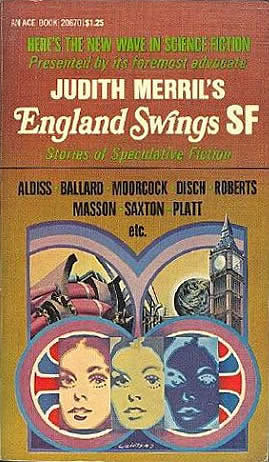
The most stimulating challenge that has come to science fiction writers recently has been the question of whether it is time for a change. The advocates of what is called the New Wave say yes. They insist that the "old" science fiction belongs to the past, is stereotyped, and no longer represents the whirl of modern times, the revolution of new thinking and the mind-tingling innovations that seem to be prevalent in all the arts these days.
The New Wave in SF--they prefer to call it Speculative Fiction--has its roots among the imaginative writers of England, most specifically around the magazine New Worlds, and a great deal has been coming from that source that is indeed different and surprising. Judith Merril, an acknowledged authority on science fiction, has made herself the foremost American defender of the New Wave, and in this book ENGLAND SWINGS SF she has produced an anthology and a running, sparkling dialogue between its contributors and its editor on what they are doing to SF in England and why they are doing it.
Are the New Wave advocates correct? Is it indeed time for new forms and new approaches to imaginative speculative fiction? Has science fiction as we have known it really become moribund?
Here is the book which may be the turning point of that New Wave. Ace Books presents it because it is a work, a manifesto perhaps in the form of a group of most unusual SF stories, which everyone interested in science fiction ought to read. It will be a stimulating experience, whether you agree with Miss Merril or not.
Ace Books, long the foremost publisher of science fiction in America, does not take any stand on this controversy. We have published and will continue to publish the best obtainable in all types of writing, from space-action adventures to the award-winning Specials, from the old "classics" to the best of the new collections of short stories. We reprint ENGLAND SWINGS SF not because we are in agreement or in disagreement with it, but because we think it is part of Ace's traditional service to science fiction.
Two quotes may be apropos. Josephine Saxton says, inside the book, "British writers are in the vanguard--one thing they do is make much American S.F. look old-fashioned."
Isaac Asimov said, outside the book, "I hope that when the New Wave has deposited its froth and receded, the vast and solid shore of science fiction will appear once more."
Decide for yourself.
"A mind-stretching, nerve-sizzling adventure." -- Raleigh News & Observer
"So far out it's left the understandable galaxy." -- Atlanta Journal
"Intriguing, disturbingly mod... a bit too much of a good thing." -- Publishers Weekly
"This book is a must for anyone interested in the future of the field of SF. Or in the future." -- WBAI, New York
"They are closer to the world of Kafka and William Burroughs than to Asimov and Bradbury... it is doubtful that the New Wave will sweep away the more traditional science fiction." -- Boston Globe
"The first wholesale application of modern styles of writing to the SF short story form." -- Columbus Dispatch
Contents: The Island (1965) by Roger Jones Ne déjà vu pas (1967) by Josephine Saxton Signals (1966) by John Calder Saint 505 (1967) by John Clark The Singular Quest of Martin Borg (1965) by George Collyn The First Gorilla on the Moon (1968) poem by Bill Butler Blastoff (1964) by Kyril Bonfiglioli You and Me and the Continuum (1966) by J. G. Ballard Who's in There with Me? (1968) by Daphne Castell The Squirrel Cage (1966) by Thomas M. Disch Manscarer (1966) by Keith Roberts The Total Experience Kick (1966) by Charles Platt The Silver Needle (1967) poem by George MacBeth The Baked Bean Factory (1967) by Michael Butterworth The Hall of Machines (1968) by Langdon Jones The Run (1966) by Christopher Priest All the King's Men (1965) by Barrington J. Bayley Still Trajectories (1967) by Brian W. Aldiss Sun Push (1967) by Graham M. Hall Report on a Supermarket (1968) poem by Michael Hamburger Dr. Gelabius (1968) by Hilary Bailey The Heat Death of the Universe (1967) by Pamela Zoline The Mountain (1965) by Michael Moorcock Psychosmosis (1966) by David I. Masson The Idea of Entropy at Maenporth Beach (1967) poem by Peter Redgrove Same Autumn in a Different Park (1967) by Peter Tate The Assassination of John Fitzgerald Kennedy Considered as a Downhill Motor Race (1966) by J. G. Ballard Plan for the Assassination of Jacqueline Kennedy (1966) by J. G. Ballard
Judith Josephine Grossman (Boston, Massachusetts, January 21, 1923 - Toronto, Ontario, September 12, 1997), who took the pen-name Judith Merril about 1945, was an American and then Canadian science fiction writer, editor and political activist.
Although Judith Merril's first paid writing was in other genres, in her first few years of writing published science fiction she wrote her three novels (all but the first in collaboration with C.M. Kornbluth) and some stories. Her roughly four decades in that genre also included writing 26 published short stories, and editing a similar number of anthologies.
This was a very ambitious anthology that Merril edited in 1968 to showcase the New Wave speculative fiction movement of England. Harlan Ellison's very popular Dangerous Visions had appeared the year before, and Merril posited that the heart of the English New Wave was ripe for American consumption. There was a lot of division in the field over the the question of traditional science fiction being too old-fashioned, juvenile, formulaic, and plot- rather than character-centered. Merril's book was experimental, even as to the introductions being off-centered and presented as conversations rather than as traditional lead-ins. Unfortunately, many of the stories were too diffuse and were slight or simple incomprehensible. Ace Books editor Donald A. Wollheim capitalized on the controversy as a selling point and included blurbs on the cover like: "...a bit too much of a good thing." from Publisher's Weekly, "So far out it's left the understandable galaxy." from the Atlanta Journal, and "...it is doubtful that the New Wave will sweep away the more traditional science fiction." from the Boston Globe. There are some near-classics included, such as The Assassination of John Fitzgerald Kennedy Considered as a Downhill Motor Race, and Plan for the Assassination of Jacqueline Kennedy by J.G. Ballard, and The Squirrel Cage by Thomas M. Disch, and stories (mostly from Michael Moorcock's New Worlds) by authors such as Josephine Saxton, Keith Roberts, Charles Platt, Michael Butterworth, Brian W. Aldiss, and many others. Now, over fifty years on, it seems to me that it's interesting as an historical place-marker, but not so much for entertainment.
The title seems to promise Austin Powers style grooviness, an era-specific relevance which today could be enjoyed only as irony or parody. After more than 40 years one expects the bright primary colors of Now to have faded to the pale pastels of Back Then.
But I found the stories fairly fresh and for the most part not at all dated. The determination of the writers to do something different keeps the reader’s attention from flagging and the best part of the era that is re-captured here is the exhilarating feeling as one progresses from story to story that there are no boundaries and that anything can happen. The serious nature of the work at hand is shown in the influence of Joyce, Kafka, and Beckett, the inspiration provided by the Zeitgeist by a leavening of sex, drugs, and rock-and-roll.
Some of the standard SF (the writers for the most part prefer this to stand for Speculative Fiction) tropes are here – space flight, alien invasion, wild inventions, future war, post nuclear survivals, but there are also stories like Thomas M. Disch’s “The Squirrel Cage” and, the best of the collection, P. A. Zoline’s “The Heat Death of the Universe” that don’t fit in any category Hugo Gernsback or John W. Campbell would have recognized. Another highlight is Brian W. Aldiss’s “Still Trajectories” where the accelerating, out of control and crashing sentences superbly embody the drug-addled highway chaos he describes. While Aldiss, in his forties, is the old man among this set of youngsters, J. G. Ballard, though only five years his junior, is the golden haired boy of this group, admired by the editor and other contributors, and given the unique position of having three stories included, “You and Me and the Continuum”, “The Assassination of John Fitzgerald Kennedy Considered as a Downhill Motor Race” and “Plan for the Assassination of Jacqueline Kennedy”. These last two titles show what a very naughty boy Ballard can be and are the most “in your face” type of provocation the collection provides. Michael Moorcock, who provides an interesting post-nuclear tale in “The Mountain”, is the only other writer included whom I had previously read. I definitely will read more of Charles Platt (“The Total experience Kick”) and will be searching through anthologies for stories by Langdon Jones, whose “The Hall of Machines” anticipates some of Stephen Millhauser’s stories. Inevitably, there are some weak entries here; I think Michael Butterworth’s “The Baked Bean Factory”, drawing on the author’s “pot/acid experiences” and Hilary Bailey’s (Mrs Moorcock at the time) “Dr. Gelabius” are unlikely to have been much anthologized after their appearances here.
Most unusual for an SF anthology, in my experience at least, is the inclusion of four poets, which provided a welcome shift in rhythm and density of ideas. Of the poems, Bill Butler’s Beat-inflected “The First Gorilla on the Moon” and George Macbeth’s “The Silver Needle”, an allusive conglomeration of space opera and the myth of Perseus, obviously fit in an SF collection, while Michael Hamburger’s “Report on a Supermarket” and Peter Redgrove’s “The Idea of Entropy at Maenporth Beach” would not have raised any thoughts of SF had I encountered them in other contexts.
The editor’s commentary starts in the introduction and continues between stories where she presents her ideas and impressions in counterpoint with self-supplied biographical information from the writer of the preceding story. I found the introduction itself rather self-congratulatory, but came to value the context and information Merril provided as I progressed through the collection.
This is a very interesting collection of short stories from the English counterculture movement in the sixties, by science fiction authors. Some of the stories are well written and interesting, but it is hampered overall by prioritizing the unpublishable over well-written or enjoyable. There are a handful of reasons that a work might be brilliant but unpublishable; there is an infinity of reasons why a work is unpublishable because it just isn’t that good.
In some cases it isn’t even that the author is a bad author but that they, I suspect, knew who they were writing for and wrote accordingly. Brian Aldiss’s story is a poorly-managed Burroughs-inspired cut-up. J.G. Ballard—who is praised throughout the notes on the other stories—contributed a short story that is little more than a series of cheap puns. For example, the JFK motorcade was unable to speed up until the Governor was taken out.
Speaking of Ballard, this may have been published as a sort-of British response to Harlan Ellison’s Dangerous Visions a year earlier. Ballard’s piece here was supposedly originally written for Dangerous Visions but either rejected by Ellison because the topic—the assassination of JFK—was too dangerous or because Ballard’s American agent pre-rejected it and never sent it on to Ellison. This is referred to obliquely, I think, by editor Judith Merril in the notes on Ballard’s story/stories.
The story, “The Assassination of John Fitzgerald Kennedy considered as a downhill motor race” was so dangerous that it was later accepted by a government-funded magazine in England, Ambit.
Ironically, one of the better stories in this collection is about the stultifying effect of government-funded arts; Keith Roberts’s “Manscarer” was in the middle of the collection, and surrounded by stories whose notes contained gushing praise for the Arts Council for funding failing science fiction magazines.
The best of these stories remind me a lot of Grant Morrison and Neil Gaiman. “The Heat Death of the Universe” is very Gaimanish. In this sense, the collection did a good job of showcasing the tone and style of the coming British Invasion of superhero comics, and those stories are definitely worth the collection.
Hilary Bailey (Moorcock) had an interesting take on artificial birth, though very abrupt. Michael Moorcock’s The Mountain was very Stranger-esque, with an affectless protagonist who doesn’t think much of the future, or even cause-and-effect. It is definitely a story that requires (deliberately on Moorcock’s part) multiple readings.
RATED 70% POSITIVE. STORY SCORE = 3.39 OUT OF 5 28 STORIES : 4 GREAT / 13 GOOD / 5 AVERAGE / 2 POOR / 4 DNF
This may be the most important SF book of the year … (or it may be the least. You must Judge for yourself. - The back cover of the paperback edition
England Swings SF is a famous and influential anthology of the period of time in Science Fiction known as The New Wave. It was a moment in when some SF writers were trying to expand and transform what Science Fiction could be. Avant Garde literary techniques. An emphasis on character above science. More explicit sex, violence, and politics. A break from the traditional American SF which was seen as the opposite of all those things. Editor Judith Merril was one of the leading figures of the New Wave movement and her work continues to be quite controversial.
It is a work, a manifesto perhaps in the form of a group of most unusual SF stories, which everyone interested in Science Fiction ought to read. It will be a stimulating experience, whether you agree with Miss Merril or not. …. We reprint ENGLAND SWINGS SF not because we in agreement or in disagreement with it, but because we think it is part of Ace’s traditional service to science fiction. - Donald A. Wollheim
When discussing the book on the wonderful Best Science Fiction and Fantasy Short Fiction Facebook Group, opinions ran the gamut from ‘it opened my eyes to new authors and new kinds of storytelling’ to ‘a particularly lacklustre selection.’ Other people found a quote that said the Merril caused ‘irreversible damage’ to the field of Science Fiction.
Whatever one’s opinion of Judith Merril and the New Wave, it is impossible to read England Swings SF with anything resembling the perspective that a reader in the time period who have had. The New Wave permanently changed Science Fiction and the stories that were inspired by it are better than the stories in this anthology. For the most part.
I’ll admit that I didn’t find this an enjoyable read. Many of the stories were borderline unreadable, with the highest number of DNF’d stories.
This anthology is deeper than merely the stories, because of the original way that Merril handled author biographies. They come after the story and are an interplay between Merril and the Author, taking place side-by-side. There is so much to enjoy here with an argument about the value of the New Wave with Brian W. Aldiss. We learn that the was the first published story for many of these writers and that everyone thinks J G Ballard is great. I agree, but there are more great stories than just Ballard’s.
You and Me and the Continuum • (1966) • short story by J. G. Ballard. Inscrutable, yet compelling. Structurally interesting with each very short section beginning with a consecutive letter of the alphabet. An abortive version of Christ’s Second Coming is told in tiny fragmented vignettes. I’m having great trouble trying to summarize it, but that’s kind of the point. You need to experience this story.
The Hall of Machines • (1968) • short story by Langdon Jones. This was the story that made me pick up the anthology. This is a beautiful, haunting, and plotless depiction of a few amazing machines from the Hall of Machines - which is possibly infinite in size. Different, but beautifully written. I wish the whole book had been this good.
All the King's Men • (1965) • novelette by Barrington J. Bayley [as by B. J. Bayley]. Aliens have conquered specific countries (England, Brazil, South Africa) but not the entire Earth, and are using them as pawns in a larger game. A smart and interesting version of alien occupation.
Sun Push • (1967) • short story by Graham Hall [as by Graham M. Hall]. A brutal human story of civil war in England told from the perspective of a solider with a desire to create art. Quite the visceral war story.
***
The Island • (1965) • short story by Roger Jones
Good. Three men live on an island in a strong power dynamic until one explores
Ne Déjà Vu Pas • (1967) • short story by Josephine Saxton
Average. Woman finds herself in an alternate state where everything is reversed.
Signals • (1966) • short story by John Calder
Good. Scientist communication with signal from other civilizations that are - like us - atoms in something bigger.
Saint 505 • (1967) • short story by John Clark
Average. Structurally expirimental story involving religion, a computer, and an undeveloped cast of characters.
The Singular Quest of Martin Borg • (1965) • novelette by George Collyn
DNF. This was dreadful. A young man is infantalized by robot, adopted by aliens, and leaves for adventure. Written with the worst faux-humorous voice.
The First Gorilla on the Moon • (1968) • poem by Bill Butler
Good. Weird, but fun and very short. Gorilla in space. Maybe?
Blastoff • (1964) • short story by Kyril Bonfiglioli
Poor. Some weird fusion of Jesus and a Rocket Launch.
You and Me and the Continuum • (1966) • short story by J. G. Ballard
Great. Inscrutable, yet compelling. Structural interesting with each very short section beginning with a consecutive letter of the alphabet. An abortive version of Christ’s Second Coming is told in tiny fragmented vignettes.
Who's in There with Me? • (1968) • short story by Daphne Castell
Average. Various people spend time in some simulation.
The Squirrel Cage • (1966) • short story by Thomas M. Disch
Good. The internal mentality of a man held captive.
Manscarer • (1966) • novelette by Keith Roberts
Good. Well written weirdness of an artist who constructs giant mobil sculptures.
The Total Experience Kick • (1966) • short story by Charles Platt
Good. A more conventional story of corporate espionage and a new way to experience music as a Total Experience. Prescient.
The Silver Needle • (1967) • poem by George MacBeth
DNF. Reads like a juvenile internet troll trying to shock with vulgar sex talk and Nazi stuff. Bounced out of this fast!
The Baked Bean Factory • (1967) • short story by Michael Butterworth
Good. A girl dies of radiation poisoning as corporations turn advertising into actual war.
The Hall of Machines • (1968) • short story by Langdon Jones
Great. A beautiful, haunting, and plotless depiction of a few amazing machines from the Hall of Machines - which is possibly infinite in size.
The Run • (1966) • short story by Christopher Priest [as by Chris Priest]
Good. War has started. As a Senator tries to get back to The Base, he is disrupted by scores of young people.
All the King's Men • (1965) • novelette by Barrington J. Bayley [as by B. J. Bayley]
Great. Aliens have conquered specific countries (England, Brazil, South Africa) but not the entire Earth, and are using them as pawns in a larger game.
Still Trajectories • [Colin Charteris] • (1967) • short story by Brian W. Aldiss
DNF. Either Aldiss was on drugs or I am. I could not focus on anything in this story.
Sun Push • (1967) • short story by Graham Hall [as by Graham M. Hall]
Great. A brutal human story of civil war in England told from the perspective of a solider with a desire to create art.
Report on a Supermarket • (1968) • poem by Michael Hamburger
Good. Fun SF poem about a cynical supermarket of the future.
Dr. Gelabius • (1968) • short story by Hilary Bailey
Poor. Doctor has a bunch of fetuses for some eugenic program. Very short.
The Heat Death of the Universe • (1967) • short story by Pamela Zoline [as by P. A. Zoline]
Good. A comparison of the end of the universe to the daily life and work of a housewife.
The Mountain • (1965) • short story by Michael Moorcock
Good. The last two men on earth after a war follow a woman’s tracks over a mountain.
Psychosmosis • (1966) • short story by David I. Masson
Good. A strong primitive culture where the speaking of a wrong name transports you to a place between the living and the dead. Probably a fantasy story.
The Idea of Entropy at Maenporth Beach • (1967) • poem by Peter Redgrove
Average. A white woman submerges herself and comes out black.
Same Autumn in a Different Park • (1967) • short story by Peter Tate
DNF. OH HELL NO STOP A STORY TOLD ONLY IN TELEGRAM STOP JUST STOP STOP
The Assassination of John Fitzgerald Kennedy Considered As a Downhill Motor Race • (1966) • short story by J. G. Ballard
Good. Fun and irreverent retelling on the Assassination of John F Kennedy. Experimental fiction, not SF.
Plan for the Assassination of Jacqueline Kennedy • (1966) • short story by J. G. Ballard
Average. Short snippets of people who want to kill Jackie Kennedy and have sex with cars.
Mindwebs audiobook ##5 is “The Run” by Christopher Priest which was taken from this collection. (Or See ##13 below ).
I really enjoyed this provocative story of future conflict between a mob of unemployed youths and a lone senator. The tension was palpable and the senator wrestled with his conscience knowing he could plough down a fair portion of the mob before they overwhelmed his maglev car. The ending was rather dark as this future society eventually engages with mob totally undermining the senators brave and final decision to try to build bridges rather than continue the escalation of conflict. We need to learn from this. 3 stars.
Irrelevant blurb.. I doubt that there are many politicians alive today who have that much integrity. Indeed I recall a certain person at Aberdeen University, (A “real” Darling), leader of the Student Representative Council proselytising with radical leftist rhetoric on our behalf for better student grants canteen food etc. He was actually from a privileged family and went on to become a cabinet member then Chancellor for the Exchequer for the Labour Party before accepting a life peerage and then retiring to accept highly lucrative city positions for such bastions of capitalism as Morgan Stanley etc. Despite the accusations of expenses irregularities while a minister, he’s done some good work but to end up earning over £100k + £250,000 in stock kinda makes me doubt his integrity. He’s certainly a millionaire now which has somewhat disappointed and disillusioned me.
05 Mindwebs-761126_TheRun.mp3 Christopher Priest ################################ Mindwebs audiobook ##13 "The Squirrel Cage" 1966 Thomas M. Disch. A story about a man in a cage. Possibly the last man, ever. He has no memory of most of his previous life, and suspects he may have to live forever. He is given “The Times" daily, and is fascinated by a story about mysterious organophores with a rudimentary brain but no mouth or known method of eating. A fantastic soliloquy! 5 stars.
This entire review has been hidden because of spoilers.
Another one of the books that blew my world open back in the early Seventies. It was so good to see another sf revolution going on. And Swinging London Era Britain seemed as exotic as fuck to a guy still experiencing an East LA/West Covina upbringing. Spec Fic from an alien culture! Groovy! I also liked the idea that writing could be experimental (I still think than in science fiction, a short story should be like an experiment, and a novel an expediton). I also learned that you don't have to understand something appreciate or enjoy it. And avant-garde is always better when it retains a sense of humor. I hope the anthologies my stories are in can have a similar effect on today's young people.
One might think it's always good for contributing authors to have bios in an anthology, but my complaint here is that the common thread of these authors is how they're comparing themselves to USA-based speculative fiction -- so they've come off as trying to distance/distinguish themselves from USA as a way to define their work. Healthy competition or a chip on their shoulder? I do approve of the unique and short intro to classic British SF by Merril though. More importantly, this has a whopping 28 entries and 26 authors (J.G. Ballard has 3 entries), and at least a third are guaranteed hits IMO, of which set a high bar for maturely aesthetic writing. Not all of them I care for at the moment, such as those in poem format, military/war setting, borderline fantasy -- but I'll come back to re-reading with a better headspace and a more open mind. This being said, there's something for everyone in the diverse stories. Most of the entries don't have a straightforward plot and don't provide their commentary at face value, so it can be tough/disorienting to read at first (had to read some of them more than once), but the payoff is great. Some faves:
The Island (Roger Jones): Is a cozy lie better than the awful truth, especially for these stranded survivors?
Ne Déjà Vu Pas (Josephine Saxton): If I travel far enough to "the edges of space and time" via "the gravity of not-time", will I get to meet yaniP iF IcS?
Signals (John Calder): Are there parallel universes contained within atoms of our universe, and in turn, our universe contained within atoms of other parallel universes? 🤯
The Singular Quest of Martin Borg (George Collyn): A space opera derivative of Heinlein's "All You Zombies--" aka the 2014 "Predestination" movie, but better?
The Squirrel Cage (Thomas M. Disch): Is the imprisoned and bored writer abducted by aliens or not?
The Total Experience Kick (Charles Platt): Prescient of the (dark) future of the music industry?
The Assassination of John Fitzgerald Kennedy Considered as a Downhill Motor Race (J.G. Ballard): Irreverent or hilarious alternate reality?
a very cool piece of history, also contained my first ballard! which was fine. not a Huge number of bangers but definitely a stunner or two, my favorite being "Same autumn in different park” by Peter Tate. the little author … i wouldn’t necessarily say bios? but micro-interviews/bios at the end of each story were very interesting though. they really captured what the zeitgeist was at the time; of a movement in England of those interested in pushing what SF could be beyond (1) American (2) from the technological to the psychological and (3) from the real to the surreal or from the prosaic to the poetic? which begs the question why SF? the shorts still swirled around scifi concepts like post-apocalypse, experiments, aliens/space civilization; but their point seemed to be the effect of surrealism, temporal circularity, observations on modern disaffectedness. it felt across the board like the scifi setting was just the ideal jumping off place to play in these psychological spaces without having to move to much furniture to get there. it was very cool to see how much of the attitude was explicitly about pushing against the rationalism or science focus of american scifi, of doing something else, and how this too is part of scifi history.
I loved this collection when it came out in 1968 and I was a teenager new to sci-fi fandom. But the stories in here don't really hold up all that well 50 years on. The SF in the title refers to "speculative fiction," a term I wholeheartedly applaud the use of. But several of these stories read more like general experimental fiction with little tie to either science or whatever definition one might apply to "speculative." Beware revisiting the pleasures of youth (a lesson I should have learned well by now).
“The Island,” by Roger Jones (1965): 8.75 - A somewhat crude allegory, and one nonetheless forgivable, as it’s not trying to be anything but. Within these parameters, then, the story’s quite successful, sketching out an intentionally vague conceptual premise (three men in a clearly defined, abusive hierarchy, with all the attendant, and yet unsatisfactory, justifications built in) and arena upon which abstract questions can be posed—and, to its credit, giving few and/or dark answers to many at the same time. In this way, prose-wise, the story reads much more like the allegorical example provided in a scholarly text — say philosophy or economics — than that existing in a mid-century science fiction magazine—a fact that I can imagine explains its pride of place in an anthology presenting novel ways of doing sf across the pond. And rightfully so. STORY: that premise, the mute one is actually smart though — or, actually (and this is one of the best elements of the story), he’s not “smart,” he just likes to think and can “reason” his way to solutions for his questions as easy as anyone else; those solutions here being: kill my captor and walk to the house to see what’s going on. In the house: skeletons (the allegorical jonbar point, if you will, as some of the other elements are pretty straightforward [ie pointlessness of “work”; ladders of abuse; weak justifications for accepting status quo]—meaning: how do we read this?)