“A shell whined in over the highroad to Churubusco. The Mexican gunners in the convent of San Mateo had found the range…Sword in his left hand, pistol in his right, Orry [Main] crouched in the marshy cornfield beside the road. He cringed as he awaited the explosion of the shell. The concussion nearly knocked him over…To his left, a geyser shot up from the wet field, lifting cornstalks and bloody heads and limbs with it. It was mid-afternoon, the twentieth of August. Orry had been in heavy fighting for nearly three hours and had thought himself numb to the sights of violent death. The disappearance of an entire squad of men when the shell hit showed him how foolish he’d been. He gagged as the human remains splattered back to earth…”
- John Jakes, North and South
For me, John Jakes’s North and South occupies a place in the top tier of historical fiction for one simple reason: it is absolutely committed to being two diametrically opposed things.
On the one side, North and South is one-hundred percent soap opera, awash in the low, quotidian drama of people falling in love, people falling out of love, plotters scheming about sex or power, and schemers plotting about power or sex. There are fisticuffs and battles, betrayals and revenge, and even a duel or two. It is crowd pleasing fun.
On the other side, North and South is one-hundred percent serious about the United States in the antebellum era, especially with regard to slavery. Big chunks of the novel are set in prewar South Carolina, and though there is plenty of serene gazing at the big white houses, magnolias, and genteel chivalry, it doesn’t go more than two or three pages at a time without reminding you of the raw, gaping wound of slavery.
As you might have noticed, my percentage math does not quite add up, in the same way this book does not quite add up. These different impulses – to divert and to teach – often bump and grind against each other. There are mixed messages galore, including a dance with moral relativism that lasts almost the entirety of the book’s 700-plus page length.
(I dare you to play the “both sides” drinking game, and down a mint julep each time a character equates the sin of slavery in the south with some other, supposedly equal sin in the north. Actually, I don’t dare you, because it will kill you).
The setup of North and South is simplicity itself, literalizing the figurative conception of a “house divided against itself.” While obvious, it is also quite effective. In the north, we have the Hazard family, and in particular George Hazard, who – when the novel opens in 1842 – is heading to the United States Military Academy at West Point. George comes from a wealthy family of Pennsylvania ironworkers. Before he even gets on the steamboat to take him up the Hudson, he meets Orry Main, the son of a wealthy rice grower in South Carolina.
George and Orry become friends the old fashioned way: by beating up some aggressive stevedores. From there, their bond grows and deepens, as they survive the sadistic, wonderfully-named upperclassman Elkanah Bent; fight in Mexico; and attempt to navigate the turbulent rapids of American domestic politics in the years leading to the Civil War.
While things begin with George and Orry, the story expands to include the other members of each family. Especially important, in the north, are George’s brothers Stanley and Billy, as well as abolitionist sister Virgilia. Among the Mains, a number of storylines belong to Orry’s progressive brother, Cooper; devious sister Ashton; and boring sister Brett.
Jakes writes in a firmly realist style. In his world, a thing is a thing, and he evokes that thing with detail. This works well for creating a sense of place, whether that is a muggy southern plantation or a smoke-belching northern factory. On the other hand, he tends to over-describe his characters thoughts and emotions, bluntly informing us the exact state of their hearts at any given moment. This has the effect of flattening the characters to a certain extent, by taking away ambiguities and shadings.
That is not to say that Jakes’s characters are not memorable, for they are, and not simply because they were performed with such utter devotion in the fabulous 1985 miniseries. The brooding Orry, his star-crossed lover Madeline, and Madeline’s ferociously hateful husband, Justin, are just three of the unforgettable creations in a lengthy dramatis personae. They can be short on psychological complexity, but never lack for impact.
Jakes keeps this story moving at a pell-mell pace, heedlessly speeding from one encounter to the next. The result of this pacing is a noticeable inconsistency in the big set pieces. For instance, Orry and George’s time in Mexico – despite some sharp scenes – generally feels truncated, despite it being one of the signature moments in their lives (with major repercussions for their futures). Truncation is a natural result of Jakes’s proclivity for needless subplots, and I wouldn’t have minded the disappearance of a character or two (such as Cooper, who does not exist in the miniseries).
Still, more often than not, Jakes is able to deliver. Near the end of the novel, he does a fine job narrating the travails of Cousin Charles, who is posted to Texas with the Second Cavalry. Also good is Jakes’s conception of a post-secession Charleston as a riotous Cabo San Lucas on spring break.
In any event, whether an arc pays off or not, there is no danger of getting bogged down. If you didn’t like a love scene, a battle, a fistfight, don’t worry, because there is another love scene, battle, or fistfight just around the corner. Of course, if you don’t like love scenes, battles, or fistfights – or brandy snifters, heaving bosoms, and expositional dialogue masquerading as everyday conversation – you best look elsewhere.
(A quick note on the love scenes, since you are all secretly wondering: they are of the goofily euphemistic, soft-R variety. People are definitely having sex, but there isn’t a single description that will have you reaching for a cigarette or clutching your pearls. The violence, though, is fully hardcore).
Being historical fiction, a number of real people make cameo appearances. Jakes does not really take the time to give any of these walk-ons an interesting characterization, and at times, their presence feels like window dressing. With that said, I give Jakes credit for his research, which is extensive. He is not always able to work that research into his novel organically, but it cannot be said that he has not studied the period of which he is writing.
This is as good a time as ever to segue to slavery, an institution which is inseparable from any discussion of the Civil War. Jakes is on record as making a determined effort to avoid being a southern apologist, even as several of his most likeable, dashing, and able protagonists have as their flaw a propensity for owning their fellow human beings. When all is said and done, I think Jakes succeeds rather admirably.
The evils of slavery, the ugly realities of involuntary, race-based servitude, are constantly at the forefront of North and South. To be sure, there are many voices rationalizing the practice, or equating the enslavement of people with “wage slavery” in the north, but those voices are consistent with 19th century viewpoints, and create the palpable tension that quivers like a live wire from the first page to the last. Jakes does a remarkable job of imagining what it must have felt like to live in these times, with the country trembling along the Mason-Dixon fault line. To exist in the years leading up to 1861 was to exist in the midst of a massive, deafening, multiparty argument among idealists and opportunists, between revolutionaries and reactionaries, all trying to forge their vision into being.
Unsurprisingly, Jakes is not perfect on this front. While there are black characters, we never really get their perspective. Too often – though there are exceptions – blacks seem more like audience members watching their fates argued over by others than active participants. Furthermore, I found it a bit troubling that the one abolitionist in the novel – that is, the one character whose moral compass actually points true north – is presented as literally mad.
Gone With the Wind, to which North and South aspires in setting, grandeur, and scope, is a better book. But – and this is important – North and South has the advantage of being simultaneously more sensitive and more accurate regarding issues of slavery and race.
This is all getting a bit heavy, so I’ll wrap it up.
You shouldn’t read a novel to learn history, any more than you should attend the Indy 500 in place of driver’s ed. Yet there is something to be said for the ability of fiction to spark your imagination, to encourage you to learn more about a person, an event, a period. There is also something to be said for the way that fiction can spark our empathy, and help us to connect with people, even though their lives and ours are separated by a century-and-a-half.
But let’s not get too serious here. Weighty themes are debated, to be sure, yet just about every character is willing to forget their own name at the glimpse of perfumed décolletage or britches that are just a bit too tight. There is a trashy heart at the center of North and South, and I say that with admiration.
Jakes ably fulfills the first imperative of historical fiction, to take you back in time, and once it gets you there, to keep you entertained.


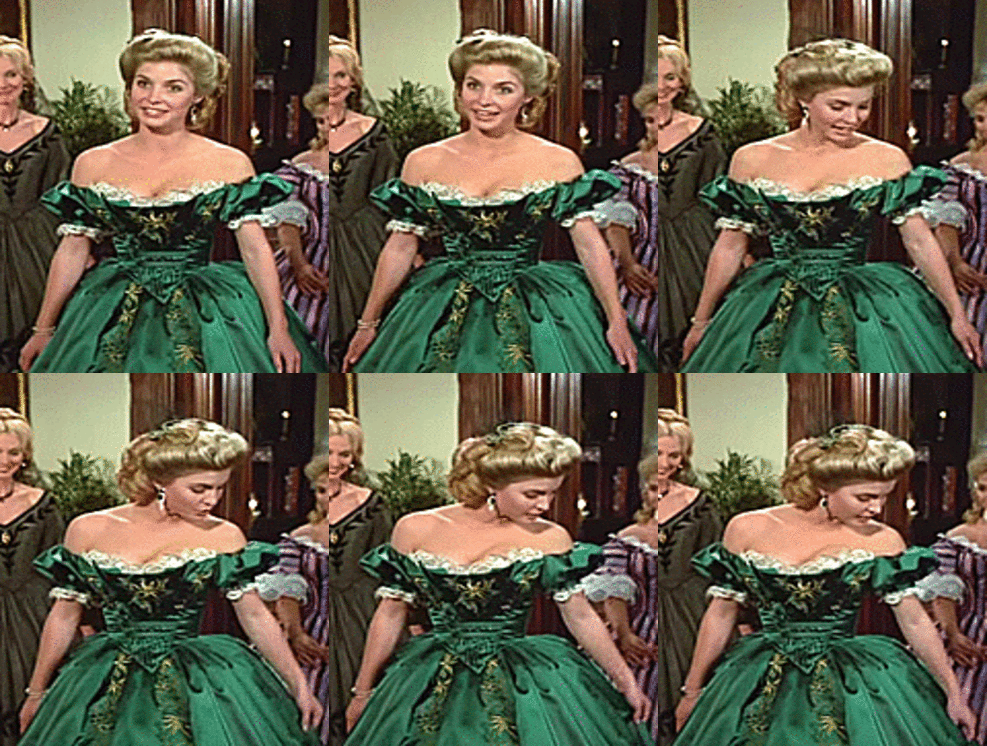


 The mini series.


