Books can be attributed to "Unknown" when the author or editor (as applicable) is not known and cannot be discovered. If at all possible, list at least one actual author or editor for a book instead of using "Unknown".
Books whose authorship is purposefully withheld should be attributed instead to Anonymous.
You certainly have to love the occasional lyric poetry, especially when it is about the end of everybody’s favourite legendary English king, Arthur Pendragon. Actually, I’m not sure if that is actually his last name, though it seems that this guy, and the legend that surrounds him, is much like Robin Hood – he may have existed, he may not have, but a huge legend has arisen around them while there doesn’t actually seem to be any consistency in these legends. In fact, this particular book contains two contrasting versions of his death, though the common feature is that he was killed by Mordred (though whether Mordred was his son or not is also up in the air because one of them suggests that he is, while the other suggests that he is just naughty lord).
Anyway, these two poems contain literally everything, and it is no wonder that the story of Arthur has been picked up by so many authors and film makers, and the stories that come out of it are vastly different in nature. For instance there was a film from the eighties called Excalibur which focused much more on the fantasy elements, with Excalibur, Merlin, and a tragic end as he searched for the holy grail. Another version (named King Arthur), was set during the times when the Romans pulled out of England, and Arthur was basically a Knight from the other side of the empire and was fighting to stop the Picts from overrunning the England.
There was also this book I remember called The Mists of Avalon, which I remember seeing as a kid, but never getting around to reading it, probably because upon looking at it I came to the conclusion that it was the thickest book ever written – in fact it was huge. Mind you, there are probably much, much thicker books these days, but that one still sits in my mind as being pretty thick. Oh, and we cannot forget to mention this all time classic.
As I previously mentioned there are two versions of the story, both of them dealing with Arthur’s death, so there is no mention of Merlin, nor of the sword, nor of the Lady in the Lake (or the test to remove the sword from the stone). In fact both stories seem to eschew the fantasy elements and come across much more historical. Anyway, the first story deals with Arthur going on conquests across Europe and coming to blows with the Emperor of Rome. He eventually defeats the emperor, however discovers that back in England Mordred has taken the throne for himself. Mind you, after going to war with Rome, Arthur has actually lost a lot of men, but with the handful of men he does have he returns to England, confronts Mordred’s much larger army, and defeats Mordred while dying in the process.
There are a couple of things that come out of this story, one of them being the plot where the King is abroad and the person keeping the throne warm decides to name himself as king. This is something that has happened a number of times in history, but the one event that comes to mind is that of Richard II (of which I have written two blog posts, the second being here). Mind you, I would hardly equate Arthur with Richard, particularly since if it wasn’t for Shakespeare’s play he would probably be little more than a footnote in history – Arthur is a legend. Mind you, it is noticeable that both die, because we can’t have Mordred defeating Arthur and giving us an evil laughter and riding off into the sunset. Mind you, even in Shakespeare’s tragedies the bad guy eventually gets it in the neck. In a way it seems as if you simply cannot have a situation where the bad guy wins, and the good guy simply cannot come back and eventually win the day – it is almost as if it is anathema in literature.
The other thing is how Arthur pretty much conquers Europe. This is taken directly out of History of the Kings of Britain, and seems to attribute the barbarian invasions of Rome to being an invasion let by Arthur. Mind you, Monmouth puts Arthur around 700 AD, which is sometime after Rome collapsed, but it is interesting how we have no record of any legendary king carving out a huge empire in Europe. However, it should also be noted that this is one of those empires that exists only on the personality of a single man, and it appears that after his death the kingdom pretty much disintegrates. Another thing that I have noticed is that Bede seems to have a gap in his Ecclesiastical history right around the time Monmouth has Arthur appear. That’s not to say that I am suggesting Arthur existed because, other than Charlemagne, there doesn’t seem to be any evidence of a king establishing an Empire on the Continent, especially one where the throne was in England.
Mind you, this whole thing reeks of nationalism, yet it is interesting that England did have an identity as far back as the 10th century. Monmouth also suggested that two English Kings were responsible for crossing the channel in around 400 bc, conquering Europe, crossing the Alps, and sacking Rome. Obviously what is happening here is a medieval version of ‘Fake News’, though it is probably better described as being ‘fake history’ (though the Romans seems to have a lot of problems with this fake history) – this is history that really has no substance to it, and no archaeological support. Mind you, writers of history back in those days really didn’t take the academic and scientific approach that we do today (though all history is still tainted by opinion), but rather wrote from the legends that were in vogue.
The second story is pretty much the same (that is about how Arthur died), however it’s focus is more on the love affair between Lancelot and Guenevere. In fact, this affair could be considered one of the greatest affairs in literature (okay, there are probably others, but I really have no interest in stories about love affairs – I would call them forbidden love but it sounds so clichéd – still, something that you can’t have always seems much more desirable than something that you can). Whereas the first story has a lot more action and large scale battles, this one has a lot more intrigue where people are being killed, and then the murder is being covered up, and there is adultery, poisonings, duels, and finally King Arthur’s death.
In a way this is an incredibly painful episode to watch because we all know how it is going to end – badly – especially since Lancelot is one of Arthur’s most trusted knights. However, this episode is set mostly in the court of Camelot, and doesn’t even have any mention of wars and expeditions to foreign lands. Actually, come to think of it there is always the story of David and Bathsheba in the Bible – that’s a pretty well known love affair, but I digress. Anyway, it seems as if the story of Arthur is a story of betrayal, with his wife and best friend having hanky panky behind his back, and Mordred going off and stealing his throne (and dying in the process).
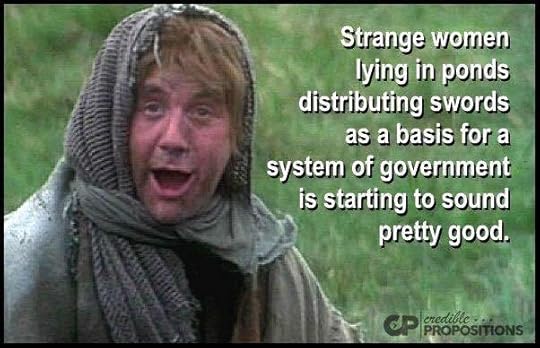
Anyway, before I finish off, I probably should end with this cartoon, especially considering the state of politics these days:
This volume contains two accounts of the same topic: king Arthur's death and demise of the Round Table. Morte Arthure (around 1400) is an alliterative poem, focusing on Arthur's and the knights' of the Round Table war exploits against the Romans. What strikes me here, in this Arthurian poem, is the richness of the detail and explicit descriptions of the war (and anything connected with it). At the times, I couldn't help myself thinking I am watching a Die-Hard type movie, with blood and body parts flowing and flying everywhere. And of course, everything a good chivalrous romance needs, is also there: super-natural forces, divine help, treason, magic.....Love, however, is absent-it is mentioned only once, and that in an indirect way. The second poem is Le Morte Arthur-stanzaic (around 1350), which makes it very agreeable to read it out aloud (which I did). The subject is (almost the same as in the poem above), but it differs in that love plays a central role here (the liaison between Lancelot du Lake and queen Guinevere). As love is absent from the Morte Arthure, magic doesn't play any part in Le Morte Arthur. Both romances represent a fine exemple of English poetry. They draw on French sources, but do not follow them blindly. They are adapted to the circumsatnces of the 14th and 15th centuries (as is evident from the descriptions of battle techniques). The importance of these two romances is not its content, but in the influence they exerted on the last, and most beautiful English Arthurian romance, namely on the Le Morte d'Arthur by Thomas Malory.
I read half of the first ballad, and then the whole of the second. The first I found was far above my reading ability, but I thoroughly enjoyed the second, Le Morte Arthur. Le Morte Arthur is the story of the fall of Camelot and the Round Table. It is the story of how Lancelot and Guinevere's many affairs behind Arthurs back are exposed. In the end this abolishes the court. Vert entertaining, and full of beautiful poetry. I enjoyed the essays as well as the summaries. The summaries very much helped and improved the reading experience.
I enjoyed this volume. It contains two poems, the alliterative Morte Arthure (c. 1400) and the stanzaic Le Morte Arthur (c. 1350), both of whose subject is the series of dramatic events that lead to the death of King Arthur and several of his knights.
These poems pre-date Sir Thomas Malory's more well-known work Le Morte D'Arthur and it is clear from reading them that Malory heavily drew from the stanzaic poem, which in turn is a re-working of an earlier Arthurian work. That's the thing with Arthurian legend: there is no one "original" story. Rather, there is a whole corpus of medieval works in different languages that treat the subject of "The Matter of Britain." These two poems alone are starkly different in their narrative focus. Although both culminate with the treachery of Mordred and the death of the King, in the alliterative poem Mordred betrays Arthur after he goes to the continent to defeat the Romans, while in the stanzaic poem the betrayal happens while Arthur and Gawain are in France fighting against Lancelot. However, in Arthurian legend as a whole, both things are said to happen, depending on the work you read. Thus, since Malory's work synthesizes most Arthurian literature available at the time, I recommend readers to read that work if they want to know the "full story" of King Arthur and his Knights of the Round Table.
That being said, I wish I was more equipped to appreciate the different types of verse in this volume. Brian Stone (the translator) offers a helpful introduction about his sources and the meter of each poem, but I don't know much about the development of poetry in the English language to fully appreciate it. They were both very well written poems, and it was interesting to see how the characters differed in each poem. Gawain, for example, is much wiser in the alliterative poem and more stubborn in the stanzaic one, although also much more round. (Gawain deserves a much deeper discussion than this review allows). It is also interesting to think of these two poems within the context in which they were written: England's Hundred Years' War against France. Edward III and Henry IV may both have been the inspiration for these renditions of King Arthur.
I recommend this volume to students of English and/or Arthurian literature. Like I said before, people that want to read about the epic quests of all the Knights of the Round Table should read Malory instead. Also, if you are a fan of Lancelot, you will be disappointed to find that he only has a very minor role in the alliterative poem, though his character is at the center of the stanzaic one.
Morte Arthure -- The translation of this alliterative poem seems okay. It tries to keep the alliterative nature of the original poem, which works in some places and feels overwrought in others. The introduction to the poem is pretty good, anyway, and helpful in understanding it.
The story of the poem focuses for the most part on Arthur's battles with Rome, when they demand tribute for him, but it contains several other episodes, including Arthur's battle with the giant of Mont St Michel (not handed off to another knight, as that kind of episode often is in Arthurian literature, but undertaken by Arthur alone) and the fight against the treacherous Mordred. At this point, you can almost still relate to Mordred, treacherous and cowardly as he is -- or I can, anyway, perhaps influenced by his sincere lament for the fallen Gawain.
The fall of Gawain, and Arthur's reaction, remind me a lot of The Song of Roland, re: Roland's death and Charlemagne's reaction.
Le Morte Arthur -- The translation of the stanzaic poem is actually better than that of the alliterative poem, I think. I found it easier to read. Something about it keeps it lively, even though the subject matter is largely tragic. Again, the introduction is pretty good and explains what's going on pretty well.
The alliterative poem doesn't deal much with Lancelot, but this poem is based on a French version which focuses on Lancelot and Guinevere's adultery. Arthur is much less important here, and instead it's his knights and his wife that hold centre stage: Lancelot, Gawain, Guinevere. Although Mordred and Arthur are important too, they're not what lives for me in the narrative.
I do love Sir Gawain: his portrayal in this version is one I can get behind.
This is a book best tackled by the hardcore fan of Arthurian tales; it may be best to have read one of the more modern versions like "The Once and Future King" before trying this one. It is a long book, digressive, and nonlinear in it's narrative. The language is also makes it a tough read with frequent interruptions to check the glossary. The reward for all this work is a unique view of the environment of the high middle ages and the paradoxes of the code of chivalry and the hubris it causes in the protagonists. Herein are the tragic quests for the Holy Grail, the doomed romance of Lancelot and Guinevere, the triumph of Sir Gawain and the epic of Percival, all rolled into one big rambling package. It's a good look at how honor can govern lives and where the traps are.
I actually read a different version, the Keith Banes rendition from 1962. I found it a valuable insight into the values of the medieval tale-tellers.
The stories were enjoyable though not very well developed, as one might expect from a collection of legends. That said, it is remarkable how many characters there are and how much their affairs intertwine.
Two tales: one of the usual cleaving, hacking, slicing, chopping and general carnage on the battlefield. Chivalry it's called. The other a somewhat more simplistic poetic version from another source - translated with the best intentions, I'm sure.