Jump to ratings and reviews
Rate this book

The Little School: Tales of Disappearance and Survival

Rate this book
One of Argentina's 30,000 "disappeared", Alicia Partnoy was abducted from her home by secret police and taken to a concentration camp where she was tortured, and where most of the other prisoners were killed. Smuggled out and published anonymously, The Little School is Partnoy's memoir of her disappearance and imprisonment.

144 pages, Paperback

First published January 1, 1986

32 people are currently reading
925 people want to read

About the author

Alicia Partnoy

19 books6 followers

Ratings & Reviews

What do you think?
Rate this book

Friends & Following

Create a free account to discover what your friends think of this book!

Community Reviews

5 stars
261 (32%)
4 stars
334 (41%)
3 stars
171 (21%)
2 stars
28 (3%)
1 star
6 (<1%)
Displaying 1 - 30 of 66 reviews
Profile Image for Christmas Carol ꧁꧂ .
963 reviews834 followers
March 9, 2022
They cut off my voice
so I grew two voices
into different tongues
my songs I pour
They cut off my voice
so I grew two voices
in two different tongues
my songs I pour
They took away my sun
two brand new suns
like resplendent drums I am playing-
Today I am playing

Bernice Johnson Reagon quotes this poem by Partnoy at the start of her hard-hitting introduction.

Partnoy was one of the Disappeared. Over 30k political dissidents disappeared in Argentina between 1976-79 - & most were never heard from again. I guess you could call Alicia Partnoy one of the lucky ones as she survived & was forced to move to The States where she was reunited with her husband & young daughter.

The writing was somewhat fragmented, which normally I hate but with Partnoy's experiences, how could it be anything else? Partnoy & the other captives were kept blindfolded & were beaten if the blindfold became loose. They were also tortured- horrible, horrible torture - & sexually molested. Often this seemed to be because the guards were bored.

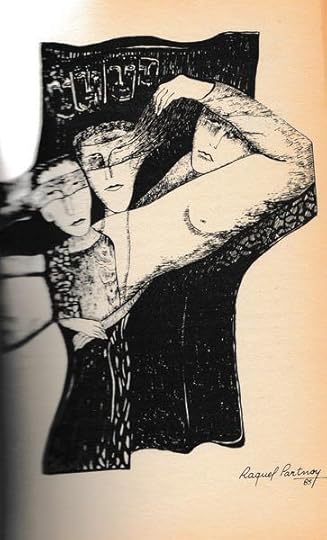
The b/w line drawings by Partnoy's mother Raquel are so moving & thoughtful;


The appendices at the back are very helpful in figuring out what happened & for keeping the characters straight. I wish the map of the prison (The Little School name is just some weird attempt at humour by the captors) had been at the front of the book.

Moving, an important part of recent history & very strongly recommended.


https://wordpress.com/view/carolshess...
Profile Image for Kara.
24 reviews
June 29, 2009
Most readers are confused by the shift in the narrative voice, and it's best to approach these stories as testimonial vignettes of the Little School, a detention center and torture chamber emblematic of many during Argentina's "dirty war." Partnoy remembers and recollects her experiences as a political prisoner, and her writing serves as an act of resistance and political testimony (this served as evidence against Videla). While many of the guards were exonerated of their torturous deeds, Partnoy does not let her country or her readers forget the humanity of the 30,000+ "disappeared." Her writing gives voice to the voiceless and re-writes history as it's been recorded. A very important text of the twentieth century.
Profile Image for Gill.
68 reviews5 followers
October 11, 2011
Alicia is a survivor of the Argentine dictatorship of the 1970's who was taken without legal process to a secret prison and tortured there. In Argentina these secret prisons are often called "concentration camps" but to me that term is being used for emotional weight and is inaccurate. Camps are open air, hold large numbers of inmates, kill with disease and forced labor as much as by violence, and their existence is publicly acknowledged to maximize terror. None of this was true in the Argentine case and these secret facilities, to my mind, resemble the prisons of the Inquisition or the Czar more than the camps of the Nazis or the Gulag.

Americans who speak casually about "waterboarding", "muscular interrogation", and suspension of habeus corpus should know where this leads. There was no excuse for this in Argentina and there is no excuse for it in the United States.

President Obama seems to be stopping it for now (January 2009) but whether this will be backed up by legislation and adherence to international treaties, like putting Americans under the jurisdiction of the World Court for war crimes, remains to be seen. As of now, the next President could go back to torture and secret prisons as easily as Obama reversed Bush's policies.

(2011 Update)
Obama did not reverse policy in these areas. That was an early hope, now seen to be hollow.
30 reviews
July 24, 2016
The pain of the desaparecidos is brought to life in this little gem that reads like real memories.
Profile Image for Amy Lenord.
42 reviews9 followers
May 14, 2013
I really loved reading this book despite the sadness and the tragedy the author faced. I am horrified, yet fascinated with the histories of Latin American countries and I searched out a book like this not to enjoy, but to educate myself. Although Partnoy is sharing immense darkness with us, she is so very human and miraculously finds a way to share with us the minutia that the human mind focuses on in search of comfort, to stave off insanity and to preserve that which makes us human.

The Little School is an important read and should be compared to books like Night by Elie Weisel or The Diary of Anne Frank because so little is widely known about the horrors that have taken place and continue to take place in Latin American countries under dictatorships.
Profile Image for Matthew Carr.
Author 22 books94 followers
May 5, 2024
Short, brutal tales from one of the most notorious torture and detention centres established by the 1976-1982 Argentine military dictatorship - La Escuelita (The Little School) in Bahía Blanca. Partnoy was a prisoner there, and unlike many others, she survived. These are heartbreaking glimpses of the world she lived through for more than a year, which capture the small ways in which people can sometimes affirm and hold on to their humanity, even in places where humanity is ruthlessly denied.
28 reviews1 follower
September 6, 2009
I first read this book in the late 1980s when working on my degree for Latin American Studies. It is only one of many books on this subject, however Alicia Partnoy's voice is so clear that the reader is present in the concentration camp - as frightening as this may be. Her simple human beauty also shines through the pages of this very sad tale - she may show anger and cynicism, but is never overcome by hate.
Profile Image for hh.
1,104 reviews70 followers
April 7, 2010
ok, i'm going to go out and say the awful thing first: there are some major issues with the craft of this book. it's half-brilliant, half-cringe-inducing from a technical standpoint.

the content is difficult and important. The Little School is a series of vignettes dealing with an Argentine concentration camp. the book is moving, funny, startling. it asks questions that have no answers, but should.
Profile Image for Tamara.
238 reviews23 followers
September 20, 2011
very quick read, very profound topic. The change in point of view didn't distract me as it did some others, for I didn't think the point was so much who things were happening to, but rather that they happened at all. I recommend it for anyone interested in Latin America.
Profile Image for J.M..
Author 301 books567 followers
June 23, 2009
Argentina has often been a hotbed for political activism. Even those unfamiliar with foreign governments know of Juan Perón and his wife Eva, immortalized in Andrew Lloyd Webber's catchy musical, Evita. For many of us, the concept of a military coup is unfathomable ~ such actions are relegated to footnotes in history books, dates learned in school and forgotten once we're tested on them. The fear that someone could barge into our homes and take us prisoner against our wills is unfamiliar to Americans. We say what we want, when we want, in ways that loudly broadcast our own beliefs, mostly without fear of reprimand or repercussion.

Alicia Partnoy's book, The Little School, is an eye-opener, to say the least. Within the pages of this slim volume lies a fictionalized account of her own imprisonment at the hands of the military that overtook her government. What makes her stories more profound is the knowledge that this didn't happen a lifetime ago but in the late 1970's, when most Americans were reveling in newfound freedoms of expression. While teenagers in the United States were expressing their views on warfare, feminism, and sexuality, their peers in Argentina were being silenced for daring to speak out against the government.

By 1979, over 30,000 people "disappeared." Most of these were young adults between the ages of 18 and 35, though Partnoy's book mentions some friends of hers who were abducted when they were merely 15 years of age. Parents watched helplessly as their children were taken by force from their homes; small children cried on doorsteps or were scooped up by relatives as their own parents were taken from them. These "disappeared" were transferred and held ~ blindfolded, immobilized, inadequately fed and clothed, tortured ~ in a secret concentration camp Partnoy calls "The Little School."

This book documents the stories of those imprisoned. Though the preface states that the stories are fictional accounts, the truth of Partnoy's experience is poignantly clear. Without detailing exact punishments or tortures, she nonetheless spells out clearly for her readers the agony and pain the prisoners endured on a daily basis. They were kept blindfolded and bound, forced to stand or lie completely still for hours on end in a room full of fellow prisoners with whom they were forbidden to speak.

It is the small details that make these stories so heartbreaking. A child's nursery rhyme that runs endlessly through the mind of one prisoner while being tortured. A friend's jacket that shields the guard's blows once that friend is removed from the school, possibly killed. A broken tooth kept in a matchbox that reminds one prisoner she is still "whole." The glimpses of life another prisoner catches through the bottom of the blindfold, where it doesn't quite lay flat against her cheeks. The sheer delight in catching raindrops in the palm of a hand where the window leaks during a storm.

These elements drive home the desperation and despair hinted at in the stories. They make the moments real, in a way more detailed explanations of the torture endured could not. Even without knowing the exact political views that caused the prisoners to be kidnapped and held, readers will empathize with the stories ~ feeling both a lingering helplessness at the prisoners' plights and an overwhelming indignation at the injustice imposed upon the rights of fellow human beings. Such a book will encourage readers to recognize their own freedom, which many take for granted, while serving as a constant reminder to be vigilant against atrocities that endanger freedom everywhere.
Profile Image for Rachel.
591 reviews24 followers
March 16, 2014
This short fictionalized novel tells the story of Alicia’s disappearance during the Dirty War in Argentina which was a period of
state terrorism against political rebels. The military and security forces lead guerrilla warfare against these progressive rebels’, and anyone believed to be associated with socialism. Our narrator recounts her experiences while being held at “The Little School”; a detention center controlled by the military regime. Through these short vignettes, we gain glimpses of the people she met
while being held captive, and the torture they experienced.

This is another assigned novel for my Human Rights literature class and I thoroughly enjoyed it! I love the narration style and it was heartbreaking to read the conditions the people lived in and the torture they went through. The novel explores the theme of vision and the overall five senses as it’s prisoners are physically and metaphorically blinded. Our narrator Alicia, is being able to peek under the blindfold, despite it dangerous consequences, she continues to document the truth of the atrocities and crimes that are being committed and can sometimes is able to prevent situations that happen throughout the novel. Through its fictionalization, the author is able to write the novel like a memoir, but also gives vivid, lyrical descriptions of each event.
Profile Image for Jeneé.
400 reviews19 followers
May 8, 2017
This is a really quick read, I finished it in an hour and a half. The author skips back and forth between first person and second person and between talking about herself and then other people but not making it clear which person she is talking about.

I wouldn't have read this if I didn't have to for one of my classes. I don't think I would have been able to get through this one so easily if this was the last book out of all the war, rape camp, depressing books we read in that class.

One thing I wish was more clear was what esactly the author got captured and imprisoned for. I also wish there was more depth to the book, there were more details and specifics. I guess if you like political depressing war and horror stories this is for you. Not really a book I enjoy.
Profile Image for Veronica.
22 reviews
February 19, 2013
It is tough to review such thought-provoking true tales of misery and oppression without feeling badly about not giving it the full stars. My only reason for rating it 3, is because I had the opportunity to read several selections from this book in Spanish that seemed to be superior in their literary style. I can not remember if this book had first been translated into English, or published as such, since I imagine they were originally written in Spanish. If that is the case, this is most likely the cause for some of the choppiness at times. Otherwise, as mentioned, this was very thought provoking and my heart goes out to all of the "Desaparecidos" and their families.
Profile Image for Xandria.
152 reviews8 followers
July 18, 2018
The Little School is based off of Alicia Partnoy's experience as one of Argentina's 30,000 disappeared people. The Little School is really a prison where terrible torture occurs against people who hold different political ideologies. Partnoy focuses on other things besides the torture; we see how she navigates holding on to her sanity by focusing on other details, such as having a shoe with a plastic daisy on it. At the end, Partnoy includes the names and ages of some individuals who have still yet to be found since disappearing.
Profile Image for Tianna.
137 reviews32 followers
March 24, 2013
The Goodreads page numbers are inaccurate as usual, but I really enjoyed this book. It was such a fast read - really only about 90 pages condensed. The vivid descriptions and poetry are amazing. This was probably the best book I've been assigned to read in college so far. Hiighly recommend. The only thing that didn't earn the 5 stars was the fact that I kept questioning how certain characters were related to the narrator because there wasn't as much back story as there could've been.
Profile Image for Chris Cook.
241 reviews4 followers
May 7, 2014
I read this one for my masters degree program. It was intense, but very enlightening. I had heard of the Disappeared, and had even listened numerous times to the U2 song about the Mothers of the Disappeared, but I had never heard of this account from a survivor. Some of the torture they went through was excruciating to read, and hard to take. But I'm glad I've read it, so I can speak more knowledgeably on the subject.
Profile Image for Corina Prince.
125 reviews10 followers
February 16, 2020
This was a sad yet compelling book! It's sad to think that at the time these events took place in a completely different country, the victims stated were all around my age. How some survived baffles me! They had a tremendous amount of hope and held on as long as they could. I truly wish I could visit the author and just be able to tell her I a complete stranger is there for her...
Profile Image for Anne.
Author 13 books73 followers
February 24, 2008
Compelling story, but written poorly. Constant tense switching, switching the main characters in each chapter so that you have no idea which one you're following, and shifts from the first person to the third person frequently.
Profile Image for Alicia.
95 reviews
April 12, 2010
It looked so good, but it was disappointing. I didn't particularly like the writing style, and I didn't think that the character development was as good as it could have been. It had potential, but just never drew me in. However, it is a sad part of history that I never knew about.
Profile Image for Sara.
655 reviews66 followers
October 15, 2012

Vignettes about the missing in Argentina, many teenagers who'd been reported killed in confrontations with police while being outright murdered. The final tally of the author's cell mates is devastating.
Profile Image for Judy.
443 reviews117 followers
June 8, 2008
A heartbreaking account of the author's experiences as a "disappeared" person in Argentina - very short, powerful and poetic.
342 reviews10 followers
November 2, 2013
Lacks the visceral imagery required to frighten and affect the modern reader.
15 reviews
October 1, 2014
I noted that many reviewers said that this book was choppy and confusing. I did not find that to be the case, but I did read it in Spanish the first time, so that could be why.


I was introduced to this book when I did a report on "La Guerra Sucia" and "Los desaparecidos" in Argentina for my conversational Spanish class. After I gave my presentation, my professor told me that if I was interested in the subject, this book was one of the only survivor accounts of that particular war.


Upon reading the reviews of it here on Goodreads, I'm saddened a bit. Several people critiqued the fact that she doesn't go into gruesome detail about the imagery, but as she explains the tortures, kidnappings, and rapes, I didn't feel it needed any more detail. The cut and dry basics are horrific enough without painting vivid picture in my head.


I also saw criticisms of the author being vague about why she was kidnapped and subsequently tortured, but that was the point. Many of these people were kidnapped without any legitimate reason and held for indeterminate amounts of time without trial or even official charges.


Overall, I feel that this is an incredibly important piece of writing, not so much for it's writing, but for it's subject. Is the grammar perfect? No. Does she jump from character to character? Yes. However, if you can overlook all of that, this is a story of one of South America's ugliest wars, which is something that should not be forgotten.
Profile Image for Cognatious  Thunk.
535 reviews30 followers
May 16, 2025
To help sort out the character shifts, I wish I had read the handy appendix at the end of the novel, that contains brief character descriptions, before I began reading. Despite being prepared for the temporal and narrational fluctuations that often accompany Latin American literature, the transitions in this novel were particularly difficult for me to discern. Now that I know about the appendix my rating may shift upon rereading since I have a way to arrange the narrative in my mind, but this novel is too depressing to read back-to-back. As a side note - I was struck by how similar reading this book felt to reading accounts of WWII concentration camp prisoners. Apparently, the language of torture and survival is universal.
Profile Image for Sonia Gosetti.
26 reviews3 followers
March 20, 2017
A very short and quick read. I enjoyed the small chapters which read almost as diary entries or memories. Reading it as different moments and memories allows one to overlook the tense changes as well as the character changes.

What I did not like about the book was the number of people. Names were thrown around very often and it was hard to keep track of who was who. However, there is a little glossery at the end of the book which was helpful for gaining backstory and more detail on the people's lives.
Profile Image for Tess Taylor.
192 reviews16 followers
June 11, 2017
3.5- I must be honest, I only read (or rather, listened) this story for a history class I was taking. It's not something that would normally appeal to me, but Partnoy's tale of triumph in the face of huge adversity is both inspiring and heartbreaking. The writing is pretty good, it's just not my cup of tea.

Word to the wise: Avoid the audiobook. The narration is done by a woman named Yazmin Venegas, who has a beautiful voice, but is sometimes difficult to understand through a thick accent.
Profile Image for Sarah Harbin.
20 reviews3 followers
April 9, 2008
This is based on an Argentinian woman's experience in a sort of torture camp and then in prison. It is simply written and is a little disorienting because it takes you into a normalized perspective on captivity. It is a quick read (i read it on the bus this afternoon)and pretty informative of a pretty common (world wide)experience.
2 reviews
November 24, 2008
Was the most amazing book. Very easy to read. But it is a very sad a scary book, so don't think it is an uplifting type of book. I guess you can look at it this way the author was one of many that "disappeared" in the Dirty War.
Profile Image for Gretchen.
461 reviews
November 3, 2011
I was doing research for a Spanish paper. This book looked so interesting and good that I sat down and read it at the library. It took me around an hour. It was a quick read and very informative. I recommend people go to the library and learn a little about Argentina's history.
Displaying 1 - 30 of 66 reviews

Can't find what you're looking for?

Get help and learn more about the design.