Jump to ratings and reviews
Rate this book

Inspector Shan #5

Prayer of the Dragon

Rate this book
Praise for the Shan

“Nothing I’ve read or seen about how China has systematically crushed the soul of Tibet has been as effective. . . . A thriller of laudable aspirations and achievements.”— Chicago Tribune

“Shan becomes our Don Quixote. . . . Set against a background that is alternately bleak and blazingly beautiful, this is at once a top-notch thriller and a substantive look at Tibet under siege.”— Publishers Weekly (starred review)

“A rich and multilayered story that mirrors the complexity of the surrounding land.”— San Francisco Chronicle

“Pattison thrills both mystery enthusiasts and reader fascinated by, and concerned about, Tibet.”— Booklist

“Pattison has taken an unknown world and made it come alive.”— Library Journal

Summoned to a remote village from the hidden lamasery where he lives, Shan, formerly an investigator in Beijing, must save a comatose man from execution for two murders in which the victims’ arms have been removed. Upon arrival, he discovers that the suspect is not Tibetan but Navajo. The man has come with his niece to seek ancestral ties between their people and the ancient Bon. The recent murders are only part of a chain of deaths. Together with his friends, the monks Gendun and Lokesh, Shan solves the riddle of Dragon Mountain, the place “where world begins.”

Eliot Pattison is an international lawyer based near Philadelphia. His four previous Shan novels, set in Tibet, are The Skull Mantra (which won the Edgar Award for Best First Novel), Water Touching Stone , Bone Mountain , and Beautiful Ghosts .

396 pages, Hardcover

First published January 1, 2007

71 people are currently reading
428 people want to read

About the author

Eliot Pattison

34 books352 followers
Edgar Award winning Eliot Pattison has been described as a "writer of faraway mysteries," a label which is particularly apt for someone whose travel and interests span a million miles of global trekking, visiting every continent but Antarctica.

An international lawyer by training, Pattison first combined his deep concerns for the people of Tibet with his interest in fiction writing in The Skull Mantra, which launched the popular Inspector Shan series.

The series has been translated into over twenty languages around the world. Both The Skull Mantra and Water Touching Stone were selected by Amazon.com for its annual list of ten best new mysteries. Water Touching Stone was selected by Booksense as the number one mystery of all time for readers' groups. The newest installment, Soul of Fire, was included in Publisher's Weekly's list of "Best Book of 2014".

Pattison's fascination with the 18th century American wilderness and its woodland Indians led to the launch of his second critically acclaimed Bone Rattler series.

His dystopian novel, Ashes of The Earth, marks the first installment in his third book series, set in post-apocalyptic America.

A former resident of Boston and Washington, Pattison resides on an 18th century farm in Pennsylvania with his wife, three children, and an ever-expanding menagerie of animals.

Ratings & Reviews

What do you think?
Rate this book

Friends & Following

Create a free account to discover what your friends think of this book!

Community Reviews

5 stars
339 (41%)
4 stars
334 (41%)
3 stars
103 (12%)
2 stars
26 (3%)
1 star
6 (<1%)
Displaying 1 - 30 of 92 reviews
Profile Image for Michael.
1,094 reviews1,970 followers
March 30, 2013
I love this addition to the series about a former Beijing detective, Shan, exiled in Tibet. His empathies lead him to volunteer his skills on cases that help rural Tibetans is desperate straits in the face of Chinese government forces of corruption and cultural repression. As with the other 2 of the 6 in the series I’ve read, the novel show a good balance between character and a plot-driven strengths in the narrative while at the same time excelling in rendering a great sense of place and history.

In this story, Shan accompanies his dear friends, the illegal lamas Lokesh and Gendum, to a remote village where an unconscious man is being held as the guilty party in the murders of two men who have been found at a remote mountain shrine with their hands cut off. Shan’s investigations of the crime place in him many dangerous situations as he works through a host of suspects and explores the superstitions and history of a mountain considered the sacred home of thunder gods long before Buddhism came to Tibet.

At play is a fascinating intersection of people which reflect in microcosm the conflicts among social forces that shape the fate of Tibet today. They include: 1) the people of an agrarian village deprived of their Buddhist roots, 2) the Chinese communist military guided by a bureaucratic policy campaign to keep it taking root again, 3) Buddhist holy men and sympathetic villagers who revere the mountain and its past role in traditional spiritual pilgrimages, 4) outlaw miners whose profit-making goals threaten its devastation, and 5) foreigners seeking to study and preserve ancient relics that pre-date Buddhism . This collision of purposes comes to life for me through characters who face divisions within their families over moral choices in deciding between spiritual vs. materialist ways through the world.

Key characters in the tale include a physicist whose reward for serving the government is a retirement in a secluded retreat on the mountain and a Navajo father and daughter on a quest to explore anthropological linkages between their culture and that of ancient Tibetans. The daughter has disappeared, so solving the murders becomes important for Shan to assure her safety. It is also imperative because the village headman wants to pin the murders on the elder Navajo and is holding his monk friends hostage for a limited time for Shan and the Indian to succeed. The physicist may have some helpful resources, but his biases against Shan are well expressed in the following:

A high strung pedigreed hunting dog who turned on his handlers…After a few years of hard labor he was let loose in the Tibetan wilderness by a colonel he did a favor for. He defies the laws of physics. In an age when scientists can turn dirty rocks into diamonds, he is the diamond who became a dirty rock.

Shan is perpetually between a rock and a hard place:
He had not felt such despair since the early days of his exile and imprisonment in the gulag. His life was spiraling out of control. The lives of everyone close to him were threatened by dark destinies—prison, firing squad, cancer. Murderers who hacked off hands were loose on Sleeping Dragon Mountain and he could protect no one.

He respects his Buddhist friends, but their philosophical outlook puts them on an ethereal plane:
It was a lesson often repeated to Shan by Lokesh and Gendrun and the other monks they lived with. What point was there in trying to manipulate events in the outer world, they would ask. The stream of destiny would not change. No matter how many rocks you rearranged in the stream, the water would always replace them and continue its fated course.

Granted the plot was a bit overwrought and baroque. Still I had a lot of fun with the mysteries, especially the accumulation of threads that dealt with the fit between the belief systems of the Buddhists and Navajos. In an afterward by Pattison, he points out some of the scholarly efforts on a theory related to common ancestors 10-15,000 years earlier:

Sandpaintings, thunder gods, and religious swastikas are only some of the more readily apparent indicators of possible links. Whether your particular interests lean toward linguistics, medicine, ice age geology, genetics, cosmology, or earwax, you can find fragments of evidence supporting an ancient connection. …the most compelling similarities have not so much to do with the artifacts of everyday existence but the overlapping remnants of the spiritual life of the two peoples.


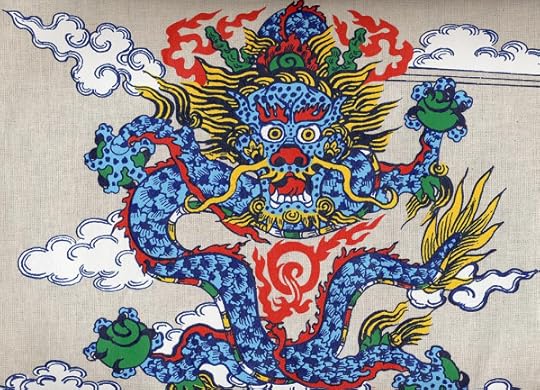
Tibetan thunder dragon deity (druk), an outcome of fusion of Buddhism with more ancient animistic and shamanistic religions.
[image error]
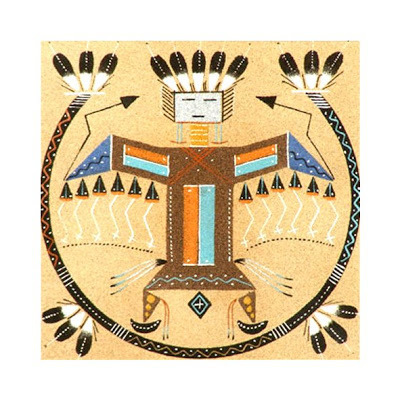
Sandpainting mandala of the Navajo thunder god (left). The Buddhist style of mandala sandpainting (right)is more abstract, so not very compelling as evidence for a cultural linkage.


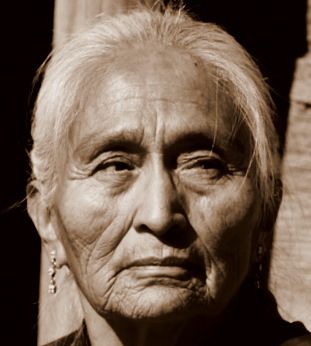
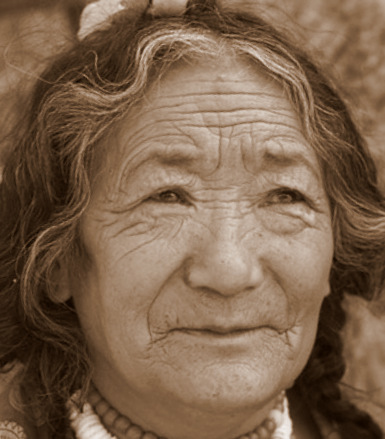
Faces of a Navajo and a Tibetan woman. Similarities in appearance possibly reflect a common ancestor who crossed the Bering land or ice bridge between continents from Asia during cycles of the ice ages.
Profile Image for Sophie.
2,639 reviews116 followers
March 5, 2013
Spoilers follow.

Oh :( The last time I suffered as much while reading something was when I was reading "First against the wall". My favorite part of these books is the friendship of Shan and Lokesh, and to see that friendship disturbed was very painful to read. And that Shan decides to leave Gendun and Lokesh in the end makes a certain amount of sense but it saddens me.

Still, this book was good. And thinking about it, I have to admire Pattison for writing in such a way that you really seem to feel the same things Shan has to feel - when he is taken to a small village on a mountain to help solve a murder, suddenly his two friends Gendun and Lokesh are taken hostage by the head of the village who sees his safe position threatened by their arrival. And so for most of the book, Lokesh and especially Gendun are in horrible danger while Shan is trying to find out the truth and I found myself worrying about them most of the time.

I've written before about the many interesting and wonderful things about this series and the many reasons why I love it so much, but there is one thing I've forgotten so far: these are some of the few books I can think of that don't feature a romantic subplot of some sort, and it's refreshing to read. Or not to read, if you want. So often it seems to me that it's added because it's "expected", because "you need a little romance", but really, you don't. Not necessarily.
Profile Image for Kyle.
7 reviews5 followers
October 22, 2008
Nice little mystery that delves into the problem between Tibet and China. Though it's not an in depth, high level political drama, it does touch on the heart and soul of the struggle of it's people. Shan, the main character, was once a senior level investigator for the Chinese government, but was sent to prison for being too good at his job. there he befriends and learns the way of tibetan monks. The story centers around a stranger found nearly dead by a Tibetan village. Shan is compelled to solve the mystert while trying to protect his monk friends. Three things I liked about this book:

1. illustrates a detailed view of the struggles of the tibetan culture under Chinese government.

2. fascinating look at the parallels between tibetan and american indian (Navajo) mythology.

2. Shan's character is not your typical investigator. he's conflicted between being of chinese descent and having a deep love for tibetan beliefs and ways of life. he doesn't deal with anything in the typical western, TV cop style. just read it and see what he does with a gun!

i wished i had noticed the glossary at the end of the book while i was reading it, things would have made a little more sesne. it started slow, but i think that was just my western head used to wanting immediate gratification. after a while, reading the book feels like an odd type of mediation.

i'd read it again.
Profile Image for Filip.
1,207 reviews45 followers
August 17, 2021
This was an interesting one. The setting, the description of life in Tibet under China's rule and depth of research that has gone into the information about Buddhist, Navajo and Bon spirituality and customs is simply astounding. The characters are really well-written, three-dimensional, real and interesting. The writing itself is also really good, tantalizing us with snippets of the backstory while being comprehensible when reading apart from other volumes.

That said, not everything is great - the mystery seems needlessly convoluted and, frankly, is not that good. The characters can sometimes become really annoying. The biggest flaw, however, was the pacing. The last part dragged on way too long (with a weird Indiana Jones-like style) and it is the main reason why I'm giving it only three stars instead of the four I wanted.

This doesn't mean it is a bad book, of course. I'm glad to have read and I will gladly try more books of this author - both in this series as well as in other.
Profile Image for SDestinie.
Author 3 books195 followers
November 2, 2014
This book is a platonic Chinese love story disguised as a Tibetan/Navajo murder mystery, which manages to make excellent social and world commentary while being a rivetting story.

"you live in a fairy world" -how many times have I heard this (in 4 languages)! Now, I feel vindicated. And yes, the cost is high, but in the end, worth it.
ShiraDestinie
Today's 'normal' date is: Sun Nov 02 2014
Today's U.N. Date is: Thursday, November 2. 12014 H.E. (Holocene Era)
----
Este libro es la historia de un amor sin sexo de dos Chinos, disfrazado como misterio de matanza Tibetano/Navajo, lo cual logra a hacer excelentes comentarios sociales mientras siendo una historia imnensa.

"vives en un mundo de hadas" -cuantas veces he oido eso (en 4 idiomas)!
Ahora, me siento absolvado (Vindicado?). Y si, cuesta mucho, pero en fin, lo vale.
ShiraDestinie
fecha de hoy : Domingo, 2 Nov. 2014
fecha Universal: Jueves, 2 Noviembre, 12014 e.H. (era Holocéno)
Profile Image for CarolineFromConcord.
502 reviews19 followers
September 10, 2017
Although Eliot Pattison is one of those mystery-series authors who has kept turning out episodes to the occasional detriment of quality, his latest book has a lot of new and interesting research. And author enthusiasm. Makes a difference. I think he was smart to take breaks from Shan's adventures in Tibet by alternating with a different series about 18th C America ("Bone Rattler" et al).

In "Prayer of the Dragon," the Chinese ex-investigator, ex-gulag-prisoner follows his Buddhist monk friends to a village at the foot of a mountain with ancient religious associations. Murders have been committed there, and an unconscious man has been taken prisoner because of his bloody weapons. The elderly monks don't care if he did it or not. They are not interested in the crimes of this world, but are praying for his soul and the souls of the murdered.

Shan as usual is torn between his friends' approach to life and his recognition that they may be in danger if the murders go unsolved and more occur. Solving crimes is his strength, but he tries to be a detective with Tibetan characteristics.

An interesting aspect of the complicated plot is that an American Navajo woman is studying the ancient similarities between her tribe's religion and a pre-Buddhist religion called Bon, which left a dangerous pilgrimage path on the mountain. The murder victims were with her party.

Meanwhile, on the far side of the mountain, the Chinese government has set up one of their ubiquitous military installations, and a retired Communist Party officer is studying giant birds with his East German buddy. Oh, and illegal miners are paying off the village headman to prospect for gold.

The challenge for Shan is to solve the murder case, protect his old friends, and keep Chinese security away from the villagers, who against all odds are trying to preserve and revive the Tibetan way of life.

I once heard this author speak at Porter Square Books in Cambridge. Everyone wants to know how he got so interested in Tibet and first traveled there, but he doesn't give a straight answer. I surmise he had a clandestine US government function. Whatever the reason, he is deeply committed to the people and probably does more to help them through this mystery series than many charitable and government initiatives do.
Profile Image for Ver.
644 reviews7 followers
October 9, 2021
Two things I don't understand about this book - people cannot decide whether to kill or help the inspector, they try both and why they give beating to others all the time. Other than that, a very interesting story, with a lots of threads connected to the spiritual part of Tibet and to Chinese occupation. The solution has a variety of twists which are sometimes confusing and rather sad, unfortunately.
Profile Image for Dorothy.
1,387 reviews110 followers
September 23, 2014
"Omit needless words," wrote William Strunk Jr. in The Elements of Style. It is a dictum that Eliot Pattison could profit by following. He seems to suffer from diarrhea of the pen or word processor. Words pour forth in great profusion, often repetitively and to very little effect. The words do not really seem to advance the narrative or provide enlightenment. They simply occupy space on the page. One would think that Pattison is being paid by the word.

Not only is he overly wordy but Pattison has certain writing tics that get under my skin. For example, the repetition of the descriptive phrase "the old Tibetan." This appears on practically every page of the book and sometimes more than once on the page. We get it. There are no young lamas, but find an alternative way of describing them, for Buddha's sake!

What irritates me most about this series is that I really, REALLY want to like it. I keep picking up the next entry in the series every few months in the hope that the execution might finally live up to the promise. So far, disappointment has been my only reward.

In every book, the former Beijing inspector Shan and his two friends and companions, the monks Gendun and Lokesh, wander endlessly over the mountains and through the caves of Tibet where every rock seems to have been painted with a sacred symbol of some deity or demon. They are repeatedly caught and beaten and tortured, but they persevere, with Shan investigating murders which the authorities don't pursue or don't even know about. Those ever-present deities and/or demons will somehow prove to be involved and, in the end, Shan will reveal all in a meandering narrative.

Oh, and also, there will be an American in the mix. The plots are really very predictable.

In this entry, Shan is summoned to a remote village (apparently, all villages in Tibet are remote) where a comatose man was found with two dead bodies. The headman of the village drew the conclusion that this man was the murderer and now they are waiting for him to wake up so they can execute him.

Almost immediately, Shan intuits that something is unusual about this man, but it is only when he finally wakes up that he is able to determine that the man, in fact, is not Tibetan but Navajo. He was in Tibet with his niece, a researcher investigating ancestral ties between the Navajo people and the Bon, ancient ancestors of the people of Tibet. She was seeking to prove that they were two branches of the same stream. Now she has disappeared and her uncle is seriously injured and accused of murder.

Shan sets out to discover what really happened on the mountain where the murders occurred and the Navajo man was injured. He quickly learns that these were not the first murders in the area. Indeed, there has been a pattern of murders here in recent years with the most curious feature of the crimes being that the hands of the victims are being removed by the murderer.

Shan's investigation reveals a tangled web of relationships between the unmapped mountain village, illegal gold miners, and, as always, corrupt officials in Lhasa and Beijing. How he puts all of this together to arrive at a solution to the murders and to again save Gendun and Lokesh involves lots of wandering and finally solving the riddle of Dragon Mountain, the place "where the world begins" in thunder and lightning.

By the last couple of chapters, I had lost interest and was scanning the pages pretty quickly, but I doubt that I missed anything truly significant.

Profile Image for Alain DeWitt.
345 reviews8 followers
April 7, 2019
I really thoroughly enjoy the Inspector Shan series but a bit of same-ness is creeping in. I certainly won't give up on them but I hope Pattison introduces some substantive changes to the Shan series so genuine fatigue doesn't set in.

Another issue I have (and this may be just me) but each book has a heavy "natural" element to it. The geography of Tibet is almost a character in the book. In this one in particular, a lot of the action involves the characters exploring and climbing a mountain and I found it very hard to keep track of where the characters were and to keep a picture of where they were in my mind.
Profile Image for Verena Hoch.
194 reviews22 followers
June 17, 2020
Mir wurde das Buch im Rahmen der Challenge "Lies Das!" der Mitlesezentrale, hier auf goodreads, empfohlen.
Zum Teil hatte ich Schwierigkeiten mich in diese tibetische Welt zurecht zu finden und sie zu verstehen. Ich habe von dieser Reihe bisher nur dieses Buch, Band 5, gelesen und das hat die Sache bestimmt noch weiter erschwert.
Neben die Auflösung des Krimis habe ich viel über tibetische Bräuche gelernt und auch über die Unterdrückung der tibetischen Kultur und Religion durch die chinesische Besatzung.
Ich werde bestimmt demnächst Band 1 der Reihe lesen. Ich bin auf die Vorgeschichte von Shan neugierig geworden.
Profile Image for Kate.
270 reviews3 followers
March 31, 2008
It's not often that I start reading a book over again right after finishing it, but that's what I'm doing with this one. Eliot Pattison writes about Tibet in such a way that my heart aches, not only for the Tibetans, but also because I feel such a strong resonance for how the Tibetans live and experience life.

A good mystery that kept my guessing all the way to the end, as well as a strong proposal for the American Navajos and the Tibetans having common ancestry. As usual, Mr. Pattison's writing spoils me for less-well-written works.
Profile Image for Eileen.
40 reviews1 follower
June 26, 2008
I loved this book. It was deep and complex. I love stories about more ancient spiritualities, as I practice one type myself. Navaho and Tibetan spirituality, Wow!
I never did figure out who the murderer was until the end. And Pattison keeps you guessing. You think you have it figured out, and he throws something else in there. You get a glimpse a couple of times, but you never get that, "Aha, I've figured it out." feeling. I will definitely read more of Pattison's work.
12 reviews
September 29, 2009
This was the follow-up book to the The Skull Mantra. The book is also a mystery novel with the same primary characters. Again, I enjoyed the pace of Pattison's writing. As expected, this book was essentially a continuation of Pattison's first mystery novel. I enjoyed the first book more and thought that by this second book, Pattison's story had become too predictable. Still, an enjoyable quick read.
Profile Image for Roxanne Gonzalez.
6 reviews5 followers
April 10, 2013
Once again Inspector Shan gives us a book that not only provides a murder(s) to solve, but shows the suffering of the Tibetan people. I could not put this book down. It stands next to The Skull Mantra in its spellbinding story.
898 reviews25 followers
January 22, 2010
If you have any interest in Tibet and the current assult on the culture by the Chinese, or if you just want to read a terrific, mesmerizing mystery, pick this one up.... It is really brilliant!
Profile Image for Timons Esaias.
Author 46 books80 followers
December 22, 2023
I think I'm going to have to formally define The Inspector Shan Dilemma. I like the settings of this series, and greatly enjoy many of the character dilemmas presented in the novels, and there is some beautiful and sensitive writing. I intend to read all the rest of the series.

But (hence the dilemma) there are annoying and frustrating parts to the series, some amateur writing flaws, and all but maybe the first one jump the shark at some point. There are generally too many characters and too many plotlines, so that the ending almost always feels contrived. Because of the complexity of the works, and the density of the prose, they are also slow reads. I find myself reading another mystery at the same time, to lighten the mood and keep up my reading pace. [In this case I took the book on an overseas trip, so managed to finish it in less than three weeks, due to being stuck on airplanes and in airports.]

Partway into this reading I posted the following note on Goodreads: If this were the first book of the series or the first I had read, I would throw it at the wall on page 102. A character who nearly died from a head wound and was flat on his back, unconscious for days finally gets up and is immediately coshed unconscious again. Out for a day or so, and the next day he's climbing a mountain with Shan. ???? Utterly stupid and inexcusable. Loses a star right there.

Later Shan himself will be knocked unconscious, will be out for some time, and will show some signs of concussion, but they are quickly forgotten. Later he will be beaten unconscious again (though without head injury?). Is the book about Traumatic Brain Injury? Um, no. This is the stuff of old noir detective novels, where Marlowe and his like seemed to be concussed at least once per book. That stuff should be left to history. There are only three grimaces in this volume, down from eleven in the previous volume, but that makes my list of problems, as well.

One thing that could have been a bit much, but worked for me, is that we have some Navajo characters in this story, searching for data on similarities between Navajo culture and early Tibetan culture. This makes for the third-in-a-row intrusion of Americans (and other outsiders) into the novels, but one of the things I like about the settings is that Pattison reveals that what we tend to think of as simple cultural settings are always more complex than that. When you actually visit places with lengthy histories, you find different ethnic roots from village to village, and you find outsiders wandering across the landscape for various reasons. Today, academics and NGO workers and military folks are slipping in and out of everywhere, and Pattison's character lists have always reflected that.

The world is quite complicated, and that seems to be a theme of these works.

So my dilemma is that I enjoy these enough to keep reading them, but they annoy me enough that I can't really recommend the series. I do recommend trying the first volume, but not buying any further volumes unless you're sold.

This volume starts with Shan being summoned to solve a mystery. There has been a double murder (it will turn out that there have been several murders) on a sacred mountain, and it is hoped he can solve the case quickly, before it brings in outsiders. Why the fear of outsiders? Because the village involved has been flying under the radar for a while, and has avoided direct interference from Beijing until now. But there's a Chinese military base at the foot of the mountain on the other side, a number of mysterious characters wandering around, a group of illegal gold miners, a mysterious compound near the top of the ridge, a State Security team looking for excuses to inspect the place...

Too many characters, too many plotlines. Lots of bloodshed, threat and danger; to the point that it can't really add up by the end.

But still, I like to hang out in the imagined world of these stories, so when Pattison next comes up in my mystery series rotation, I'll be reading the next one.

One reason I'll be reading the next one is that Pattison may not understand the physical effects of coma or brain injury, but he sure knows how to physically torture and emotionally scour his characters. It gets so bad for Shan that we learn in the course of the book that he needs to break with certain folks he's too much of a danger for. I'll have to read the next book just to see if that actually happens, and what life Shan finds for himself if it does.
This entire review has been hidden because of spoilers.
Profile Image for Nick.
Author 21 books141 followers
March 30, 2019
The premise of Prayer of the Dragon was irresistible to me — a Buddhist former monk former Chinese Gulag prisoner now detective solving crimes in Tibet. Perfectly fraught and inherently interesting. And on the whole, the actual book delivered on the idea reasonably well. The reader learns a good deal about the current state of Tibet and its Chinese occupiers along the way, and that information is deftly handled and profoundly affecting. The only disappointment was the detective story itself. It was a bit of a hot mess, with too many suspects thrown up in an ultimately unsuccessful attempt to hide the identity of the killer, which was obvious from the start. Which one of these characters is unlike the others? Only one, and that one was indeed the murderer. Our detective’s anguish, musing, and doubt finally got a little tedious in the face of the inescapability of that fact. But as a picture of modern Tibet, this is a fascinating book, and one that more citizens of the world should read.
126 reviews1 follower
June 27, 2021
A good mystery set in Tibet. Inspector Shan is a disgraced Communist Investigator who was released from gulag. He has lived with monks ever since, trying to be better, but whose weakness is that he will do anything to protect the monks he loves. This weakness is used against him when a Chinese professor, former villager of Drango village are found murdered, and a Navajo man accompanying them is found unconscious next to them and accuse of being the killer. Shan is to find the real killer, but his investigation leads to more murders, the exposure of corruption, and the potential for disaster for the people Shan wants most to protect. At the heart of the mystery is the hypothesis of the ancient history of the Tibetean people and the Navajo. The exploration of the similarities of their religious beliefs and practices is intriguing. I look forward to reading the first four of Pattison's Shan mysteries.
Profile Image for Cara.
291 reviews14 followers
July 22, 2020
Inspector Shan series, book 5
Another murder-mystery set in Tibet, this time exploring the links between ancient Tibetans and Native Americans, specifically Navajo traditions.
Shan and his Lama companions are called in to a remote village to investigate a series of murders on the Dragon Mountain, a place steeped in ancient Tibetan ritual and lore.
This is a fascinating insight into the old Bon religion which predates Buddhism in Tibet. The quest to uncover the murderer takes Shan to dark episodes in his past, continuing his spiritual journey while piecing together the clues which lead to a dramatic conclusion.
Another excellent book from Eliot Pattison
104 reviews
June 24, 2021
I am rereading the Shan series before I let myself read the final one. I found this one to be a little breathless, because Shan was all over the mountain and there were so very many characters in it. I did like all the stuff about the Dine (called Navajo in this book, I guess so the average schmo would get it) and the similarities between some of their culture and ancient Tibetan culture. I read these largely for the breath of Tibetan Buddhism. The denouement I thought was only barely believable, which is why I only give this one 4 stars. Still, these books expand my soul and they are so very very good, that I'd gladly read them in a cycle every couple of years.
Profile Image for Chris .
730 reviews13 followers
May 16, 2017
I really enjoy this series set in Tibet with a Chinese investigator who used to be a top corruption investigator in Beijing until he fell fowl of the political establishment and spent years in a Chinese gulag in Tibet. Now he has been released but lives just outside the law with a group of illegal Tibetan llamas. Despite this he still manages to solve intricately plotted murders. This one is as well written and entertaining as the others in the series.
Profile Image for Elisabeth.
737 reviews9 followers
March 10, 2023
No 5 in a series, and the easiest read to date ... Tibet as an interest was heightened when spending a year in Nepal fairly recently .. Tho we lived tucked inside them, the most massive Himalayan mountains were remote and often shrouded by clouds. Family and friends completed treks, Buddhist priests and nuns a common and vibrant part of the community. This series has expanded and refreshed memories and the history of Tibet assaulted by the significant brooding presence of China ..
Profile Image for Anne.
86 reviews2 followers
July 29, 2019
Wow! This is a book that swept me up. It's the first I've read in the series, and I'm almost afraid to read the others, because this was so good.

Mystery, set in the high mountains of Tibet (so a lovely summer read that takes you out of the heat), with criss-crossing plot involving ancient wisdom and modern greed.
Profile Image for Jan.
1,256 reviews6 followers
October 4, 2019
This early entry in a great series was especially complex & frequently sad. The lives of Tibetans struggling to survive Chinese oppression are portrayed in a story that kept me puzzling for solutions to an array of seemingly unrelated events. The pacing was good as the story reached a stunning climax.
Profile Image for Maurice.
608 reviews
May 30, 2022
This mystery concerns itself with the similarities between the cultures of the Native Americans of the southwest, mainly Navajo, and the ancient pre-Buddhist Tibetans, the Bon. I don't like to give away too much in my descriptions, but the prevalence of gold in the Tibetan mountains has a lot to do with it. A great series.
Profile Image for Ruby.
547 reviews7 followers
January 19, 2023
I like this series, and overall liked this one ok, but it just wouldn't end! Improbable scenario after improbable scenario and basically everyone was guilty. The end.

The connections between Bon and Navajo culture were great, but it felt like either the author or the editor felt like that wouldn't be enough and added all this fantastical fighting.
2,540 reviews9 followers
January 4, 2020
I'm completely enjoying this series, particularly this book which discusses the connection between tibetan and navajo cultures and spiritualism. The relationships between the main characters are fascinating.
5 reviews
April 27, 2020
I am normally not a fan of mystery novels but this was absolutely ridiculous. Poorly written and a confusing and convoluted plot. With that said, I did appreciate the allusions to Tibetan customs and practices, particularly the Bon references. Such were the only redeeming qualities for me.
Profile Image for Joyce Loth.
135 reviews1 follower
June 5, 2020
I liked the discriptions of life in Tibet. I sometimes had problems understanding the thought processes when they were meditating. Interesting to get some of the backgrounds abou Chinese rule in this country.
210 reviews5 followers
August 5, 2023
very interesting story

Typical inspector Shan story. The author does a good job in relating ancient Navaho traditions and ancient pre Buddhist (bon) traditions together. The story had lots of twists and was a fun read. I highly recommend.
Displaying 1 - 30 of 92 reviews

Can't find what you're looking for?

Get help and learn more about the design.