

What do you think?
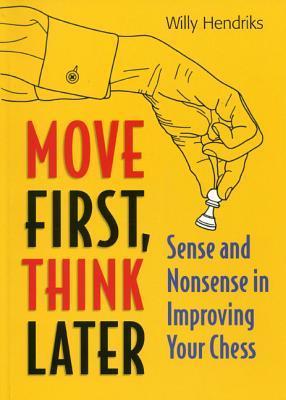
Move First, Think Later: Sense and Nonsense in Improving Your Chess
The chess instruction establishment claims that all you need to do is concentrate on the characteristics of a position. Stick to some rules of thumb and good moves will pop up more or less automatically. But that is not how it works, finds International Master Willy Hendriks. Chess players, both weak and strong, don't first make a plan before looking at candidate moves. Trial and error is a very common and in fact highly effective way to get to the best move. In his journey into the chessplaying mind, Hendriks uses recent scientific insights in the working of our brain. He raises a number of intriguing questions: Can you, too (whether you are talented or not), become a grandmaster? Why does a chess trainer's advice often sound like a horoscope? Can you find strong moves by ticking off a todo list? Is it possible to reach master level without ever making a plan? Presents a wealth of valuable, nononsense training material. In this refreshing, entertaining and highly instructive book, Willy Hendriks shows how you can travel light on the road to chess improvement!"
254 pages, Paperback
First published June 16, 2012
Ratings & Reviews
Friends & Following
Create a free account to discover what your friends think of this book!
Community Reviews
Displaying 1 - 9 of 9 reviews

May 9, 2015
Winner of The English Chess Federation Book of the Year Award 2012. I hadn't purchased a chess book for a few years, having read well over 50 as a junior, but the title of this one caught my eye, and I was looking for a new book with exercises I could use for coaching. It was an interesting read with plenty of original perspectives.
Move First, Think Later is very meta, discussing a chess player's thinking during a game, or in training. I do agree with Hendriks that as chess trainers (or the stronger we become as players), it is so easy to fall into the habit of feeling like we know what's happening in the position - we can explain the intricacies of a position, discussing the plans for either side - but during a game, our thinking is not nearly as ordered. As much as it sounds attractive to assess the position and understand it before thinking of a course of action, players of all levels are thinking in predominantly concrete terms when they are looking at the board. Even with the positional plans, they are a string of concrete moves and sequences mixed together with words, and the concrete aspects always come first - taking in a position, we cannot assess the position without seeing a multitude of possible moves and sequences.
This book also criticises many other chess books on improvement and thinking, again arguing along the same lines that chess books and trainers often work backwards from the effects of a move, knowing what the idea was, or suggesting that a particular move is the best in the position because it fits into what is demanded of the position, or what is being taught - but again, things aren't so simple when we are thinking about what move to play over the board (and thus we should have a more critical eye).
The book contains exercises over 27 chapters, each covering an aspect of chess psychology, understanding or improvement/training. The exercises are particularly suitable for players rated between 1500-2000 (they have been useful in my lessons with such players), who can play strongly at times but are often confused about how they should think about a position, in terms of assessment, planning, and positional understanding.
Even to players rated over 2000, reading this book is useful as the exercises are quite fresh (some of them are indeed suited to stronger players, so some players rated around 1500 or so would really struggle), and I thought the author's ideas are along the right lines in general, being objective and balanced, critical of looking for trends or patterns when the case under scrutiny is only a unique one - and after all, even if a game we play has similarities with previous ones we have played, the concrete aspect of the positions are always going to be rather unique to each game.
Recommended to club-level players rated between 1500-2000 (and stronger players can find it as a comfortable read), and players who struggle with the meta aspects of the game - how should I be thinking during a game, how should I be working on my chess, and are books on chess improvement actually qualitatively useful?
Move First, Think Later is very meta, discussing a chess player's thinking during a game, or in training. I do agree with Hendriks that as chess trainers (or the stronger we become as players), it is so easy to fall into the habit of feeling like we know what's happening in the position - we can explain the intricacies of a position, discussing the plans for either side - but during a game, our thinking is not nearly as ordered. As much as it sounds attractive to assess the position and understand it before thinking of a course of action, players of all levels are thinking in predominantly concrete terms when they are looking at the board. Even with the positional plans, they are a string of concrete moves and sequences mixed together with words, and the concrete aspects always come first - taking in a position, we cannot assess the position without seeing a multitude of possible moves and sequences.
This book also criticises many other chess books on improvement and thinking, again arguing along the same lines that chess books and trainers often work backwards from the effects of a move, knowing what the idea was, or suggesting that a particular move is the best in the position because it fits into what is demanded of the position, or what is being taught - but again, things aren't so simple when we are thinking about what move to play over the board (and thus we should have a more critical eye).
The book contains exercises over 27 chapters, each covering an aspect of chess psychology, understanding or improvement/training. The exercises are particularly suitable for players rated between 1500-2000 (they have been useful in my lessons with such players), who can play strongly at times but are often confused about how they should think about a position, in terms of assessment, planning, and positional understanding.
Even to players rated over 2000, reading this book is useful as the exercises are quite fresh (some of them are indeed suited to stronger players, so some players rated around 1500 or so would really struggle), and I thought the author's ideas are along the right lines in general, being objective and balanced, critical of looking for trends or patterns when the case under scrutiny is only a unique one - and after all, even if a game we play has similarities with previous ones we have played, the concrete aspect of the positions are always going to be rather unique to each game.
Recommended to club-level players rated between 1500-2000 (and stronger players can find it as a comfortable read), and players who struggle with the meta aspects of the game - how should I be thinking during a game, how should I be working on my chess, and are books on chess improvement actually qualitatively useful?

November 28, 2020
Not your typical chess improvement book, as the puzzles presented are present more to illustrate the author's thesis than to be exercise to illustrate a chess strategy or tactic, although they do serve this purpose as well. Mr. Hendriks thesis is that chess players always see moves. Indeed, the very first thought a chess player has when looking at a chess position is a chess move (moves first), and not general plans ("thoughts" that mostly develop with the hindsight of the games outcome). Hendriks discusses philosophy, psychology, thinking, and learning as applied to the game of chess. A bit about how computers approach chess--and how they can help us "find" moves we missed, or never even thought about--is discussed along the way.
Hendriks takes issue with chess books and authors that espouse general principles and the need to develop deep plans before thinking about moves. He argues that it is the moves that count, and the more a player is able to "see" and make good moves, the better the chess player. Kotov's Think Like a Grandmaster takes a significant hit, and rightly so in my opinion, about its chess tree and deep planning, which Hendriks states developed from Kotov's communist indoctrination, as well as the 20/20 hindsight that arises after the game is over and masters have analysed the why and how of various moves. Hendriks also chastises authors Silman and Solits as offering "planning" advice in place of finding good moves. He likes authors who focus on chess players working hard on analyzing their own games as well as the games of others--Watson and Yermolinsky.
He quite rightly states that chess is a difficult game and that improving is not easy, especially if one focuses on studying general principles instead of on the moves--analyzing a game or position to find the hidden gems, ie, the best moves. His advice is similar to what other authors espouse--including his bete noir Silman--which is to study tactics and to study games with the goal of creating one's own set of "key positions" and trying to find the best moves, and then comparing one's analysis with that of a computer. Soltis states as much in his What it Takes to Become a Chess Master. So, Hendriks is not really saying much new.
This book is geared towards players below expert level whose game is stuck and would like a fresh perspective on how to think about the game. As Hendriks states, there is no magic bullet to becoming better at chess. Hard work and talent (yes, the true sticking point) are the keys to success.
Hendriks takes issue with chess books and authors that espouse general principles and the need to develop deep plans before thinking about moves. He argues that it is the moves that count, and the more a player is able to "see" and make good moves, the better the chess player. Kotov's Think Like a Grandmaster takes a significant hit, and rightly so in my opinion, about its chess tree and deep planning, which Hendriks states developed from Kotov's communist indoctrination, as well as the 20/20 hindsight that arises after the game is over and masters have analysed the why and how of various moves. Hendriks also chastises authors Silman and Solits as offering "planning" advice in place of finding good moves. He likes authors who focus on chess players working hard on analyzing their own games as well as the games of others--Watson and Yermolinsky.
He quite rightly states that chess is a difficult game and that improving is not easy, especially if one focuses on studying general principles instead of on the moves--analyzing a game or position to find the hidden gems, ie, the best moves. His advice is similar to what other authors espouse--including his bete noir Silman--which is to study tactics and to study games with the goal of creating one's own set of "key positions" and trying to find the best moves, and then comparing one's analysis with that of a computer. Soltis states as much in his What it Takes to Become a Chess Master. So, Hendriks is not really saying much new.
This book is geared towards players below expert level whose game is stuck and would like a fresh perspective on how to think about the game. As Hendriks states, there is no magic bullet to becoming better at chess. Hard work and talent (yes, the true sticking point) are the keys to success.

December 21, 2024
This is a very peculiar chess book.
Hendriks goes all in with his “revolutionary” ideas and concepts.
Basically, he claims that pattern recognition is essential in finding good moves. Others had expressed the same idea before, but never so open and blunt.
Don’t bother mastering positional nuances, analyze classical games, just load your brain with as many recurring patterns as possible and the results will come.
Hence the title - we make a move because it is ingrained in our memory storage and not because we found it by deep analysis during the game.
Of course, author’s hypothesis is not universally accepted, but that’s exactly the point!
The book won many major publishing awards because of its original premise and wit.
Highly recommended!
Hendriks goes all in with his “revolutionary” ideas and concepts.
Basically, he claims that pattern recognition is essential in finding good moves. Others had expressed the same idea before, but never so open and blunt.
Don’t bother mastering positional nuances, analyze classical games, just load your brain with as many recurring patterns as possible and the results will come.
Hence the title - we make a move because it is ingrained in our memory storage and not because we found it by deep analysis during the game.
Of course, author’s hypothesis is not universally accepted, but that’s exactly the point!
The book won many major publishing awards because of its original premise and wit.
Highly recommended!

January 5, 2022
The Gist of this book is that Making the best chess move is a scientifically based objective subject while how does a person improve in chess is a pseudo science opinionated subject.
He is of the mindset of doing puzzles that stretch your thinking and teach us what a good move might look like in certain situations is a path to improvement .
Each chapter comes with a handful of chess puzzles with discussion of a theme Anastasia Mate, Confirmation Bias , the Barnum effect. A little snarkiness here about some things and tempered with not taking himself too seriously.
Did all the puzzles except for the last 3 chapters which I will return to.
He is of the mindset of doing puzzles that stretch your thinking and teach us what a good move might look like in certain situations is a path to improvement .
Each chapter comes with a handful of chess puzzles with discussion of a theme Anastasia Mate, Confirmation Bias , the Barnum effect. A little snarkiness here about some things and tempered with not taking himself too seriously.
Did all the puzzles except for the last 3 chapters which I will return to.

November 22, 2012
really enjoying this. probably my fave chess book that I've read. doesn't have any magic revelations but that's kind of the point. also, I like this guy's Dutch sense of humor.

June 6, 2021
Wasn't expecting to find in a chess book so much good content about psychology / philosophy about how our mind thinks and learns, but I guess that's what I got!
January 10, 2024
There is a lot to digest in Hendricks' book. The broad brush is that we do not really know how best to study or learn. Hendricks pokes holes in many of the popular methods and assumptions of chess instruction. The one path that he does seem to support is the Dutch Steps method.
July 19, 2025
Incredible book, on par with Rowson's "Chess for Zebras".
October 1, 2012
interesting ideas
Displaying 1 - 9 of 9 reviews