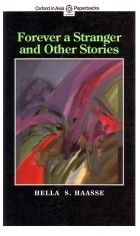
In this collection of stories, Haasse, one of Holland's most popular contemporary writers, deals with themes of alienation and estrangement. Born in the Dutch East Indies, Haasse calls up the images, people, and memories of her childhood. These are the first English translations of Haasse's work.
Hella S. Haasse (1918 - 2011) was born in Batavia, modern-day Jakarta. She moved to the Netherlands after secondary school. In 1945 she debuted with a collection of poems, entitled Stroomversnelling (Momentum). She made her name three years later with the novella given out to mark the Dutch Book Week, Oeroeg (The Black Lake, 1948). As with much of her work, this tale of the friendship between a Dutch and an Indonesian boy has gained the status of a classic in the Netherlands. Titles such as Het woud der verwachting (In a Dark Wood Wandering, 1949), Een nieuwer testament (Threshold of Fire, 1966) and Mevrouw Bentinck of Onverenigbaarheid van karakter (Mrs Bentinck or Irreconcilable in Character, 1978) have been greatly enjoyed by several generations.
Faced with finally returning this book to the library, and realizing that due to its rarity I’ll likely never have it in my hands again - it’s review time! Albeit several months delayed. Here goes.
The narrator of this short novel is a Dutch boy who is best friends with Oeroeg, son of Indonesian workers employed by his father. But what seems a simple friendship to maintain as children soon becomes more complicated - the lives of these two boys are fundamentally different, and as they grow older those differences cut at the ties of friendship they share. The narrator is left trying to maintain contact Oeroeg, wondering how their relationship has so thoroughly dissolved. More broadly this is Haasse’s struggle to relate to her homeland - to reconcile her love for the place of her childhood memories with the colonial oppression that brought her there and the underlying condescension of instilling European society in a place that may prefer to reject it.
"I knew him as I knew Telaga Hideung -- as the sparkling surface of a crater lake. But I never fathomed the depths. Is it too late? Am I forever to be a stranger in the land of my birth, on the earth from which I do not wish to be transplanted?"
A short read but Haase makes you feel the loneliness of the main characters, their sense of isolation. Forever a Stranger as told from the view of a young dutch boy born and raised in the dutch east indies in the 1930's. A mother who seems to be neurotic and a father who is distant. The description of the country is very evocative.
Wyatt joked that he thought this book would be longer, considering all the effort to get ahold of it. My copy came all the way from Oklahoma, through the wonder that is ILL. I found out just after placing that hold that it’s been more recently translated under another title and is available on kindle, though it’s quite pricey.
It was worth the effort. The story of the title is really moving. A Dutch boy and his Indonesian playmate, who grow up together and then very much apart as one goes to study in Holland and the other joins the independence movement. It was an interesting read - the boy grows up speaking the local language better than Dutch and considers his friend his equal but then doesn’t seem able to see or understand how his friend has a very different experience of life than he does. It’s like a novella illustrating the “I don’t see colour” viewpoint because the kid just can’t seem to get it.
The last story was also very moving, an exploration of the bitterness of a child who knew of an affair and the different experiences of those who left before the Japanese occupation and those who were caught in it as well as the ways Indonesians and Europeans interacted, dated, married.
For such a short book, Haasse says so much. And the descriptions very much brought back memories of travelling in Indonesia and Malaysia (which is where I saw a tea plantation that sounded just like her descriptions).
Read the 1001 book Oeroeg, which is the original Dutch of 'Forever a Stranger'. This is a translation of my review in Dutch.
It's amazing how attached you can get to a few fictional personae in a book as short as this one. On the surface it's about a boyhood friendship between the son of the administrator of a tea plantation and the son of one of the indigenous families who work there. Growing up together almost like brothers, learning together, discovering together, the European narrator does not realise that society makes it impossible to continue in the same way. In retrospect he realises that his Indonesian friend Oeroeg has grown up between two cultures and was perfectly aware of the underlying problems that it caused. In the Dutch East Indies (now Indonesia) of that time, children of Indo-European parents or westernised Indonsian children lived between two worlds, not fully accepted by the one or the other. Because of this tension was almost impossible that their friendship could continue, and indeed the boys were increasingly driven apart.
As the end of the book, the political situation in the Dutch East Indies was in a time of uncertainty, with a militant independence movement. The changing relationship between the main characters of the book reflects the changes in the country. Thus the book is more than just a story about two boys, it is symbolic and has more depth than is at first apparent.
It's easy to read, and I will definitely be reading more of Hella S. Haasse's books. This book is on the 1001 list, probably because there is an English translation of it, even though I suspect it is not her best book. The English translation is called 'Forever a Stranger' (published in a book with other stories by the same author), which is a better reflection of the main theme of the book.
About discrimination (Dutch quotations translated by me, so not necessarily the same as the official English translation]: "A panther is different to a monkey," said Gerard, after a pause, "but is one of the two less than the other? You think that's an idiotic question, and you're right. Don't forget how idiotic it is for people too. Being different - that's normal. Everybody is different to everyone else. I'm different to you. But to be better or worse depending on the colour of your face or what your father is - that's nonsense. Oeroeg is your friend, isn't he? If he's good enough to be your friend - how can he ever be less than you or anybody else?"
About nostalgia for the land of your birth. The storyteller feels: ... a deeply-rooted sense of connection to the country where I was born and raised. The years I had spent in Holland, though important, meant less to me than my childhood and schooldays there. If it is true that for every man a landscape of the soul exists, a certain atmosphere, an environment, which evokes responsive vibrations in the farthest recesses of his being, then my landscape was - and is - the image of mountain slopes in the Preanger. This is certainly true for the author, but many expats have these feelings for another country, and as an expat that speaks to me.