What do you think?
Rate this book


486 pages, Paperback
First published December 31, 1991
Mikhail Bulgakov is now widely acknowledged as one of the greatest writers of the Soviet period, but due to the rigid censorship of the regime, didn’t live to see his best works published or performed. Because Bulgakov was adept at reworking his material in different forms — novels, plays and short stories — and because different versions of his work were published at different times, reading his work becomes a kind of literary treasure hunt.
J.A.E. Curtis, Professor of Russian Literature at Oxford, is an invaluable guide on the treasure trail. In Manuscripts Don’t Burn, she draws together 11 years of research to chronicle Bulgakov’s life through letters and diaries. The book was first published in 1991 on the centenary of Bulgakov’s birth, and only one to two years after sections of his diaries were released from the KGB archives. The last two chapters include excerpts from the diaries of Bulgakov’s third wife, Yelena Sergeyevna, which provide a first-hand account of the day-to-day existence of writers and artists during the Stalinist purges.
The title “Manuscripts Don’t Burn” is a line from Bulgakov’s masterpiece, The Master and Margarita. It is both prophetic, because his best works were published posthumously, and ironic, given his predilection for burning material he considered sub-standard. As he wrote to a friend in 1932, “The stove long ago became my favourite editor.”
The early chapters provide an insight into Bulgakov’s fierce ambition:
“I am frightened by the fact that I am thirty two, by the years I have squandered on medicine… I can’t believe that the voice that keeps troubling me at the moment is anything but prophetic. It must be. There is nothing else for me to be. I can be only one thing — a writer.”
Incidentally, it appears that Bulgakov wrote the short stories published as A Young Doctor's Notebook — based on the years he felt he had “squandered on medicine”, when he ran, almost single-handed, a hospital in a very poor rural area — to demonstrate the work he had done for the proletariat as a way of deflecting the criticism he attracted for wearing that symbol of the bourgeoisie, a monocle. The monocle, of course, reappeared as a motif in The Master and Margarita.
Suspicion and professional jealousies continued to plague Bulgakov’s life and career. Understandably, he started to become paranoid after the secret police raided his flat in 1926, confiscating his personal diaries and the manuscript of Heart of a Dog.
Manuscripts Don’t Burn includes a series of extraordinary letters Mikhail Bulgakov wrote to Stalin, begging to be permitted to leave the USSR. I couldn’t help holding my breath as Bulgakov detailed, for page after page, the despair and frustration he felt over the banning of his plays, despite their popularity; the misappropriation of his work outside the Soviet Union; the increasingly savage reviews of his work; and the continued denial of his requests to travel overseas. Bulgakov seemed to have forgotten exactly who he was writing to! He was probably saved from arrest by the fact that Stalin was a fan of Bulgakov’s play, The Days of the Turbins, the theatrical adaptation of his first novel, White Guard.
The desire to travel abroad became an obsession for Bulgakov. In May 1934, Yelena Sergeyevna described the cruel cat-and-mouse game of seeing “two red passports” lying on the desk of a government official, and being advised that the couple could collect them the following day:
“M.A. kept repeating exultantly, ‘So that means I am not a captive! It means I will see the world!... M.A. held my arm tightly to his side and was laughing and thinking up the first chapter of the book he would bring back from his travels: Am I really not a prisoner?’”
On 10 April 1937, Yelena Sergeyevna noted simply, “Misha will never see Europe.”
During the Great Terror, Yelena Sergeyevna’s diaries make increasingly frequent references to friends, acquaintances, neighbours, and former colleagues being arrested, or sent into internal exile (Siberia), being sentenced to be shot, committing suicide, and the chilling euphemism, “has fallen seriously ill and won’t be coming back”. She also makes wry references to no less than three well-known informers who persist in dropping in uninvited.
In February 1936, Yelena Sergeyevna wrote, “Misha’s destiny is clear to me: he will be alone and persecuted until the end of his days.” Only two weeks later, three of Bulgakov’s plays were cancelled.
In 1937, the rumours intensified. I felt a sense of horror on reading about the discussions between Stalin and Molotov in the “Government box” at the opera about which of Bulgakov’s plays should be permitted to be staged — discussions which always made their way back to the Bulgakovs.
Yelena Sergeyevna’s diaries also provide some glimpses into the real-life inspirations for her husband’s work. In April 1935, she described a ball thrown by the American Ambassador in Moscow:
“There were people dancing in a hall with columns, floodlights shining down from the gallery, and behind a net which separated off the orchestra there were live pheasants and other birds. We had supper at separate tables in an enormous dining room with live bear-cubs in one corner, kid goats, and cockerels in cages.”
Fans of The Master and Margarita will note the similarities between this event and Satan’s ball in the novel.
The theatre director Konstantin Stanislavsky also became an unwitting subject. As Yelena Sergeyevna wrote in her diary in April 1935:
“Rehearsals of Moliére are continuing at Stanislavsky’s house in Leontyevsky Street, driving Misha to exasperation. Instead of rehearsing the scenes of the play, he occupies the actors in pedagogic exercises and tells them all sorts of irrelevant things which do nothing to make the play progress. Misha has been persuading me that no ‘method’ and no efforts are going to make a bad actor to act well.”
Bulgakov later satirised these episodes in A Dead Man's Memoir: A Theatrical Novel.
But the cumulative effect of censorship weighed heavily on Bulgakov towards the end of his life. In October 1937, he wrote:
“Over the last seven years I have created sixteen works in different genres, and they have all perished. This is an impossible situation, and in our home everything looks utterly hopeless and sombre.”
But during this period, even while his health was failing, Bulgakov was working in secret on his great novel, The Master and Margarita. In June 1938, he wrote a poignant letter to Yelena Sergeyevna, who was on holiday to restore her own health:
“In front of me lie 327 typed pages (about twenty-two chapters). If I remain in good health, the typing will soon be finished…‘And what will come of it?’ you ask. I don’t know. In all probability you will put it away in the writing desk or in the cupboard where the corpses of my plays lie, and from time to time you will remember. However, we cannot know our future…
Oh dear, Ku, you can’t see from a distance what this last sunset novel has done to your husband at the end of his dreadful life in literature.”
Mikhail Bulgakov died less than two years later, on 10 March 1940 of the same kidney disease which had killed his own father. He was 49. In a sad postscript, Yelena Sergeyevna wrote to Bulgakov’s brother Nikolay, in Paris, “As a doctor, he knew everything that would happen to him.”
Mikhail Bulgakov wrote that we cannot know our future. But of course, we know how his story ends. The Master and Margarita was published a quarter of a century later, and now lives on as one of the best novels of the 20th Century.
I enjoyed Manuscripts Don’t Burn for the insights it gave into the complex and multi-layered work of Mikhail Bulgakov; it has made me want to read more of Bulgakov, and to re-read my favourites with a new understanding.
****
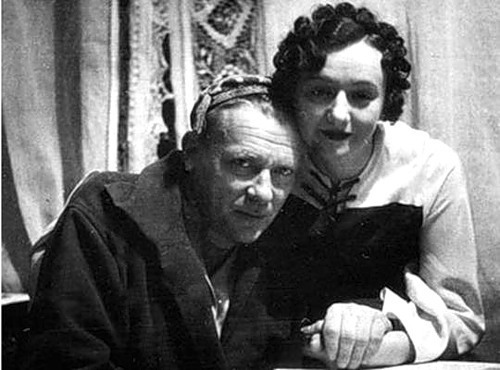
Manuscripts Don’t Burn includes some black and white photos. I have included the one of Bulgakov and Yelena Sergeyevna below, to illustrate the stark difference between the handsome, urbane 35 year-old on the book cover, and his appearance towards the end of his life. As Yelena Sergeyevna wrote in September 1938, “Misha blames himself for everything, but I find this painful; I know perfectly well that it is others who have ruined him.”