

What do you think?
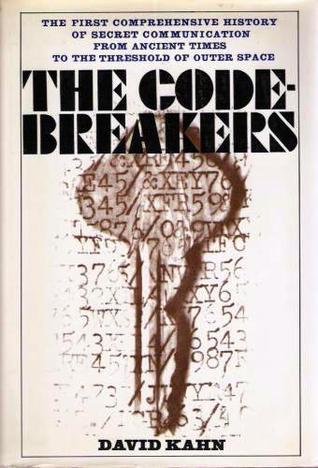
The Codebreakers: The Story of Secret Writing
A complete, factual account of cryptology including famous personalities, the techniques and the history of this science.
1164 pages, Hardcover
First published January 1, 1967
About the author
David Kahn
71 books70 followersA specialist on the history of cryptography and military intelligence, David Kahn worked as a reporter and op-ed editor for Newsday until his retirement in 1998, and was selected in 1995 as scholar-in-residence at the National Security Agency. Kahn earned a D.Phil in modern German history from Oxford University in 1974 under the supervision of the then-Regius professor of modern history, Hugh Trevor-Roper.
Librarian Note: There is more than one author in the GoodReads database with this name. See this thread for more information.
Librarian Note: There is more than one author in the GoodReads database with this name. See this thread for more information.
Ratings & Reviews
Friends & Following
Create a free account to discover what your friends think of this book!
Community Reviews
Displaying 1 - 30 of 79 reviews

July 9, 2018
Q: ...Zimmermann telegram...
It would not require much wit for the Americans to surmise that England might also be supervising the code telegrams of another neutral: the United States, which, like Sweden, was working as a messenger boy for the Germans and had, in fact, transmitted this very message. This realization would both embarrass and anger the United States and would not conduce to pro-Allied feelings. ...
Suddenly, Americans in the middle of the continent who could not get excited about the distant poppings of a European war jerked awake in the realization that the war was at their border. Texans blinked in astonishment: the Germans meant to give away their state! The Midwest, unmoved because untouched by the submarine issue, imagined a German-officered army crossing the Rio Grande and swung over to the side of the Allies. The Far West blew up like a land mine at the mention of Japan ...
And so it came about that Room 40’s solution of an enemy message helped propel the United States into the First World War, enabling the Allies to win, and into world leadership, with all that that has entailed. No other single cryptanalysis has had such enormous consequences. Never before or since has so much turned upon the solution of a secret message. For those few moments in time, the codebreakers held history in the palm of their hand. (c)
Q:
This kind of work, particularly in the early stages of a difficult cryptanalysis, is perhaps the most excruciating, exasperating, agonizing mental process known to man. (c)
Q:
since military operations are usually accompanied by an increase in communications, traffic analysis can infer the imminence of such operations by watching the volume of traffic. When combined with direction-finding, it can often approximate the where and when of a planned movement. (c)
Q:
The solution had taken a terrific toll. The restless turning of the mind tormented by a puzzle, the preoccupation at meals, the insomnia, the sudden wakening at midnight, the pressure to succeed because failure could have national consequences, the despair of the long weeks when the problem seemed insoluble, the repeated dashings of uplifted hopes, the mental shocks, the tension and the frustration and the urgency and the secrecy all converged and hammered furiously upon his skull. (c)
Q:
the use of atbash in the Bible sensitized the monks and scribes of the Middle Ages to the idea of letter substitution. And from them flowed the modern use of ciphers—as distinct from codes—as a means of secret communication. (c)
Q:
The secret police... It gathers external intelligence as well as guarding internal security. It thus encompasses the functions of a C.I.A. as well as an F.B.I. This seemingly unusual situation began under the czars, when revolutionary agents were very numerous outside Russia. (c)
Q:
Yardley nearly suffered a nervous breakdown, and in February went to Arizona for four months to recover his health. Several of his assistants had already had trouble in this regard. One babbled incoherently; a girl dreamed of chasing around the bedroom a bulldog that, when caught, had “code” written on its side; another could lighten the enormous sack of pebbles that she carried in a recurring nightmare only by finding a stone along a lonely beach that exactly matched one of her pebbles, which she could then cast into the sea. All three resigned. (c)
Q:
This cipher is absolutely undecipherable. (c)
Q:
One letter containing knitting instructions was held up long enough for an examiner to knit a sweater to see if the given sequence of knit two and cast off contained a hidden message like that of Madame Defarge, who knitted into her “shrouds” the names of further enemies of the French Republic, “whose lives the guillotine then surely swallowed up.” A stamp bank was maintained at each censorship station; examiners removed loose stamps, which might spell out a code message, and replaced them with others of equal value, but of different number and denomination. Blank paper, often sent from the United States to relatives in paper-short countries, was similarly replaced from a paper bank to obviate secret-ink transmissions. Childish scrawls, sent from proud parents to proud grandparents, were removed because of the possibility of their covering a map. Even lovers’ X’s, meant as kisses, were heartlessly deleted if censors thought they might be a code. (c)
It would not require much wit for the Americans to surmise that England might also be supervising the code telegrams of another neutral: the United States, which, like Sweden, was working as a messenger boy for the Germans and had, in fact, transmitted this very message. This realization would both embarrass and anger the United States and would not conduce to pro-Allied feelings. ...
Suddenly, Americans in the middle of the continent who could not get excited about the distant poppings of a European war jerked awake in the realization that the war was at their border. Texans blinked in astonishment: the Germans meant to give away their state! The Midwest, unmoved because untouched by the submarine issue, imagined a German-officered army crossing the Rio Grande and swung over to the side of the Allies. The Far West blew up like a land mine at the mention of Japan ...
And so it came about that Room 40’s solution of an enemy message helped propel the United States into the First World War, enabling the Allies to win, and into world leadership, with all that that has entailed. No other single cryptanalysis has had such enormous consequences. Never before or since has so much turned upon the solution of a secret message. For those few moments in time, the codebreakers held history in the palm of their hand. (c)
Q:
This kind of work, particularly in the early stages of a difficult cryptanalysis, is perhaps the most excruciating, exasperating, agonizing mental process known to man. (c)
Q:
since military operations are usually accompanied by an increase in communications, traffic analysis can infer the imminence of such operations by watching the volume of traffic. When combined with direction-finding, it can often approximate the where and when of a planned movement. (c)
Q:
The solution had taken a terrific toll. The restless turning of the mind tormented by a puzzle, the preoccupation at meals, the insomnia, the sudden wakening at midnight, the pressure to succeed because failure could have national consequences, the despair of the long weeks when the problem seemed insoluble, the repeated dashings of uplifted hopes, the mental shocks, the tension and the frustration and the urgency and the secrecy all converged and hammered furiously upon his skull. (c)
Q:
the use of atbash in the Bible sensitized the monks and scribes of the Middle Ages to the idea of letter substitution. And from them flowed the modern use of ciphers—as distinct from codes—as a means of secret communication. (c)
Q:
The secret police... It gathers external intelligence as well as guarding internal security. It thus encompasses the functions of a C.I.A. as well as an F.B.I. This seemingly unusual situation began under the czars, when revolutionary agents were very numerous outside Russia. (c)
Q:
Yardley nearly suffered a nervous breakdown, and in February went to Arizona for four months to recover his health. Several of his assistants had already had trouble in this regard. One babbled incoherently; a girl dreamed of chasing around the bedroom a bulldog that, when caught, had “code” written on its side; another could lighten the enormous sack of pebbles that she carried in a recurring nightmare only by finding a stone along a lonely beach that exactly matched one of her pebbles, which she could then cast into the sea. All three resigned. (c)
Q:
This cipher is absolutely undecipherable. (c)
Q:
One letter containing knitting instructions was held up long enough for an examiner to knit a sweater to see if the given sequence of knit two and cast off contained a hidden message like that of Madame Defarge, who knitted into her “shrouds” the names of further enemies of the French Republic, “whose lives the guillotine then surely swallowed up.” A stamp bank was maintained at each censorship station; examiners removed loose stamps, which might spell out a code message, and replaced them with others of equal value, but of different number and denomination. Blank paper, often sent from the United States to relatives in paper-short countries, was similarly replaced from a paper bank to obviate secret-ink transmissions. Childish scrawls, sent from proud parents to proud grandparents, were removed because of the possibility of their covering a map. Even lovers’ X’s, meant as kisses, were heartlessly deleted if censors thought they might be a code. (c)

November 21, 2020
A book about codes and ciphers: how they're made, how they're broken, and the roles they've played since the the beginning of times in war, business, diplomacy, and espionage. Sometimes interesting, other times perhaps a little bit less interesting, with >1000 pages a comprehensive account. Perhaps not your best choice as an introduction to the history of codebreaking, but if you want a definitive account, this is your book.

November 16, 2010
The definitive book on the history of cryptography. Although even with this revised edition, the modern cryptography is clearly not the focus of this book, Bruce Schneier is probabbly better for this. If you are looking for a different view on several historical events, one focused on cryptography, this book is for you.
Awesome barely described it for me. I read a cut-down translated version of the 1967 edition and reading this revised version was like rediscovering the book itself.
Awesome barely described it for me. I read a cut-down translated version of the 1967 edition and reading this revised version was like rediscovering the book itself.
October 15, 2019
What a tome! I feel like I just finished the Bible. It's a good fraction as long and covers an even bigger fraction of human history. Took me six weeks of pretty steady reading (and getting an upper body workout just carrying around the hardback library copy). It's pretty much four books in one -- classical secrets; codes in the era of telegraphs and WWI wireless; WWII and the Cold War; and miscellanea including rum runners and the like. (I gotta say, I wasn't expecting the decoding of Linear B script, talking to dolphins and communicating with aliens to arise in a book on cryptography, but they fit and I enjoyed them, even if modern thinking has evolved a bit (and the Mayan script decoded) since the book was written.)
The original edition is 1966, and the updated 1996 edition consists essentially of only a single, short chapter tacked onto the end, so it inhabits almost entirely the pre-electronic, pre-binary age. This colors Kahn's entire way of viewing the importance of various topics. At my age, we tend to think almost entirely in terms of encryption of digital data, whereas of course much of the work prior to 1960 centered on manual encoding and the application of tremendous brainpower to solving codes.
I learned a lot about the science and its evolution, of course, including the distinction between codes and ciphers (though I'm still not sure I could distinguish a nomenclator from a two-part code if you handed them to me). Basically, codes are secret, often shorthand numbers for names or phrases ("1121" = "invade Egypt on Thursday"), whereas ciphers ignore structure and operate on letters (or, later, bits).
But the book goes much farther than the evolution of ideas, focusing on people, historical context, and events. We learn much about how the Union read Confederate telegraph messages but not vice-versa, about the political repercussions of Yardley's disclosures of the codes the Americans read during WWI, how "practical cryptanalysis" (stealing code books) worked, how hard creating, distributing and protecting code is, how the U.S. confirmed Midway as the Japanese target, and how the Allies worked so hard to keep secret what they knew, to prevent the codes from changing. (This last item forms much of the basis for the plot of Cryptonomicon, which certainly rivals this book in length.)
The bits on secret inks and Cold War microfilms are.interesting. The latter stands in stark contrast to Tolkachev, the CIA's billion dollar Soviet spy, just handing over bags of 35mm film.
Importantly, it was originally written before the disclosure of Ultra, so the extensive Enigma history in the middle part could really use to be revised more extensively than it was. Turing and the Polish contribution to cracking Enigma deserve a little more, for sure. But it's also pre-DES, pre-public key, and pre-Internet, except for a few pages at the end. Of course, books covering the modern era abound, as well, so it's easy to pick up the missing bits.
As a book now more than fifty years old, it also shows its age and how much it was a product of its era. It comes across often as patronizing toward the Japanese, all women are "girls", and homosexuality was scandalous (Kahn uses pejoratives I won't repeat here). So, read it, but be prepared for a shock or two, and use them as teaching moments, if you're sharing the book with someone.
Overall, this was *well* worth the six weeks I invested in reading it, during which I read almost nothing else for pleasure and not even many other things for work. (For me, this sits right at the boundary of the two.) Highly recommended.
The original edition is 1966, and the updated 1996 edition consists essentially of only a single, short chapter tacked onto the end, so it inhabits almost entirely the pre-electronic, pre-binary age. This colors Kahn's entire way of viewing the importance of various topics. At my age, we tend to think almost entirely in terms of encryption of digital data, whereas of course much of the work prior to 1960 centered on manual encoding and the application of tremendous brainpower to solving codes.
I learned a lot about the science and its evolution, of course, including the distinction between codes and ciphers (though I'm still not sure I could distinguish a nomenclator from a two-part code if you handed them to me). Basically, codes are secret, often shorthand numbers for names or phrases ("1121" = "invade Egypt on Thursday"), whereas ciphers ignore structure and operate on letters (or, later, bits).
But the book goes much farther than the evolution of ideas, focusing on people, historical context, and events. We learn much about how the Union read Confederate telegraph messages but not vice-versa, about the political repercussions of Yardley's disclosures of the codes the Americans read during WWI, how "practical cryptanalysis" (stealing code books) worked, how hard creating, distributing and protecting code is, how the U.S. confirmed Midway as the Japanese target, and how the Allies worked so hard to keep secret what they knew, to prevent the codes from changing. (This last item forms much of the basis for the plot of Cryptonomicon, which certainly rivals this book in length.)
The bits on secret inks and Cold War microfilms are.interesting. The latter stands in stark contrast to Tolkachev, the CIA's billion dollar Soviet spy, just handing over bags of 35mm film.
Importantly, it was originally written before the disclosure of Ultra, so the extensive Enigma history in the middle part could really use to be revised more extensively than it was. Turing and the Polish contribution to cracking Enigma deserve a little more, for sure. But it's also pre-DES, pre-public key, and pre-Internet, except for a few pages at the end. Of course, books covering the modern era abound, as well, so it's easy to pick up the missing bits.
As a book now more than fifty years old, it also shows its age and how much it was a product of its era. It comes across often as patronizing toward the Japanese, all women are "girls", and homosexuality was scandalous (Kahn uses pejoratives I won't repeat here). So, read it, but be prepared for a shock or two, and use them as teaching moments, if you're sharing the book with someone.
Overall, this was *well* worth the six weeks I invested in reading it, during which I read almost nothing else for pleasure and not even many other things for work. (For me, this sits right at the boundary of the two.) Highly recommended.

April 16, 2021
What I liked about this book, it is a great start to the discussion of everything crypto. However, let me just get it out - this book is DATED. I love when people say that this is the definitive source, but the truth is that this book is probably only a third of what would have been written if it were to be written today in 2021. And don't be mistaken, that would be outdated in a matter of days upon those publications as well. It is just the nature that as new stuff declassifies, many of the stories change. Here are a few examples of what is known differently today and is just not in the book:
Alan Turing - Full information on what he actually did to create the bombe and their workings.
The American Bombe manufacturing and how the Americans took over Enigma from the British during the war.
The scale of women who worked at Arlington Hall.
The full declassified story on the intelligence that helped with the locating ADM Yamamoto that led to his death.
Anything pertaining to the Korean War.
Hedy Lamar and frequency hopping - declassified and collated in the 1980s.
Native America Code Talkers - declassified and collated mostly in the 1970s.
P 526, Specifically we know from declassified artifacts from the late 1990s/early 2000s that the FBI was actually an hindrance in the South American investigations of NAZI activity. And that Elizebeth Smith Friedman was the primary working on this project with the FBI many times almost compromising the work she and her team was doing.
These were just some of my favorites that age the book by using the word "recently:"
P 773, "More recently" was used to describe the book written by Alfred C. Kinsey for Sexual Behavior in the Human Female which was written in 1953.
P 953, N.D. Andreyev (a Russian linguist) was "recently proposing" and had "just begun" to "show promise" on a method that would enable to men to decipher any language. I had never heard of him or anything about this and I had to heavily research to find that this referenced a paper in 1965.
When I got to the chapter about the NSA, I was excited because finally we are bridging the past with an Agency that still works today. And this chapter reads like a Wikipedia page of who was director and what the budget was at the time. I have to say that I am not disappointed in the chapter though because to write this much back in the 1960s must have been a lot of work to source.
So, read it and get an idea of how the history of crypto flows, but also know that it is actually much more dynamic since WW2 because things age and new items are discovered or declassified to create new narratives. Know that with each year, new supplemental reading is really necessary to keep up because just when you think you know everything about WW2, even more gets released, and eventually we may actually make it to the Korean War, the Vietnam War, the Gulf War....and on and on....
Alan Turing - Full information on what he actually did to create the bombe and their workings.
The American Bombe manufacturing and how the Americans took over Enigma from the British during the war.
The scale of women who worked at Arlington Hall.
The full declassified story on the intelligence that helped with the locating ADM Yamamoto that led to his death.
Anything pertaining to the Korean War.
Hedy Lamar and frequency hopping - declassified and collated in the 1980s.
Native America Code Talkers - declassified and collated mostly in the 1970s.
P 526, Specifically we know from declassified artifacts from the late 1990s/early 2000s that the FBI was actually an hindrance in the South American investigations of NAZI activity. And that Elizebeth Smith Friedman was the primary working on this project with the FBI many times almost compromising the work she and her team was doing.
These were just some of my favorites that age the book by using the word "recently:"
P 773, "More recently" was used to describe the book written by Alfred C. Kinsey for Sexual Behavior in the Human Female which was written in 1953.
P 953, N.D. Andreyev (a Russian linguist) was "recently proposing" and had "just begun" to "show promise" on a method that would enable to men to decipher any language. I had never heard of him or anything about this and I had to heavily research to find that this referenced a paper in 1965.
When I got to the chapter about the NSA, I was excited because finally we are bridging the past with an Agency that still works today. And this chapter reads like a Wikipedia page of who was director and what the budget was at the time. I have to say that I am not disappointed in the chapter though because to write this much back in the 1960s must have been a lot of work to source.
So, read it and get an idea of how the history of crypto flows, but also know that it is actually much more dynamic since WW2 because things age and new items are discovered or declassified to create new narratives. Know that with each year, new supplemental reading is really necessary to keep up because just when you think you know everything about WW2, even more gets released, and eventually we may actually make it to the Korean War, the Vietnam War, the Gulf War....and on and on....
August 10, 2010
ABANDONED. Well written and interesting in places, but the opening chapters on Pearl Harbour are really tedious (and it looks like we're to be treated to yet more of the same later in the book). Includes such 'balanced' comments as "It became increasingly evident that Nippon's march of aggression would eventually collide with American rectitude".
January 21, 2013
This is too big a book to review comprehensively so I'll restrict myself to dot points:
* Every serious book on cryptography cites it, except the ones written before. This is not an accident.
* No one is going to attempt a detailed history of cryptology (notice the different word) like this for a very long time. Although I'm sure parts of it need updating as archaeology and historians break new ground, that's going to be a job few will be up for. We know a lot more about WW2 cryptology for instance, and the updated version which I own doesn't even scratch the surface of modern cryptology. You will need Schneier for that. Historical cryptology is a far more difficult nut to crack.
* Kahn pays attention to the needs of the cryptographer, not simply the technique or technology. You would be hard pressed to find a better encapsulation of WWI cryptographic issues or the vital part that Friedmann and his amazing wife Elizabeth played in Prohibition and what that taught them.
* More than that, it is extremely readable (and often funny), more than HF Gaines classic Cryptanalysis: A Study of Ciphers and Their Solution, which is for serious nerds only!
It is probably the biggest book I own but worth it. You never know when you'll need to refer to it.
* Every serious book on cryptography cites it, except the ones written before. This is not an accident.
* No one is going to attempt a detailed history of cryptology (notice the different word) like this for a very long time. Although I'm sure parts of it need updating as archaeology and historians break new ground, that's going to be a job few will be up for. We know a lot more about WW2 cryptology for instance, and the updated version which I own doesn't even scratch the surface of modern cryptology. You will need Schneier for that. Historical cryptology is a far more difficult nut to crack.
* Kahn pays attention to the needs of the cryptographer, not simply the technique or technology. You would be hard pressed to find a better encapsulation of WWI cryptographic issues or the vital part that Friedmann and his amazing wife Elizabeth played in Prohibition and what that taught them.
* More than that, it is extremely readable (and often funny), more than HF Gaines classic Cryptanalysis: A Study of Ciphers and Their Solution, which is for serious nerds only!
It is probably the biggest book I own but worth it. You never know when you'll need to refer to it.
January 25, 2011
Kahn wrote "The Codebreakers" in the 1960's. An update was added, I believe in the 90's, that discusses the entry of cryptography into the public sphere, largely because of the Internet, but this new section is short, comprising less than twenty pages. Information concerning British and American decoding of German and Japanese communication during World War II that has been declassified since the original edition has not been added. Despite all these drawbacks, this is still the best history of codes and code breaking available. The explanations of the generation of codes and the methodologies used to break them have still not been equaled in other texts.

February 27, 2020
This is a very interesting and detailed book about cryptography and the cryptographers who have worked with codes and code breaking over the years. I loved the level of detail and the many fascinating anecdotes that are included.

March 14, 2016
It so happens that my father was a professional codebreaker. He told me a few stories about what really went on in WWII.
David Kahn comes closest to all I have read and been told about this subject.
David Kahn comes closest to all I have read and been told about this subject.

December 9, 2021
Widely regarded as the best account of the history of cryptography up to its publication.

April 26, 2015
A definitive history of pre-computer cryptography (nothing newer than the Enigma is covered, but the 'deciphering' of lost languages is) which has no theory or practice - it is history of the people and events alone. Writing is somewhat dry. Tarnished additionally by entire paragraphs being sprinkled through the work for no other purpose than to impugn the Bible as 'com[ing] from the merely human minds of a pagan civilization' (p. 914) which 'held the world in bondage to superstition' (p. 913) as long as people believed it, a view which was 'disproved by the discovery of the Epic of Gilgamesh' (p. 914), followed by a list of half a dozen 'plagiarisms' from that work in the Bible, to innumerable other, similar digs, including a discourse on communication with space aliens (according to the author, unfamiliar with Fermi, they're DEFINITELY out there) which have no place in an ostensibly scholarly work on a completely unrelated subject.
Minus one star for both of the above, and dated and becoming more so (nothing on modern ciphers or their inventors, except for a brief mention of Rivest, Shamir, and Adleman in one sentence on p. 987) this would better be entitled 'A History of Cryptographers and Codebreakers to 1959'.
Three stars. Two if you're interested in the cryptography or modern ciphers. Read Schneier, 'Applied Cryptography', Ferguson, 'Cryptographic Engineering', or Anderson, 'Security Engineering' instead.
Singh's 'The Code Book' is much more recent history which gives computers more than a four-page appendix if you can do without the tedious, 70 pages of detail regarding the precise organizations and reorganizations of the eleven German intelligence divisions from 1933-1945.
(Pre-Nov 2018 review)
Minus one star for both of the above, and dated and becoming more so (nothing on modern ciphers or their inventors, except for a brief mention of Rivest, Shamir, and Adleman in one sentence on p. 987) this would better be entitled 'A History of Cryptographers and Codebreakers to 1959'.
Three stars. Two if you're interested in the cryptography or modern ciphers. Read Schneier, 'Applied Cryptography', Ferguson, 'Cryptographic Engineering', or Anderson, 'Security Engineering' instead.
Singh's 'The Code Book' is much more recent history which gives computers more than a four-page appendix if you can do without the tedious, 70 pages of detail regarding the precise organizations and reorganizations of the eleven German intelligence divisions from 1933-1945.
(Pre-Nov 2018 review)

December 24, 2013
The analyses of codes started at time immemorial. The Codebreakers is encyclopedic if not complete and Khan's knowledge is both thorough and entertaining. He is not the first to point out that the greatest codes ever made can and have been brought to their knees through persistence, good luck, and very often the ability to capitalize on human foibles. Solving ciphers is a mix of sweat and inspiration; creating them a remarkable affirmation of human ingenuity. Cryptography is essentially a mathematical undertaking as in y = mx+b. Code breaking involves both deductive and inductive reasoning, starting with analysis, hypothesis, prediction and finally ending in verification or refutation.
The book is an interesting mix of both history and technique The book is a treatise and at 1000 pages covers some of everything.The Notes section is as additional 200 pages and I confess to skipping over large sections not because they were inherently less interesting but I do have a life! From Vigenere's archetypal system of polyalphabetic substitution to one time pads and microdots, the book traces the development of codes into the highly complex and asymmetric forms of D.E.S. and R.S.A that we have today. A great read.
The book is an interesting mix of both history and technique The book is a treatise and at 1000 pages covers some of everything.The Notes section is as additional 200 pages and I confess to skipping over large sections not because they were inherently less interesting but I do have a life! From Vigenere's archetypal system of polyalphabetic substitution to one time pads and microdots, the book traces the development of codes into the highly complex and asymmetric forms of D.E.S. and R.S.A that we have today. A great read.

January 19, 2010
I read this book a a few years ago. It's fairly long and in places very technical. Translation: lot's of long and good examples of various codes and ciphers. It also clarified the distinction between a "code" and a "cipher", which i f you are like me, you probably thought were the same thing.
Because of it's comprehensiveness and length, it's a somewhat "daunting" book to start, but the author knows his topic, writes well, and includes lots of interesting samples and uses of both codes and ciphers.
There is another similarly-titled book that was first published only a decade ago (versus several wars) which may cover much of the same ground, but in less depth. I strongly recommend this book if you have ever wondered about how these things work and want a full history of the topic.
I'm sure there are shorter, more focused books on specific methods and trends, but if you want a book that covers it all, read this one. Then, you too can follow it up on a book about the NSA!
Because of it's comprehensiveness and length, it's a somewhat "daunting" book to start, but the author knows his topic, writes well, and includes lots of interesting samples and uses of both codes and ciphers.
There is another similarly-titled book that was first published only a decade ago (versus several wars) which may cover much of the same ground, but in less depth. I strongly recommend this book if you have ever wondered about how these things work and want a full history of the topic.
I'm sure there are shorter, more focused books on specific methods and trends, but if you want a book that covers it all, read this one. Then, you too can follow it up on a book about the NSA!

November 10, 2014
I spent a whole summer reading this book when I was laid up in bed with a bum ankle and a heating pad. Besides telling more than I ever thought there was to know about the history of secret communications, it also taught me a lesson on how to write something both scholarly and entertaining. When I was in library school, my professors often told me that my papers were not just well-researched, but also very readable. (One called my 15-page tome on the history of the Copyright Clearance Center "a real page-turner"!) I think I owe the credit for that entirely to this book and David Kahn, who managed to make 1200 pages fly by and leave me wishing for more in the end.

October 1, 2016
This book was absolutely riveting.
I loved the in-depth exploration of not only the history of codes and ciphers, cryptology and cryptanalysis, but also the related areas of linguistics, information theory as well as the unraveling of ancient texts and inscriptions. The logic, creativity and rigor that goes into cryptanalysis and the understanding of ancient records is simply astonishing.
10/10 for this book, which although well over a thousand pages long was a thoroughly enjoyable read.
I loved the in-depth exploration of not only the history of codes and ciphers, cryptology and cryptanalysis, but also the related areas of linguistics, information theory as well as the unraveling of ancient texts and inscriptions. The logic, creativity and rigor that goes into cryptanalysis and the understanding of ancient records is simply astonishing.
10/10 for this book, which although well over a thousand pages long was a thoroughly enjoyable read.
December 31, 2015
excellet, really covers all you might want to know
a little to much raw data here and there, but still great
why on earth is the first chapter first? is really pearl harbor the must crucial part of codebreaking&ww2?
a little to much raw data here and there, but still great
why on earth is the first chapter first? is really pearl harbor the must crucial part of codebreaking&ww2?

September 1, 2015
This is a spell binding account of the history
of cryptology and cryptoanalysis...
This is a must read for anyone that wants to
understand what happened in world history...
of cryptology and cryptoanalysis...
This is a must read for anyone that wants to
understand what happened in world history...

November 7, 2025
He leído decenas, si no cientos, de ensayos en mis casi 50 años de vida, ya sea por gusto, por formación o por motivos profesionales. Instrumentos musicales, composición, análisis cinematográfico, historia económica, monetarismo, teoría económica, teoría de juegos, divulgación científica, gastronomía, cocina, viajes, arte, literatura, biografías... algunos de ellos de disciplinas altamente especializadas. Y ninguno de ellos llega al nivel de detalle de su disciplina como lo hace este libro de Kahn sobre criptología clásica. Es impresionante. 980 páginas sobre la historia de la criptología (que Kahn acertadamente distingue de criptografía) y sus diversas aplicaciones en letra apretada y página extensa, y otras 155 de notas y bibliografía dan cuenta de la magnitud de este clásico insuperable. Para muestra el capítulo inicial de 67 páginas que describe con una minuciosidad apabullante la cronología del descifrado del código japonés por parte de Estados Unidos en las postrimerías de Pearl Harbor.
Denso, a veces derivativo o directamente anticuado, la información histórica que recoge lo convierte en una referencia fundamental en la materia y en un interesante punto de partida para seguir profundizando en técnicas o autores concretos.
Denso, a veces derivativo o directamente anticuado, la información histórica que recoge lo convierte en una referencia fundamental en la materia y en un interesante punto de partida para seguir profundizando en técnicas o autores concretos.

March 31, 2020
This is a good book. However, I just felt that I had conceived it to be a different kind of book in my mind. I expected more technical information and novel applications. While the book does contain that, it's more so an account of major instances where cryptology played an integral part, something that the book did promise to do. It highlights key moments relevant to cryptology across the ages, has a fascinating account of the tales and the way situations revolving around key cryptologic breakthroughs evolved, and at times gets very interesting.
However, for me personally, this book lacked a bit of direction. It may not be the case of someone else, but I really felt things proceeding much more in a chronological manner rather than an inherently progressive manner. Also, some parts of the book simple felt irrelevant at times. Owing to these causes, I feel just a tad bit detected with this book. But who knows, maybe I'll come back to this book some time later, and enjoy it as a challenging fictional piece rather than as a technical recollection.
However, for me personally, this book lacked a bit of direction. It may not be the case of someone else, but I really felt things proceeding much more in a chronological manner rather than an inherently progressive manner. Also, some parts of the book simple felt irrelevant at times. Owing to these causes, I feel just a tad bit detected with this book. But who knows, maybe I'll come back to this book some time later, and enjoy it as a challenging fictional piece rather than as a technical recollection.
October 2, 2026
Now, this absolute monster of a book first dropped back in 1967, and let me tell ya, it is the granddaddy, the holy bible, and the whole kitchen sink of cryptography—which is just a fancy city-slicker word for writing secret messages so your neighbors can't nose into your business. The best parts of this yarn are where Kahn shows how some fellers with sharp pencils won major wars without ever firin' a rifle. Kahn details how the British intercepted a secret German message in World War I, cracked the code, and showed it to the US, rilin' Uncle Sam up enough to join the big fight. He shows how American code-breakers intercepted Japanese naval signals in World War II, figured out exactly where their fleet was hidin', and ambushed 'em prettier than a fox in a hen house. This book is so dang accurate and detailed that the US Government actually tried to stop Kahn from publishing it! The NSA was scared to death that he was tellin' too many secrets. If the spooky government suits are tryin' to hide a book, you know it’s got the good stuff in it.
November 19, 2023
I read this book on the advice of Neal Stephenson. I borrowed a copy from the library and learned from the Preface that I was reading an abridged version of the 1,100 page original. I mention this because it might explain the almost total neglect of Enigma and Bletchley Park. I don’t know. The book was written in the 70’s, so maybe the details of that episode were still secret?
Anyway, I found it pretty interesting. The discussion of the cryptologic techniques is infectious. And the importance of cryptography and cryptanalysis to military goals is argued convincingly.
I might say the book is quaint. The author not only fails to anticipate AI or networked computers, but positively asserts that no such things will exist. In his telling, U.S. casualties are sons and brothers; other casualties are numbers. And cryptanalysts are men, while women are clerks.
Anyway, I found it pretty interesting. The discussion of the cryptologic techniques is infectious. And the importance of cryptography and cryptanalysis to military goals is argued convincingly.
I might say the book is quaint. The author not only fails to anticipate AI or networked computers, but positively asserts that no such things will exist. In his telling, U.S. casualties are sons and brothers; other casualties are numbers. And cryptanalysts are men, while women are clerks.

October 24, 2016
A very comprehensive history of hidden writing, codes, ciphers and other such things. It goes pretty well into depth with how it describes ancient codes and ciphers, how new ones were made and how they were then broken.
It doesn't cover internet security or anything, since this edition of this book was published in 1967. So it is still in the midst of the Cold War. Interestingly, most code breaking was done by linguists and language experts, but that eventually turned into mathematicians.
It doesn't talk about Alan Turing, since at the time of this book being published, it was classified, or at least I think it was.
Anyway, a wonderful tome on how people tried to keep their messages secret.
It doesn't cover internet security or anything, since this edition of this book was published in 1967. So it is still in the midst of the Cold War. Interestingly, most code breaking was done by linguists and language experts, but that eventually turned into mathematicians.
It doesn't talk about Alan Turing, since at the time of this book being published, it was classified, or at least I think it was.
Anyway, a wonderful tome on how people tried to keep their messages secret.
June 15, 2021
I read this book when it was first published in the late 1960s when the Fort tried to stop publication. It is more than about codes (about signals including jamming), and it was published before the revelations at Bletchley Park (read David's follow on book Reader of Gentleman's Mail (was at one of his book signings)), and before the Cray-1. So the book is a little dated. Still a must read. The last chapter is also about SETI.
Helps a tiny bit to have had an algebraic coding theory class, but not essential.
Very dated old photos of Ft. Meade. Bamford has newer photos, but some of the less interesting buildings. Visit the Crypto Museum (weekdays better than a weekend (library closed)).
Helps a tiny bit to have had an algebraic coding theory class, but not essential.
Very dated old photos of Ft. Meade. Bamford has newer photos, but some of the less interesting buildings. Visit the Crypto Museum (weekdays better than a weekend (library closed)).
December 23, 2024
DIDNT FINISH. Just a review for me.
If you're going to read something on Cryptography in 2024, reading a book published in 1996 I think is a waste of time. Sure, it may accurately capture the cryptographies of Egypt but it will fail to bring everything into the modern day - super computers, AI, modern conflict. This was updated from it's first publication in 1996 but it DESPERATELY needs a new version.
Also, the second sentence is either grammatically incorrect, or badly written, or just redundant: "It produces much more and much more trustworthy information than spies." Either way, if that's the second sentence, it's not a good sign.
If you're going to read something on Cryptography in 2024, reading a book published in 1996 I think is a waste of time. Sure, it may accurately capture the cryptographies of Egypt but it will fail to bring everything into the modern day - super computers, AI, modern conflict. This was updated from it's first publication in 1996 but it DESPERATELY needs a new version.
Also, the second sentence is either grammatically incorrect, or badly written, or just redundant: "It produces much more and much more trustworthy information than spies." Either way, if that's the second sentence, it's not a good sign.

October 19, 2021
An exhaustive, and often exhausting, history of cryptology (codes and ciphers). If you want a description and the actual street address of every building that has ever housed a group of cryptanalysts, foreign or domestic, this is the book for you! Ugh. There are some fascinating anecdotes buried in the noise (almost like hidden messages!), but you have to sort through a lot of chaff to find the wheat. The "Side Stories" addenda compose the most readable and engaging section of the book.

September 16, 2025
Only took me 16 months! An absolute tome of a book but clearly the definitive history. It was good to learn about cryptography vs cryptanalysis. Very detailed in sections and super dry, and pretty hard to follow in sections, as it can get very technical. It really is the authoritative book on code making and breaking. Was interesting to read all about the NSA, and evidently why they tried to stop it getting published. I also definitely only glanced some sections.
June 5, 2018
This book is a must read for describing the evolution of secret intelligence gathering and codebreaking in practice throughout the world. The art form of applying cryptology, and its counter part cyber security is carefully and simply explained.
A true classic in the field. Endorsed by thousands of professionals. Over eleven hundred pages of brilliant writings
A true classic in the field. Endorsed by thousands of professionals. Over eleven hundred pages of brilliant writings
February 18, 2020
Very comprehensive account of cryptology up to about the mid 1960s.
Of course it doesn't cover, say, public key cryptography or explain the Crypto AG story, and some of the remarks about homosexuality are very dated now; but it has great technical detail. One quibble is that the Wheatstone cipher (1854 document) is not explained in the text at all.
Of course it doesn't cover, say, public key cryptography or explain the Crypto AG story, and some of the remarks about homosexuality are very dated now; but it has great technical detail. One quibble is that the Wheatstone cipher (1854 document) is not explained in the text at all.

November 7, 2019
Not absolutely thorough (obviously much has been written on the NSA since this) and some details can be nitpicked at but this is definitely essential for anyone thinking about the history of espionage and the various esoteric arts of secrecy. James Joyce is even brought in!
Displaying 1 - 30 of 79 reviews