Jump to ratings and reviews
Rate this book

Drinking Water: A History

Rate this book
The completely revised and updated edition of the definitive book on one of the most important and controversial topics of our drinking waterWhen we turn on the tap or twist open a tall plastic bottle, we probably don’t give a second thought about where our drinking water comes from. But how it gets from the ground to the glass is far more convoluted than we might think.In this revised edition of Drinking Water, UCLA professor and environmental policy expert James Salzman shows how drinking water highlights the most pressing issues of our time. He adds eye-opening, contemporary examples about our relationship to and consumption of water, and a new chapter about the tragedies that occurred in Flint, Michigan. Provocative, insightful, and engaging, Drinking Water shows just how complex a simple glass of water can be.

320 pages, Hardcover

First published October 25, 2012

48 people are currently reading
1006 people want to read

About the author

James Salzman

27 books7 followers

Ratings & Reviews

What do you think?
Rate this book

Friends & Following

Create a free account to discover what your friends think of this book!

Community Reviews

5 stars
116 (17%)
4 stars
292 (42%)
3 stars
218 (32%)
2 stars
44 (6%)
1 star
10 (1%)
Displaying 1 - 30 of 125 reviews
Profile Image for H (trying to keep up with GR friends) Balikov.
2,149 reviews831 followers
May 6, 2022
What do you need to know about water?

It is the essential component of our bodies.

It accounts for as much as 78% of what is in us.

Deprived of water, a human can live, at best, only a handful of days.

It has been the source of disputes for thousands of years.

Intelligence agencies around the world are worried about the consequences of poor water quality, droughts, shortages, and floods. They predict an increase in mass migrations and wars stemming from these situations.

In my town and towns all over there are breakdowns of the water transport infrastructure on a frequent basis.

Our industrial waste and poor land management have created contamination of our surface and subsurface sources of drinking water.

We don’t put enough effort into water reuse: the consequence is the waste of water.
Water will be a commodity with an ever-increasing price-tag which will exacerbate the conflicts between the “haves” and the “have nots.”

The situation will be getting much worse from what we now experience.

It will involve: Climate Change; Terrorism; Social Justice; Globalization and more.

Salzman’s book is a fine means to begin thinking about changes in policy that could help.
Profile Image for Hákon Gunnarsson.
Author 29 books162 followers
March 28, 2019
Water is essential for everybody, and yet this is the first book I’ve come across that deals with it in this way. It goes through the way people, cultures, nations have dealt with all sorts of issues that have to do with our use of water. It’s actually fascinating in many ways, well researched, and full of interesting facts that I didn’t know before.

There are some problems with the writing though. It feels like it would have needed an editor to shake the stuff into place. For example, the author goes into the origins of bottled water, which was in selling holy water. This is an interesting part of history, but then the author goes back to this piece of history a few chapters later like it hadn’t been mentioned before. It is unnecessary to repeat this, and this isn’t the only example of that in this book.

Even though water may not seem very political when you look at it, the way people have dealt with it over the centuries has been quite political. It has played its part in wars, and will probably play even greater part in our future wars, unfortunately. One of the things the author does pretty well is to show views that can be said to the right, and left when it comes to water. And he does manage to show that there are no simple answers when it comes to water.

So I think it is pretty good in many aspects, but definitely not without flaws.
Profile Image for James.
2 reviews
February 2, 2013
Drinking Water, by James Salzman, is an informative read, though the end of the book is much more interesting than the beginning. If you already have a good understanding of the water treatment industry, and are short on time, I would recommend reading chapter 3 and the final two chapters. Please see below for a brief summary of each chapter.

The first few chapters (1, 2) detail the history of drinking water, as well as the history of the laws governing its uses. While somewhat interesting, I felt that these chapters were the weakest. They were basically just a number of anecdotes strung together, and didn't really tell me much that I didn't already know.

The middle of the book (chapters 3-5) is devoted to the safety of our drinking water. There is a chapter on biological pollutants, one on chemical pollutants, and one on possible terrorist attacks on the drinking water system. The key thing that I got out of these chapters is that it is impossible to make water (or anything else) 100% safe. Therefore, our society needs to decide how much risk is acceptable, and how much we are willing to pay to achieve that risk-level. I think this is the correct way to look at the drinking water issues in our country, as well as many other topics being debated in the news every day. While Drink Water re-iterated this risk versus expense point a number of times, I think that the topic is important enough to merit the amount of focus it was given.

The final chapters are, in my opinion, the best in the book. Salzman gets into various technologies and companies that are trying to revolutionize the drinking water industry in the coming years. Salzman does a good job of summarizing the advantages and disadvantages of privatizing the water systems, and gives good examples of cases where privatization both worked and didn't work. I liked that fact that both points of view are presented, as many sources on the subject that I have seen have a definite agenda either for or against privatization. I think that these final two chapters are by far the strongest and most interesting in the book, and they bumped the ranking from 3 to 4 stars.
Profile Image for Jeanette.
4,128 reviews849 followers
May 13, 2022
Written poorly. Too wide an inclination and end product here to cover this essential to life subject in a more than barely adequate fashion.

Transport of water and its degree of drinking or cooking values (historically and in physical labor reality) is not covered to even a partial degree as it deserves for homo sapiens past or present. Other water source/commodity to pollution control and other modern aspects of water decisions are featured far more.

To me it is way too nonspecific and dated. But it does hold some general information although wider than the title, is yet interesting.

It always makes me ponder and compare both. The first half of my life with fountains faucets and no plastic. And the second half with constant carries in observable hands amidst mountains of empty plastic bottles at every gutter and city cranny space observable. And that was an improvement? Not.
Profile Image for Bettie.
9,976 reviews5 followers
June 2, 2015
G B Ep
To Heather
Opening: IN THE WINTER OF 1512, JUAN PONCE DE LEÓN HAD IT ALL. Two decades earlier, he had set off for the New World as a raw seventeen-year old deckhand on Christopher Columbus’s second voyage. When Columbus returned home, Ponce de León chose to stay on and seek his fortune. As his biographer later described, Ponce de León was a fierce fighter, hard and ambitious: “a man spirited, sagacious and diligent in all warlike matters.” These were valuable qualities in Spain’s emerging empire, where fabulous wealth was waiting to be taken, and they assured his rapid advance. He led the conquest of Puerto Rico, claiming the island for Spain, and was appointed governor in 1509. With lands and wealth to his name, he had officially arrived.

01:06:2015: Having put this on the back burner for a few months, it is time to resurrect it. The reason? I have spent the day reading about water in Victorian Old Town Edinburgh, and Victorian era Tibet. *shudder*
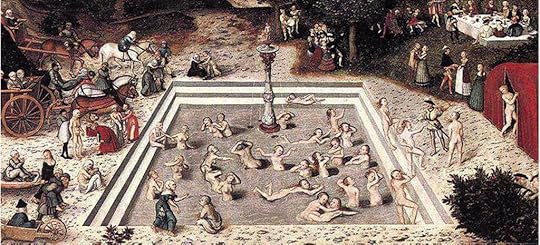
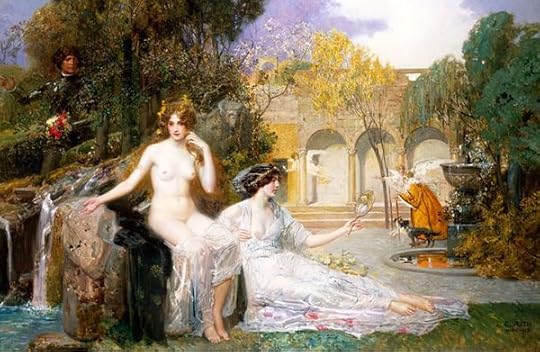
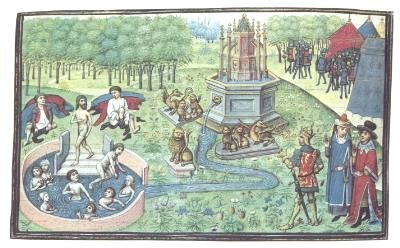
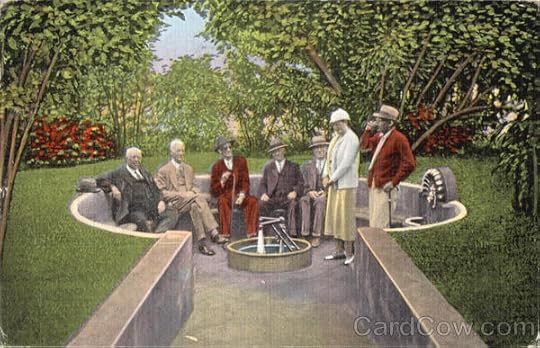
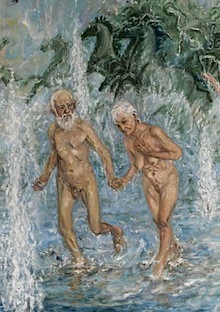
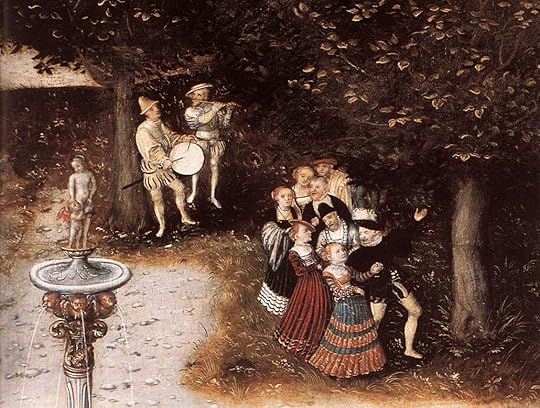
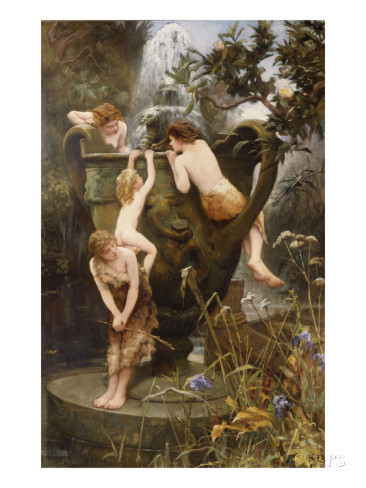
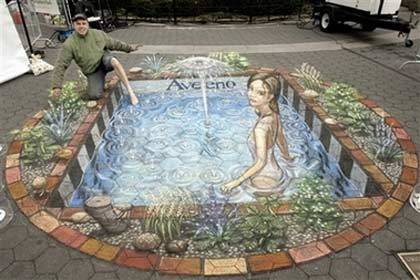
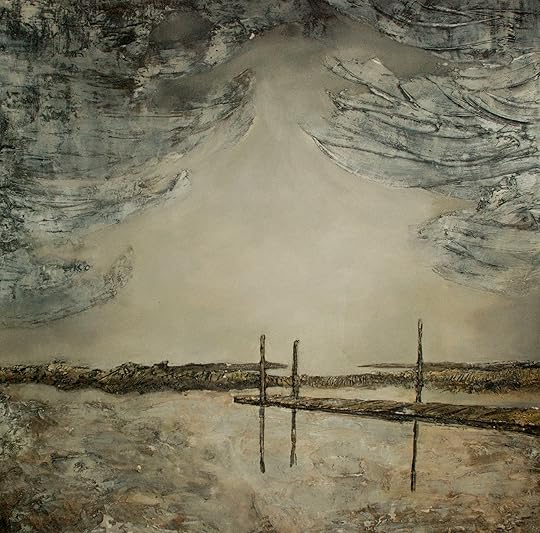
I am lucky to have my own well fed by a 35m deep icy cold water table; unfortunately it is not a Fountain of Youth, which seems to have been covered extensively in the art world...


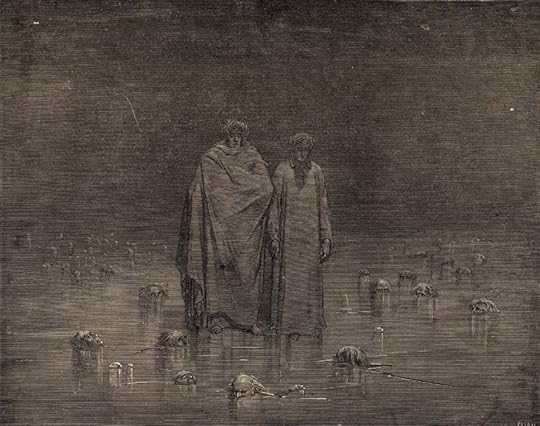
'INTERESTINGLY, MANY CULTURES HAVE A STRONG MYTHIC TRADITION that presents the very opposite of the Fountain of Youth and spiritual rebirth. Rather than drinking water to provide eternal life, water now provides the means and a balm for death.Rivers serve as the crossing point between life and afterlife in many cultures. In Greek mythology, for example, the spirits of the recently deceased must cross five rivers. The River Styx is the first boundary between earth and Hades, the domain of the Underworld. It was guarded by Phlegyas, and gods made oaths upon its waters.'
- page 26
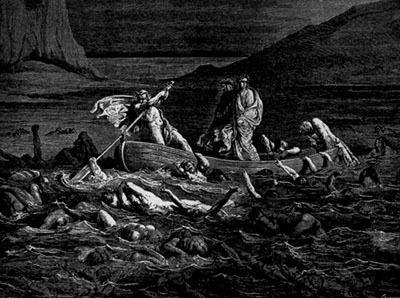
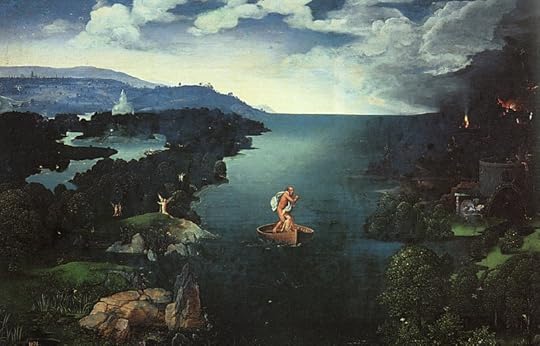



Dante's Phlegethon

River Archeron

River Cocytus
Profile Image for Michael Huang.
1,041 reviews56 followers
Read
August 20, 2018
Some interesting factoids about drinking water throughout history.

Historically, people don’t really drink water, they drink beer, wine etc. Romans were the first to systematically deliver water to the city into public basins every 150 feet within the city. To remind people the Empire is good, they put “Water in the name of Caesar” on these basins. Not until the mid 19th century did people finally realize many diseases spread through contaminated water (not air as thought). Currently there are so many sources of pollutions to water, treating it is still a challenge. For instance, there are high levels of chemical compound in water ultimately from pharmaceuticals. Distribution stage is vulnerable. Case in point: a bunch of teen decided to pee in public water supply and cost the public $40,000 to flush the water and test it. Bottled water is not found to be better and create problem of plastic waste. Today, access to drinking water is considered a basic human right, even appearing in S. Africa’s constitution. Some company was shipping fresh water from the Great Lakes to Asia, tanker style, but was later banned by the states surrounding the lakes. Researcher even studied feasibility of moving a 7 million ton iceberg from Greenland.
Profile Image for Patrick.
1,045 reviews27 followers
December 23, 2012
Looks like this will be right up my alley as the author was inspired by Cod: A Biography of the Fish that Changed the World and Salt: A World History, two books that I loved, though the first chapter describing legends about magic water was not very informative or interesting.

OK, finished. This is good...BUT disappointing. The content is mostly 4 star, but the writing style is mostly 2 star. I'd give this a 2.5 if I could, but fudged to the 3 stars. didn't live up to Cod and Salt.

The chapters feel a little like a really well-researched high schooler plugging his facts into the same formula over and over again. Grab the reader's attention with an interesting anecdote, explain the problem, explain how the common questions aren't useful or common perspective is misinformed, list your own 3 or 4 "better" questions that somehow sounded exactly the same in each chapter, answer those questions, and end with a summary of those answers and repeating the fact that the issues are complex. I know that sounds like much good writing, but his rote repetition of the questions and answers really was weird.

So I was annoyed many times while reading and found myself approaching this as a chore to be finished rather than a reading pleasure. BUT, I really do feel much better informed and enjoyed sharing many of the anecdotes and issues with Shauna. I especially enjoyed the last few chapters discussing the economics of safe water delivery and modern dilemmas both in 1st world and 3rd world settings. I just think the author's expertise is at a much higher level than his formulaic writing style, and it really does get in the way of appreciating the content of the book.

The overarching relevant issue, whether water should best be approached as an economic commodity or as a common community resource/human right, is fascinating. The pragmatic reasons to support either view often largely cancel each other out. It has made me think, and I'm not sure where I fall, though I would always be against major profits preventing easy access. The multiple perspectives detailed in the book will definitely frame my thinking when community water issues are debated.

So a worthwhile read not written especially well.
Profile Image for Sajith Kumar.
729 reviews147 followers
July 13, 2016
Water is essential for all life forms. Perhaps that is the reason why we treat it in such a cavalier fashion often. We assume it to be a fundamental right of every human being to have access to clean drinking water. However, the cleanness of the water we consume is not a guaranteed entitlement in many parts of the world. Public opinion is divided in the middle on how to handle the issue of drinking water. Some say it is a basic human right that is to be fulfilled by governments free of cost, or if at all, with a nominal price tag. On the other hand, there are people who point out that water is a commodity just like food, even though both are equally essential to life. The quantity and quality of water will be improved if and only if more capital is infused into it. This mandates private enterprise and competitive pricing. However, the side that opposes privatization enjoys greater popular support and political backing. This is amply illustrated by the revoking of rights granted in many parts of the world to entrepreneurs. This book presents a brief history of how drinking water was distributed in households of ancient civilizations, how the distribution system took shape, and the several issues related to the handling, distribution and marketing of water. It also provides a brief glimpse on the methods of purification at the end point, that is, our homes. James Salzman is a distinguished professor of Environmental Law at UC Santa Barbara. He has addressed topics spanning drinking water, trade and environment through his books and articles. Consensus among scholars points him out as the fifth most cited environmental law professor in the world. This book is a must read for environmental enthusiasts and students of public administration.

Salzman begins with a general discussion on the need of any society to ensure its supply of drinking water, which involves source identification, its protection from enemies, purification by suitable treatment, and distribution to end users. Water is essential to life, but the question of whether to treat it as a commodity is still not settled conclusively. Ancient communities recognized the Right of Thirst, in some cases, even to outsiders of the tribe. If a person was thirsty, water was given to him, without any monetary obligation. On the other hand, there is a group that argues that even though food is equally essential to life, that is held as a commodity that can be bought and sold freely. Why water should be singled out then? The issue of free water supply dogged private investment in water treatment and distribution for a long time with its repercussions felt in the bottled water industry also. Strange as it may seem, but bottled water is making its second appearance now. It flourished at the end of the 19th century, when water treatment plants were unheard of, or in its infancy. By the middle of the next century, efficient treatment schemes were in place, making tap water safer. This forced bottled water companies into hibernation. Now, as the public perception on the safety of tap water has again hit a bottom, they are back in the game. Chlorination was the most effective technique that removed biological contaminants from drinking water. Salzman notes with concern the widespread practice in Asia of using a common water cup. This is a recipe for inviting contagious diseases, but we are oblivious of the darker side of this common custom. The book includes posters of information campaigns that sought to end the use of a common cup in public places. Disposable cups known as Dixie Cups were developed as a solution to this menace. At the same time, sharing of water, especially at a holy place like Lourdes in France, Zamzam well in Mecca or numerous Hindu pilgrimage sites was quite common across the world.

The second part of the text deals with transportation, sale and distribution of water on an industrial scale. The emergence of bottled water owed its origins surprisingly to marketing charades of shrines and religious places which certified a bottle of water with special seals to denote that it was taken from a source considered to be holy. People venerate water from springs, which explains the liberal use of snow-clad mountains and streams on the bottles of water we purchase from shops in the city. Depending on the minerals dissolved in it, water from springs can offer therapeutic value, as Lithium salts in solution are helpful for alleviating mental illnesses. So, Salzman is hinting that there might be some truth behind miraculous cures claimed by holy water. He also notes with irony that tap water is regulated more closely than bottled water. Stringent rules on the safety of tap water exist, whereas bottled water is treated as packaged food and lax rules apply. Besides, the use of PET bottles pause biohazards as well. Notwithstanding the pollution caused by discarded bottles, manufacturing of one bottle that can hold one liter of water requires the use of three to four liters of water. Storage and distribution of drinking water raises some interesting problems as well. Threat of terrorism in the wake of 9/11 has forced many U.S. cities to considerably enhance the physical security thrown in for their water treatment plants and distribution pipelines. The author lists many plausible scenarios of attack, each more fanciful than the previous one.

The book throws some light on a raging issue that exercises the minds of many people across the world – that of whether water is a marketable commodity or a human need. Those who assert that water is a gift from god get the stinging rejoinder that He had forgotten to lay the pipes to distribute it! Politicians and public anywhere in the world generally side with the altruist cause. This was the real reason in reversing the decision to allow private companies to participate in water distribution projects. Only the constitutions of India and South Africa recognized water as a fundamental right of a citizen. However, the ground reality is far removed from the idealistic banter. Salzman explains a number of technologies currently available to improve water conditions at the point of use. Even though a bit costly, this ensures the best value for money for speedy implementation. An informative discussion on treatment of sewage as recycled water for potable use is presented. This may feel disgusting for the casual reader, myself being one of them. But on second thoughts, what is so revolting in the idea? The water we consider as pure and drinkable took its liquid shape long, long ago, and many plants and animals might’ve ingested and then discharged it!

Nobody can fail to notice the immense significance of the topic in our daily lives when we remember that drinking water is the single largest killer today in the form of communicable diseases spread by contaminated water. However, the author’s lament that there are no books on the subject is not borne out by facts. Philip Ball’s eminently readable book, ‘H2O – A Biography of Water’ is one such. Interested readers can read a review in this blog itself. Having written the book for an American audience in mind, most of the units are not represented by their more familiar international equivalents. Gallons and ounces confound the reader in place of liter and gram. By the same token, the author takes a condescending attitude towards other poor countries, by even remarking at one place that ‘even’ the United States don’t have such a system in place! Repetition of the same idea verbatim at two places may be attributed to the need for better organization of conceptual design. The book is accompanied by an impressive collection of Notes at the end and a good index. Even though the book is compiled with due care for the major political issues that are plaguing drinking water systems in the world, lack of sharp focus and depth of research is disconcerting at times.

The book is highly recommended.
Profile Image for Steve Moseley.
63 reviews3 followers
March 22, 2017
Typically, books like these tend to be preachy and political and I find that quite annoying, especially when a book has a non biased title like this one has. I found this book to pretty interesting, informative while presenting various different views about regulating water or the lack thereof fairly.

The book discusses the history of drinking water and how civilizations have tried to keep it plentiful and safe from the stories of in the Bible, to the Romans, to current day.

Questions of whether safe drinking water is a basic human right or a commodity to be sold as water bottles, etc, as well as the possibility of it being compromised by natural events or some terrorist attack are discussed.

The issues surrounding drinking water are much more complicated than I realized.

Profile Image for Scott.
106 reviews
December 20, 2020
This books is great. I went through it in one day. I love learning about water. this is important. The writer expresses an interest in being like Kurlansky. It was sort of like that. I liked this book. Thanks Salzman. It was helpful to learn. Especially as a serious religious person, I was interested in the history of how drinking water was going. I learned a lotl
Profile Image for Shahab.
152 reviews13 followers
August 20, 2018
کتابی درباره تاریخچه مصرف آب در جهان
ابتدای کتاب به تاریخ تبدیل آب به نوشیدنی اول مردم پرداخته و مطالب خواندنی درباره لوله کشی آب در روم باستان ارائه میکنه
مثلا یکی از راه های حکومت برای جلوگیری از کودتای مردم در روم باستان لوله کشی آب برای دسترسی عمومی مردم بوده
فصل های بعدی به آلودگی آب در قرن 19 تا ابتدای قرن 20 و مشکلات نوشیدن آب و بیماری های ناشی از اون پرداخته
در کل کتاب جالب و خواندنیه و توصیه میشه اگر وقت خالی داشتید نگاهی بهش بکنید
ضرر نمیکنید
Profile Image for Rai.
500 reviews45 followers
December 16, 2020
In "Drinking Water," Duke professor James Salzman shows how drinking water highlights the most pressing issues of our time--from globalization and social justice to terrorism and climate change--and how humans have been wrestling with these problems for centuries.

Drinking Water: A History is an extremely informative, if somewhat rushed, look at the cultural history of drinking water, and what our drinking water supply could look like in the future. Each chapter could have easily been a book in its own right, and as such, it feels like Salzman is speeding through the information and not going into the level of depth he could have on each topic. However, it is well written, well researched and enjoyable to read.

On a personal note, I am starting to become slightly irritated by how ‘American centric’ these microhistories are; I’m aware that it makes sense given that the author is American, but America is an anomaly when it comes to food production, regulations etc. and I’m tired of reading about America. It would have been a lot more interesting – to me, a European reader – if Salzman had branched out more in his look at water systems throughout the world, rather than focusing 90% of the book on the American viewpoint.

I also didn’t appreciate Salzman’s own capitalist bias showing through what is supposed to be an objective text. He very heavily implies that he believes water should be treated as a commodity and that water infrastructure should be privatised, and he is trying to make his case and swing the reader in that direction very subtly.

Overall, not a perfect history, or a perfect book, but an enjoyable and easy read and a good starting point for anyone interested in these kinds of microhistories.

3 / 5
Profile Image for Becky.
903 reviews149 followers
November 21, 2016
I want to start by saying that this book contained a lot of interesting information, there are now many topics which I feel compelled to research further. Ultimately the problem with this book is that I would have loved an entire book about any single chapter, especially the chapters towards the end. It all felt rushed, and since I felt that Salzman was giving me a pretty fair and balanced dialogue about private vs. government ownership of water, water safety (both chemically and physically), etc., I really wanted him to explore more in depth so that I could have felt like I had an even better understanding of the topics. There was just too much in this book for me to do anything than to feel like I came away from something introductory. Additionally- I felt too much time was spent on the beginning discussing the cultural heritage of water. This would have been allowable and even interesting on its own, but I don’t feel that it was adequately tied in enough later to warrant the time spent on it. Then the whole book ended so abruptly that I thought Audible had glitched and I tried to go back a chapter and listen through. The story telling over all seemed disjointed, a series of articles that were not woven together. But we do NEED books and authorship on this topic, so I would recommend this as a place to start, and will be trying to find books on the same subject to learn more.
Profile Image for Sarah.
37 reviews
April 16, 2018
I enjoyed this book not only because I'm a "water person" but also because it was super interesting in general. The book starts with the ways different cultures through the ages have viewed water and what they considered to be "good" water. It then delves into the first public water supply in Rome and how it was managed in order to serve rich and poor. Then the development of public water supplies in New York, Boston, London and other cities. New York had a hard time of it at first, but gradually found their way. Also included is a nice overview of supply, distribution, and treatment of water followed by terrorism threats against water supplies and the current bottled water craze (which is not the first). There is a thought-provoking in-depth analysis of the Flint, Michigan water crisis. It covers places where people really suffer to get water and where greed sometimes prevails in snatching up water supplies. As a world citizen who uses water and after learning about the trends in this book, I expect that safe water will become much more expensive in my lifetime as we are forced to learn to conserve it and pay for the treatment of less desirable water sources. How efficient can it be to water our lawns and flush our toilets and wash our clothes with water that is treated to a high enough quality to drink? I think that is something we will ask ourselves in years to come.
Profile Image for Larry Bassett.
1,641 reviews337 followers
May 18, 2019
This book attempts to cover the history of drinking water as well as the very many issues about the availability and safety of drinking water all over the world. The nonfiction writing style is adequate but not easy to follow all the time. There is alternatively a broad brush and then an effort to delve into detail. It does fairly effectively remind us that bottled water has become a major issue in recent time. It raises the issue of whether the availability of safe drinking water is a right or a legitimate commodity. It comes to this debate frequently but leaves you with the feeling that this is still a very unsettled issue in the world. In an apparent effort to be fair to the different opinions on a variety of water issues it seems to lose the option of being a strong advocate for a particular point of view. I found that lack to be a liability.
Profile Image for Kendra.
35 reviews1 follower
February 4, 2013
Several reviewers compared this one to Kurlansky's Salt, which filled me with dread when I cracked open this book. Luckily, while Salzman says he was inspired by Kurlansky, this book reads nothing like Salt. Drinking Water is well organized and well written. Salzman provides a very balanced approach to the topic and explains contentious issues (private vs. public good) with equal weight given to each side. He makes good use of recent examples (The Marcellus Shale being of particular interest to me) to further explore what we really mean and think when we talk about "safe" and "clean" water. The book ends with a chapter on new technologies and hopes for ensuring access to clean water for generations to come. I would definitely recommend this book.
Profile Image for Chris Leuchtenburg.
1,240 reviews8 followers
October 13, 2015
This book contains many interesting anecdotes about drinking water, but in no coherent order. The historical references yo yo between the Old Testament, to the twentieth century, back to the Middle Ages and ahead again to the 19th century for no particular reason accept that they all seem to have come from a pile of note cards sorted by chapter heading. These poorly digested facts are not organized by historical period, but by modern concerns such as safety and availability. Although the book is titled A History, it is more of a presentation of modern concerns with random references to people in the past with similar problems. This book reflects the interests of a lawyer, not a historian.
Profile Image for Victoria Haf.
290 reviews82 followers
September 22, 2015
Interesante e informativo, te hace sentir que toda el agua que bebes está sucia, habla de que en NY es super segura pero como estoy en el DF no sé que pensar.
Desmitifica al agua embotellada y cuenta como hemos conseguido el agua para beber a lo largo de la historia, habla de los manantiales de Europa que tenían fama curativa (y como a veces era real y otras veces no, como en una ocasión en que un científico tomó el agua Perrier para comparar la pureza del agua con esa agua de manantial francés y descubrió que tenía arsénico ) y de la inminente crisis de agua (y como muchos tienen planes de capitalizarla) mi parte favorita fue una chiquita donde habla de que en Venecia usaban pura agua de lluvia y tenían unos pozos/cisterna en las plazas.
Profile Image for Kirk.
103 reviews5 followers
July 2, 2016
Pretty informative read. It is unnerving to know that we are so susceptible to having our water contaminated. The history of water and how the Romans and other ancient civilizations receoved, purified, and valued water was a real treat as well. I don't think I'll be keen to be downing bottled water as much as others. I may be just sticking to my traditional tab water.
499 reviews15 followers
February 21, 2014
Informative, interesting and practical. One portion of the book is immediately useful to me, in developing policy around agricultural runoff. Surface water and groundwater interaction are a part of my work. This book should be of interest to anyone.
Profile Image for Jill.
185 reviews3 followers
May 7, 2016
Many parts of this book were interesting and informative, but the author's continual promotion of progressive politics was neither.
Profile Image for Jul.
381 reviews4 followers
July 26, 2016
So, I have a thing for water. I love swimming in it, I love taking baths and I especially love drinking it, so naturally, I found this book to be quite interesting.
Profile Image for Anders Rasmussen.
60 reviews12 followers
October 29, 2018
We all depend on water. Without water we die. Unclean water kills about 3.4 million people per year and is among the leading causes of death in humans today. This book accomplishes the rather impressive feat of giving the reader a broad introduction to various issues associated with drinking water. In one book he manages to cover the history and myths associated with water, justice and economic issues (who gets to drink and can you charge for water), safety and health issues, terrorist issues, and last but not least, how you can help bring water to those who do not have it today.

This tendency to associate powers with water is as strong as ever in our modern society, which is partly why it is extremely profitable for companies to sell bottled water. These companies rarely shy away from shouting out grandiose claims about the properties of their water. The fact is that, with some exceptions, tap water is as good or better than bottled water which may come from contaminated springs.

In chapter 2 and chapter 7 Salzman discusses the often forgotten but extremely important issue of whether water should be considered to be an essential human right or whether it should be considered a commodity, or perhaps rather a little bit of both. Humans who don’t get water die is one very good argument for why water should be a human right. However, should we say therefore that it is not ok to sell water. It is after all not free to transport water from those who have it in excess to those who have too little. If people are allowed to earn money on water they might even work hard to build systems that allow them to transfer their commodity to their potential customers. Salzman, even if he may not say so explicitly seem to argue that a combination of these two approaches is best. The romans developed a very efficient system for delivering water to all their people, but that would not have been possible was it not for the money they earned by selling privileges (e.g. water directly into your house), to the rich. There are few things that motivate people and businesses as much as money and often the best products are achieved if people are allowed to earn money when they do deliver.

Another thing that become evident when reading this book is that there is really no such thing as clean water, only water that is clean enough. Water taste different depending on where it originates from. Almost all water, including tap water in western nations, also contain certain small concentrations of poisons such as arsenic and lead. As if that was not enough there are many kinds of bacteria that also live in our water sources. To eradicate every kind of contaminant completely from the water we drink would be excruciatingly expensive, and it would really not be worthwhile given that the human body is generally quite good at handling small amounts of contaminants (this why I am rarely convinced by alarm report saying potential carcinogen found in x - it is often (not always) negligible amounts). I guess the lesson that should be learned is that our tap water is clean (again there are exceptions), but that does not mean that it is devoid of any microbes

Apart from being a good book, it also made me realize the importance of providing clean water to those who do not have it. The benefits go very far, because not only does unclean water kill people and make them sick, it also uses up people’s time when they have to walk, sometimes several miles to get water (dirty water). Often girls in Africa have to quit school at an early age in order to spend their days fetching water. Indeed in Africa alone people spend 40 billion hours per year, fetching water. It is indeed hard not be affected by this book
Profile Image for K.A. Ashcomb.
Author 4 books52 followers
October 3, 2018
Read or listen to this book. It's worth your time. The book goes over the importance of water, history and myths, current trends concerning bottled water, political and humanitarian issues with water, terror towards water sources, ponders if water should be free or should we pay more of it, and can it be privately owned. The book is informative which made me go over what I think and know about water (+its health benefits.)

Here are my complaints and then we can move on to the juicy stuff, the water. When you combine a book with this many points, you can't deepen too long for any subjects. Not when the book is relatively short. I know this book is meant to peek my interest still I wished there would have been enough space for myths, history, and legends and on the humanitarian issues.

Another complaint I have is the defense for higher water prices. The argument and its justification were too short and hasty. I wasn't convinced with the generalization from a few examples and with a lack of study to back the claim. I'm not saying the writer is wrong. I'm saying the argumentation wasn't enough.

Rest of the review is my rambling, feel free to skip this. First, the book spent most of the time talking about bottled water and pointing out what bottlers claim about its health benefits and what issues evolve around bottled water. Basically, bottled water is a waste of money and can be even more dangerous than tap water. No revelations there. But it made me wonder has the trend of water's healthiness passed. Nowadays more flavored water with added minerals and vitamins, calming to aid skin health, muscles recovery or being against of cold are sold and bought. Clearly, health claims are not enough when people are used to drinking sodas, juices, and everything else but water. (Eroding their teeth at the same time. Yay.) It is worrisome how our chemically cleansed recycled water gets second to everything else. Our civilizations wouldn't be where they are now without it. The cities' and population sizes would be a lot smaller due to diseases and other nasty issues. We should praise basic tap water higher we do now. But I guess we only appreciate when it's gone.

Should water be free and shared commodity? There are costs to maintain and clean our water system, so yes we all need to chip in. We need to keep the system working so there won't be epidemics and deaths. But what about the water itself, the source? I don't think any individual or corporation should own it. I think a corporation can buy rights from the local community around the water source to pump and use it (although it is useless when there is a working water system.) However, they can't restrict the locals' access to it nor control the water any other way. I think we go to dangerous grounds if we give private ownership to water sources as with control comes power and with power comes discrimination and preferences and then we are on the shaky ground. Water is our basic need, and it should be accessible to all. This isn't the case. We see global ramifications from the lack of fresh water, and it will continue to cause duress. One or two investors have said the best place to invest your money is water and I have to agree. It might be a way to secure one's future how awful that might sound.

Okay, this review took a darker turn. I'm sorry about that. Read the book and make up your own mind and ignore me and my thoughts of doom if you want.

Thank you for reading!
Profile Image for Scott Pearson.
874 reviews46 followers
June 24, 2021
Why develop a detailed history about something as ubiquitous as water? Salzman shows why in this well-written inspection of a resource without which humans could not survive. He covers contemporary legal issues as well as (in the revised edition) the 2016 debacle in Flint, Michigan. He discourses about science, economics, human history, and public policy at length. Through adept writing, he makes the mundane and overlooked to become interesting and critical. To the curious reader, he offers a look at an environmental issue of importance that barely receives notice of the average citizen.

Salzman bookends his book with the tale of a small California town targeted by Nestle for a water plant. This dying town’s leadership sought a bottled-water facility as a way to restore economic health. However, many in the town rebelled from their leadership for environmental reasons. The economic-versus-environment motif played out through the courts, and Nestle eventually withdrew its plans. While many citizens saw this as a victory, the town council still has no other plans to aid the region’s economic health.

Controversies such as this will likely take place with increasing rapidity in America in coming decades. America’s water infrastructure is aging, and public funds, required in the billions of dollars, are lacking. Worse, public interest is also lacking – something that Salzman, a law professor and environmental policy wonk, seeks to combat.

Finding healthy water sources and providing water treatment has been an integral part of human society since the Romans, as the author delineates. Public attention often passes despite the issue’s obvious importance. Water infrastructure in the developed world is surprisingly still vulnerable to fears of terrorism. An expanding society means an increasing need of water, yet few politicians attend to such concerns.

This book should gain the attention of those interested in public policy. Hopefully, it will also grab the attention of informed citizens and their leaders. It brings interest to a topic that is, as the author convincingly persuades, worthy of such. This work focuses on the social impacts yet provides scientific detail of involved elements. As such, Salzman’s words can access a wide audience. Hopefully, the world need not repeat scenarios like Flint, Michigan, to realize the importance of attending to these matters.
Profile Image for Graham Barrett.
1,387 reviews5 followers
January 2, 2023
3.5-4.0 (rounded up)

"Drinking Water: A History" is an interesting mix of history book, science textbook, analysis of water rights activism, and a PSA about what really goes into making a glass of water drinkable. The book is complex but that makes sense as water is a complicated topic as is making sure everyone has access to cheap and clean water.

When it's not complex though, Drinking Water A History could be really fascinating. It starts off talking about mythology and the religious significance of water which becomes clearer as it explains how it connects to contemporary drinking water. The pieces fell into place when the book explains how bottled water came about by businessmen trying to capitalize on springs with religious significance by bottling up the spring water for tourists to bring home. From there the book goes into fascinating bits about the development of city's water systems, including busting a few myths (i.e. Rome's decline was not due to lead pipes in the city) before inevitably talking about Flint Michigan, the water crisis of our time (but not the last). The book covers so much that it's hard to pick a favorite topic it covered, although the chapter about water security is up there.

It's a good thing the subject matter could really be interesting and varied because there were times the writing on these topics really made it a challenge to otherwise get through conversations about these interesting topics. Like the proverbial tides, my interest and attention had highs and lows throughout the book and the chapters, sometimes I was following along, other times I had to refocus and reread the previous paragraphs of somewhat dull content. As such Drinking Water A History was a lot tougher to get through than I would have liked.

As the climate crisis worsens and water conflicts increase, "Drinking Water: A History" may get increased focus as leaders and consumers trying to get clean drinking water will look to it for a sense on how the world got to its current water issues and where we could possibly go from here. While not the best written, there's plenty of unique lessons about water here to learn.
Profile Image for Saba.
355 reviews1 follower
August 30, 2018
My top three thoughts on 'Drinking Water':
1. This book is informative, interesting and very necessary. Water is currently being taken for granted, carelessly contaminated and regularly wasted. 'Drinking Water' covers a huge host of topics: the history and distribution of water, politics, debates, economics, the environmental impact and water preservation efforts. There were some parts in the book that I was already familiar with, like the power play involved in the distribution of water and the illusion of 'safe' drinking bottled water. What I didn't know though, until my recent trip to The Roman Baths, was the history behind this essential element. This book sheds light on it in detail e.g. Water was associated with a caste system in ancient times. It was undesirable and was consumed only by the poorest or weakest members of society.
2. The writing by Salzman is very inconsistent. It didn't take away from the message of the book but it was a bit unexpected. Sometimes the tone and language felt apt for an essay, at other times it felt too casual.
3. There is a section in the book that mentions a London physician in the 1800s called John Snow. He was an advocate for clean water and more or less developed the field of Epidemiology. I admit that initially, I was focused more on his name rather than the subject. Please note: I'm a silly person with a weird sense of humor. I was amused and distracted by the thought that it must be incredibly hard for all John/Jon Snow's to be taken seriously after 'Game of Thrones'; especially if they are/were experts in their fields. I kept thinking, the line "You know nothing Jon Snow" will keep undermining their work till GOT is forgotten.
Displaying 1 - 30 of 125 reviews

Can't find what you're looking for?

Get help and learn more about the design.