The classic literary canon meets the comics artists, illustrators, and other artists who have remade reading in Russ Kick's magisterial, three-volume, full-color The Graphic Canon , volumes 1, 2, and 3.
Volume 3 brings to life the literature of the end of the 20th century and the start of the 21st, including a Sherlock Holmes mystery, an H.G. Wells story, an illustrated guide to the Beat writers, a one-act play from Zora Neale Hurston, a disturbing meditation on Naked Lunch , Rilke's soul-stirring Letters to a Young Poet , Anaïs Nin's diaries, the visions of Black Elk, the heroin classic The Man With the Golden Arm (published four years before William Burroughs' Junky ), and the postmodernism of Thomas Pynchon, David Foster Wallace, Kathy Acker, Raymond Carver, and Donald Barthelme.
The towering works of modernism are here--T.S. Eliot's "The Love Song of J. Alfred Prufrock" and "The Waste Land," Yeats's "The Second Coming" done as a magazine spread, Heart of Darkness , stories from Kafka, The Voyage Out by Virginia Woolf, James Joyce's masterpiece, Ulysses , and his short story "Araby" from Dubliners , rare early work from Faulkner and Hemingway (by artists who have drawn for Marvel), and poems by Gertrude Stein and Edna St. Vincent Millay.
You'll also find original comic versions of short stories by W. Somerset Maugham, Flannery O'Connor, and Saki (manga style), plus adaptations of Lolita (and everyone said it couldn't be done!), The Age of Innocence , Siddhartha and Steppenwolf by Hermann Hesse, "The Negro Speaks of Rivers" by Langston Hughes, One Flew Over the Cuckoo's Nest , Last Exit to Brooklyn , J.G. Ballard's Crash , and photo-dioramas for Animal Farm and The Wonderful Wizard of Oz . Feast your eyes on new full-page illustrations for 1984 , Brave New World , Waiting for Godot , One Hundred Years of Solitude,The Bell Jar , On the Road , Lord of the Flies , The Wind-Up Bird Chronicle , and three Borges stories.
Robert Crumb's rarely seen adaptation of Nausea captures Sartre's existential dread. Dame Darcy illustrates Cormac McCarthy's masterpiece, Blood Meridian , universally considered one of the most brutal novels ever written and long regarded as unfilmable by Hollywood. Tara Seibel, the only female artist involved with the Harvey Pekar Project, turns in an exquisite series of illustrations for The Great Gatsby . And then there's the moment we've been waiting the first graphic adaptation from Kurt Vonnegut's masterwork, Slaughterhouse-Five . Among many other gems.
Editor of the website The Memory Hole which publishes and archives hidden US government documents, including scientific studies and reports, civil rights-related reports, intelligence and covert action reports.
He was also editor-at-large for The Disinformation Company, where he had published several books including The Book of Lists and 50 Things You're Not Supposed to Know.
"an encyclopedia of ways to merge images and text"
This enormous book is a hubristic folly which is hard to love but impossible not to admire.
FOLLY :
a costly and foolish undertaking; unwise investment or expenditure; a whimsical or extravagant and often useless structure built to serve as a conversation piece, lend interest to a view, etc.
This is the third volume of a gigantic undertaking which, in its editor’s words
Was always meant as an art project, part of the ages-old tradition of visual artists using classic works of literature as their springboard... It turned into a lot more – a survey of Western literature (with some Asian and indigenous works represented) , an encyclopedia of ways to merge images and text, a showcase for some of the best comics artists...
So what you get is a one page (sometimes one paragraph) summary of the author of the work to be illustrated, a discussion of the work itself, its position in the canon, the reasons why the artist chose this particular work, and a short précis of the artist. That’s a hell of a lot to cram into a page (or a paragraph).
Then you get the illustration. This might be one page only -
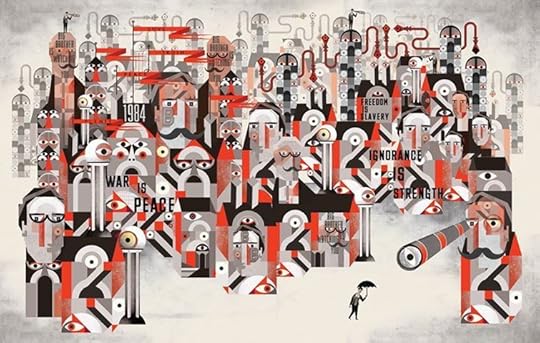
here's 1984:
or up to 12 pages.
What is this canon anyway? Who sez? It’s the usual problem, same as that encountered by the notorious 1001 Books You Must Read Before You Have Dinner. Russ Kick’s version includes short stories, poems, essays, plays, Freud, Colette, Sartre, diaries and a song (“Strange Fruit”), along with the usual-suspect novels. A real supermarket dash of the written word. So the format of this book means that Rudyard Kipling’s repulsive poem "If…" gets 6 pages, and Infinite Jest gets – 6 pages.
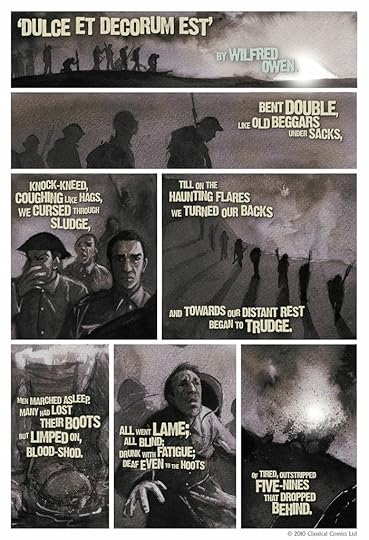
Some entries try to graphic-novelise the whole work, here's an example :
- the ones for short stories do that especially. Many choose one “significant” scene from a novel. (Like playing your guitar version of one minute from someone else's symphony). Most splash their pix with lots of text from the work but some are wordless. Is this anything more than beautiful (and often God-damn ugly) but pointless, occupying precisely the no-man’s land between graphic art and literature, a forced hybrid to be regarded with curiosity which no one will particularly love except graphics fans who can treat this as a large exhibition catalogue displaying the work of 75 or so artists? Interesting for them, I guess. But for lit fans, it’s neither fish nor fowl. If you don’t know the artist and you haven’t read the work, your encounter with it here may permanently put you right off – I’m never going to read Gorky now!
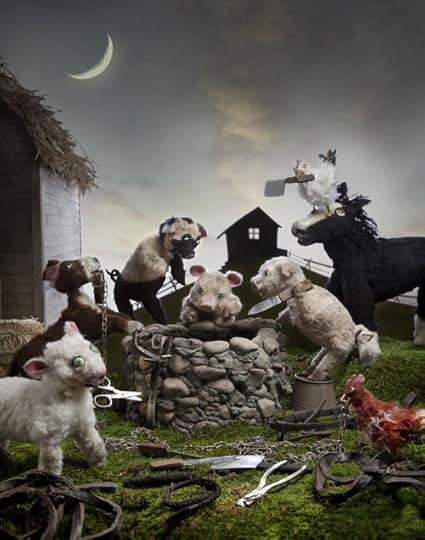
I loved some artists! Sonia Leong mangarises a Saki story and it’s just de-lovely. Bishakh Som does an obscure DH Lawrence story and it’s a delight. And here’s Animal Farm :
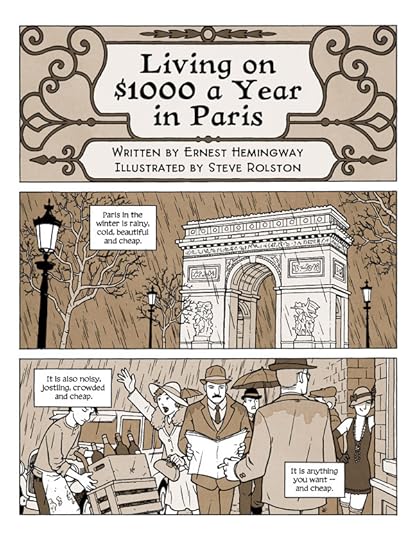
I want a whole book of that, please! And Steve Roiston’s version of Hemingway’s essay is great :
But for every ladder you climb up there’s a snake you slither down – for instance, Crumb’s beautiful text-rich 9 page version of Sartre’s "Nausea" has all the text in French. Great. And then there’s moments when the choice of work by the big name author is way too cute – for William Faulkner they dig up a story which was omitted from all his collections because it’s a piece of juvenilia. Same thing with Thomas Pynchon.
Even so, in every page there is the strong feeling that the artists themselves really believe in what they’re doing. Maybe I just don’t get this thing. Three baffled stars.
A comics anthology, with all the variability in quality that the term implies. This is the final volume of a Quixotic attempt to adapt the canon of world literary classics in comic form. Since the entire series is only three volumes, obviously some abridgment is happening. "Comics" is given a broad interpretation, encompassing creative typography and single page illustrations as well as the more traditional sequential art. In at least most cases, straight adaptation is abandoned in favor of interpretation, comics inspired by the literary sources. Often, if one isn't familiar with the original work, the comics rendition of it will be all but meaningless. There's some good work here, but there's also mediocre work as well. It's an interesting project, but there are certainly comics anthologies of more consistent quality out there.
After being sorely disappointed with the first two volumes, I just skimmed through this volume. Having been most familiar with the literature in Volume 2 (and much of Volume 1) and still having to skim or skip through much of it (either due to unreadable art styles and/or a disinterest in the literary work), I knew this volume would hold my interest even less than the first two.
As a whole, the Graphic Canon series is a great concept, but the editing is not great at all.
Unfortunately, I thought this series got progressively worse. The first had a lot of full stories - the Arabian Nights, the Native American "How the Coyote got his..." stories, the great Greek and Roman myths - and that made for more entertaining reading. As the series went on, the illustrations became more abstract, and they reflected less of the stories I actually like.
I know it's pointless in a collection to say, "Why didn't you choose THIS?" because ultimately, it's impossible to satisfy everyone, but I was supremely annoyed to see someone like Richard Brautigan - who wrote my least favorite book ever ("Trout Fishing in America,")- getting a spot, while Joseph Heller, Hunter Thompson, and Kurt Vonnegut all failed to make an appearance.
That's the curse of any collection though. It was an awesome project, and I'm glad someone did it, but I hope - I'm sure it won't - stop there. Adapting literature in graphic form is a fantastic idea, and, like literature, some of it's going to leave me cold, and some of it's going to excite me. Kick, I thought, tended to lean towards the more Harold Bloom camp, which is probably the more "serious" literature, and I can't deny that most of what he picked would be agreed upon by most academics. I hate Harold Bloom's taste though. Give me Stephen King over Ulysses any day. I don't care if that makes me a philistine.
It was a good series, and it's not up to Kick to pick my favorites.
My father sent me this. From my limited understanding of parent-ness, parents want to give their children the future. Thus, The Graphic Canon was the perfect gift. If I am still teaching literature ten years from now, I suspect I will make the Graphic Canon part of my surveys, not just because they give students a quick, accessible reading off which they can gauge their own, but because they are beautiful, necessary books. I'm jealous and hopeful that someday these will replace the corporeal Norton Anthologies (each of which is an argument for the Kindle) as the provocation for backaches in English majors everywhere.
الفكرة مش واضح جدواها بالتحديد بالنسبة لى . اختيار عمل ما مهم و رسم عدة مشاهد منه . الرسومات متفاوتة فى الجودة من عمل لآخر . اهتميت بيه عشان النكتة اللانهائية . فى خمس رسومات من اربع مشاهد (نوبة الفزع بتاعة هال فى المشهد الاول - التجربة التى تحمل نكهة جنسية بعيدة بين مليسنت كنت و ماريو انكاندينزا - بميولس و هو بيعرض البول الآمن \لخالى من المخدرات كأطفال الملا .-تهىتهى- للبيع فى شكل كاريكاتورى لانه ماحصلش فى الرواية - جولى فان داين وهى بتقول حاجة ما لجاتلى من الشباك اللى مش ممكن يكون بتاع اوضتها ,ساعة خناقة جايتلى مع الكنديين دفاعا عن راندى لينز ,و هو مش سامعها - جاتلى و هو بيضرب واحد منهم فى الزجاج الأمامى مكونا هالة حوالين رأسه من شبكة عنكبوت ) . الرسومات عادية فشخ .و اختيار حتى المشاهد من الرواية مش ذات دلالة . حتى مش دقيق فى مشهد ماريو , ماريو رأسه كبيرة , و انفه معوجة اللى جانب وجهه ,بسبب الاصابات المتكررة اللى بتتضمن انه بيقع عليها ,حرفيا ,فمكانش الرسم دقيق , بس درجة اللون بتاعة الزواحف لجلده دقيقة نوعا ما . و رسم قصيدة كيبلينج برضو if , برضو وحش جدا . ملحوظة :_ على ذكر محاولات نقل النكتة اللانهائية لشكل اخر , افتكرت المشروع اللى عمله استاذ للادب الامريكى , كيفين جريفيث . بتحويل مشاهد لليجو . https://www.theguardian.com/books/boo... http://www.brickjest.com
This is an ambitious collection, but is more like an appetizer sampler, not a full meal.
There are two adaptations of Ulysses by Robert Berry with Josh Levitas & David Lasky.
J. Ben Moss' adaptation of Siddhartha looks an awful lot like Jesus.
Molly Kiely's adaptation of Kathy Acker's Blood and Guts in High School is reminiscent of all the dick drawings in the film Superbad.
Kafka's Metamorphosis stylized as a Peanuts strip by R. Sikoryak was my favorite.
My least favorite were Tara Seibel's interpretation of The Great Gatsby and PMurphy's brief One Flew Over the Cuckoo's Nest.
My biggest gripe was that Infinite Jest was advertised in the collection's title, but there are only 5 full page images coinciding with 53 total words from the source material. There are only 8 total paragraphs (including the Further Reading section) addressing the novel. Hal Incandenza is described as a "stressed out" "tennis whiz" and Don Gately looks like Bubba Ho-Tep.
The silver lining of this collection was the discovery of Zak Smith's 760 pager, Pictures Showing What Happens on Each Page of Thomas Pynchon's Novel Gravity's Rainbow.
This collection is surprising and very enjoyable. The Graphic Canon showcases "the classics" reimagined by various graphic artists. This is your grade 7-university reading list but the plot, characters, and general feel of the novels translated into amazing graphics.
This is an anthology, some of the interpretations were excellent and others came up a bit short. While different from the prose we expect of the original works these graphic interpretations nonetheless told the same stories we are familiar with. Overall I found the art to be very good to excellent.
It was a delight to rediscover from a different vantage these well-known books. I shared a few with my HS teen, through this book he's now been exposed to some of my favorite stories and cultural references which as a kid who doesn't enjoy reading would have never known.
I can’t say enough in praise of this three volume project. The volumes are phone book sized and still leave one gasping for more. The meeting of visual arts and literature isn’t just clever it’s mesmerizing and inspired. Of course there are many favorite writers i wish had been included but that’s just a matter of logistics. Maybe an alternative volume 4 could capture more of the stuff that fell through the cracks. But i have a feeling it could go on and on so why not a serial publication? I’m on board for a subscription.
I really enjoy classics, several of my top 10 favorites are such. I've never really gotten into graphic novels however, and this was a great intro, merging my love of classics with appreciation for art with my unfamiliarity with graphic novels. Each novel has a great, brief intro about the synopsis, historical relevance and interesting antidotes, along with a brief bio of the illustrator. Recommend for all the above reasons. I will read another, and am really looking forward to it in the future.
I'm working on the 1001 books to read before you die list and this is getting me started. Here are the graphic versions I read in this book:
The Awakening Mother The Voyage Out Age of Innocence Ulysses Steppenwolf Lady Chatterley's Lover Sound and the Fury Maltese Falcon Grapes of Wrath 1984 Man with the Golden Arm Lolita On the Road Naked Lunch One Flew Over the Cuckoo's Nest Gravity's Rainbow Crash Blood and Guts in High School Blood Meridian Foucault's Pendulum Wild at Heart Infinite Jest
Weakest of the three volumes. It is also the most American/British male dominated volume. This is particularly true when it comes to the modern authors. The Three Panel Reviews, as always are great and the adaption of Lolita was particularly good. I thought the inclusion of "Strange Fruit" was a good touch.
I felt some real running out of steam in this last volume. A lot of one page images rather than more full interpretations. And of course I quibble with many of their more modern canon inclusions, but I suppose that your never going to make people happy there.
Introducing myself to the graphic novel format - this was a good way to do it; - with familiar classics. Fun. I don't feel qualified yet to really critique with any intelligence.
Meh. I really wasn't feeling this one even though it included stories from a plethora of my favorite authors. The art didn't grab me as much as the other "canons". Oh well, you can't win 'em all.
How can you not love a book that combines most of the greatest books of all time? The artwork was done by different artists so you got to see a lot of different styles and interpretations. Some were long, cartoon-like panels while others were single, memorizing pieces (The Wind-up Bird Chronicle artwork sticks out the most. That long, strange book was done up in a single picture. Same with The Bell Jar...and many others but I've returned the book to the lib and can't reference it). Some missed the mark completely while other will stay with me long after the book itself fades from my memory.
My own complaint is that it was done by mostly graphic artists and ultra modern illustrators. There was nothing poetic about the artwork or any of the artists interpretation...it was too straightforward and cold for the most part. Interesting pictures and a lot of raw talent but very little true beauty. You wouldn't put any of this on your wall unless you were 15.
I keep dropping my rating down to a 3 and then moving it back up to a 4. Why OH WHY can't they start doing half stars?! I think I'm in love with the idea of this more than the actual execution. While writing all this I realized that I can't really name one image that I LOVED....in fact, I can only remember a handful of images at all. Nothing was really that memorable or stood out. I can't even remember the imagery for Borges short stories and that was the main reason I even picked up The Graphic Cannon in the first place. It's a bad sign when I can't name one image I absolutely loved in a book with this many artists(not to mention references to books I love)...
What I loved most was getting to read the story burbs and adding books to my To Read shelf.
It's huge so flip through it at the library. If you like it, I definitely suggest buying it to own. It's one of those books that needs to be looked through several times.
Commentary on classics, samples of great works and lovely art are the trademark of the Graphic Canon series. Since the three volumes were worked on in tandem, they flow seamlessly. Volume 3 doesn’t disappoint, and presents a new perspective on the literature of the 21st century.
In my review of the first volume I commented on the fact that I enjoy reading these anthologies as they give me a taste and understanding of great literature from around the world without having to read them in their entirety. In my review of the second volume I talked about how one goes about deciding what gets included in the canon, how literature becomes famous, and censorship.
This volume included some lesser known works of famous authors which were nice to see included. It makes you wonder about what works become famous and why. There were even some that were written in high school. While I don’t think they should really be part the graphic canon seeing as they aren’t really part of the literary canon, they were really interesting to read.
I also noted how bleak and dismal the portrayal of the world was in the 21st century. The vast majority of the works included are about sex, drugs, poverty and violence. I much preferred the fantasy that suffused the earlier centuries. But, it was really cool to travel through history across the three volumes and watch new movements and styles emerge.
Recommended to lovers of graphic novels and classic literature.
While the third volume delivers the kind of high quality art work I've come to expect from the Graphic Canon series, I have to confess to being somewhat disappointed by the final collection. The problem, I think, is that somewhere along the way the series moved from retelling the great stories to merely illustrating them. Some of these illustrations are gorgeous - my favorite being Chandra Free's mesmerizing art work for The Waste Land - but they reflect, for the most part, a fairly trivial engagement with the underlying text. About half the pieces in the anthology seem like they would make great covers for a new paperback edition of a modern classic, but little more.
There are, of course, some notable exceptions to this criticism, the most brilliant among them being:
1. Frank Hansen's delightful take on Rudyard Kipling's 'If' 2. Annie Mok's lovely rendition of James Joyce's 'Araby' 3. R. Sikoryak's hilarious Kafka-meets-Peanuts take on 'The Metamorphosis' 4. Robert Berry and Josh Levitas' insightful take on Ulysses, part of a larger project that I'm now really, really excited to see. 5. A graphic novel version of Sartre's Nausea by the inimitable Robert Crumb 6. Mardou's adaptation of Anais Nin's Diaries.
Ernest Hemingway - It's a matter of colour. Who knew I'd enjoy Ernest Hemingway?! I sure didn't. This was very well drawn by Dan Duncan and the story was very good! Hemingway's Living on 1,000 a year in Paris also stood out from the other works!
Colette - Cheri. Oh how beautifully drawn By Molly Crabapple!!
John Blake - Dulce et Decorum est. Completely and totally spoke to me. Mainly because of its topic.
Edna St. Vincent Millay - The Penitent and The singing-woman from the Wood's Edge. These were such beautiful poems, I felt so moved when I read them the first time that I had to read them again immediately. Also wrote them down and have to read more of her work in the future. Also, very beautifully drawn by Joy Kolitsky.
T.S. Eliot - The Waste Land. Yes, I've found T.S Eliot and though he might have been talking about entirely different things in this poem than I think, I found myself in the midst of it all anyway! Very modern drawing by Chandra Free which gave the poem a nice edge.
There were some other good and interesting works there too, some of them I've already read and others have not. In some of the works the drawing might have been better than in others but that's just me.
Russ Kick's idea, to render great works of literature graphically, is certainly worthwhile. And Volume 3 starts out with a bang: Matt Kish doing "Heart of Darkness". How could the rest of the artists improve on that?
They don't.
And so, though other interpretations sparkled here and there, I was basically disappointed with the whole. My daughter, a big fan of graphic novels, was also not that impressed.
Still, of note: Caroline Picard's "the Voyage Out", Lisa Brown's Three Panel Reviews, R. Crumb's Sartre, Jeremy Eaton's "The Man with the Golden Arm", Yeji Yun's "On the Road", Juliacks' "Last Exit to Brooklyn", Mardou's "Diaries of Anais Nin", Rick Tremble's "Wild at Heart", Aiden Koch's "The Famished Road".
I have not seen Volumes 1 and 2, but I would certainly give them a look.
But no one else here gave me the double whammy of Matt Kish: I want to look at all his other work, and I want to re-read "Heart of Darkness".
Overall, I thought the collection went downhill as we progressed through time.
In addition to awkward blurbs and serious fact-checking errors (apparently Russ Kick thinks Zora Neale Hurston wrote Go Tell It on the Mountain), there were many strange decisions made as to what is "classic" in this third volume - with few exceptions I would have preferred authors' more well-known works.
There were also a ton of single page illustrations, mostly of how the artist reacted to a particular story. Very different from the other volumes. Combined with the fact that there were many stories I didn't know, this made a lot of the book a slog.
There are exceptions, though. In particular, I liked the excerpt from Dubliners illustrated by Annie Mok (who has also illustrated Joyce's letters... Hilarious) and LOVED Kate Glasheen's adaptation of Faulkner's "the Hill".
This was much more underwhelming than I thought it would be. I was excited by the premise of this book when I first stumbled upon it, but I found very little enjoyment in it. Though much of the art was interesting or beautiful, most of the works were too vague to be appreciated, in my opinion, unless you had already read all of the stories and loved them all. I had to force myself to finish the book, but I did find some islands of great interest in the seas of wreckage. Also, I did appreciate it as a reading guide of what to read and to NOT read of the "classics". For this reason alone, I'm thinking about reading the first two volumes as well. Though it was a chore to get through for me, I added quite a few books to my reading list, based on the entries in this volume.
A really enjoyable anthology. Great art and of course, great stories. However, because the prose is removed from these classic tales, some subtext and literary beauty is lost in translation. Some stories are able to compensate through the art, but others are a little disappointing and seem to miss the point of the original text. This matters a lot to me, as a former English major, but possibly not to everyone.
The adaptations are nonetheless very entertaining and this is an anthology I am sure I will keep coming back to. A very ambitious project, and very well executed.
Disclaimer: I received this book for free from First Reads.
“Behind him was the motionless conflagration of sunset, before him was the opposite valley rim upon the changing sky. For a while he stood on one horizon and stared across at the other, far above a world of endless toil and troubled slumber; untouched, untouchable, forgetting for a space that he must return. He slowly descended the hill.” --W.F.
“I had the feeling something was going to happen, it was in the slowness of the shadows and the light, and that whatever it was might take me with it.” –R.C.