An epic tale of one man’s courage in the face of genocide and his granddaughter’s quest to tell his story
In the heart of the Ottoman Empire as World War I rages, Stepan Miskjian’s world becomes undone. He is separated from his family as they are swept up in the government’s mass deportation of Armenians into internment camps. Gradually realizing the unthinkable—that they are all being driven to their deaths—he fights, through starvation and thirst, not to lose hope. Just before killing squads slaughter his caravan during a forced desert march, Stepan manages to escape, making a perilous six-day trek to the Euphrates River carrying nothing more than two cups of water and one gold coin. In his desperate bid for survival, Stepan dons disguises, outmaneuvers gendarmes, and, when he least expects it, encounters the miraculous kindness of strangers.
The Hundred-Year Walk alternates between Stepan’s saga and another journey that takes place a century later, after his family discovers his long-lost journals. Reading this rare firsthand account, his granddaughter Dawn MacKeen finds herself first drawn into the colorful bazaars before the war and then into the horrors Stepan later endured. Inspired to retrace his steps, she sets out alone to Turkey and Syria, shadowing her resourceful, resilient grandfather across a landscape still rife with tension. With his journals guiding her, she grows ever closer to the man she barely knew as a child. Their shared story is a testament to family, to home, and to the power of the human spirit to transcend the barriers of religion, ethnicity, and even time itself.
Dawn Anahid MacKeen is an award-winning journalist who spent nearly a decade on her grandfather's story. Previously, she covered health and social issues for Salon, SmartMoney, and Newsday, where her investigative series on assisted living facilities' poor care helped prompt legislative reform. Her work has appeared in the New York Times Magazine, Elle, the Sunday Times Magazine (London), the Los Angeles Times, and elsewhere. She lives in Southern California.
Reading memoirs about ethnic cleansing is always difficult, at multiple points I had to put the book down and take a breathe because I felt so overwhelmed and upset by the things being described. The things that are the hardest to confront or think about are the most important to do so with and so I think that this is a really worthwhile read. Especially if the Turkish still won't acknowledge what happened, that makes it more imperative to make sure everyone knows what happened with the Armenians and hold people accountable. It's the events written about in this book which convinced the Germans they could get away with mass killing as well. The only thing I found annoying were the parts with the Granddaughter in modern day, every time it was one of her passages I got annoyed because it was interrupting the rest of the book and I really needed to know if her grandpa would be okay even though clearly yeah he was because we have this memoir but I was very emotionally involved and didn't appreciate being jarred out of it.
This book was incredibly hard to get through. Not because of the author, don't get me wrong. This book is beautifully written. The author intertwines her grandfather's story (past) with her own (present). It's the subject matter that got to me. It made me sick. Sick to read about the deaths, the murder, the gross atrocities. But even more than that, I'm sick that I knew nothing about the Armenian genocide. Read this book. Read this book not because it is a lighthearted tale. Read this book for the knowing. For the knowing and the recognition of suffering. Read this book to honor the hundreds of thousands of lives lost.
I have read a number of books on World War II and the Jewish Holocaust, and I am always left speechless by the atrocities that humans inflicted on other humans solely because of the religion a person was born into. I knew much less about World War I and the massive Armenian genocide, which was the topic of this memoir. Dawn Anahid MacKeen pieced together her Armenian grandfather's experiences from his personal journals, countless interviews, and clearly a great deal of research. Alternating between her grandfather's long journey from Turkey to Syria (much of it by foot!), and her own journey to retrace his steps, I was enthralled with this important but heartrending book. The Hundred-Year Walk took her a decade to write and is a loving tribute to Stepan's memory and to all the Armenians who perished. A villager in Syria had these powerful words for Dawn, "A friend of the clan will not be asked what religion he embraces. Religion is for God; the homeland is for all." Thanks to Dawn Anahid MacKeen and the publisher, I won a copy of this book. This was my unsolicited review.
The 100 Year Walk: An Armenian Odyssey by Dawn Anahid MacKeen
The Armenian genocide should be taught in every high school world history curriculum. Sadly it was not taught in mine nor in my daughter’s more recent IB world history curriculum. Perhaps it is because there are only so many horrors that can be absorbed in one history class. More likely the omission is that the Ottoman theater was so far removed from the trench warfare in France and did not play a major role in the outcome in the West. Nonetheless the Armenian story is every bit as sad and pointless as the events at Verdun or the Somme. To add more historical context to story in this book, I can unequivocally recommend a history called The Fall of the Ottomans: The Great War in the Middle East by Eugene Rogan
So this book was written by journalist Dawn MacKeen the granddaughter of Stepan Miskjian. Stepan is our protagonist and a survivor of the four year horror waged by the Turks on the Armenians during WW1. MacKeen, who grew up in Los Angeles’s Armenian community, found several of her grandfather’s diaries and decided to write this book. She spent ten years researching.
MacKeen intertwines her modern travels back to Turkey and Syria following her grandfather’s path through the desert. The Turks starved many of the Armenians through forced walks. After many months and even years these marches often involved many summary executions. The disingenuous excuse for executions was that the weakened Armenians were likely to pass diseases to local Arabs and troops.
Stepan’s numerous escapes and betrayals by Syrians, who were Ottomans, were countless. There were so many it was numbing and in a strange way began to detract from the story. Many times Stepan had some warning or intuition that the roundups and likely executions would occur and he could plot his escape into the desert. Early in the war he had money and he bought temporary freedom. Of course surviving in the desert for more than a few days was not possible so he would often end up in a nearby town hiding or offering to work until he was turned in by someone.
As the war went on, the Turks were more eager to kill the remaining Armenians to prevent reprisals and witnesses when the war ended. After some early victories the Turks were not faring so well against the Allies. By the war’s end well over a million Armenians were killed, most of the population. In some areas the annihilation was total.
The author said that Hitler remarked that when he read that the Turks responsible for the Armenian genocide got away with it, it gave him the idea for the genocide against the Jews. There was some belated accountability on the Armenian genocide. When the remaining Armenians saw that the Western powers and the new Turkish government would not hold the perpetrators responsible some Armenians engaged in limited assassinations of high profile Turks who were responsible and were living in exile.
So Stepan’s story was at times riveting. I don’t know that the portions covering Dawn’s modern day travels added much to the story. I would have liked to have seen a little more historical context but the author is a journalist and not a historian so that largely explains the approach.
There were a number of references to Henry Morgantheau, who was the U.S. ambassador to the Ottoman Empire at the time of the Great War, and his outrage over the Armenian genocide. There were numerous contemporaneous reports that he made to Woodrow Wilson and Secretary of State Lansing about the genocide. The American government did nothing to intervene but in part were stymied by the Ottoman government when Morgantheau offered to provide $100,000 of humanitarian relief in the form of food.
So this is an excellent book in many regards and it reads quickly. I thought the narrative describing her grandfather’s horrific journey could have benefited by a little more historical context.
4 stars. I am surprised, as are many in the West, at the Turkish government’s continual denial of the facts around the Armenian Genocide. The fact that Turkey was admitted to NATO in light of this is also disconcerting.
After having read The Hundred-Year Walk, I couldn't not to write a review about one of the heaviest books out there. This page turning masterpiece made me discover the detailed cruelty of yet another massive annihilation of the entire ethnicity group. Carefully hidden page of the history is being unfolded by wonderful and fearless Dawn Anahid MacKeen! She compassionately delivers to us the long struggle for survival of her grandfather who along with his family was affected by horrific deportations of the Armenians during The WWl. I will always feel heaviness and empathy while thinking of Armenian genocide.
Following the detailed memoirs of her grandfather, MacKeen delves into the darkest recesses of human history. Part family heirloom, part history lesson,The Hundred Year Walk is an emotionally poignant work, powerfully imagined and expertly crafted. The considerable archival scaffolding remains invisible as MacKeen carries her readers on an emotional journey full of heartache and hope.
She has such an endearing style of making tragedy her grandfather lived through more palatable, even with humor. Her list of references and resources is nothing short of what a historian would have used. Bravo !!
The more I learn of history, the more I see events repeating themselves. In some cases, it’s fascinating to see. In others, the repetition breaks my heart. For example, many people had pointed out the similarity in western countries denial of refugees from Syria is an awful lot like our denial of Jewish refugees before and during World War II. Dawn Anahid MacKeen’s book The Hundred-Year Walk: An Armenian Odyssey, taught me that our treatment of Jewish refugees mirrored the West’s unwillingness to help Armenians when word got out that the Turkish government was trying to kill them all. The only thing that could make things any worse is that now, even a century later, the Turkish government refuses to admit that there was a genocide. There are laws on the books that prohibit Turkish citizens from speaking about it; activists and writers have been threatened and even killed for speaking out...
Read the rest of my review at A Bookish Type. I received a free copy of this ebook from NetGalley, in exchange for an honest review. It will be published 12 January 2016.
"The Hundred-Year Walk is difficult to read, as it's never easy to read about people being cruel to each other – or even worse, dispassionately killing them or allowing them to die. It is however, an important book that reminds us that humanity is capable of such acts. It's both well-written and compelling, and highly recommended to anyone who wishes to know more about the Armenian genocide or who has an interest in stories about survival in the face of near-certain death." - Kim Kovacs, BookBrowse.com. Full review at: https://www.bookbrowse.com/reviews/in...
Wow! Just wow. This book was a lot. It was emotional. It was heartwarming. It was sad. It was educational. I kind of heard about the Armenian genocide, but I didn't really understand it and of course, I didn't really do any research. Then, an Armenian woman's story showed up in the Suffragetes book I read a couple of years ago, and I looked it up. I got the highlights, but this book is more what really happens from the perspective of a survivor and his granddaughter telling the story. I'm so glad that her grandfather wrote everything down as much as he could. I loved that we would have a chapter of where she was, and then the next chapter would be her grandfather's survivor journey and where he was, which correlated. She worked hard to piece together exact locations based on his journals. I'm so glad she went to Turkey and Syria (I didn't even know Syria was part of the Ottoman Empire) to in a way relive the past of what her grandfather survived. This book also reminds the reader of the mistakes we keep making. I have to say I see a lot of similarities in this genocide vs what is going on currently. It's the same rhetoric from the leaders doing it, the people surviving it, and sadly, the Americans. And I guess thanks to the Germans for writing their accounts to German officials and complaining to Turkish leaders, because we wouldn't have official recordings of what happened. And yes, in about 20 years, they will do their own genocide learning nothing. But I digress.
I'm so glad I spent the time reading this book, and I honestly couldn't put it down. I'm blown away by what I read, and what I learned. This book will not be for everyone. It's extremely difficult to read what happened. But I think it's worth it, especially if you know nothing about the Armenian genocide.
The book is the account of the author’s journey, Dawn Anahid MacKeen, an American, retracing the steps of her maternal grandfather Stepan Miskjian. Stepan was an Ottoman Armenian from the small Anatolian village Adabazar (now Turkey) later deported in a death march towards “the interior”; he survived the genocide to emigrate later in life to the USA. Dawn had his grandfather’s memoirs translated and collected the testimonies of a tight group of Adabazartsi survivors living in Los Angeles.
The narrative alternates between Dawn’s 2007 journey and the WWI years following Stepan’s life and his odyssey in the desert. Stepan’s tale is augmented with the eyewitness accounts and foreign officials’ dispatches to their own countries, these reports are testimonies of the horror perpetrated by the Ottoman government at the time. In her book, Dawn presents the moving story of Stepan’s struggle for survival, fighting off hunger and thirst in the desert, facing bands of thieves, to be witness of innumerable brutalities towards men, women and children.
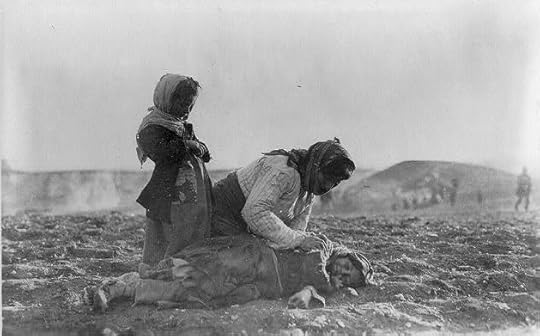
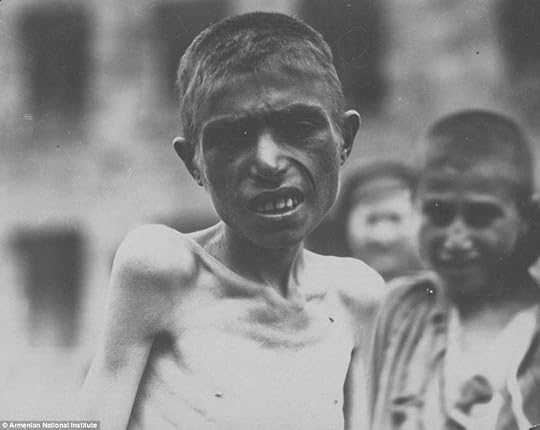
The book includes photographs from Darwn’s trip comparing them to older photos of the places in Stepan’s saga, as well as a few of the photographs documenting the persecution and killing of Armenian civilians.
The Ottomans tried to defend mass deportations by spreading the propaganda of Armenians aiding the enemy during the war campaign (Russians) and later on by killing the Armenian witnesses in the desert of Syria.
Maps of Armenian deportations
The diplomats’ (from USA, Germany, and other countries) and foreign missionaries’ accounts of the genocide are chilling. Only few photographs have survived of the annihilation campaign, estimated to have resulted in the killing of 1.5 million Armenians. The Ottoman government forbade any reporting, threatening officials with expulsions and accusing them of interfering in internal affairs. Some of the photographs were smuggled out of the country by Armin Theophil Wegner (a German soldier and medic in World War I) at great personal risk:
“Where are we going?” many would remember asking. “To the interior,” the gendarmes would answer. One rare photograph captures an image that would become iconic in the next war: three boxcars filled with hundreds of minorities, their dark eyes looking outward at a world standing by.
These photos are daunting as what happened to the Armenians foreshadowed the genocide of the Jews in WWII, twenty years later. This is a sore spot for modern Turkey government, which denies the genocide even when this stance affect its foreign policy, but to quote Dr. Phil, “You can’t change what you don’t acknowledge”. We must stop History repeating itself.
Dawn is clearly very proud of her courageous and resourceful grandfather and Stepan should be proud of his granddaughter too, the comprehensive references at the end of the book are proof of the amount of research the author put into her work. This is a very hard read, but an important one and well deserves the full 5 stars rating. Highly recommended.
Fav. Quotes: These Adabazartsi natives had found their way to our living room, half a world away from their birthplace. Many were widowed. One of them had lost her first husband at the outset of the deportation, when he was blamed for building bombs and hanged; her children would one day bury her with the love letters he sent her from jail while awaiting execution.
It’s a human flood, Stepan thought as the thousands inched along the Euphrates. Clouds of dust settled on them, one after another, coats of earthen paint on their olive skin, on their matted beards or braids. Stepan’s convoy was being driven into a more solitary part of the desert, all of them stooped by the weight of their belongings, bent like half-moons above the dirt.
Dawn Anahid Mackeen, author of this fantastic book, finds her grandfather's journal and tries to have it translated, though it is disintegrating with age. As she put it, she was "trying to follow a road that was being quickly washed away." A perfect quote from the book as it embodies the loss of that generation who experienced a terrible atrocity as well as the loss of a piece of history that is rarely taught or written about. This is a very well written depiction of Armenian genocide during World War I through the eyes of Stepan Mekjian, and his granddaughter, Dawn Anahid MacKeen as she uses that journal to return to the land of the former Ottoman Empire to retrace his steps. The author's rendition of her experience in modern day Turkey and Syria as well as her grandfather's ordeal a hundred years earlier is riveting. I especially appreciated the map in the beginning of the book as I tried to get my bearings for as I read I was instantly transported into the story and felt the pain and suffering of Stepan Meskjian. It is a story that will bring you to tears of frustration and hopelessness but also tears of great joy. I recommend it heartily.
The Hundred-Year Walk: An Armenian Odyssey (Spoiler alert) The number of times reporter and writer Dawn Anahid MacKeen’s maternal grandfather Stepan Miskjian escaped death during World War I at the hands of the Ottoman Turks is mind boggling. This is a graphic, disturbing, but ultimately redemptive account of one very resourceful man’s survival during the first genocide of the 20th century—when the ruling pashas set out to exterminate Turkey’s large ethnic Armenian population.
MacKeen alternates Stepan’s story with her own experiences in 2007 retracing his steps. His diaries in hand, she traveled from his hometown of Adabazar outside Constantinople, all the way to the killing fields of Deir El Zor in present-day Syria, where the surviving Armenians were mercilessly slaughtered. Ironically, this region is now in the hands of the so-called Islamic State.
The author manages to turn an unbearable subject into a page-turner. With each chapter you wonder how the 5-foot 4-inch Stepan will slip away from his captors—armed, saber-wielding gendarmes on horseback—and evade being swept back into the massive deportation of Turkey’s Armenian population.
MacKeen’s clean, spare reporting style is dispassionate but descriptive. We are transported to that place and time. We see what Stepan saw and survive the horrors alongside him. He is resourceful, intelligent, generous and scrupulously honest throughout his ordeal, while many around him are not. We root for the diminuitive hero throughout. My only regret is that MacKeen does not offer the reader even more about her own experiences and travels retracing her grandfather’s steps.
But, without the stories and without the diaries, MacKeen’s mother would never have pleaded with her reporter daughter to “tell Baba’s story.” I’m glad that she did.
This gripping book the culmination of years of her harrowing reporting that continues her grandfather's journey that began during the Armenian genocide. Beautifully told, alternately between current-day and the past, I learned so much and was deeply moved by what the author uncovered and her ultimate hope for reconciliation and peace.
Capturing the historical genocide of the Armenians in Turkey around World War I, the book centers around the author’s grandfather - his early life leading up to his family and thousands of Armenian families’ deportation, being swept into internment camps, and mass slaughter and the hands of the Turkish government. The book unfolds in two timelines - back in the 1900s tracking Stepan Miskjian’s life as he is struggles to survive - experiencing capture, escape, hunger and thirst, a six-day desert trek with two cups of water and a gold coin, almost execution, and the amazing kindness and protection from many, including Turks. The second timeline is in present day - his granddaughter - author Dawn Anahid MacKeen, uses notes from Stepan’s journals, traces her grandfather’s steps in Turkey and into Syria to follow in the footsteps of her grandfather and see firsthand the places he encountered as he fled Turkey being pursued at every step of the way. An absorbing and engrossing historical tracker that brings to the forefront the unvarnished expose of the Armenian genocide of the early 20th century. We also witness acts of humanitarian - whether it’s the Turkish gendarme, the Turkish people, or others (no spoilers!) , we experience tiny bursts of human spirit that signal to us there were at least little acts of kindness performed amidst the enormous atrocities that were committed against the Armenian people. A definite 5-star read or listen - the narration of which was delivered by Neil Shah (well done) and Emily Woo Zeller (wish her narration was delivered in a less wide-eyed and oh my gosh kind of exclamatory way in some sections). I highly recommend the book.
This book is a personal history of the Armenian genocide as told by the grand-daughter of a survivor. It is based on yearly accounts which were written by her grandfather. The historical accounts are interwoven with a report of her trip through Turkey and Syria duplicating the trail that her grandfather took.
I have read several books about the Armenian genocide that took place between 1915 and the early 1920s. Some have been pure history; some personal accounts; some second-hand personal accounts, such as reports of the experiences of parents or grand-parents; some have been novelized accounts. This book taught me new things that I had never known before. Many of the experiences which are described match what I've read before, such as the "inventive" ways in which some of the Armenians were killed, the rapes, the kidnapping of women and children, the attacks by Kurdish or Arab bandits on defenseless Armenians while their Turkish guards just stood and watched. What was different in this book was the description of stages of deportation which were done. Some groups were forced to move from their homes to a new location, and then stayed there for several months before being forced to relocate again. In some cases the Armenians were allowed to keep their possessions. Some Armenians were even allowed to return to their original homes after the war was over, but then were forced to flee again to escape Ataturk's army.
The book is well-written and very readable. I can strongly recommend it.
It puzzles me to understand why so little attention has been given to the Armenian Genocide. I have spent many years reading both novels and non-fiction studies of the Holocaust and WW II. Recently I have turned my attention to the former subject. I have come to the conclusion that Hitler was a student of this horrifying period, complete with all that conspired to erase an entire population of innocent people and their beautiful culture.
"From 1915 to 1918, an estimated 1,200,000 Armenians perished. ...Adolf Hitler, before his invasion of Poland in September, 1939, said:' Kill without pity or mercy. Who still talks nowadays of the extermination of Armenians?' In a way, der Fuhrer was right. Only Armenians seem to remember the Armenians." (p.6)
The author of this book undertook the difficult and often heartbreaking chore of traveling to her grandfather's homeland, through Turkey and Syria, in the attempts to retrace his steps. She was armed only with his recently discovered long- lost journals. Each chapter alternated with her experiences and his. It is obvious that she spent much time and effort on compiling her information and writing her book. In viewing the picture of her grandfather, how he survived (and wrote about) all the humiliation and deprivation he experienced, it is not surprising to see that this author also possesses resourcefulness and intelligence.
With 2018 being the 100-year anniversary of the end of WWI, I have been trying to read more books, both fiction and nonfiction, that involve that time period. The Armenian Genocide is certainly one of the most overlooked events from that time.
In 2015, I read Orhan’s Inheritance , a historical fiction novel about the Armenian Genocide. It struck me that I had barely even heard of those tragic events, so I started researching. The sad fact is that even over a century later and despite undeniable evidence, the Turkish government officially denies that genocide occurred. It’s proof that history is written by the victor. And while the American government previously recognized those events as genocide, they will no longer officially call it genocide. It’s been downgraded to the generic category of “tragedy” because of flimsy excuses that there isn’t enough proof that 1.5 million people were slaughtered. To learn more, I picked up The Hundred-Year Walk, a nonfiction account of the genocide.
Dawn MacKeen grew up hearing bits of her grandfather’s experiences during the Armenian Genocide, but never gave it much focus. After the surviving the tragic events of the genocide and seeing them ignored by most of the world, Stepan Miskjian spent the rest of his life journaling his experiences in effort of keeping them from being forgotten. After years of her mother’s urging, MacKeen put her journalistic skills to use reconstruct and retrace her family’s journey and the history surrounding them.
The book alternates between a third person retelling of her grandfather’s journal and MacKeen’s efforts to translate the journals, research events, interview survivors, and eventually retrace the path of her grandfather. The events leading up to and during the genocide were horrifying to read. But MacKeen’s own journey was not without its own danger. Her travels included tense situations in Turkey and the deteriorating situation in Syria. While she was researching her book, Hrant Dink, a Turkish-Armenian journalist was assassinated for his very vocal attempts to get recognition of the genocide.
The reason this book gets four stars instead of five is because of some issues with the writing and format. What those people went through was a tragedy and a travesty. But I also have to look at the book as a whole. Journalistic writing is very different from book writing, and many writers have difficulties switching between. There are some pacing issues. Certain parts of the book were more engaging than others. It was also hard to remember who the side characters were especially since some of them were mentioned so sporadically. Sometimes the narrative stayed focused on the author’s family and at other times it went for a broad overview of historical events. It wobbled between broad biography and intimate memoir.
This is a wonderful book for anyone who likes emotional memoirs or who wants to explore an overlooked part of history. It’s an emotional and tragic story. Obviously, a book about genocide is going to have graphic content. Those events were horrific, but they are so important to be aware of. You shouldn’t try to study WWII without first understanding WWI. And what happened to the Armenians had farther reaching affects than anyone expected. One thing that stood out to me was the pleas of certain officials to intervene on behalf of the Armenians. The ambassador’s pleas to America were haunting enough, but I had no idea that some people in Turkey reached out to their ally, Germany, to try to intervene. Not only did they not help, the Armenian Genocide became an inspiration for the Holocaust and proof that such horrors could be gotten away with. Hitler himself said, “Our war aim does not consist in reaching certain lines, but in the physical destruction of the enemy. Accordingly, I have placed my death-head formations in readiness – for the present only in the East – with orders to them to send to death mercilessly and without compassion, men, women, and children of Polish derivation and language. Only thus shall we gain the living space which we need. Who, after all, speaks today of the annihilation of the Armenians?”
These events shed light not only on past events but also on current ones. It gave me chills to see echoes of the same sentiments that people still bandy about today. Xenophobia is as rampant today as it was back then. Just look at the treatment of Syrian refugees. Look at the treatment of immigrants in the United States. What ethnic cleansing didn’t start with small grudges? Then those grudges escalate to blaming an ethnic group for economic hardships. Bad people use those grudges and prejudices as a foundation to slowly build hatred towards and fear of a minority. That’s not to say that an ethnic cleansing is right around the corner, but it is clear how easily people are manipulated from dislike to outright hatred.
It is absolutely vital not only to recognize past events but also to identify when the patterns of prejudice repeat themselves. That is why books like The Hundred-Year Walk are so important. We have the ability to speak for those who were harmed in the past. And we have the ability and responsibility to speak for those who are persecuted in our own time. Each voice that joins in helps to prevent some future villain from saying, “No one remembers that. No one cares.”
RATING FACTORS: Ease of Reading: 4 Stars Writing Style: 4 Stars Level of Captivation: 5 Stars Attention to Details: 4 Stars Emotional Level: 5 Stars Plot Structure and Development: 4 Stars
From the time she was a young child, Dawn MacKeen could remember her mother talking about Dawn’s grandfather, Stepan Miskjian, and his survival of the Armenian genocide in Turkey which began in 1915 and finally ended in 1918.
Weary of hearing these stories repeated, after college Dawn set off to pursue a successful career in journalism in New York City. She didn’t really pay much attention to her mother’s frequent phone calls asking for Dawn’s help in telling her grandfather’s story. But shortly after her thirty fifth birthday, Dawn realized that she couldn’t ignore her mother’s pleas any longer. “Perhaps it was her advanced age. Or maybe it was my own realization that, as a reporter, I was spending my life telling other people’s stories and ignoring my own family’s incredible one.” So Dawn returned home to Los Angeles and began to research the story of the Armenian genocide and her own grandfather’s miraculous survival.
Dawn’s meticulous research into the history of the genocide and the context within which it occurred, gives a close up look at this horrible atrocity. To this day, Turkey has never admitted to the genocide. Many of the perpetrators of the crimes were never prosecuted. The world’s superpowers also have not labeled it as a genocide. Because of its geographical importance to issues currently happening in the Middle East, other countries are reluctant to stir up any controversy regarding Turkey’s history and its violation of the civil rights of its minority populations.
In this poignant and haunting account, Dawn tells her grandfather’s story. After reading through Stepan’s written memoir, Dawn decided to trace his journey through what is now Turkey and Syria one hundred years after his brutal and heart wrenching “walk”. It’s a sad story, but one that sheds light on a disturbing event in world history.
The Hundred Year Walk was a finalist for the Dayton Literary Peace Prize.
This book is so well written, draws me into the story. It's about the tragic history of suffering and overcoming adversity during the Armenian Genocide, retold tthrough a genocide survivor's granddaughter. I can picture the details in the desert, by the river, in prison. Feel the main character Stepan's hope, his fears.
What is really striking to me, is the parallels. The author's journey into the unknown researching and developing the story. She was on her own path "walking" with Stepan.
I walk to work most days. Nothing compared to Stepen's 1000 mile walk, but still it gives time to think about life, and the strife of every day life. I loved Stepen's inspiring quotes about life - glad the author included them.
I can't stop thinking of his incredible trek across the desert. How he maintains hope and a positive attitude through it all. And the author's trek across the sands of time retracing his step both literally and figuratively.
All this to say this book has made a difference in my life and how I look at the most basic needs of food, shelter, health and respect for all people and peoples. I bought an extra copy for a Japanese friend who's parents were interned in camps during the war. She was interested too.
I received a copy of this book through Goodreads' First Reads program. In the past few years, I had read a couple of fiction works which touched briefly on the experiences of immigrants who had survived the Armenian genocide. I was struck by how the topic was largely omitted from the history books I encountered in my education, from primary school through university. This book was an intense and unflinching look at the events leading up to the genocide, and the repercussions for the survivors and future generations. The narrative alternates between the story of the author's grandfather's experience (reconstructed from his journals), and the author's own as she retraces his journey in the modern day. The result is an incredible story of one man's resilience, and a solemn remembrance of many more men, women, and children who did not survive. The atrocities that were carried out means this isn't an easy book to read, but it is an important one to read, as this oft glossed-over period of history still has many ramifications for our world today.
This was book I had a hard time putting down. On the one hand I wanted to, as reading more about the Armenian genocide, than I ever had was not easy. But this is a redemptive book. Mackeen has written a masterpiece on a genocide, few Americans know much about, I would imagine. From her grandfather's journals, she vividly recounts the forced deportations of the Armenians from their homes in Asia Minor/Anatolia and their subsequent death marches. The Hundred Year walk is more than a historical biography though. In order to understand her family's history, MacKeen retraces her grandfather's steps, revisiting important places in his life and meeting the descendants of the man who saved his life. This is a book about horror, but redemption and love too and I highly recommend it.
This is a story of on the steps of a man who survived the Armenian genocide.
This is a story to thank the kind people of the Syrian desert cities Ar-Raqqa & Deir al-Zor, who helped a large number of Armenians in the era of the WWI, taking them under their protection, & hiding them from the Turkish Gendarmes.
This is a story for not forgetting the past, & looking forward to reach a fair solution for our cause, which is making the Turkish government recognition of the Armenian genocide.
What an amazing story, full of people that truly inspire you to be a better person and have courage to live and then to forgive. Not much brings me to tears but this really got me going. A stunning read.
A U.S. born woman of Armenian grandparents writes of her grandfather's plight, suffering, and miraculous survival during the Armenian genocide. She gives side by side accounts, combining her own memoir as she follows her grandfather's life in present day Armenia, and then travels to the middle east to precariously follow the trail of his forced marches by Turkish forces in present day Iraq and Syria. She does this with the help of Turkish, Armenian, and Syrian guides. She combines this with a 1st person narrative presented by her grandfather through his journal writings. His journal documents in detail the horrors and mass killing inflicted upon the Armenians during World War I. Through her work she preserved his legacy that would have remained hidden without her efforts.
When I began reading, I didn't like the book at first. Her own memoir starts out with a lot of fluff some if which I wanted to skip over entirely. It distracts a lot from his own story so I nearly put it away. But I'm glad I kept reading because the book improves a lot later on. His journal is very inspiring. Highly recommended.
I had to put this book down for a while. The devastating sadness and horror of the Armenian death march was overwhelming. I have the same issues reading about American slavery, the genocide (in many ways) of native Americans, the Haulocaust, and other time periods when man collectively becomes inhuman towards another group of people.
Can you forgive such things?
Ultimately, this is where the book ends. With this question. As a Christian, my faith and core belief is you must. As a human, I struggle with forgiving such things. I struggle with forgiving those who hate people that look like me, just because my skin is brown. I struggle with learning how a country could turn upon neighbors and friends and treat them in such a brutal and needlessly cruel manner.
If this was just a story of the genocide, it would be enough. We must remember these things if we are not to repeat them. But it is also a story of redemption, forgiveness and hope. I highly recommend reading it. I especially hope those from this region of the world read it and imagine redemption and healing for this land.
This entire review has been hidden because of spoilers.
I didn't know anything about this period of history in relation to the fate of the Armenian people. For that reason, I chose this book, believing a memoir would be a more personal story than a history book. Events follow two time periods - a modern day journey by a young woman - relative of the man who suffered during early 1900s. Her search is to find the places and people mentioned in a set of diaries which reveal Stephan's story. The other time period is about the events that Stephan experienced as an Armenian during a time of persecution. I found the modern part to be engaging. Its first person tale and lively narrator was good but these sections were too short. Unfortunately the sections telling the past are in the third person and the narrator is monotone. I got bored during these bits, even when truly terrible hardships and tragedy was being described. Overall a bit disappointing and I don't feel like I understand the period or the experience.
This important book about the Armenian Genocide is unique in that it's drawn from MacKeen's own grandfather's meticulous notes on surviving the death marches. A clever prankster before the genocide, Stepan's wits helped him avoid death many times, including a trek across the desert, naked, with no food, and only his own urine to drink. This gripping story alternates with MacKeen's 2007 journey to Turkey and Syria to retrace his 1,000-mile trek, in which she met the descendants of a Muslim Arab who saved her grandfather's life despite his ethnicity, his Christianity, or the political narrative of the times--that Armenians were dangerous. In a sad turn of history repeating itself, these same family members are now refugees themselves, fleeing their Syrian homeland. Thoroughly researched and told with compassion and an uplifting message, this is a must-read account of the horrors of ethnic cleansing.
A difficult, tragic book to read about the Armenian genocide in 1915-1918 in the Ottoman Empire . Her grandfather kept journals of his life story especially his survival in this tragedy . The author is his granddaughter and she translates and follows his path in Syria and Turkey. So one has a view of his struggles , the landscape, the dangers , terrors and death in the 1915 plus era and then her visit to the lands a few years ago before chaos and death, genocide returned to Syria. I had knowledge of this genocide but not the grueling, horrific tale of death and destruction in such personal terms. I have a much better understanding of the Armenian Genocide from having read this account. Very well researched.