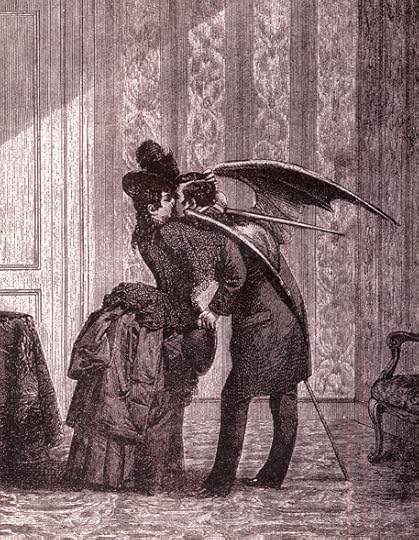
Meet the Vampire Soul: the savage OTTYSOR. "They are veritable shades," says Doctor Bonhomet. "Not one of them has ever been captured, and in spite of the many volleys discharged at them, no one has ever seen them fall or flee. No one knows what they do with their dead, if they do die..."
Jean-Marie-Mathias-Philippe-Auguste, Comte de Villiers de l'Isle-Adam (1838-1889), pioneer of the Symbolist Movement, is known for his proto-science fiction works Axel (1885) and L'Eve Future (1886) and his "Cruel Tales" collected in The Scaffold. He also chronicled the colorful adventures of Doctor Bonhomet collected in The Vampire Soul. Poet Paul Verlaine called Villiers' works a "genial melange of irony, metaphysics and terror" and translator Brian Stableford dubs it "a bizarre literary landmark."
Stableford has published more than fifty novels and two hundred short stories. The Vampire Soul, written in 1867 - thirty years before Bram Stoker's Dracula - is one of the many classic vampire stories available from Black Coat Press. This book is the first English-language edition, and includes an authoritative introduction and historical notes.
Auguste Villiers de L’lsle-Adam (1838-1889), eccentric French literary figure par excellence, created dozens of innovative tales and novels, but none more innovative, more peculiar than his novella The Vampire Soul (Claire Lenoir). Published by Black Coat Press and adopted by Brian Stableford, this collection includes several other short tales, but for the purpose of review, I will focus on the novella, the weirdest of the weird. And, fortunately, to better enable a reader to appreciate the novella’s various dimensions, included is Brian Stableford's most informative fifteen page introduction as well as his extensive notes on the text.
Doctor Tribulat Bonhomet is the novella’s first-person narrator and a less reliable narrator is not to be found in all of literature. Bonhomet portrays himself as a brilliant, witty, dapper, highly refined and cultured man-of-the-world; in fact, he is exactly the opposite: insensitive, dim-witted, rude, coarse, smug, bourgeois, buffoonish. Since Villiers viewed most French readers of serialized stories published in the newspapers of the day as having similar traits as Bonhomet, he was hoping his novella (scheduled to be printed in installments) would initially draw readers into the story and then drive some readers mad and perhaps even send a few to the lunatic asylum. Brian Stableford's introduction notes how two leading French authors, Paul Verlaine and Remy de Gourmont, judged rightly when they observed that nothing like The Vampire Soul (Claire Lenoir) had ever been written in the entire ninteenth century and that Villiers’ novella remains a bizarre literary landmark.
In Chapter One Bonhomet describes his own physical characteristics in serious, excruciating detail that are laugh aloud hilarious for us as readers. Here is our puffed-up narrator describing one of his prominent features: “My nose is considerable in dimension – large, even. . . . The nose, you see, is the expression of the human capacity for reason; it is the organ that goes before, which enlightens, which proclaims one’s presence, which scents trouble and which points the way.” And then, “My voice is sometimes shrill and sometimes (especially when I speak to women) rich and profound – and it can go from one to the other seamlessly, as I please.” This quote provides us with our first glimpse of Bonhomet’s views on women: totally condescending and misogynist in the extreme, reminiscent of Arthur Schopenhauer, but in Bonhomet case, he has no more brains or capacity for philosophy than Mr. Bumble.
A good portion of the story takes place before, during and after dinner, at the home of Bonhomet’s best friends, Cesaire and Clair Lenoir. Much conversation transpires; many opinions are shared, including opinions on music and poetry, the nature of the mind and reality, the existence of God, the existence of soul and spirits along with a number of recent studies in the fields of medicine and natural science. One of my favorite parts is when Bonhomet reflects on Edgar Allan Poe. “Did I mention the American? That one appeared to me to be a hearty fellow with a nice line in colorful rhetoric. But one thing that struck me was the way he labeled his works. He called them, rather conceitedly, Unparalleled Stories or Extraordinary Tales or some such. I have read all these stories and have tried in vain to see anything extraordinary in what he relates. It is, in fact, the last word in banality-presented, it is true, in a bourgeois manner, but banal nevertheless. It sent me off to sleep many a time, in a delightful way. I can only conclude that the title was chosen by the editor to pique the curiosity of vulgar readers.”
Clair Lenoir has a keen sense of the supernatural in its many manifestations. For example, as she explains to Bonhonet, “”There are other beings,” she continued, softly, “who know the roads of life and are curious about the paths of death. Those, who must submit to the realm of the Spirit, disdain the years in order to possess Eternity. In the depths of their sacred eyes, they are alert to a gleam more precious than a million tangible solar systems like ours, from our equator to that of Neptune.” As we read on, the reality of other beings, savage and demonic, frightful and possessive, take center stage in the tale, a provocative twist in light of Bonhomet’s disdain and dismissal of Edgar Allan Poe.
And here is Bonhomet describing Clair’s husband, Cesaire. “He was a haunter of solitary places, a man of dark theories and a vindictive temperament. Something rudimentary had gone astray in his fundamental nature. He pretended, laughing under his South Sea Islander’s nose, that he had something in him of the hairy vampire. He was excessively fond of making jokes about cannibalism. It all seemed to be submerged within bourgeois innocence, but wherever he was carried away by his favorite themes – the form that the nervous fluid of a dead person might take; the physical and temporal power of the spirits of the dead over the living – his eyes burned with the flames of superstition.” And as the evening’s conversation progresses, Cesaire's views take on a progressively darker cast.
If all this sounds like an odd combination of philosophy, science, paranormal phenomenon and occult speculation, you are correct. And to add yet another twist, in the course of the evening’s conversation, as we listen to each of the three exchange feelings and opinions and passions, it becomes increasingly probable we are dealing with three unreliable narrators. I will stop here so as not to spoil the novella’s unexpected twists and turns right up to its shocking conclusion. Chances are, reading Villiers’ tale will not send you to the lunatic asylum; however, it might drive you a little mad, but in a good way.
Imagine a writer of genius—like Nabokov in Pale Fire—who creates as his unreliable narrator another genius, a man who (in addition to his narcissism and a host of disagreeable opinions) is also stark, staring mad! Ah, but then—to move beyond Nabokov—imagine that this madman's creator is also a madman, and you will have imagined a work akin to Villiers de L'Isle-Adam's The Vampire Soul.
De L'Isle-Adam came by his madness the old-fashioned way: he inherited it. His father threw away the family fortune buying up old aristocratic estates, defacing their grounds with unsightly holes, and selling them at a loss. His objective: to find the fabled lost treasure of the Knights of Malta. His son--our writer--was extraordinarily eccentric, if not precisely mad, haunting cafes at all hours to avoid his poor shabby room, feverishly scribbling his articles and stories on any piece of paper that came to hand, convinced that one day these fragments would bring him enormous fame. He wrote pounds of dreck, but also enough dark, concentrated, memorable tales to earn himself the title of “the French Edgar Allan Poe”. (You may find many of them in Cruel Tales, a collection well worth your time.)
The Vampire Soul is dark and memorable, but it could not be called “concentrated.” At its heart is a frightening story of possession by a dead soul seeking revenge, but it is embroidered, postponed and frustrated by a host of philosophical reflections by the three main characters, the fanciest, most frustrating roadblock to a clear narrative being the narrator himself, Dr. Tribulat Bonhomet. The conservative Catholic de L'Isle-Adam created Bonhomet to embody everything he loathed--atheism, godless science, a disdain for the symbolic, a love for absurdly literal solutions—but he unbalances his tale so unrelentingly that he forces the reader to question the mental balance of the author himself.
I have to admit I thoroughly enjoyed the first thirty pages, seeing in Bonhomet an amusing and worthy ancestor to Nabokov's Kinbote. But then philosophical reflection piled upon philosophical reflection, ironies became buried beneath heaps of obsessions and quirkiness, and I became convinced I was reading someone a few french fries short of a happy meal, someone more than a few ravens short of a Poe.
The short novel that gives this volume its name is followed by ten vignettes and stories that carry on the adventures—or at least the spirit—of Dr. Tribulet Bonhomet. I did not find them particularly memorable, except for the “The Swan Killer,” which has at its heart a wild, violent host of images I find it impossible to get out of my mind. Read it if you get the chance, and it will give your a taste at the extraordinary effects that—at his best—the eccentric “French Poe” was capable of.
. 📚 El vaso de sangre y otros cuentos decadentes de París ♀️♂️ VV:AA 📕 Físico
_________________________
⭐5⭐
YAS!
En primer lugar, quiero darle las gracias a @retirosdelectura por esta maravillosa y desconocida recomendación que, además de dejarme sin aliento, ha hecho que me haya obsesionado con algunos relatos y autores. Hacía muchísimo que no disfrutaba tanto de una lectura así. Esta obra ha sido muy enriquecedora, no solo por el descubrimiento en sí del ejemplar y de la editorial, sino también porque desconocía por completo lo que era el decadentismo francés. (según Wikipedia:)
Los relatos de esta antología mezclan lo sórdido, oscuro, tétrico, y la locura decadente del ser humano en París. A pesar de ser relatos que nos pueden llevar a lo fantasioso, la triste realidad es que muchos de ellos podrían ser historias reales, localizadas en un París más macabro y escabroso del que conocemos hoy en día. Mientras leía, podía imaginarme esas calles de París sucias, sin ningún control, rodeadas de miseria, delincuencia y, sobre todo, cadáveres. Porque sí, amigos, en el siglo XIX la morbosidad era de las pocas cosas que los parisinos podían disfrutar, rodeados de tanta decadencia en sí.
La belleza por lo cotidiano pero por su cara mas oscura, la exaltación y fascinación del mal, el morbo y los mundos imaginarios además de ser los ingredientes del decadentismo, los encontramos en este libro. Increíble.
¿Qué más puedo decir? NECESITO conocer cada autor, libro y obra de arte de esta corriente artística. Creo que mi siguiente lectura será Las Flores del mal de Baudelaire.
"Clair Lenore" (here as "The Vampire Soul") - Dr. Tribulat Bonhomet, an amateur anthropologist and expert on microscopic fauna, visits his friends, the Lenores. After dinner they get into a long, very long, extended discussion about Reality, the spirit, the Soul, God, etc. Days later, Mr. Lenore dies, seemingly nursing a grudge based on the belief that his wife has been unfaithful (we actually know this to be true, having met the opposite number of the affair near the start of the story). Years later. Bonhomet runs into the dying Mrs. Lenore, and experiences a disturbing image imprinted on her eye at the moment of her death.
Well, there were things to like about this "sardonic tale" - Bonhomet is a comic character, constructed of arrogance, sophistry and the like - and he has some funny lines and thoughts. And the actual "gruesome gothic image", when it arrives, is pretty good. But the damned philosophical discussion goes on for so long that it's impossible to trace and, to be honest, you lose interest regardless because at a certain point you realize that Bonhomet is just trying to "score" in the argument and may not believe anything he says. So, 1/3 of a good story. Shame.
Recopilación de relatos de la corriente "decadentista" de finales del siglo XIX de 156 páginas, publicados a partir de 1867. Con un punto siniestro e imbuidos por un ánimo de decaimiento a causa de la derrota en la Guerra Franco prusiana y el levantamiento de la Comuna de París, éstos autores desconocidos para mí, salvo el gran Émile Zola, nos traen unos oscuros relatos. Los que más me han gustado son: "El secreto del cadalso", "Los dilatantes de la morgue", "Marroquinería", "La damisela oscura", "Constantin Guingard", "Un víctima de la publicidad" y "Enemiga hereditaria". Una obra ideal para descubrir nuevos y desconocidos autores franceses que se constituirían en influencia para la posterior corriente "existencialista". Sin duda, un recopilatorio muy recomendado para los amantes del terror y de los clásicos franceses.
48:25 If it had not been for some men who believed and some women who believed whom you did not recognize and would have trampled down, and outrage you would have afflicted you because of them without even your knowing it.
A fantastic collection of darkly satirical and absurd interconnected stories of Doctor Bonhomet whose spares nothing from religion, science, society or the supernatural