Begin jaren zeventig stelde de Duitse schrijver Walter Kempowski aan allerlei mensen – schrijvers, kunstenaars, taxichauffeurs, de krantenverkoper op straat – de Heeft u Hitler gezien? Daarop kreeg hij de meest uiteenlopende antwoorden, die samen een fascinerend beeld geven van een volk dat zich liet verleiden door een valse profeet. Enkele jaren later stelde Kempowski de vraag die niemand durfde te Wist u ervan? Velen ontkenden of antwoordden ontwijkend, anderen vertelden juist gretig waar ze getuige van waren geweest. Beide boeken verschijnen nu in één band voor het eerst in het Nederlands. Een bundeling van getuigenissen van mensen die het nationaalsocialisme hebben meegemaakt. De weerzin, het enthousiasme, het (on)geloof en de verbijstering achteraf. Een volstrekt unieke leeservaring.
Walter Kempowski was a German writer. He was known for his series of novels called German Chronicle ("Deutsche Chronik") and the monumental Echolot ("Sonar"), a collage of autobiographical reports, letters and other documents by contemporary witnesses of the Second World War.
Walter Kempowski asked about 500 people this question in 1973 and the book lists the answers that were given. So this is obviously not a novel, and totally different from the other two books of the German Chronicle that I read before. But it fits nicely – chronologically – between books two and four, so it makes sense to read it too, although the history of the Kempowski family is not carried forward in any way. Good thing is that this book perfectly works as a standalone.
Before reading I had doubts whether I should do this to myself, wading through two hundred pages of more or less the same. What’s the benefit of reading stories from completely unknown people? The only things we know about these people are their gender, professions in most cases, and the year they were born (between 1881 and 1944). This is in no way a representative and scientifically based opinion poll. For this, the sample is way too small. In addition, one can hardly expect a statistically durable result with only one wishy-washy question. But that was not the author's intention, because originally Kempowski wanted to gather material for the next novel in the series.
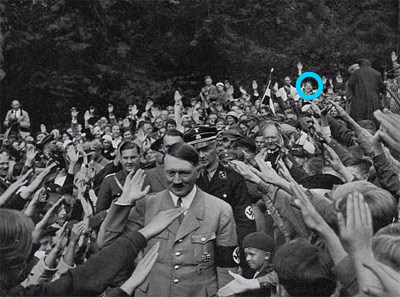
[one of the possible eye-witnesses (this and the other photos are not included in the book, I took them from a google image search for “Hitler Crowd”)]
After evaluating the answers (which were recorded on tape or shorthand), Kempowski became convinced that they justify a separate book, and I agree to this. The author arranged the answers so that they follow Hitler’s life more or less chronologically. This way we get an unedited patchy mini-biography of Hitler from afar, written by unknown people. Of course, not everyone actually saw Hitler and those who didn’t, answer the question by giving a little personal story from the Nazi-time, and that was quite interesting too. The scope of responses ranges from a few sentences to little essays of one or two pages. The latter shows that many people (whether they were pro- or anti-Nazi) seem entirely willing to report. I hadn’t necessarily expected that.
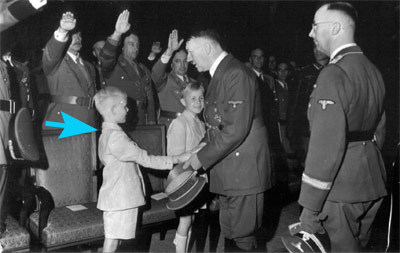
[and another one]
One of the things I personally found intriguing was the way people addressed Adolf Hitler in their reports. Some simply say “Hitler”, or “Adolf Hitler” which is probably most common and neutral. Others say “der Hitler” (“the Hitler” with a definite article). I find this to be slightly more familiar, but still sort of neutral. “Dieser Hitler” (“this Hitler”), on the other hand, sounds more negative to me. Then we have those calling him by his first name “Adolf”. Now, this could be either meant to be sort of familiar and positive if you pronounce it the official way, that is with a long sounding A (IPA: [ˈaːdɔlf]), but it becomes negative if you pronounce it with a shorter A (IPA: [ˈadɔlf]). The difference is quite subtly but perceivable to German ears. Unfortunately there’s no way to find out from the transcript how the interviewees pronounced the name. The funniest, to me, insulting designation someone gave was “der Schlammbraune” (“the mudbrown”).
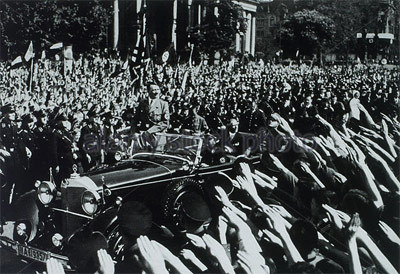
[or anyone from this crowd]
Wrapping up, here are some (non-representative) quotes from the book. I highlighted so many parts of the text in the Kindle edition that it’s hard for me to choose (translated by me and most likely different from the English edition):
[…] I think Hitler was a man who was still perfectly normal until 1937. After that he got the megalomania which then grew into a veritable madness. That he was normal, I would not accept. […] (a city employee, b.1906)
[…] Then he delivered a speech, calm and relaxed, said what an army should be, and then he began to cry out: I’m going to need you, in no time! etc., and we all would have immediately taken our guns, so great was the willingness. It’s still a mystery to me how a man could carry us along in such a way. […] (a military officer, b.1916)
From my parents I had received this Hitler, this figurine, which could make the arm go up and down. And with this Hitler I went into the rear chamber, and there I built a gallows and I always hung him up there. The gallows I made from a Matador model kit. (a radio editor, b.1924)
[…] And the people have raged and raged, they wetted their pants with excitement; elderly women, sobbing as if the Savior was coming. […] and the fathers lifted their children up, and [Hitler] greeted with folded arm, and with his left hand he covered the last nonworker, as it was said, so his genitals, no? (a teacher, b.1924)
By the fluidum he was effective.[…]People were fascinated, it was like a kind of hypnosis, psychosis, independent judgment was no longer possible. This whole preparation ... Today no one believes that. (a forest ranger, b.1916)
[…] Like all fantastic humans, when they meet resistance, so he became hysterical. Yes, and this hatred then erupted against the Jews who were then killed so brutally, unfortunately. He never watched that. […] (a colonel, b.1896)
[…] One greasy petty bourgeoisie with short legs, big belly and solemn gestures […] (a professor, b.1922)
Hitler, is this still interesting today? […] (a commercial clerk, b.1929)
The edition I read concludes with an afterword titled “The Germans and Hitler” by Sebastian Haffner (author of The Meaning of Hitler) in which he explains the importance of the book at hand, and also gives a gripping account of Nazi-Germany, and how it could come to Hitler in the first place.
________________
Did You Know About It?
The second part of the book (volume #6 of the German Chronicle) deals with the most horrible crime in all of human history. Reading it made me feel sick to my stomach.
As a German, born in 1963, I knew pretty much all of what’s been talked about here already, and I’m sure many if not all of you do too. We learned about it in high-school – several times in fact, so often that at some point it came out of our ears (German saying, meaning we felt sick and tired of it, thinking “Not that Nazi-shit again”). We were young, and didn’t know any better – but at least the lesson was learned. In the 30+ years after I finished school I read numerous books and I saw quite a few films, both fictional and non-fictional, and original footage galore. I will even torment myself by reading Hitler’s Mein Kampf, the Critical Edition published earlier this year, which, by the way, got combined with the other editions for reasons that are way beyond my comprehension, and if there is one man I would like to kick in the balls – excuse me “ball”, singular, because he had only one –, it would be him.
Now this book. As far as I can tell there is no English translation available and that’s a shame. While the previous part about seeing Hitler was mostly interesting and revealing, even sort of funny sometimes, this part definitely is not. Again German people were asked a closed question that can be fully answered by just saying yes or no. But they didn’t. Each person had some story to tell, some are very short, some stretch a few pages. Many answers start with “No, but…” or “No, except…” and some with “Yes, because…” or even “Yes, of course”. Some answers have nothing to do with the question, at least I didn’t see it. Some people seemed to be happy to finally tell their story, some were reluctant, trying to circumvent their real feelings. In any case; it’s a book that was written by the people and that makes it most valuable.
Walter Kempowski merely took the answers he considered important enough to be published and put them in a meaningful order, which is mostly chronological, but not always. You could say he composed a collage and I can confirm he was very good at it. The more I read by him, the more I feel sorry I didn’t discover him earlier. The original reason why he asks these questions was to gather material for his novels and I discovered several of those “mini-stories” in his novels Tadellöser & Wolff, Uns geht's ja noch gold, and Heile Welt. I’m sure there are more.
A book against oblivion. A great book but hard to digest.
I meant to translate some of these answers like I did above, but, frankly, it would be too painful for me.
Instead I like to end on a happier note by providing my own little story about the one time I got personally involved somewhat with the Holocaust:
Through a Neil Young mailing list (called the Rust List) I got to know a woman from Israel. We both were the same age (she is two years younger), shared our love for the man, and were soon mailing and chatting about pretty much anything. She told me about Israel and I told her about Germany and it was all very nice – up until I asked her if she would visit Germany at some time, to which she said she would never do this because of the HaShoah. I respected her wish, of course, and there were no hard feelings whatsoever between us. One day we met near Paris in France (Orléanѕ to be precise), for a so-called Rust Fest, an international meeting of Neil Young fans. An we had great time there. Now it was her who asked me to visit her and her family in Tel Aviv. And that’s what I did. In June 1999 I flew to the Holy Land and stayed in the family home for about two weeks. Her husband and two kids were a little reluctant at first, but more because of a “stranger” in the house, and not because I was German. I was a little nervous to meet her father (a professor for art-history), but it turned out he was a distinguished and intelligent man with whom I had some great discussions, although not about the Nazi time. One day I bought a small Yad (a Torah pointer) from one of the many shops in Tel Aviv selling all kinds of things made out of silver. The shop owner, an older man, wore short sleeves because of the heat, and I could see the tell-tale blueish tattoo with six digits on his left forearm. So he was a prisoner in Auschwitz, because that kind of tattoo (the prisoner number) was unique to this KZ. He probably knew I was German by my accent, but he didn’t say a word, and neither was I. What should I have told him anyway? Another mandatory stop for me was the Yad Vashem, the official memorial to the victims of the Holocaust. It’s rather impressive in its contemplative sobriety. In one room, however, they show Nazi propaganda, mostly photos, newspapers, and posters of the time. And put Hebrew and English translations next to them. I don’t know Hebrew, but from the English texts I could see that the translations were far too tame. They didn’t get the cynical tone of the original at all, so I had to made a new ad-hoc translation for my friend, and she confirmed the Hebrew wasn’t any better. I really wonder why they decided to tone down the texts. Guess I’ll never know. Anyway, it was an unforgettable trip to Israel for me, and on the last day my friend said she reconsidered and that she now might want to visit Germany provided I would take care of her while she is there. It didn’t come to that though, because a year later (September 2000) the Second Intifada broke out, and the family decided to leave Israel – to raise their kids in peace –, and moved to New Zealand.
Heeft u Hitler gezien? Wist u ervan? Getuigenissen van Duitsers uit alle geledingen van de samenleving. Interessant , boeiend en leerzaam … het nawoord van Sebastián Haffner…het heeft mij nieuwe inzichten gegeven. Kanttekening…Walter Kempowski heeft een selectie gemaakt uit alle getuigenissen om te publiceren. In hoeverre geeft dit een ‘gekleurd’ beeld…?
I'm grateful this book exists. The effect of reading so many short answers to the question "Haben Sie Hitler gesehen?"--an overwhelming tumble of humanity answering in a few sentences what relationship they had to the man who led their country--is hard to describe. My edition has only this volume and not "Haben Sie davon gewusst" which I plan to read soon.
Here is just one transcribed answer, chosen at random, one I find chilling though because it feels like the story of a kid who just missed seeing Santa Claus, or the kid left behind by the piper in Hamlin Town:
ich war in Wien, in der Kinderlandverschickung, 1941. Es hieß, der Führer soll kommen, und zwar um 10 Uhr. Und ich kam 2 Minuten zu spät! Ich hörte noch den Jubel und sah den Rest des Konvois. Da wae ich todtraurig, den er war ja ein Idol.
It has been chilling in general to be reading this book during the 2016 U.S. presidential election, an experience that has allowed me to see first-hand how easily a powerful personality can replace reason and civility with strife and hate--it can happen anywhere.
Superinteressant om te lezen hoe Hitler werd ervaren door de gewone man. Nog steeds relevant voor nu, historisch gezien interessant door een nawoord uit 1970 en de terugblik naar de jaren dertig en veertig.
Molto interessante, e sinceramente fa riflettere.A parte pochi casi, sembra che nessun tedesco sia stato, o abbia appoggiato, l'ascesa di Hitler ed il nazismo. Mi ha ricordato quello che diceva mio padre, che dopo l'8 settembre nessuno era piu' fascista, anzi erano sempre stati tutti antifascisti!
An amazing compilation of quotes from 300+ interviews with a wide range of Germans in the early 70s asking the pointed question, Haben sie Hitler gesehen? (Did you ever see Hitler?) The answers cover his career from before 1933 to the war's end, and they are disturbing, funny, gripping. The English edition, unlike the German, has a terrific intro by the translator and photos that Germans pasted in their scrap books. To understand Hitler's power and effect on the people, this is essential.
Heeft u hitler gezien? Wist u ervan? Deze twee zinnen zijn de vragen die dit boek vormen.
Walter Kempowski stelde deze vraag aan alle lagen van de bevolking, Heeft u Hitler gezien? Daarop kreeg hij de meest uiteenlopende antwoorden, die samen een fascinerend beeld geven van een volk dat zich liet verleiden door een valse profeet. Enkele jaren later stelde Kempowski de vraag die niemand durfde te stellen: Wist u ervan? Velen ontkenden of antwoordden ontwijkend, anderen vertelden juist gretig waar ze getuige van waren geweest. Beide boeken, beide vragen verschenen nu in één boek en het is een bundeling van getuigenissen van mensen die het nationaalsocialisme hebben meegemaakt. De weerzin, het enthousiasme, het (on)geloof en de verbijstering achteraf.
Dit boek word een volstrekt unieke leeservaring genoemd en dat is het zeer zeker. Het is zonder twijfel een meerwaarde om te lezen als deze geschiedenis je interesse draagt. Zelfs wanneer dit niet zo is, is dit boek een belangrijke inkijk in hoe mensen die tijd hebben beleefd, wat ze hebben gezien of gehoord of denken gezien te hebben en gehoord. Van de kunstenaars, het gewone werkvolk tot de mensen op de straat, hun beleving is super interessant om te lezen als ik eerlijk ben.
Twee samengevoegde boekjes, die een indringend beeld schetsen van de gewone Duitser tijdens het twaalf jaar durende bewind van Hitler. Het eerste bevat antwoorden op de vrij onschuldige vraag of men ooit Hitler heeft gezien. Het tweede deel gaat over de vraag hoezeer men op de hoogte was van de verschrikkingen, en dan met name de concentratie- en vernietigingskampen. Enorm verhelderend: Het gefascineerd zijn, de meeloperij, de afschuw, de verwondering, de ontkenning. Alles komt aan bod, ook de angst. Een overtuigende verklaring van de houding van het Duitse volk tot ver in de jaren vijftig geeft Sebastian Haffner in het nawoord. Wat ik niet wist, is dat Hitler zich na 1942 nog maar nauwelijks in het openbaar heeft laten zien.
Een ontnuchterend relaas over hoe mensen over Hitler dachten. Enthousiasme, onverschilligheid, afschuw, ongeloof en verbijstering lopen door elkaar heen in de intrigerende en openhartige ooggetuigenverklaringen. Walter Kempowski noteert de ervaringen van mensen die in de jaren 30 en 40 als kinderen of (jong)volwassenen de opkomst en neergang van Hitler meemaakten. Het zijn ooggetuigenverslagen die in de jaren '70 werden genoteerd en verwerkt tot dit boeiend boek. Het werk was reeds einde jaren '70 in Duitsland verschenen en zorgde toen voor heel wat beroering. Pas nu is de Nederlandse vertaling verschenen. Als lezer krijg je een heel ander beeld hoe de gemiddelde Duitser het nationaalsocialisme en Hitler ervaarde, weg van alle propagandafilms die eertijds verschenen, weg van de grote manifestaties, maar gewoon een beeld van alledag. Uit de getuigenissen bleek ook dat veel mensen opgetrommeld werden (m.a.w. verplicht werden) om de manifestaties bij te wonen. Enkel en alleen voor propagandadoeleinden zoals eigen aan elke dictatuur.
Het tweede deel van het boek gaar over de vraag of de mensen weet hadden van de concentratiekampen. Daaruit bleek dat de meesten wel wisten dat deze KZ's bestonden maar wat er juist gebeurde was meestal onbekend. Uit de getuigenissen bleek ook dat meesten vanaf 1933 liever hun mond hielden om niet in een KZ terecht te komen. De massamoorden in het oosten, de Holocaust en daarna uitroeiing met industriële middelen vallen voor bijna alle respondenten onder de kop ‘niet geweten’. Zoals gezegd, als het om de precieze feiten gaat, is dat meer dan plausibel: alleen wie er werkelijk getuige van was, kon het beseffen. Getuigen die er toch over durfden spreken, werden niet geloofd. Maar velen wensten gewoon niet verder na te denken waardoor men de waarheid niet onder ogen moesten zien.
Ontnuchterend was het feit dat toch enkele getuigen ruim 30 jaar na de feiten nog altijd achter Hitler bleven staan. Ontnuchterend is dat anno 2023 steeds meer en meer mensen flirten met extreemrechts (zie recente verkiezingen in Nederland of de overwinning van Meloni in Italië). De geschiedenis herhaalt zich dus duidelijk en andermaal trekt de mens geen lessen uit het verleden. En over zoveel jaren zal dan andermaal de boodschap komen: wir haben es nicht gewust en 30 jaar later zal dan opnieuw een boek met getuigenissen moeten verschijnen om de toekomstige generaties te waarschuwen om niet dezelfde stommiteiten uit te steken en de macht over te dragen aan niet-democratische partijen die elke dissonante stem met geweld uitroeit.
Walter Kempowski vroeg enkele honderden Duitsers, die leefden ten tijde van de opkomst van Hitler, of ze hem gezien hadden. Een ‘neutrale’ vraag, maar wel eentje die ons een beeld schept over die tijd én over hoe die ervaring (naderhand) verteld en gezien werd. Vervolgens ging hij nog een stapje verder: ‘Wist u ervan?’. Deze 2 vragen leidden tot 2 boeken. De antwoorden van de eerste vraag werden uitgegeven in 1973, in 1979 volgde een uitgave over de tweede vraag. Het huidige boek ‘ Heeft u Hitler gezien’, bundelt beide boeken. Een historisch, niet te verwaarlozen document.
De schrijver stelde, begin jaren 70, twee vragen aan inwoners van Duitsland. De eerste was "heeft u Hitler gezien" en de tweede "wist u er van? (de concentratiekampen). De antwoorden op de eerste vraag beslaan meer dan de helft van het boek en ik vond het na een tijd niet meer boeiend. Het tweede deel vond ik wel interessant. De vragen werden gesteld aan gewone burgers. Veel mensen hadden blijkbaar last van geheugenverlies na WO II. Ik wil geen oordeel hierover uitspreken. Niemand weet hoe hij/zij handelt onder omstandigheden de men nog nooit heeft meegemaakt. Toch vond ik het opvallend dat de overgrote meerderheid verklaarde, tot na de oorlog, geen weet te hebben gehad van wat er zich echt in de kampen afspeelde.
Mooie, originele tijdschets van hoe de Duitse bevolking de opkomst van Hitler heeft ervaren en hoe men erop terugkijkt. Geen 5-sterren omdat er ook veel repeterende verhalen in zitten en er stijltechnisch niets aan het verhaal is gedaan (echt letterlijk de woorden van mensen opgetekend). Maar ook het tweede gedeelte, met hoe mensen reageren op de vraag of ze er van wisten, levert een unieke kijk op van hoe men de oorlog heeft ervaren.
Literaire (non-)fictie van het hoogste niveau. Kempowski organiseerde de antwoorden op de twee kernvragen van na de Tweede Wereldoorlog (‘Heeft u Hitler gezien?’ en ‘Wist u ervan’ - de vertaler had beter kunnen kiezen voor ‘Heeft u het geweten?’) in twee geweldige boeken. Beter wordt het niet.
Interessant tweeluik waarin Walter Kempowski in de jaren zeventig de vragen ‘Heeft u Hitler gezien?’ en ‘Wist u ervan?’ stelde aan allerlei inwoners van Duitsland. Daaruit komen de meest huiveringwekkende en interessante getuigenissen. Erg bijzonder boekje.
Ik heb deze korte getuigenissen vooral losjes tussendoor gelezen maar begon er hoe langer hoe meer de waarde van in te zien. Nee, ik heb hem nooit gezien maar de mensen toen waren niet anders dan wij nu.
Fascinerende vraag die op allerlei verschillende manieren beantwoord wordt. De moeite waard om eens te lezen voor een niet zo wetenschappelijke benadering van het fenomeen Hitler.
Interessant boek met argeloze antwoorden op de vraag aan Duitsers: Hebt u Hitler gezien? Vreemd genoeg is voor mij de verrassing er enigszins van af, na de lectuur (jaren geleden) van het werk van Armando (dat veel later dan dat van Kempowski verscheen). Het nawoord van Sebastian Haffner is in alle bondigheid en relativering geweldig.
This is a collection of comments from people, rather than straight text. One could make something interesting, but for me, it was not interesting to plough through a dozen, "nee, habe ich nicht", before getting to somebody with something interesting to say.