Jump to ratings and reviews
Rate this book

The Life and Adventures of William Cobbett

Rate this book
A remarkably perceptive and vivid life of William Cobbett, one of England's greatest radicals. The early years of the nineteenth century were ones of misery and oppression. The common people were thrown into conditions of extreme poverty by enclosures and the Agricultural Revolution, and the long Tory administration of Lord Liverpool saw its task as keeping law and order at all costs. The cause of reform was a dangerous one, as William Cobbett was to find. Cobbett is best known for his Rural Rides, that classic account of early-nineteenth century Britain which has never been out of print. But he was a much greater figure than that implies, being the foremost satirist and proponent of reform of the time. He had an invincible stomach for provoking the deceit and vanity of the supposedly good and great, and had an abiding hatred of the establishment, or 'The Thing', as he christened it. In the pages of his Political Register he lambasted corruption and excoriated hypocrisy, and walked forever in fear of prosecution for libel, for which he was sent to Newgate prison for two years, suffered bankruptcy and was forced to flee to America. For all that the establishment loathed and feared him, the people loved him, and he was greeted by adoring crowds wherever he went. He was a hero of his time, and Richard Ingrams's admirable biography is both judicious, moving, sometimes funny and always utterly engaging.

Hardcover

First published June 20, 2005

Loading...
Loading...

About the author

Richard Ingrams

160 books
Ingrams served his National Service as a Private in the Royal Army Service Corps, but failed to gain a commission and joined the satirical publication Private Eye in 1962. In the same year Ingrams married Mary Morgan.

The following year Richard Ingrams became editor of the satirical magazine Private Eye - a post he retained until 1986.

He is now editor of The Oldie magazine.

Ratings & Reviews

What do you think?
Rate this book

Friends & Following

Create a free account to discover what your friends think of this book!

Community Reviews

5 stars
12 (41%)
4 stars
10 (34%)
3 stars
5 (17%)
2 stars
1 (3%)
1 star
1 (3%)
Displaying 1 - 8 of 8 reviews
Profile Image for Bettie.
9,973 reviews
March 23, 2013


R4x 2:45 Monday: http://www.bbc.co.uk/iplayer/episode/...


The rise of a one-man force of the 1800s. Biography of the author and political reformer.

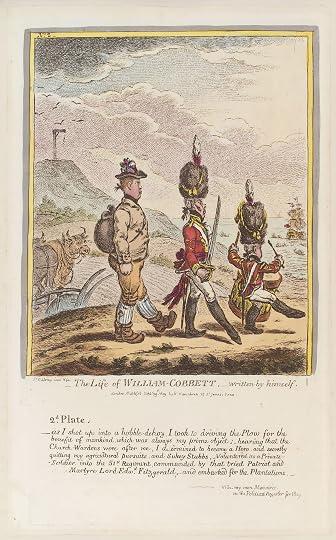
Cartoon of Cobbett enlisting in the army. From the Political Register of 1809. Artist James Gillray.
From wiki: William Cobbett was born in Farnham, Surrey, on 9 March 1763, the third son of George Cobbett (a farmer and publican) and Anne Vincent.[1] He was taught to read and write by his father, and first worked as a farm labourer at Farnham Castle. He also worked briefly as a gardener at Kew in the King’s garden.

On 6 May 1783, on an impulse he took the stagecoach to London and spent eight or nine months as a clerk in the employ of a Mr Holland at Gray's Inn. He joined the 54th (West Norfolk) Regiment of Foot in 1783 and made good use of the soldier's copious spare time to educate himself, particularly in English grammar.[1] Between 1785 and 1791 Cobbett was stationed with his regiment in New Brunswick and he sailed from Gravesend to Halifax, Nova Scotia. Cobbett was in Saint John, Fredericton and elsewhere in the province until September 1791, rising through the ranks to become Sergeant Major, the most senior rank of NCO.

He returned to England with his regiment, landing at Portsmouth 3 November 1791, and obtained discharge from the army on 19 December 1791. In Woolwich in February 1792, he married Anne Reid, whom he had met while stationed at Fort Howe in Saint John. He had courted her by Jenny's Spring near Fort Howe.


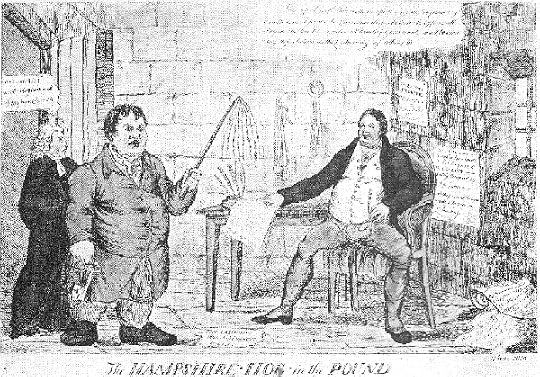
Contemporary engraving of William Cobbett in Newgate prison having been sentenced for treasonous libel, 1810, "Crimes and Punishment" magazine
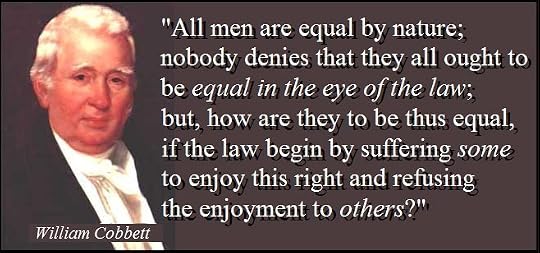


Guardian review: My hero: William Cobbett by Richard Ingrams
Profile Image for Jack Theaker.
63 reviews
May 3, 2020
Like a 19th century Tony Benn, Cobbett represents a radical with the most rational of conservative instincts. Compelled into politics out of necessity; the necessity to raise a voice for the common folk of his country, the necessity to elucidate the corruption of Britain's warmongering government, and the necessity to fight for proper democracy. It's not often I'll be so impressed by a self-made man, (perhaps I am a little bias as I used to drink in the house where he was born and play concerts where he was buried); but for a farmer's lad who ended up taking on the tory party establishment (what he calls 'the thing') one has to express their admiration. If the book didn't focus so excessively on the multiple court cases he was subject to during his life, I would have given it 5*. The very fact he dug up Tom Paine's bones and, in the innocence of wanting to give him a proper send off, ended up forgetting them and left them in his attic until he died pretty much sums him up. Its no wonder he inspired the likes of Karl Marx, Michael Foot, and many others from the across the political divide.
Profile Image for Simon.
1,276 reviews4 followers
January 13, 2022
Beryl Bainbridge (who I still miss) chose this for her book of the year 2006 and I can see why. This is an excellent place to begin to put some flesh on the bones, and Ingrams is an excellent guide; someone who sees things in a similar way to Cobbett; has a similar revulsion at cant, hypocrisy and corruption. Yet the author/biographer is skilfully able to keep himself out of the text.

Very readable. Full of telling quotations from all stages of Cobbett’s life.

To give some idea of Cobbett’s importance after his death and his appeal to followers of all political parties (so long as they genuinely care for the well-being of the country and are opposed to dishonesty) I’ll quote a short extract from the last chapter of this book:

“As far as recent historians are concerned, it is significant to find Cobbett being quoted and admired by the whole spectrum: Arthur Bryant (Tory), G.M.Trevelyan (liberal), A.J.P.Taylor (socialist), E.P.Thompson (Marxist), George Woodcock (anarchist). This in turn suggests that his appeal transcends any political bias, being more emotional and specifically English in character.”

The enthusiasm is not universal. Simon Schema is disparaging which is understandable given that Cobbett was often disparaging about the Jews, who he mistakenly treats as a whole group when in fact his ire is aimed not at the faith but at those who were amassing huge profits and country estates off the impoverishment of the labouring classes whether they were Jewish, Quaker, C of E or whatever. I’m not arguing that Cobbett wasn’t a prejudiced man; he was; but that modern sensitivities don’t always allow for a truer picture. I come from a Jewish heritage, and indeed a Quaker one and Cobbett offends me not one little bit. But then my Jewish and Quaker forebears didn’t profit greatly from enclosure and the Napoleonic wars.

Two snippets of interest to file under the “Well I didn’t know that” heading are; 1. that he effectively founded Hansard and 2. he effectively founded The Lancet. Well, I didn’t know that!
14 reviews
March 11, 2024
Richard Ingrams has written a very satisfying and much needed "popular" biography. He clearly shows a passionate interest in Cobbett and with a lifetime in journalism applies a forensic analysis both of the man, his admirers and critics in much the same way he did with his earlier authorised concise biography of Malcolm Muggeridge. As with Muggeridge Cobbett comes to life and the assessment that he was a reformer not a revolutionary, a defender of the "Brave Old World" under pressure from the changes in agriculture and manufacturing during his lifetime arises as the natural conclusion at the end of the book. Cobbett's final years and death makes use of new research based on previously unavailable documents. I also liked the way the author anchors Cobbett in the pre-Victorian era of the Napoleonic Wars, social unrest and repression with finely drawn portraits of Cobbett's main targets at the time and a motley lot they were too.

Cobbett may have become super-annuated by 1835 and his finally becoming an MP, but this highly enjoyable read makes a good case for celebrating his universality and relevance today as an example of the much needed "thorn" in the side of authority.

Wonderful book.
Profile Image for Paula.
415 reviews9 followers
August 28, 2017
Whoever abridged this book for the BBC broadcast did a horrible job. It was only 5, 13-minute segments, but it jumped around so badly I never knew what was going on. One minute he and his new wife are sailing into NY harbor, and next he's in a London jail. His daughter adores him, and then she doesn't, not even speaking to him when he's ill. Bizarre. I suppose if you're into this guy you might enjoy the biography, but if the abridge audio is a reflection of the book, it's a slog.
Profile Image for Greg.
67 reviews2 followers
July 27, 2013
This ranks as one of the best books that I have read, possibly because it coincided with a current interest. Richard Ingrams is clearly an admirer of William Cobbett and writes in an easily readable style about this 19th century reformer who was instrumental in bringing about that very important 1832 parliamentary Reform Act. A self taught farmer's son, Cobbett fought, throughout his life, for the rights of the “Commons of England” as he called the ordinary labourers, mainly through his newspaper, the “Register”. He believed that 'It is the chief business of a government to take care that one part of the people do not cause the other part to lead miserable lives.' The Prime Minister of the time, Lord Liverpool believed that such a view was not only deluded but dangerous.

Parliament was corrupt. An MP could expect to become rich with their families looking forward to similar benefits all on the back of the hard pressed tax payer. If that sounds familiar, so much of Ingrams book could be applied to the corruption of the ruling elite of today.

Cobbett's public image was of a belligerent, abusive egotist but at the same time he was a shrewd pragmatist, and was totally against violent demonstration. The country came close to revolution in this time period as hayrick burners were hanged and destroyers of threshing machines were transported for seven years, by a government determined to crack down on any sign of dissent. His Register was widely read as was his calls for only peaceful protest, which influenced many away from outright revolution despite the actions of government.

Cobbett himself was tried three times for seditious libel, spending two years in Newgate prison and once fleeing to America.

He fought against almost everyone in any position of authority and often even turned on his friends and family as he was always totally convinced in his own actions which were not always well thought through. Later in life he seemed to suffer from a short period of extreme paranoia, but did recover.

He was a man of his time who brought about the start of huge parliamentary reforms but would have been out of place in the coming industrial society. For anyone wanting a better understanding of this period of great social change, do read this book. You will enjoy it.
Profile Image for Les Dangerfield.
267 reviews
October 12, 2015
A well written biography of William Cobbett by Richard Ingrams, who, when editor of Private Eye, must have learned a thing or two from Cobbett about handling libel actions. Although I knew something of Cobbett before, I didn't realise he was such a colourful and multi-faceted character. He came from a poor background to be an influential journalist, prolific writer and satirical commentator of his time (late 18th and early 19th centuries). He was very much a self-made man, self-taught and very much self-sufficient. A passionate advocate of the rights of ordinary people and a tireless critic of the corrupt and self-serving establishment of the time. At the same time a family man (until the last years of his life) and a lover of gardening, farming and the English countryside.
Displaying 1 - 8 of 8 reviews