At the age of twenty-five, Arthur Rimbaud—the infamous author of A Season in Hell, the pioneer of modernism, the lover and destroyer of Verlaine, the "hoodlum poet" celebrated a century later by Bob Dylan and Jim Morrison—turned his back on poetry, France, and fame, for a life of wandering in East Africa.
In this compelling biography, Charles Nicholl pieces together the shadowy story of Rimbaud's life as a trader, explorer, and gunrunner in Africa. Following his fascinating journey, Nicholl shows how Rimbaud lived out that mysterious pronouncement of his teenage "Je est un autre"—I is somebody else.
"Rimbaud's fear of stasis never left him. 'I should like to wander over the face of the whole world,' he told his sister, Isobelle, 'then perhaps I'd find a place that would please me a little.' The tragedy of Rimbaud's later life, superbly chronicled by Nicholl, is that he never really did."— London Guardian
"Nicholl has excavated a mosaic of semi-legendary anecdotes to show that they were an essential part of the poet's journey to become 'somebody else.' Not quite biography, not quite travel book, in the end Somebody Else transcends both genres."—Sara Wheeler, Daily Telegraph
"At the end of Somebody Else Rimbaud is more interesting and more various than he is not less mysterious, but he is more real."—Susannah Clapp, Observer Review
Charles Nicholl is an English author specializing in works of history, biography, literary detection, and travel. His subjects have included Christopher Marlowe, Arthur Rimbaud, Leonardo da Vinci, Thomas Nashe and William Shakespeare. Besides his literary output, Nicholl has also presented documentary programs on television. In 1974 he was the winner of the Sunday Times Young Writer Award for his account of an LSD trip entitled 'The Ups and The Downs'.
Nicholl was educated at King's College, Cambridge, and is a fellow of the Royal Society of Literature and has lectured in Britain, Italy and the United States. He lives in Lucchesia in Italy with his wife and children. He also lectures on Martin Randall Travel tours.
A brilliant child and a poetic genius, Rimbaud was a true prodigy who flared incandescently ("plus libre que les plus libres", as Verlaine said of him) for literally but half a decade (1870-1875), before burning himself out in a luminous epiphany of sexual and poetic debauchery.
Whereupon, after a few years of wandering about Europe (often on foot), he hurled himself, in what Nicholl calls "a sort of doomed existential adventure", into the very ends of the earth -- the desert wastes of the Yemen (Aden), Somalia, and eastern Ethiopia (Harar), slaving, gun running, trading coffee, working as a warehouseman, accountant, caravanist...
The problem is, that Rimbaud did nothing of any interest during those desolate years of 1880-1891, which are the topic of Nicholl's book -- he constantly complains in letters to his mother and sister of his misery and boredom...; he did this nothing in the most desolate and nothing place on earth..., as if living in the wastelands, practically, of the Moon..., not struggling with Demons like St. Anthony in the deserts of Egypt, but having apparently abandoned not only poetry and literature, but seemingly even the life of the mind; and there is no evidence, save a few memoirs in the hand of his employer - a coffee-trader on the Moon (Bardey) -- and a few others -- about all this nothing that Rimbaud did in this utter nothingland.
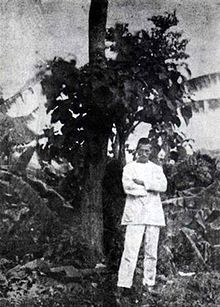
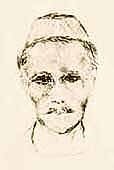
All that remains of Rimbaud are three fuzzy photos that he took of himself in 1883 (above), and this sketch, made just before his death (1891) by his surviving sister, Isabelle:
Nicholl did the best one could do with this story. Nicholl himself seems like a droll and interesting cat -- a 'public shool' Brit, who used to get high by smoking dope and looking for symbolist influences in the poetry of Bob Dylan. But the material he had to work with here was rather thin, indeed.
The lessons to be learned from this life are hard to pin down - was there some hidden poetic purpose in Rimbaud's suicidal self-exile? or did he simply flare out and was nothing more than an empty husk by 1875 (at the age of 20), when he handed Verlaine a manuscript copy of what would later be known as "Illuminations"?
Hard to tell... But Nicholl's leaves one with the impression that it was the latter rather than the former.
A very interesting book, I would say. It's a mix of biographical narrative through which Nicholl interweaves reflections on the possibility of realizing a "complete and accurate" biography of anyone as well as bits and pieces of a memoir of his research and the writing of this particular volume. I find this sort of biographical work highly satisfying if for no other reason than than it forces the reader to confront and acknowledge a very simple fact - that a biography that pretends to "objectivity" is fraudulent - or the work product of a self-deluding writer. Of his own book Nicholl writes (p. 5): "It is not, of course, a definitive account: it is more like some scratchy old home-movie. The faces around him have blurred. There are jump-cuts due to lack of information. There are guesses." And for another few pages Nicholl writes again and again of the guess-work that his narrative documents.
And so for those of us who care about biographical narrative this book raises, by example, a host of questions regarding the proper objectives of biography and the methods one might reasonably employ to achieve those objectives. I could cover scores of pages with words, words, words of my current views on the subject - always subject to revision at the turn of every page. But this is neither the time nor the place for that. But I will state what I discern to be Nicholl's views on the subject, if not expressed directly, then indirectly by example and through the qualifiers that he interlards liberally in his narrative.
As far as I can tell - today, at this moment - one might assert reasonably that Nicholl has adopted a rather low evidentiary standard - not by choice, of course, but by reason of necessity. For example, (p. 35) "Those who knew him cannot agree; their reminiscences seem faintly untrustworthy; indeed the poems have in themselves - as do the later African letters -- a curious timbre of rumour, as if the young man who wrote them cannot be trusted either, as if these experiences he recounts are momentary reveries, hoaxes, fumisteries. It is hard to reconstruct Rimbaud because he was so unconstructed, so much in flux; 'there is nobody here, and yet there is somebody.' "
So to what evidentiary standard does Nicholl's book rise? Well, several. Where the evidence is clear and compelling, for any reasonable reader, that is, Nicholl tells us so, and uses it in that way. Where he can only draw conclusions founded on less conclusive standards, "preponderance of the evidence," he tell us that as well. Where there is "some credible evidence," even less conclusive, NIcholl deploys even that in a responsible manner. When he gives us his informed guesses, we know that as well.
So what are we left with? In my estimation, all that can be had.
But I am alerted, however, to the possibility of applying the rules of evidence that apply in criminal and civil procedure to the writing of biography. One seeks clear and compelling evidence, of course, and where it can be found, the biographer, like Nicholl, uses it appropriately, and so on.
One quibble, not so minor - which will appear in due course.
I am the sort of reader, an engineer by education, trade and livelihood, who happens also to hold a Phd in history - a long story. But I insist upon two characteristics of successful biography, and these demands are a product of my education and taste, namely, (1) a clear and precise (not to say objectively/scientifically accurate) depiction of the trajectory of a life (I hate metaphors), and (2) an assessment of the evidentiary standard to which the biography rises.
I have the sense that Nicholl began his project with those intentions (as his introduction suggests) but that at some point the demands of focused research and writing distracted him. He forgot, it seems, that he owes his readers not only gripping narrative but also clear conjectures of the place and significance of the events that concern him in the context of AR's life course, about which I think Nicholl harbors only very tentative and vague notions. For example, NIcholl writes (p. 12) "his whole life is a story of departures and flights, of disappearances and reappearances." Lovely words, but insufficient in my view - certainly unsatisfying. He writes further (p. 283): "There is also a drastic sense of exertion throughout Rimbaud's life ... and this physical driving of himself reaches a climax in Africa. ... There is an element of iron will-power in this ... He pushes himself, punishes himself, to the point of exhaustion and beyond."
All true enough, I think, but more can and should be said. How and why did AR's life assume that form? Under what circumstances? Forced/prompted by what circumstances? And why Africa? Why life in extremis at the limits of human endurance? And on and on. I think there are answers to these questions - that derive in part from the preponderance of the evidence that Nicholl can adduce, in part from "some credible evidence" and in part from the promptings of his sense of the man. All admissible in the court room over which I preside - so long as the evidence is properly collected, tagged, presented - and molded into a complete, coherent, plausible and defensible argument. We have no other choice if we choose to reconstruct the lives of persons who interest us.
So who might be best prepared to read Nicholl's biography? My sense is that one should have a sense of the entire life before one grapples in greater detail with the events of the last segment of AR's foreshortened life. I read Graham Robb's, Rimbaud, before I read Nicholl, and it helped. I can't imagine how I would have gotten through the details of AR's life as trader, coffee merchant, explorer, orientalist, etc. without knowing - however tentatively - what those events MEANT in the context of AR's life course. Perhaps others could and can - I don't happen to be one of those persons.
AT END. So what can we make of AR's eleven years of experience in Africa (1880-91)? What do these years MEAN if we interpret them in the context of the course of his life?
Nicholl isn't very helpful. Nonetheless, I've had to gain some sort of closure with AR, and so I offer my hypothesis. In my remarks concerning Graham Robb's biography of Rimbaud, I describe what I take to be "the trajectory" of AR's life. Here I modify and amplify that characterization somewhat.
My sense is that after AR grew weary of outrageous and self-destructive behaviors, all focused on the complete obliteration of convention and constraints imposed by external authority, which he encountered first of all in that monster of a kulak mother of his, he began to wonder - what am I made of? Certainly something extraordinary - it appears, but it's all been rather easy so far. What gifts, talents, potential do I possess that I've not even begun to discern, much less to employ and develop? How and when will life get hard for me?
[By the way, as far as I can tell, AR was no poet. He composed poetry and prose poems, to be sure, but poetry served the purposes of his larger project for a while, and when poetry wasn't useful any longer for that purpose, AR didn't reject poetry, he simply stopped without so much as a second thought. Rejection would have consumed time and energy that he felt no need to expend.]
And so during the years that remained to him, after he put poetry, Verlaine, bohemia and general vagabondage out of mind, he placed himself in extremely dangerous circumstances, often life-threatening. At first in Europe, say 1875-80, with interruptions at points when illness, injury rendered him altogether unable to carry on. At home, of course, with LaMother.
Eventually these experiments allowed him to discover just so much in himself, and I have the sense that AR realized that there was more - but what? and how much? So he disappeared from France once more - and for the last time - without a word.
By a series of accidents and coincidences, he landed in Aden, attached himself to a mercantile house, and began to trade in coffee. And in a matter of a few years, he is trading on his own account, and undertaking trading expeditions (caravans) in and through the most dangerous regions of East Africa. Nicholl describes the dangers, hazards and challenges of caravaning in this region brilliantly. Let us say that success there - no, mere survival in the desert, among slavers, bandits of every kind and description, all armed to the teeth and death everywhere - required that he become that much more cunning, scheming, audacious, mendacious, avaricious than any of the most hardened natives of the region, who prided themselves in slaughtering Europeans, harvesting their testicles, displaying them in piles as trophies. Really.
Nicholl's account of AR's last gun-running caravan, which he led as owner and master, proves beyond any quibbling that he could best even the most vicious among the savage marauders in the east Africa of his day. [AR had been developing this gift for cunning, dissembling and mendacity from the age of ten, if not earlier, in order to survive his mother, with soul and self intact.]
And he used every one of his gifts - developed certain of them to a degree that he could never have attained in any other circumstance. He went native completely and, I think, willingly - not a matter of policy and the politics of assimilation, but out of curiosity and interest. He even began to urinate in the squatting position customary among men there. He became fluent in Arabic and a host of local dialects. He became a revered scholar of the Koran - an expert interpreter, a wandering preacher, one whom local elders welcomed to their debates. Of course, these skill served to burnish his brand, let us say. Then he mastered every form of treachery that any stakeholder in that region's vast complex of corruption might interpose, in every imaginable form, to extort, to extract bribes, to sell permissions, approvals, and on and on. Then there was the need to curry the favor of the great slave trading families, who commanded the trade routes. And of course they all wanted what he had: guns and ammunition, which he had contracted to deliver to King Menelik of Shoa, who would become the Emperor of Ethiopia. There seemed no end to the obstacles, privation, mortal dangers that he did not encounter and overcome during the 18 months that that last gun-running mission/caravan consumed. And in the end he lived - and he made a great deal of money, which in the end became his measure of achievement, of successful self-realization.
So I think that in Africa he learned what he was made of; he recognized, realized, developed, as fully as any set of circumstances on this planet would permit, the components of his "actual nature." And over these extraordinarily eventful years - this extraordinary man completed the project that he had been driven to under undertake and complete from childhood. In the end, I believe he became as contented as he could be. And in 1891, at thirty-seven years - he died - in bed.
I am one of the many out there who have heard of Arthur Rimbaud and that he was a French poet but haven’t actually read anything by him. The most interesting thing I’ve taken from this book is the knowledge of how little he wrote, you’d think he would have had a huge catalogue of work, in fact there was one small collection of poems and that was it really, the odd little bit here and there but that was published by others.
There has been a huge amount of effort put into this book, Nicholl is quite the detective, tracing the footsteps of Rimbaud to not just find out where he went in Africa but also investigating his early life to find out why he suddenly up’d and left to become a trader in Africa. The information that Nicholl is working with is a small collection of letters, a lot of hearsay, the odd photograph and research carried out by other biographers. A tough job to carry out indeed, by carefully working through the data he does his best to filter out the truth from all the fiction. The reader is always told where Nicholl has got the information and whether he thinks it is right or wrong and gives his reasons, I think he has done a great job at keeping his passion at bay to not get angry at previously untrue “facts” and to not get carried away when he has a breakthrough.
The photos are a great addition, they show you where Rimbaud lived and those people in his life, there are also a number of selfies and interesting enough they add to the myth, slightly dark and out of focus, just giving you a glimpse of the man and not the whole story. Nicholl’s writing is superb, it kept me engrossed the whole time, he goes very in-depth when he has proven facts and also has the odd tangent to expand on the writing, it all works very well and I’m left feeling I know Rimbaud well…next stop is finding a copy of “A season in hell”. Anybody looking to find out more about Rimbaud’s life won’t go wrong if they start here.
The life of French poet Arthur Rimbaud is a mystery even after I read Charles Nicholl's excellent biography, Somebody Else. After changing poetry forever in his late teens and early 20s with a radically innovative style, Rimbaud renounced writing. He embarked on a life of wandering, first in Europe, then Asia and finally Africa and the Middle East, where he remained for 11 years as a trader. Nicholl brings the poet's story alive, with a title of his biography plucked from Rimbaud's poetry, but in the end I still had questions about Rimbaud's motivation.
What drove Rimbaud to the road? His life in his French homeland and Africa is a kind of legend, yet it was incredibly exhausting. One doesn't get the sense that Rimbaud sought adventure. The exotic destinations were not really the point of his travels. Nor was he a "lost soul," who is estranged from life and friendship. A couple recollections of Rimbaud in Africa depict him as a great raconteur, a genial story-teller, a man most people liked and held in high regard. It appears the poet found peace in constant movement, even if he spent a couple years of his years in Africa in one location, Harar, Ethiopia, in the 1880s-90s. The life of the brilliant poet and enfant terrible became its own poem even if it meant running guns and trading clothing material and other stuff.
Rimbaud chronicled his life through copious letter-writing mostly to his mother, a difficult woman. Nicholl has researched generously, uncovering letters, old photos and journal diaries. The reader has a picture of who Rimbaud was, but his life still raises questions.
Rimbaud traveled everywhere over the course of his life. On foot, he traversed the Alps twice. He walked between his northern France home and Paris a couple times. Rimbaud signed on as a Dutch mercenary, traversing the oceans to go to Java, a Dutch colony in Asia. After a couple months, he deserted his role as a mercenary, escaping into the jungle and somehow making it back to Europe. Once, as a gun-runner in Africa, Rimbaud organized a caravan between present-day Djibouti and Ethiopia. Nicholl's depiction of the trip is exhausting just to read.
The question for the reader is why did he give up poetry and debauchery for a life of wandering? Nicholl's book tantalizingly asks the question and correctly leaves it for the reader to answer. Rimbaud wanted to be somebody else. And he achieved his life's goal.
Charles Nicholl is my favorite investigative biographer/historian, not that I really know that many. He loves to pick a juicy but ambiguous subject and then do some serious figurative & literal leg-work to fill in the story's gaps with plausible speculation. As a stylist he is exceedingly sensitive and at times while reading his books my eyes will drop into a particular description of something so minor yet so lovingly executed that flickers of heightened perceptions will smolder in my brain.
In this book he writes a sympathetic account of Rimbaud's post-poetry years. At times he goes out of his way to see in the late Rimbaud some vestige of the visionary poet he once was, but all in all he paints a rich and plausible portrait of Rimbaud as a somewhat interesting man, however obsessed with money and even a possible murderer.
Much to be liked in here, although much remains speculative. But as usual Nicholl has done the hard work (archives etc), and it shows. Yet as usual with him, too, as he tackles things that can't be known anymore, he speculates, and 'probably this is why', or 'he may well have met...' etc, all of which gets slightly tiring in the end. He does well to leave the French period to others, just touching on it enough to make the rest comprehensible, it reads well, and he knows where and when to stop. So yes: worth your time.
Simply magnificent. Nicholl is a brilliant writer, a tenacious investigator, and a sensitive interpreter of Rimbaud's life and works. The 200 pages that recreate Rimbaud's African years are frequently revelatory and always evocative in their details. This is literary biography of the highest calibre: perceptive, insightful, sympathetic and, yes, personal. The final pages soar off into a kind of doomed poetry that Arthur himself would have appreciated. A wonderful book.
Todo un personaje de la segunda mitad del siglo XIX. Desde luego el poeta francés llevó una vida interesante y particular, que en gran medida podemos descubrir a través de este interesante ensayo, con particular detalle en su vida como comerciante, cuando residió entre Adén (Yemen) y Harar (Etiopía), en base a sus propios escritos y de otros muchos personajes que le conocieron. Lógicamente, descubrimos también muchos aspectos de los comportamientos y formas de pensar de la sociedad de la época.
Nicholl paints a portrait of Rimbaud after the music has gone. His Rimbaud is saturnine and Conradian. My love of Conrad's fiction, more than Rimbaud’s poetry, is what drove me to read this. Although Charles Nicholl can make you interested in almost any topic he finds fascinating. I will buy and read anything with his name on the cover.
"We see above all, that like most creative individuals, he was incapable of learning from experience." Henry Miller on Rimbaud
Very thorough and interesting biography that is well written. What amazes me the most is that it contains details that I have not found in almost all the accessible articles & brief biographies I went through. However, I lost my interest in the last few chapters (probably because there wasn’t much going on in Rimbaud’s life) thus, the four stars.
First read this in 1999. A great example of a book that should have been an article. Rimbaud life after poetry was slightly interesting but pretty empty. To try to make a full book out of it was to me like beating a dead horse and the conclusions reached based on nothing
In the summer of 1880, the twenty something Arthur Rimbaud (pronounced Rambo) landed in the Port of Aden ready to start a new chapter in his young life. Despite his youth, he had already experienced more adventure than most experience in a whole lifetime. He’d been an infamous surrealist poet (considered the first modern poet), an enfant terrible of Paris, Brussels, and London: bohemian drifter vagrant, libertine Communard, journeyman, and briefly a mercenary in the Dutch Army. But that summer he travelled east to Aden and the Horn of Africa to put that life behind him and to spent the next decade, his final decade, as an explorer, an adventurer, and a trader in pots and pans, and textiles, and coffee and guns – this was the scramble for Africa, when Leopold and Stanley were causing devastation in the Congo, and Rhodes was taking control of southern Africa. Somebody Else, is the story of Rimbaud’s explorations and adventures during this final decade of his short life. Whilst some in the literary world say that Rimbaud betrayed his revolutionary ideals by leaving poetry behind and working in Africa. Albert Camus, in The Rebel, went as far as to say that there "is nothing to admire, nothing noble or even genuinely adventurous, in a man who committed a "spiritual suicide", became a "bourgeois traficker" and consented to the materialistic order of things." As far as I’m concerned he lived the true life of adventure on the road that he wanted to live, and no one can argue with that. Great book.
Charles Nicholl shapes often quite sparse material into such a readable form. His book about the murder of Christopher Marlowe, The Reckoning, is one of my favourite books. This book, Somebody Else, is about the last years of French poet Arthur Rimbaud. He had given up literature and gone to Africa to earn money. Though this is a very enjoyable read, the personality of Rimbaud is hard to embrace - he's truculent, careless of his friends and seems driven by a incessant desire to keep moving. Rimbaud walked huge distances, fighting the desire to stop, even when stricken by serious illness. The mystery is not as intriguing in the Marlowe book - most people know Rimbaud died while quite young, broken by his experience in Africa. I would still recommend it - any book by Charles Nicholl is so well written and researched that it's a pleasure to read..
Everyone remembers Rimbaud the punk poet, and every black-clad teen in the last fifty years has had a copy of "Season in Hell" there on the nightstand. Chas. Nicholl gives us Rimbaud the quarry foreman, the disappointed photographer, the gunrunner, the gaunt expat with the Abyssinian housekeeper/concubine, the merchant with a keen eye for cutting costs. "Somebody Else" is that long, forgotten second act of Rimbaud's life--- the boy from Charleville who disavowed his past (Verlaine, poetry, bohemian life) and went off to the Horn of Africa to 'make something of himself'. Fascinating and sad and full of period detail and local colour.
I purchased this biography after seen the film Total Eclipse Total Eclipse (film) with Paul Verlaine (David Thewlis) and Arthur Rimbaud (Leonardo DiCaprio).
I was looking forward to the read. I stopped reading when I got to page 30. I absolutely could not stand the fact that this book had so much French words/sentences/phrases. And the style of writing, it did not agree with me. I developed a headache.
Read a bit like a puzzle trying to be solved, enjoyable and certainly alot of effort put into the research. I was interested in the day to day life, Rimbo's favourite meal for eg., which was a bit sketchy.
Awesome achievement of a book. Superb sense of place and a great musing on a side (and time) of Rimbaud that is never explored or dealt at length with.