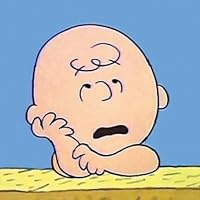
Charles Monroe Schulz was an American cartoonist, whose comic strip Peanuts proved one of the most popular and influential in the history of the medium, and is still widely reprinted on a daily basis. Schulz's first regular cartoons, Li'l Folks, were published from 1947 to 1950 by the St. Paul Pioneer Press; he first used the name Charlie Brown for a character there, although he applied the name in four gags to three different boys and one buried in sand. The series also had a dog that looked much like Snoopy. In 1948, Schulz sold a cartoon to The Saturday Evening Post; the first of 17 single-panel cartoons by Schulz that would be published there. In 1948, Schulz tried to have Li'l Folks syndicated through the Newspaper Enterprise Association. Schulz would have been an independent contractor for the syndicate, unheard of in the 1940s, but the deal fell through. Li'l Folks was dropped from the Pioneer Press in January, 1950. Later that year, Schulz approached the United Feature Syndicate with his best strips from Li'l Folks, and Peanuts made its first appearance on October 2, 1950. The strip became one of the most popular comic strips of all time. He also had a short-lived sports-oriented comic strip called It's Only a Game (1957–1959), but he abandoned it due to the demands of the successful Peanuts. From 1956 to 1965 he contributed a single-panel strip ("Young Pillars") featuring teenagers to Youth, a publication associated with the Church of God. Peanuts ran for nearly 50 years, almost without interruption; during the life of the strip, Schulz took only one vacation, a five-week break in late 1997. At its peak, Peanuts appeared in more than 2,600 newspapers in 75 countries. Schulz stated that his routine every morning consisted of eating a jelly donut and sitting down to write the day's strip. After coming up with an idea (which he said could take anywhere from a few minutes to a few hours), he began drawing it, which took about an hour for dailies and three hours for Sunday strips. He stubbornly refused to hire an inker or letterer, saying that "it would be equivalent to a golfer hiring a man to make his putts for him." In November 1999 Schulz suffered a stroke, and later it was discovered that he had colon cancer that had metastasized. Because of the chemotherapy and the fact he could not read or see clearly, he announced his retirement on December 14, 1999. Schulz often touched on religious themes in his work, including the classic television cartoon, A Charlie Brown Christmas (1965), which features the character Linus van Pelt quoting the King James Version of the Bible Luke 2:8-14 to explain "what Christmas is all about." In personal interviews Schulz mentioned that Linus represented his spiritual side. Schulz, reared in the Lutheran faith, had been active in the Church of God as a young adult and then later taught Sunday school at a United Methodist Church. In the 1960s, Robert L. Short interpreted certain themes and conversations in Peanuts as being consistent with parts of Christian theology, and used them as illustrations during his lectures about the gospel, as he explained in his bestselling paperback book, The Gospel According to Peanuts, the first of several books he wrote on religion and Peanuts, and other popular culture items. From the late 1980s, however, Schulz described himself in interviews as a "secular humanist": “I do not go to church anymore... I guess you might say I've come around to secular humanism, an obligation I believe all humans have to others and the world we live in.”
A series as long-running as Peanuts is bound to have overlap in its anthologies, but I didn't realize this contains almost identical comic strips to A New Peanuts Book Featuring Snoopy, which I recently read. You can refer to my review of that, but I did want to note that these two books are essentially the same.
I love, love, loved this! I remember reading these books as a little girl in Tokyo and it brings back a nice warm, fuzzy feeling. I love the general good humor and that these kids have bad days. Bad days that can be dealt with in a functional way. And sometimes tantrums are good. I love the facial expressions on Snoopy. Anyone with a dog knows and can relate to the feeling that sometimes your dog might be smarter than you. I like that Snoopy is a little bit saucy. Go Snoopy!
Join Snoopy as he plays out his many adventures alongside Charlie Brown, Lucy, Linus and the rest of the gang, bringing a smile - and the occasional groan - to his friends. Schulz will have readers of all ages laughing with his lighthearted humour. Stick it out with Snoopy and have a good old time!
It's Schulz at his best. These collected strips are from the sixties, which was peak Peanuts, although he was still hitting it during the seventies as well. If you're a fan you'll love it. If you're not a fan, you will be after reading it.
I love Snoopy, especially the young Snoopy as he was developing an identity. He grabs blankets, is afraid of weeds, and imitates others--everyone from a kangaroo to Lucy!
Muy entretenido, aunque noto que tiene muchos comentarios sarcástico que lo entienden los adultos, como lectura infantil no lo recomendaría, snoopy maldice y a veces dice groserías.
I grew up with Peanuts, and Snoopy was perhaps the first dog I ever loved. I had a Snoopy poster and a stuffed Snoopy. There were also at least a dozen Peanuts books about the house, which I must've read a zillion times.
Now, in my 50s, most of the Snoopy stuff has gone, but I still have one Peanuts book. This one. This is a very well-loved 1958 paperback that's falling apart.
As the title suggests, the cartoons chosen from Snoopy, Vol. 1 All feature Snoopy. He's in nearly every panel. Most of the stripes are one-off gags, but there are some longer stories, such as Snoopy doing a series of imitations, and Snoopy suffering from claustrophobia.
Since all of these cartoons were done in the 1950s, there are references to Westerns, transistor radios and raccoon hats that may puzzle younger readers. The Peanuts gang also read books instead of staring into phones.
Snoopy himself is slightly different than how he was drawn in later decades. His nose was longer, his legs were longer, and he spent more time walking on four feet. Charlie Brown does teach him to stand on his hind legs in this book ... and later regrets it. Snoopy does his characteristic goofy dance on his hind legs. I'm not sure if this is the first time the dance appears.
It's a fun little book, even if the pages are tan and falling apart.
There is something I really love about the early Peanuts cartoons. Maybe it's because Snoopy seems so much more like a dog in the early days, or how the kids themselves are more real, more KIDS instead of vehicles for delivering wise one-liners which they later become. Not that I don't love the Peanuts in every incarnation. Rather, I just like noting this stage of their development and the innocence and utter joy they bring in these early days. I am very thankful I found this in a clearance bin at Half Price books.
Hay algunas viñetas bastante antiguas en las que los personajes todavía no tienen su apariencia característica. Me ha gustado mucho, Peanuts como siempre no me decepciona.