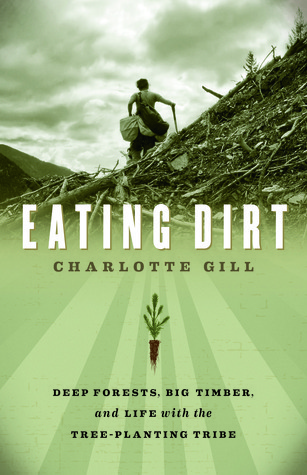
Winner of the BC National Award for Non-Fiction, and short-listed for both the Charles Taylor Prize for Literary Non-Fiction and the 2011 Hilary Weston Writer's Trust Award.
A tree planter's vivid story of a unique subculture and the magical life of the forest.
Charlotte Gill spent twenty years working as a tree planter in the forests of Canada. During her million-tree career, she encountered hundreds of clearcuts, each one a collision site between human civilization and the natural world, a complicated landscape presenting geographic evidence of our appetites. Charged with sowing the new forest in these clearcuts, tree planters are a tribe caught between the stumps and the virgin timber, between environmentalists and loggers.
In Eating Dirt, Gill offers up a slice of tree planting life in all of its soggy, gritty exuberance, while questioning the ability of conifer plantations to replace original forests that evolved over millennia into complex ecosystems. She looks at logging's environmental impact and its boom-and-bust history, and touches on the versatility of wood, from which we have devised countless creations as diverse as textiles and airplane parts.
Eating Dirt also eloquently evokes the wonder of trees, which grow from tiny seeds into one of the world's largest organisms, our slowest-growing ""renewable"" resource. Most of all, the book joyously celebrates the priceless value of forests and the ancient, ever-changing relationship between humans and trees. Also available in hardcover.
Published in partnership with the David Suzuki Foundation.
Charlotte Gill is the author of three books, including EATING DIRT, a tree-planting memoir, and LADYKILLER, a collection of short fiction. Her work has appeared in Vogue, Hazlitt, Best Canadian Stories, The Journey Prize Stories and elsewhere. Her latest title, ALMOST BROWN, a mixed-race family memoir, is published by Penguin Random House.
This is an interesting look at the life of a tree planter and the botany of trees & their environment, nature and our part in all of this. Charlotte Gill's life as a tree planter is a different career path than most of us follow. It is hard, fun, dirty, cold, hot and seasonal. As a day-hiker in the region that Charlotte writes about, I recognize the beauty and silence of the mountains. They are a marvel and potentially a hazard but truly stupendous. The trees tower around, the air is fresh....Charlotte's descriptions bring these hikes back. Her descriptions of the life of a tree planter teeters between the repetitive (which it probably is), the jubilations, the boredom, the huge amounts of food needed to fuel the activity, the dirty & worn clothing, the reception in the small towns. Without having lived this sort of life, I imagine it is just as described, making this life a mixed bag of fun, freedom, boredom and distance from society. I also really enjoyed the botany of the trees, the life of the fauna & birds and the thoughts of the Earth & forests.
I couldn't read this book fast enough. Reminiscent of John Vaillant's The Golden Spruce (he also endorses this book), Eating Dirt tells the story of one full year of tree-planting in the 20 year career of author Charlotte Gill. The description of her year forms the narrative arc, while interspersed are fascinating tidbits about the logging industry, thoughts on environmentalism, the types of characters you encounter in the bush, on the camps, in the remote outposts where tree-planters are so often based. Having spent one season planting trees in northern British Columbia, I was instantly transported back to that time - the brutal conditions, the long and isolated days, but also the friendships and the satisfaction of doing something so hard core - and frankly the constant inner debate about whether what it is you're doing is good for this planet or entirely the opposite of that. Gill describes this internal conflict with a beautiful literary style, humour and amazing detail. Highly recommended.
I am so excited to win this book. Can hardly wait for it to arrive. Thank you Charlotte Gill, Greystone Books & David Susuki Foundation, Goodreads "first reads" and anyone else responsible for bringing this book to my hands!
Arrived in the mail today, Tuesday, after the long weekend Tuesday, October 11, 2011. A great mail day makes going back to work so much nicer. Will start reading tonight!
Wednesday, October 12, 2011: Just a few pages in and already wondering what motivates tree planters to do the job for 20+ years. I can maybe understand the attraction for a student who works during the summer for a few years to sock away money for education, to do something "feel good" for the planet and to do a physical labour sort of job when the body is more than capable of it. But, B.C. or not, damp February mornings would have to get to you after a while... I assume I'm going to find out.
p.50 "I could stand to have my back broken if this was the way a spine could grow back."
October 19, 2011: Finished the book last night. What a marvel it is. I knew before I had it in my hands that I would like it. I figured that anyone who would plant trees for 20 years would have a spirit at least somewhat kindred to my own. When the author sent me a message letting me know I could expect to receive her book, I was thrilled and responded with a message of my own admitting that I was looking forward to reading it; that my friends and family considered me to be a smarty-pants when it came to my knowledge of trees. And it's true, at least in comparison to their own tree-smarts. I can't help myself from pointing out the white pines and red pines on our walks through bushy wilderness or the elms and cottonwoods in our urban landscape. With the least bit of prompting I'll tell them how to identify them (the trees); which has clumps of five needles and which two, the colours of bark, the grains of the wood and what it's used for. From the looks on my friends' faces, I know that they haven't the slightest interest in what I say and that they'll retain none of the information I've shared with them. They tolerate my goings-on as one of my little idiosyncrasies. Friends do that.
They are a little more interested in my tales of working in the lumberyard to put myself through law school, which tales accompany and add credence to my tales of herculean strength, of arm wrestling men in bars and winning. Piling lumber does that.
Well if I thought I was a smarty pants about trees, Charlotte Gill may be the smartiest pants of all (and I might even give her odds on an arm wrestling match).
This is one of the best literary non-fiction books I've ever read. As the cover blurb suggests: "Eating Dirt celebrates the priceless value of forests, the ever-changing relationship between humans and trees, and perhaps most of all the joys of planting trees by hand, one of the world's most ancient ecological pursuits."
This book deserves the accolades and awards it has received. I felt the exhausting tedium of tree-planting work -- "bend, plant, stand up, move on" -- as well as the conflict Gill (and others) feel between wanting/needing the work and hating the clear-cutting that precedes it. "Because we plant trees," Gill writes, "logging companies can cut more today. And that is the irony of us."
Gill portrays how the hardship of the work becomes addictive, a way of proving to yourself and your tree-planting tribe that you're tough, not a quitter. How something in Gill's own nature compels her to put herself in situations in which she's vulnerable and dispensable. The book seems well researched; I appreciated all I learned about the trees and topography of the island on which I live and where Gill planted trees for 20 or so seasons. I greatly enjoyed Gill's clear prose and striking images, such as "a silence like waterlogged wool."
I loved how quickly I came to understand how brutal this job is. Then I spent the rest of the book trying to understand the author's love for it, why she returned year after year. In the end, I think I am satisfied with my answer, as she never comes right out and says so but from the tone and her stories I could figure it out. I loved her style of writing. Descriptions are clean and original, as in “sky like boiled newspaper”. (I know that sky). There is humor like “ravens and crows…are the wisenheimers of the bird world”. (No spoilers, read it to see why) The image provoked was easy and made me laugh. And drama that needs no embellishment, as in her encounter with a family of grizzlies. I would have rated it 5 stars but I did not really care for the long asides into the history of forests. Although they are well done and many readers will appreciate them, I would have much preferred more of her stories as a tree planter. I am sure that in her 20 years she had enough to fill more than one book. I hope her tree planting years paid enough to let her live as a writer because I welcome her talent into my reading world.
An exciting new entrant into the even-more exciting coalescing genre of creative nonfiction, in which the author is also a character in a work of narrative nonfiction.
This is not only Charlotte Gill's personal history of two decades as one of a very few female tree planters, but of the odd 'tree-planting tribe' - a nomadic crew who spend their springs and summers in an endeavour that doesn't seem particularly lucrative or even particularly successful in environmental terms. What, of course, is the alternative? Doing without wood entirely? This is one of the questions the book poses but cannot answer except to conclude that it is better to be on the side of the planters and restorers than it is to be on the side of the clear-cutters.
It's also a fascinating and illuminating history of some of the world's forests and of the life cycle of forests themselves. Gill's writing style in this one is simultaneously 'straight up' and compelling, and it makes me curious about her fiction, which I have to read now. Here's an excerpt:
"We roll down our windows to get a better look, and the cab fills with the smell of resin. Orange stumps dot the field. At the edges of the cut stands a wall of Douglas-fir trees, each as uniformly aged and shaped as the next. Their trunks look like telephone poles, some collapsed against the neighbouring forest, blown back in winter storms. Tree flesh, cracked and mashed, lies splintered as far as the eye can see. A second-growth forest, or at least it used to be."
I think most Canadians have known at least one person who's been a tree planter at one stage or another of their lives. The most I've ever got out of anyone who's done the work is that it was brutally hard physical labour but better than no summer job at all. Gill pulls back the veil on what the work's really like, something that, oddly, no one ever seems to have done before.
I feel a little torn about this book. I thought the parts that were actually about tree planting were very interesting and gave me a look into a profession that I really admire but would never do (because I'm not THAT crazy). I have mixed feelings about all the interspersed bits of extra knowledge, like the bits about biology and the evolution of the tree and the history of the yellow cedar, etc. On one hand, I dig science and enjoy learning about nature, on the other they felt a bit like filler. Like the author couldn't find enough to say about her actual tree planting career. I don't even know if the book would be any good with all of that stuff, but I found myself kind of trying to slog through these parts to read more about tree planting. I wish that there had just been more stories about her life as a tree planter, it seems like it's a career that would be filled with tales that would dazzle those of us who don't live half our years in the forest. Instead she mostly sticks to telling about one particular year, which was alright, but I can't help but feel like there could have been more. I also felt like the book was a little too serious. It was too serious and also took itself really seriously. It could have done with a little more humour. All in all, I'd recommend it to anyone who was curious about tree planting, but probably not really anyone else.
Gill is filled with passion for what must be one of the most grimy, dangerous, back-breaking, monotonous, low-wage jobs: tree-planting. Primarily she describes her experiences among the clear-cuts along the Canadian coast, teamed with a mix of rough-necks, students, boat pilots, and others like her who seem addicted to the work. There are two stories here; one graphic and gritty, describing what it’s like to fight your way through downed branches and salal, worry if there’s a grizzly waiting over the next rise, and get through each evening with liquor, pot, and guitar music. Gill punctuates these episodes with a description, sometimes scientific, sometimes poetic, of the natural world she is tangled with, the assaults by insects, the history of wood and the growth of forests, the look of a clear-cut ‘heavy with history, ruination and decay,” yet rich with sensations. I do find her reliance on images wearing, with as many as three analogies in one short paragraph. This book isn’t for everyone, but it leaves me with a sense of having been engulfed by the trees around her, of needing to scrape off the mud and the sweat, and of a deeper feeling for forests I will never see.
My utmost thanks to the author, the Publishing House, and Goodreads for giving me the chance to first-read and review this book.
Tree Planting has always been considered quite hard and extremely dirty work. The stamina of the worker must remain high or else they don't make very much for their effort.
Eating Dirt tells of the tales surrounding the Author's own experience with planting trees in the wild, rain forests on the coast of British Columbia, Canada.
Humorous and very informative — something rare within a book nowadays — especially about the exploits of Tree Planting and the mindframe involved to do the dirty part of reforestation and the history of trees that people truly take for granted within everyday life.
Great read. Kudos Ms. Gill. I really enjoyed this!
Eating Dirt digs into the science, the economics, the human stories of tree planting. Perhaps most importantly it delivers a dirt-deep appreciation for biodiversity - not just the theory or the concept but the living, breathing, Pacific forest reality of it. Charlotte Gill is a skilled writer, driving relentlessly through the grit of a life she has known well - seasonal tree planting in western Canada. Her prose is choppy but vivid, filled with striking similes and glistening imagery. Sample: "This is how trouble comes to find a person. Before it arrives, you catch it glimmering just under the horizon." This is a book about a forest world that is, for most of us, out of sight and too often out of mind. Gill brings it back to us, in spades.
Loved this! Charlotte Gill is a professional tree planter who has planted for more than 20 years. She weaves together a story about the logging industry, the history of planting, the history of the tree and human's relationship with trees.
My favourite part of the book were her personal experiences with planting. I planted for one year (I was TERRIBLE) and she captured the flavour and feeling of treeplanting life. THe writing in this book is exquisite; picturesque, dense and as beautiful and descriptive as a forest itself.
So glad that someone finally wrote about treeplanting :)
Trees move at a terrifyingly slow pace, yet at the same time they have accumulated more biomass than any other organism. p207
Even a razed forest tries to resume where it left off. A forest is trees but it is everything that lives on and inside and underneath the trees. p128
I've never seen a cougar, but I'm sure a cougar has seen me. p135
Into this delightful, insightful memoir of her tree planting career, Charlotte Gill combines her personal impressions with a meticulous evolutionary portrait that challenges many of our current assumptions and practices. Also conveyed is an affinity with the land that verges on the ecstatic.
Dirt. At home we...scrub it and bleach it and vacuum it up. We try to deny it....But in a place such as this, dirt is a precious thing. p160
Manual toil is not just labor of the hand, like knitting or surgery...the whole body becomes involved....Time whooshes by while appearing to stand still and the mental chatter falls silent.
Perhaps you've always dreamed of going tree planting, or never gave it more than a passing thought. This book will surely give you a taste of what you have been missing. Above and beyond all that, it will give you a wild new perspective from which to grow.
No edges are crisp, all the boundaries are blurred by things growing and transforming in time. p127
Traveling by camper van around New Zealand, a land where 70% of the endemic forests have disappeared over the last 180 years, there seemed no more suitable place to crack open Charlotte Gill’s riveting and disturbing account of 20 years as a tree-planter in the forests of Canada. Make that, a tree-planter where the forests used to be.
As a long-time tree-hugger, I picked-up Eating Dirt: Deep Forests, Big Timber, and Life with the Tree-Planting Tribe armed with a starry-eyed notion that it would be a hymn to Canada’s vast woodlands. Not quite. It is a clear-eyed, even-handed exploration of the complicated relationship between the trees and us. Or as Gill so aptly puts it, “…as if people and forests were destined to exist in inverse proportion.”
In Eating Dirt, short-listed for the 2012 Charles Taylor Prize in Literary Non-Fiction, Gill performs a fine balancing act, expertly making a case for both sides of the argument – the cutting down as well as the protection of forests. Literally working from the ground up, she takes the reader through the various stages of life as a tree-planter. She sums it up succinctly in these few words: “Bend. Plant. Stand up. Move along.”
The hardships, the uncertainty, the physical toll, the struggle against an inhospitable environment and inclement weather, these are all recounted without self-pity or boastfulness as she drags the reader along the rock-strewn path that she continually chose year after year.
Why would an award-winning writer – Gill’s short story collection Ladykiller was a finalist for the Governor-General’s Literary Award for fiction and winner of the Danuta Gleed Award and BC Book Prize – choose such hard physical labour?
“There was something alluring, even addictive about the job,” Gill writes by way of explanation, “I liked the feel of loam between my fingers, loved the look of a freshly planted tree bristling up from a tamped soil. Planting trees was a whole complete task. You could finish what you started in just a few seconds. You could sow a field in a day.”
Not like writing at all – or is it? So many of Gill’s descriptions lend themselves to metaphor.
Canada, according to Global Forest Watch, is home to over a third of the world’s boreal forest and a tenth of total global forest cover, allowing us to maintain our lead as the world’s biggest timber exporter. We accomplish this through the logging of old-growth and primary forests, which account for 90 percent of the Canadian harvest.
And to ensure that logging industry will always have trees to cut down, there is silviculture, the practice of controlling the establishment, growth, composition, health, and quality of forests. On the lowest rung of this industry is the tree-planter.
A fascinating storyteller, Eating Dirt is filled with luscious descriptions of the land and the characters that people the tree-planting tribe. There is something magical in how she brings natural elements – the soil in which she plants and the weather that must be endured – to life. Gill shares the vicissitudes of a life lived as a migrant worker, a single cog in the vast silviculture industry that has planted six billion trees in British Columbia alone. But what marks the enduring appeal of Eating Dirt is Gill’s ability to oscillate between the bone-numbing, back-breaking life of tree-planting and the bigger picture – the correlation between forests and nature and humans.
“…tree planting is a promissory note to the woods. Because we plant trees, logging companies can cut more today. And that is the irony of us.”
Who would have thought that not one but two books on logging would manage not only to hold my interest but to fascinate and entertain me. The first one is The Golden Spruce deals about the front end of the business the cutting of trees. Eating Dirt covers the tail end of the business the planting of new trees.
It’s not a subject that I would normally read about but Eating Dirt was one of the Books of the Year 2011 in the Globe and Mail. What I didn’t expect was to become a fan of the author Charlotte Gill. The woman got brawn, brain and talent.
You have to admire a woman who became and old timer tree planter. It’s a tough job. The work itself is physically demanding. Not a walk in a park but more like hiking after a hurricane. Then there are the swarm of mosquitoes and the bears. Finally there is the promiscuity of living with poorly washed quasi strangers.
She had the brain to do her research - the book includes a bibliography - and enough talent to feed us the information wrapped in honey. The fifth chapter tells us the story of logging back to ancient times. Not history but a story in which civilization and logging are weaved together until technologies allow us to “clear and build, to trample, plow, cut, and churn.”
It’s a strange job that of a tree planter. People are in it for the money but also because they love nature. Yet they are part of an industry that destroys forest on a large scale. The irony is not lost on the author. When she first see a clear cut she describes it as “The skin of the earth pulled back, revealing a sad, organic gore.” She has mixed feeling about the faller. The tree planters and the fallers are part of the same business and their job are both similar and opposites. She wonders what it must feel like to be a faller. “Trees crash down around these men all day, like dinosaurs falling from the sky”. She has hopes that one day the planters will overtake the loggers and then finally they’ll be able to sit down to rest.
Combine with the love of the outdoors is an ode to hard labor itself. Talking about a tree planter who had just told her that it’s a backbreaking job, “I could stand to have my back broken if this was the way a spine could grow back.” We are made to work and travel by foot. (One of my favourite books Born to Run” by Christopher McDougall is listed in the bibliography.) Her book gives us little homilies, some of which I could use such as "Hard work done reluctantly is more torturous than work done fast and well."
There is something…dare I say it…almost spiritual about this book. A sandwich “...reminds me why the loaf is the most ceremonial of human staples, made to be broken and shared.”
This brings me to the sheer beauty of her prose. Some sentences have the beat of poetry. Talking about tree planters who’ve paid a visit to her roommate she writes:
They came for a day and stayed for a week. They carried brandy and brie. They smelled like smoke and sweat and sandalwood soap, the spice of the wild, wide open world in their air.
Her vocabulary is as rich as humus. She never uses a boring verb when a more descriptive one can do the job. They don’t walk they beetle across the field, laden down with their backpacks. Her prose appeals to all six senses. She makes us feel the silkiness of a cedar plank, its smell. We can hear the buzzing of the mosquitoes.
I hope the editor sees fit to print a new edition with pictures so we can see to see the hemlock trees, the salal, the huckleberry, the fireweed and the red alder. This book and our forests deserve it.
Eating Dirt: Deep Forests, Big Timber, and Life With the Tree Planting Tribe by Charlotte Gill (Greystone Books 2011) (Nonfiction-This is a Canadian book that has won numerous awards, but I can't find a call number). Now here is a subculture that I've never thought or heard about. Author Charlotte Gill was for many years a “tree planter” in the Pacific Northwest. “Tree planters” are the folks who tend to the back end of timbering operations. When timber companies log a tract of land, they typically clearcut the tract. This means that once they have finished cutting and removing all of the usable wood, the area they leave behind is completely broken and destroyed. It basically looks like a war zone. There is usually no standing timber left. The few remaining trees are broken, stunted, and deformed; the tract is filled with the remains of now dead trees: treetops, brush, and limbs left behind by the logging operation. It's impossible to walk on the ground; one must wear long spikes on one's boots so that one can walk on the fallen logs left behind. Once the logging has been completed, crews of “tree planters” are hired to come in and plant one-to-two foot tall saplings every few feet to jump-start the regrowth of the forest. It is backbreaking and filthy work at best; few women are to be found on the crews. This work is usually done in remote areas away from settled areas. The crews are often miles from the nearest town or medical facility; it is not a good place to be injured. The crews share the remains of the forest with the local denizens: bears, cougars, snakes, and bees. The crew has no choice but to live together on site; once the crew has finished replanting a location (which can be miles long and wide), the entire crew moves in a fleet of worn-out pickup trucks to whatever site their company foremen have contracted to replant next. This is Charlotte Gill's tale of life among the tree planters; I'm glad to have stumbled upon this glimpse into a mostly unknown and unimagined subculture. My rating: 7/10, finished 1/27/16.
I spent six summers planting trees in northern British Columbia - so I opened this book with a lot of prejudice. I was fairly certain that a book about planting would either exaggerate the hardships or be padded with gauzy sentimental romanticism. What emerges from the book, however, is subtle, true, and quietly entertaining. Charlotte Gill is a tremendously gifted author, and I appreciated how she never got in the way of the story. The book did make me quite sentimental, but I never felt manipulated, only gently led by her deft prose. I would recommend Eating Dirt to anyone, especially retired planting vets.
Interesting book about a female tree planter. I don't know of any tree planters myself, so it was intriguing to learn about their work. The book didn't really have any plot, which is okay I guess for creative non-fiction. Very descriptive in places and gives a good background into forestry management.
What I think I found the most fascinating is that the author tree planted for 17 years. That is a long time to be doing dirty, grubby, cold, physically demanding work. Tree planters are definitely the unsung heros in the forestry industry.
There is a great mix of deeply personal experience tree planting in tough conditions and history of logging in the PNW area and more generally broadly over time.
I was most surprised at the lack of criticism for logging. Her position is clear without ever being overbearing.
Read for the CBC Bingo Challenge in 2016. I might not have otherwise given this a chance.
I love all things tree related, so I was looking forward to this book. It was real interesting to get an in depth look into the life of tree planters, how difficult and isolating it can be. However, at times I found it a bit difficult to read, not in content but more the writing.
Eating Dirt by Charlotte Gill tells the unique story of the author's own experiences working as a tree planter in the wild, specifically on the coast of British Columbia, Canada in rainforests and clear cut areas of nature. Not only does it discuss Gill's own experiences but it also includes the general scientific and ecosystem-focused information of forests. Through her novel she discusses and analyzes the logging industry, the history of planting, the history of tree species and the human relationship with trees.
I very much enjoyed this book and enjoyed the personal accounts of Gill's arduous work of planting trees in clear cut areas. I enjoyed reading about this profession of tree planting and it helped me to realize what an important task it is. She vividly describes the grimy nature of tree planting and how it is most definitely not cut out for everyone. The use of humor to portray the author's experiences was very successful. Part of the reason why I chose to read this book was because I wanted to learn about the forestry industry since I consider myself an outdoors enthusiast. I'm so glad I did because I did not realize how serious and taxing of an industry tree planting is and how it totally pulls you out of society.
One issue that I had with the book was that while I found some of the scientific/deep dive information interesting and useful, the vast majority of it inhibited the interesting personal accounts of the author. I found myself reading as fast as I could through the specific scientific/biological descriptions to get back to her personal accounts and vivid stories. I wish that this part was filled with more of her tree planting experiences and less of the deep dive information which felt a bit like filler to me. Overall, I absolutely would recommend reading Eating Dirt because of the insight it provides into an undervalued and little known about industry.
There is something special about this book... it's the story of a professional tree planter. Really, it's all about her life in the wilderness - the camps, the terrain, the annoyances, the wildlife, her fellow come-and-go coworkers, the day to day, season to season, place to place experience as if you are there beside her, slogging along with a bag full of seedling trees, getting eaten by mosquito swarms, trudging through timber slash taking what Mother Earth dishes out. She describes things in a scruffy, elegant, prose-like way that, if you've ever lived life rough or on the edge of the wilderness, making do with what the weather and surrounds gives you, it's relatable, almost humorous. I read many passages to my Alaskan husband, who made a career in the timber business. I loved this book!
My son is a tree planter - so he gave me this book as a gift. This is so much more than about the life of a tree planter. Gill has done so much research from the level of plant life and our effect on so many eco systems, to the big business of harvesting trees. Really a worthwhile read - and she is a truly engaging writer.
In Eating Dirt, Charlotte Gill gives the reader an up close and personal view of what it is like to be a tree planter in the wilds of British Columbia. We follow her from spring to fall. The writing is visceral and I gives us a real understanding of what it is like to do that kind of physical outdoor work, day in and day out. The only complaint I might have is that she really doesn't write much about how the forests in BC have been completely decimated, that there is hardly any old growth left. She only touches on very lightly the politics of it all. It wasn't the focus of the book, but I am curious about what she think about the razing of all these forests.
A woman writes about her job as a tree planter in the clear-cut regions of British Columbia. Gill's narration makes what might appear a boring subject interesting. The book has a few slow patches.
I truly did not expect to like this book. I picked it up with a sigh, thinking that here I go again, starting another book I probably didn't want to read in the first place. The story of tree planters held almost no appeal to me. So, I began the first page ready to be disappointed. By the third page I knew I liked the author's writing style. By the tenth page I found myself enjoying the descriptions of Vancouver island and the almost alien landscape the tree planters were traveling through.
Her writing is tangible, the words enveloping me as a reader. I can feel the dirt under my fingernails, the sweat clinging to the back of my neck. As I turn the pages I feel like I should be looking around to make eye contact with the people Gill is talking about.
I keep asking myself who would want to do this kind of work? The conditions, the filth, the isolation, the hours and the alienness of the terrain has it permanently removed it from every conceivable list of jobs I could ever fathom.
I told myself that I'm not interested in this book it's not a topic I have any interest in. Still, I keep turning the pages and continuing on. I can see why this book was nominated for an award - the topic is unique and the writing itself draws the reader into the story.
The drawback for me was the immense amount of information about the history of trees and forestry industry in the book. At first it felt like it was handed out in bits and peppered through stories, and that was fine as I found it quite interesting. Yet as the book continued I found myself drowning in the information and details. As a result it took me almost a full week to read this 250 page book.
The author,Charlotte Gill, has a much different take on this lifestyle than I do. Where I would find the filth, exhaustion and repetition overwhelming and not something that I would want to spend a career doing, never mind a single season, she finds that she has a love for it.
"Some people think planting trees is as boring and crazy making at stuffing envelopes or at climbing a StairMaster. I love my job for exactly the opposite reason because it is so full of things. There are so many living creatures to touch and smell and look at in the field that it's often a little intoxicating. A setting so full of all-enveloping sensation that it just sweeps you up and spirits you anyway like Vegas does to gamblers or Mount Everest to climbers."
Tree planting sounds like one of those jobs you would need to have a calling to. It sounds as though it may be one of the last frontier style ways of life that can be experienced in today's world. For me, this book has been interesting and illuminating. And I am quite happy (and thankful) to leave it to those who have been called.