Jump to ratings and reviews
Rate this book

Sargent's Daughters

Rate this book
One of the most celebrated painters of his day, John Singer Sargent defines for many the style, optimism and opulence of turn-of-the-century America. Among his renowned portraits, "The Daughters of Edward Darley Boit" stands alongside "Madame X" and "Lady Agnew of Lochnaw" as one of Sargent's immortal images. This painting depicts four young sisters in the spacious foyer of the family's Paris apartment, strangely dispersed across the murky tones and depths of the square canvas, as though unrelated to one another, unsettled and unsettling to the eye. "The Daughters" both affirms and defies convention, flouting the boundaries between portrait and genre scene, formal composition and quick sketch or snapshot. Unveiled at the Paris Salon of 1883, it predated by just two years the scandal of "Madame X" and was itself characterized by one critic as "four corners and a void"; but Henry James came closer to the mark when he described the painter as a "knock-down insolence of talent," for few of Sargent's works embody the epithet as well as "The Daughters of Edward Darley Boit." Drawing on numerous unpublished archival documents, scholar Erica E. Hirshler excavates all facets of this iconic canvas, discussing not only its significance as a work of art but also the figures and events involved in its making, its importance for Sargent's career, its place in the tradition of artistic patronage and the myriad factors that have contributed to its lasting popularity and relevance. The result is an aesthetic, philosophical and personal tour de force that will change the way you look at Sargent's work, and that both illuminates an iconic painting and reaffirms its pungent magnetism.

262 pages, Kindle Edition

First published October 31, 2009

14 people are currently reading
634 people want to read

About the author

Erica Hirshler

15 books8 followers

Ratings & Reviews

What do you think?
Rate this book

Friends & Following

Create a free account to discover what your friends think of this book!

Community Reviews

5 stars
82 (24%)
4 stars
138 (41%)
3 stars
94 (28%)
2 stars
16 (4%)
1 star
2 (<1%)
Displaying 1 - 30 of 78 reviews
Profile Image for Kalliope.
742 reviews22 followers
February 16, 2016


I am a great enthusiast of biographies of paintings. They have a centrifugal force, spiralling out onto many fields from a centre of origin. The one canvas will take you to the artist’s world, to the lives of the sitters, to the world depicted. And the painting will remain with you.

And The Daughters of Edward Darley Boit , painted in 1882 by John Singer Sargent (1856- 1924) at the Museum of Fine Arts in Boston, is one painting to keep in one’s mind.

What prompted my reading of this biography is the Lecture offered recently by Erica Hirshler in the Thyssen-Bornemisza MuseumAmerican Impressionism. I had been lucky to visit a similar exhibition at the NY Metropolitan Museum in 2007 on Americans In Paris 1860 - 1900. Hirshler is also a co-author of that catalogue Americans in Paris 1860-1900, which thanks to a fortunate impulse is now sitting in my shelves.

Since Hirshler provides us with a lengthy quote from Henry James’ description of the painting, I can only stand by and let James talk:

The artist has done nothing more felicitous and interesting than this view of a rich, dim, rather generalized French interior (the perspective of a hall with a shining floor, where screens and tall Japanese vases shimmer and loom)... The treatment is eminently unconventional, and there is none of the usual symmetrical balancing of the figures in the foreground. The place is regarded as a whole; it is a scene, a comprehensive impression; yet none the less do the little figures in their white pinafores (when was the pinafore ever painted with that power and made so poetic?) detach themselves, and live with a personal life.. a pair of immensely tall emblazoned jar .. seem also to partake of the life of the picture; the splendid porcelain and the aprons of the children shine together, and a mirror in the brown depth behind them catches the light... The naturalness of the composition, the loveliness of the complete effect, the light, free security of the execution, the sense it gives us as of assimilated secrets and instinct and knowledge playing together.
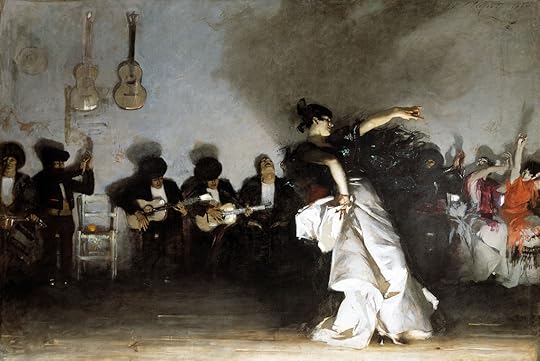
To spin out of this particular Sargent cannot have been an easy task for Hirshler, since very little is actually known about it in comparison with other of Sargent’s paintings, On the Boits there is no documentation left to us – no contract, no letters, no diaries, no photos, no descriptions or recollections from the owners and sitters, no sketches, no drawings. So, nothing can give us an indication of the most intriguing aspect, its genesis: who had the idea of going ahead with it? was it a commission and paid for, or an offering? And in particular who thought of the extraordinary composition? Other paintings, such as such as El Jaleo, or En route pour la pacha, have left us more indication of their births.


But we do know that it was painted very fast, in about one and a half months, which shows in the almost complete absence of pentimentos and in the thinner paint in parts of the background. We also know that it stayed with the family until later on when the daughters donated it to the Boston Fine Arts Museum in memory of their father.

With that scarcity of specific documentation what Hirshler does is embark on an excruciating and painstaking research on anything that has to do with the painting. She tracks the Boits-- the parents and individually the four girls--, their ancestors, their finances, their frequent travels, and their circles on both sides of the Atlantic at a time when it was cheaper to live in Paris than in Boston. Of course this is the world of the peripatetic Henry James and Edith Wharton, to mention just two of the considerable crowd of Americans living in Europe. James and Wharton actually met at a dinner at the Boits. We learn that Boit was also a painter and friends with Sargent so that they even organized a joint exhibition in 1912 in Boston, when both still stood on a not too different art podium. Sometimes I felt there was too much detail in Hirshler’s account, as in for example her tracing of the manufacturing site of the large Japanese vases, which surprisingly, have not been lost.


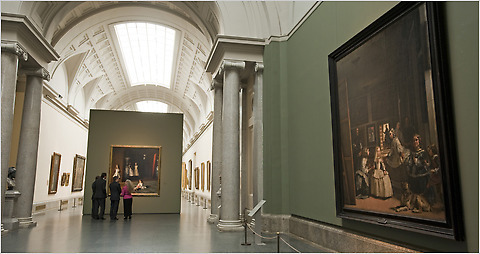
But she is very good in connecting the rich visual sources for Sargent’s conception with the most famous and often cited of Las Meninas, which Sargent copied during a visit to El Prado.


Even the literal translation of Velázquez’s work as 'Maids in Waiting' acquires an additional figurative meaning with the Boit girls. Apart from an art historical genealogy, Hirshler also places this painting as the culmination Sargent’s series of Venetian interiors, about eight of them, executed during the early 1880s and in which Sargent seemed to be digesting not only Venetian settings but also some of Degas way of framing the composition.

This read provided me with yet another visit to the art and cultural scene in Paris end of the 19C, area that does not seem to ever satiate me. This time it offered a closer look at the world of the art dealers and art schools --with Carolus-Duran and George Petit-- and without omitting the awkward relationship of Sargent to the French Impressionists. Degas acknowledged Sargent’s facility with the brush but thought that he was no artist; while Monet allowed him to paint next to him, and to portray him painting, in Giverny.


In the actual analysis of the painting, by tracing the history of its criticism, Hirshler shows how evaluations sometimes tell us more about the subject than the object described. What stands out though, in the way this painting has been received through time, is its perplexing ambiguity. Could it really be categorized as a portrait when the faces of the two eldest daughters can barely be seen? Or should we look at it as a ‘genre’ painting.

Towards the end her book, Hirshler provides us with a few chapters she has titled Afterlives: of the Boit couple, tracing their later somewhat less happy life; of the daughters, none of whom married and a couple of whom had health problems; but most interesting for me was the account of Sargent’s fame as it grew and demised in subsequent decades until revived in the later part of the 20C.

Hirshler then has achieved that at least for me, this painting will have a special place in my appreciation of Sargent’s work. It already captivated me during the Met exhibit. Now that I know its story, it has become so much more personal and memorable.


-----------

This edition does not provide illustrations of the many paintings mentioned, apart from the one in the title. I tried to keep track of them in my updates.
Profile Image for Lori.
386 reviews549 followers
March 1, 2020
I have long loved this painting. When I lived in Boston I would often walk to the MFA and spend time with it, and had a print of it over the mantle at home. This book is exactly what is promised, a biography of the painting. It encompasses the lives of the Boit family members; tells the story of what happened to each of the girls and their parents;, gives us context of where Sargent was developmentally and socially before and when he painted it; his relationship with the family; and provides reviews of, and evolving thoughts about, the painting. Hirshler's book is fascinating. It is as detailed as details are available. And it's also the tale of wealthy Americans involved with inner circles of the expat crowd in the late 1800s, including Henry James, as they lived in Paris and Tuscany, Boston, Brookline and Newport. It is a biography of the painting that is worthy of the painting, and I am very pleased with it.
Profile Image for Lorna.
1,068 reviews751 followers
December 30, 2020
Sargent's Daughters: The Biography of a Painting by Erica Hirshler was a beautiful book about one of the most acclaimed and recognized paintings by Frank Singer Sargent, The Daughters of Edward Darley Boit, now on permanent display at the Museum of Fine Arts in Boston, Massachusetts. It should be noted that the author, Erica Hirshler, is the Senior Curator of Paintings from the Americas at the Museum of Fine Arts. This renowned museum, as well as the Isabella Stewart Gardner Museum in Boston, are on my bucket list when I am able to travel to Boston.

This book explored the life of John Singer Sargent and his time spent in Paris and Italy, as well as his friendships with other expatriates living abroad at the turn of the century, particularly Henry James as well as Mr. and Mrs. Edward Darley Boit. This is also a biography of the many paintings of Frank Singer Sargent, particularly the stunning portrait of the four daughters of the Boits that has captivated all of us for over a hundred years. Clearly, The Daughters of Edward Darley Boit stands along with his immortal works, Madame X and Lady Agnew of Lochnaw. The beautiful color plates of the paintings explored are an integral part of this lovely little book.

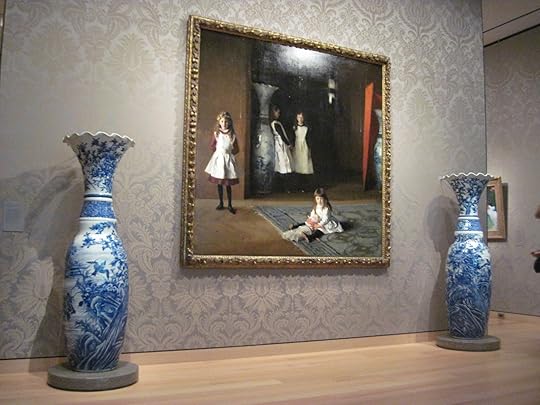
Sargent used the very authenticity of the large porcelain pots to create a sense of fantasy. He knew better than to depict every detail of these elaborately decorated vessels. Instead, he subdued their color, using a grayer blue than the rich dark cobalt of the originals, and abbreviated their motifs, only hinting at the birds and flowers that ornament every inch of their surfaces. Sargent was aware that if he rendered all of their decoration, the vases would take too prominent a role in his composition. By toning them back, he made them recede and allow the girls to come forward. Nevertheless, certain details--one bird in flight, the stylized rocks--can be identified in both ceramic and paint, proving that Sargent used the actual vases as models, not his imagination."

"Relics are by definition old, carefully preserved, vested with power. All these things are true of Sargent's painting. But the mystical potency of this canvas is not restricted to followers of one set of beliefs or another. The portrait has survived the analysis of art historians who believe in formalism as well as those who believe in Marxist theory, social context, psychoanalysis, and deconstruction. Viewers find the painting memorable and remarkable whether or not they have a background in art, in history, or in psychology; it speaks to them directly, even if they do not have sisters or daughters."

"Sargent's daughters resonate across the borders of time and nationality; they ignore the boundaries between youth and old age; they take us both outside and inside our own selves. . . . the girls in this magical, memorable picture still haunt our imagination."
Profile Image for Louise.
1,853 reviews387 followers
September 27, 2015

The painting was new and different when first shown at the Paris Salon of 1883 under the name “Portraits of Children”. It defied the norm in that the girls were not formally dressed or sweetly posed as was the period’s norm for childhood portraits.

Reviews were mixed. Most critics responded based on their acceptance (or rejection) of impressionism as a new style of painting and/or of Americans who seemed too visible in the established Parisian world of art. Today, Sargent is considered the leading portrait painter of his generation and this painting to be one of his masterpieces.

Author, Erica Hirshler, had little to work with since not much is known about the conception of the painting or the lives of the girls pictured.

She begins with the character of the Bois family, their wealth, their itinerant lifestyle and the birth and loss of their children. She describes Sargent and the art world that he and Edward Bois faced on two continents. There is discussion of the setting which is clearly their home and the Japanese vases that have crossed the Atlantic several times with the family. You learn about the painting and its reception. The end, which tells of the later lives of the girls and modern interpretations of the painting, was the highlight for me.

Sargent, known for bringing out the essence of his subjects, was on to something. That “something”, whatever it is, is the allure of the painting. The girls stand apart and alone. There is the suggestion that they have been interrupted while playing, but only one has a toy. The atmosphere is stark, but its opulence is suggested by the size of this hallway or foyer, the seemingly valuable vases and the immaculate “play” clothing of the girls, two of which are getting too old for pinafores. The painting’s title does not acknowledge their mother (deceased at the time of its final naming). It is hard to define the expressions of these girls, but the three who acknowledge the viewer seem to be either uncertain about him/her. Hirshler shows various schools of thought on these girls, their expressions and their later lives.

Quotes embedded in the text and in their own indented paragraphs account for, perhaps, ¼ of the book. There are quotes are from Edward Boit, himelf; Boit’s brother, Bob; Sargent’s friend Henry James; a host of critics and writers of the day such as Edith Wharton. They describe the luxurious life of Americans abroad, the Boit family and the opinions of the art world.

There are lots of visuals. Black and white photos of art work, people appear with the related text. There are two sections of color plates. One section of color plates is devoted to this painting with several plates showing detail. This book would have worked well in a larger size (coffee table) volume.

The index worked for everything I checked. The Notes confirm the reliance on primary sources.

It is hard to tell if the narrative is dry due to the lives of the subjects or the author's distance from them. There was admittedly little to work with, and what she found was patchy, but Erica Hirshler has provided some insight into this landmark painting.
Profile Image for Jill Meyer.
1,188 reviews122 followers
February 2, 2020
Erica Hirshler has written a masterful biography of a painting, its painter, and its subjects. The painter was John Singer Sargent, the painting was "The Daughters of Edward Darley Boit", and the subjects were the four daughters of amateur artist and American ex-pat, Edward "Ned" Boit and his wife, Isa.

The Boits were from a long line of Boston Brahmans of independent means. They left the United States for the culture of Europe, shortly after their marriage and birth of their first child, a son. The son was later placed in a sanitarium after losing his mind in the US. One other son, who died early, and four daughters followed. The four girls all reached adulthood, but never married. (Boit had two more sons when he remarried a second time following his first wife's death). Ned Boit and his family drifted from Paris to Rome and other towns in France, England, Switzerland, and Italy in the thirty or so years they lived abroad. During that time, Ned Boit studied painting and displayed his work, landscapes, in various exhibitions and he achieved some recognition as a fine artist. He was also a patron of other artists, the best known was John Singer Sargent.

Sargent, also an American by birth, met up with the Boit family in Paris and was asked to paint a portrait of the four daughters, who ranged in age from about 15 to seven. Because of his friendship with the girls' parents, Sargent felt free not to paint a conventional portrait of the girls. What he did paint was a large portrait of the four girls, one seen only from one side, two also shown in somewhat shaded style, and the fourth, shown full on. The painting, done in 1882, created a sensation when it was displayed in a Paris exhibition and has certainly generated attention ever since. It has been in the Boston Museum of Fine Arts for the past 100 or so years, along with the two huge Chinese vases, depicted with the girls.

John Singer Sargent is one of my favorite painters. His portraits are often compared to those painted by Velasquez, particularly Valesquez's paintings of the Spanish royal family in the mid-1600's. Whether Sargent, who painted 250 years after Velasquez, copied his style of subject placement, or merely was influenced by it, we'll never know.

Sargent went on to paint more society portraits in France, England, and the US. He painted individual portraits of Ned Boit and Isa Boit. His paintings have gone in and out of style since his death in 1925. Currently, they're back in style and Hirshler's book helps explain why.

If the reader is interested in learning more about John Singer Sargent, Deborah Davis wrote an excellent book, "Strapless, John Singer Sargent and the Fall of Madame X", which was published in 2003. A fictional account of "Madame X", by Gioia Diliberto, was published in 2004.

But if the reader learns about what happened to the painting and the painter, little is known about the Boit family after Ned Boit died in 1915. None of the four girls married - Hirshler wonders if perhaps bouncing back and forth between the US and Europe may have diminished their matrimonial prospects - and all lived fairly long lives in the US. Two were very good artists, themselves, but all four passed into history without leaving much of a record other than their portrayal in a very famous work of art.

Erica Hirshler is a good writer. Scholarly, yet lively. I recommend her book as a "picture beyond the portrait".
Profile Image for Gerald.
Author 64 books489 followers
November 17, 2016
[Cross posted from my review on LASplash.com "Sargent's Daughters: The One Percent of Yesteryear"]

Nonfiction books on art history by scholars tend to be dry, written to impress a rarified peer group and too often arguing about how many angels can dance on the head of a pin. Not so, this one. While Sargent’s Daughters: The Biography of a Painting is hardly a Victorian bodice-ripper, it has its intrigues and its fascinations. Author Erica E. Hirshler is Croll Senior Curator of Paintings, Art of the Americas, at the Museum of Fine Arts, Boston. Not coincidentally, this painting by John Singer Sargent is one of MFA’s most popular exhibits. So one might say it’s Hirshler’s job to be the foremost authority in the world about it, and with this book she’s taken the task seriously.
At first glance, The Daughters of Edward Darley Boit is remarkable in a number of ways. It shows four girls in an elegant drawing room – three of them standing and a toddler seated, cradling her doll. To today’s museum visitor, the poses might seem ordinary. Their expressions and body language are candid, as if they were caught by surprise in a snapshot. Except, in 1882 when this was painted, the snapshot hardly existed as a photographic technique, and certainly not for formal family portraits. Fine painters of Sargent’s era prided themselves on being able to render imagery photographers could only covet – including vibrant colors, accurate reproduction of sumptuous fabrics, and even meticulous draftsmanship such that the species of flowers in a vase could not be questioned. Highly paid portraitists – and Sargent was one of the most renowned – were skilled at not only finding the most attractive couture and poses for their wealthy subjects but also making them look prettier than they were.
As well, Sargent’s composition of the scene is odd, especially for the aesthetics of his time. The girls’ demeanor looks all the more natural because their placement in the room seems offhand and happenstance. In fact, there is more empty space than subject matter, prompting one critic of the time to describe the painting as “four corners and a void.”
So the viewer finds innocence surrounded by emptiness. Hmmmm.
As a personality, Sargent himself was somewhat opaque. Although viewers and patrons claimed to see subtleties of character and emotion in his paintings, he professed to no special insight. He regarded himself as a master craftsman and famously said he had no ability to see into the human soul. That is, he could only paint what he saw. In fact, art critic John Charles Van Dyke insisted Sargent was fanatical about realism. When the artist needed a marble column for a painting, he had a carpenter build one in his studio. Later, his jealous peers mocked him, teasing that he’d make an incredibly accurate picture of a wooden post painted white.
The most personal details Hirshler gives us about Sargent have to do with some of his experiences dealing with children as subjects. After sessions, he laughed, joked, and played games with some of them – exhibiting the childlike side of a man who no doubt presented a straight-laced persona to the adult world. But at least one of his young sitters complained of long hours enduring the tedium of his painstaking work, leaving her frustrated and angry – although she apparently continued to admire him.
You won’t come away from this book feeling you know Sargent much better. Apparently his contemporaries felt the same way. Never known as a carouser or a drinker, as were many of his colleagues, Sargent was a perfectionist workaholic.
The fascination in Hirshler’s historical account is the culture, milieu, and personal drama of the Boit family. Wealthy Bostonians whose inheritance came from the shipping industry, the Boits were friends of the artist, who by this time was comfortable among aristocrats on both sides of the Atlantic. As Sargent did, the Boits moved their entire household from time to time from one cultured city to another, between New England and glamorous addresses in Europe. Although Mrs. Boit’s health was a factor, it seems decisions to move had less to do with necessity than a desire for change of scenery. The father was an accomplished watercolorist with serious professional intentions. Although he exhibited and was discussed among the cognoscenti, he never won much of a reputation. It’s not clear that he tried all that seriously. Edward probably regarded himself as an exceptionally skilled hobbyist rather than a mediocre professional.
I first saw The Daughters of Edward Darley Boit not long ago on a business trip to Boston. I toured the MFA with some friends, who are artists in their own right. They were eager to show me the painting. They also made sure we stopped in the bookstore to grab a copy of Sargent’s Daughters. The museum has the painting on a wall by itself, flanked by the actual Oriental vases from the scene. Notably, Sargent did not render the bird pattern of the ceramics in full detail. Somehow he understood – restraining his realist inclinations – that too much artifice would detract from his subjects. Similarly, rather than take painstaking care with the fabrics of the girls’ dresses, he sketched them in hasty brushstrokes. This masterful but only suggestive technique was typical of Impressionist painting but was frowned upon by Sargent’s traditionalist peers. So, considering its departure from classical technique as well as its innovative composition, this painting is more forward-looking, more revolutionary, than perhaps any other work Sargent produced. It’s almost as if, this time, he decided to paint one just for himself.
Hirshler traces the fates not only of the parents but also of each daughter, through the years. We get the same ominous sensation that lingers from the descriptions of aristocratic life in novels of Henry James and Edith Wharton. With immense wealth came sobering responsibility and privilege – but not necessarily any happiness.
These days, we fret about unfairness, about the overweening influence of the One Percent. But, as these stories from yesteryear remind us, you can’t take it with you. J. P. Morgan founded a bank that these days doesn’t even bother to use his name in its branding.
Gerald Everett Jones is the author of the recent historical novel Bonfire of the Vanderbilts and host of GetPublished! Radio.
Profile Image for Emma.
310 reviews
August 21, 2014
I never thought a book about a painting would be so engaging, but this book is awesome! I should have figured since it is about my second favorite painting (and has a little section about my favorite one). I loved learning all about John Singer Sargent and about the girls in the painting. It is definitely worth reading for those who love this painting.
Profile Image for le chat gris.
146 reviews4 followers
August 2, 2022
Many has been the time over the years at my local art museum that the paintings of John Singer Sargent were displayed with various other pieces for a particular exhibition. Par for the course, only a small plaque accompanied each painting, so when this book was suggested by my Goodreads feed, I added it to my TBR list immediately. How neat to read an entire biography of a painting!

This painting--which has gone by several different names-- helped establish Sargent's reputation as an unconventional artist, mostly in Europe. As charming as it might seem to observers of the 21st century, the painting divided art critics, particularly in the late 1800's to early 1900's. Nothing like it had been seen before, especially within the portrait genre. Instead of just a portrait of four girls, it is a composition of light and dark contrasts within a starkly furnished room and the girls seem disengaged from each other as they are dispersed across the space. One of these sisters doesn't even look at anybody. Some "experts" have even tried to psychoanalyze the girls, since each of them seem a bit odd. Portraits in that era were expected to be winsome and charming, but this one left a lot of viewers put off by its rawness or found it disturbing.

The goal of the author was to "investigate and bring to life the story of the artist, his patrons, his sitters, and relate what happened to all of them after the portrait was finished". For the most part, Ms. Hirshler achieved her purpose, although I didn't feel I learned much about Sargent himself, other than his travels to learn about art in Europe and mentions of other paintings done by him. Much more was learned of the Boit family, i.e., Edward, the father, an artist himself, his wife, his four daughters who posed for the portrait, as well as European and expatriate American society in Paris and art in general during that period. However, at times, almost TOO much information bogged the book down and I found myself starting to skim over the excessive details. Some details were repetitive. Overall, an interesting read. Beautiful color plates of paintings as well as black and white paintings and drawings were included for reference.

3.5 stars.
Profile Image for Dana M.
273 reviews4 followers
May 22, 2020
Alright, MFA lovers: do you ever walk past John Singer Sargent’s painting of the four sisters in their Parisian apartment and feel like you just 👏 can’t 👏 stop 👏 staring👏? The painting is called “The Daughters of Edward Darley Boit” and I’ve loved this painting since I was old enough to wander the MFA on my own. My favorite pieces of this book give a detailed history of these sisters’ lives over the next 40-60 years (after the painting was commissioned). None of them got married (which was relatively rare for American women in the 1880s), and they split their time between Boston and Paris doing all sorts of cool projects / athletics/ crafts / arts/ etc. This was so good. Parts are dense with art analysis etc, which I tended to skim (I read this primarily for historical context and to better understand Boston’s Boit family). I wish I could have met all four of these cool women!
Profile Image for Ashley Owens.
251 reviews2 followers
March 24, 2022
It does a great job of telling the story of the painting but it was dragged out. More biography than I’d bargained for, but I didn’t need to know the critical reception of every painting Boit or Sargent painted within the established time period. I wish there was a bit more art historical analysis but the author did a really good job at what they set out to do.
Profile Image for Edith.
528 reviews
September 14, 2021
The book is exactly what the title describes--not a biography of Sargent or of the Boit sisters (though it contains a lot biographical information about them and their family), but truly a biography of a painting. Who were the sitters and what was their milieu, what was their relationship to the artist, what was the artist's experience, what was the afterlife of sitters, artist, and painting--these are the questions that are dealt with in this beautifully and abundantly illustrated volume. Clear, accessible language. A pleasure to read. I wish we could have a book such as this for all great paintings.
217 reviews
July 30, 2025
The Daughters of Edward Darley Boit by John Singer Sargent is one of the most beloved paintings in this collection of the Boston Museum of Fine Arts.  Curator Erica Hirshler writes a biography of the painting that explores the history of the work, its creators, its subjects, and a whole lot more.  In 1882, Florence (14), Jane (12), Mary Louisa (8) and Julia (4) posed for Sargent in this unusual composition that has the girls arranged around open space and giant vases in the foyer of the Boits' apartment in Paris.  Hirshler notes that the painting may draw inspiration Diego Velázquez's Las Meninas and for Sargent it would've been an opportunity to demonstrate his skill in painting the white of the girls' pinafores in various lighting.  Regardless, it is unusual for a portraiture of the time that has left room for various interpretations from "children at play" to deeper psychological messages (which say more about the viewers and their time than the actual Boit daughters).

Unfortunately, there is limited information about the painting's creation.  There's no record of whether the Boits commissioned the painting or it was Sargent's proposal.  Unusually, Sargent kept no records or sketches from the time he was creating this painting.  The recollections of the four girls are also limited.  It's unknown if they sat for the painting on sight or if they posed at Sargent's studio, together or separately (some critics believe the painting is four different portraits). The painting proved to be a turning point in Sargent's career helping him emerge as a major artist of his time

Edward Darley Boit was an American watercolorist who was considered a minor artists of his time but his friendship with Sargent allowed for them to have a shared exhibition later in their careers.  He married Mary Louisa Cushing who was related to many prominent Boston families including the Cushings, Perkins, and Higginsons.  The current name of the painting was given after her death and when Edward had remarried which is why Hirshler believes she's not acknowledged in the title. Together with their children they lived a largely expatriate life in Paris, but also several periods of time in Boston and Newport.

No letters or diaries of the Boits exist from the time of the painting.  Hirshler's main resource is the diaries of Edward's brother Robert "Bob" Boit.  Hirshler also refers to the writings of Henry James, who was friends with the Boits and Sargent, and to the experiences of other expatriate Americans in Paris for an understanding of what life may have been like for the Boit daughters.  The later life of Florence, Jane, Mary Louisa, and Julia makes up the latter part of the book.  None of them ever married which has lead to speculation that they lead unhappily lives, especially Jane who is known to have mental health problems.  Hirshler counters this with the example that many women of that time, especially among wealthy Bostonians, pursued independent lives outside of marriage and shows examples of how each of the Boit daughters succeeded on their own terms.

Favorite Passages:
Sargent had gained experience with painting children before he rendered the Boit girls; in fact, of all the early portraits he made that might be counted as commissions, fully one-third of them depict young sitters. Like any artist at the beginning of his career, he would have been glad to receive genuine orders for portraits, and in response he created engaging likenesses that often reveal the lively personalities of his subjects.

Sargent may have been inspired to paint the four girls in this way after actually seeing them playing in their apartment; one envisions them active, laughing, dancing in and out of the shadows. Perhaps he joined them in their horseplay, as he had done with Marie-Louise three years before: one imagines him then suddenly struck by the artistic possibilities of the moment, stopping, taking charge, and asking the girls to move in, out, and around the room until he found a pleasing arrangement, a haunting and powerful composition. The record he made of the hall and its furnishings is truthful, but the setting was severely edited by Sargent’s discerning eye. One of the most striking things about the canvas is its austerity; aside from the girls and the vases, the scene seems empty. In this way it is not a precise reflection of the family, for the Boits enjoyed a comfortable life packed with friends and belongings.

The large blue-and-white vases remained treasured possessions of the Boits. When Ned commissioned a house in Brookline from the Boston architects Peabody and Stearns in 1903, the front hall was designed to accommodate them. There they stayed until the 1980s, their miscellaneous contents a document of mischief and the passage of time. When they first traveled to the Museum of Fine Arts for display in 1986, they contained - among handfuls of the excelsior with which they had been so carefully packed - a cigar stub, a paper airplane, a pink ribbon, a tennis ball, sheets of geography lessons, a letter about the repeal of Prohibition, an Arrow shirt collar, an old doughnut, an admission card to a dance at the Eastern Yacht Club in Marblehead, Massachusetts, three badminton shuttlecocks, many coins, and a feather. The vases now stand in the museum’s gallery near the painting, mute witnesses to lost time.

there are many other examples by avant-garde French painters - Degas, Manet, Monet, Bazille - seeking to redefine the portrait. They experimented with unusual settings and poses, with lighting effects and angles, creating disjunctions and ambiguities that expressed the new tensions of life. Sargent’s painting, with its emptiness, unusual disposition of figures, and deliberate lack of a relationship between the girls, also vibrates with this distinctly modern unease. In 1885, Vernon Lee would call this quality in Sargent’s work a “crispation de nerfs,” a nervous anxiety, a certain high-strung apprehension that she found in many of his depictions

Dressing alike is a common conceit among siblings, but the Boits’ costumes are unusual for their informality. While most girls would have worn their best outfits to pose for a portrait, the Boits are shown in simple everyday clothes - dark dresses and stockings, sturdy shoes, and stiff white pinafores that would have protected the clothing underneath.... Plain and casual, the dresses reinforce the quotidian nature of the setting. One suspects that the choice of costume was made by Sargent (records document many instances of this artist telling his sitters what to wear) - not only to reinforce the informality of his subject but also to demonstrate, in the pinafores, his remarkable abilities as a painter of white on white. It is in the whites that the painting comes alive, with a dazzling display of brushwork that both defines the forms of stiff skirts and wide sashes and stands apart from them, recording the deft action of the artist’s touch.

Were the Boit girls unusual for never having married? Their single status was not as extraordinary as one might expect, for by the 1870s and 1880s, there were more unmarried women in the United States than there had ever been before. This was not just a result of the enormous number of male casualties during the Civil War, but a deliberate choice that had become more and more economically viable.

This writer’s assessment of Sargent’s painting raised familiar issues - its unconventional composition, its unusual interpretation of portraiture, its relationship to the old masters - but it also introduced a new theme, one of longevity and artistic appeal. The picture had aged well; it was “better than ever.” Now Sargent’s portrait could be seen to have transcended the circumstances of its creation, for it had become an image that engaged and enchanted viewers who had never known the sitters. The painting was suitable for hanging in a museum; it had become a “masterpiece” for the ages.

Perhaps our desire to credit Sargent with great psychological insight is still simply a continued reaction against interpreting him as a painter of surfaces. It can also justify our own pleasure in those surfaces, ensuring that our attraction is perceived as a serious and intellectual pursuit rather than as (merely?) a pleasurable and sensual one. Must the painting be more important to us if it speaks of science in addition to art? The need of our own time to psychoanalyze and to personalize, to view things only in relation to ourselves, may also be significant here. Our evident hunger to create content in Sargent’s painting - psychological, narrative, or otherwise - may also reflect how far removed from our own lives any artistic and aesthetic concerns have become.
Profile Image for Kate.
341 reviews
June 2, 2015
What a delicious read for any johnsingersargentophile-- and indeed for any artlover. I don't think I've ever read another such "biography of a painting," which tells about the people and circumstances surrounding its creation, its subsequent travels through exhibits and galleries-- and then the "what happened next" in the lives of its subjects.
Like nearly everyone who's fallen in love with the enigmatic daughters of Edward Darley Boit, I always had a sense that I understood them in an especially intuitive way. This book pointed me toward some of the artistic challenges that Sargent took on with this painting, and to a wide variety of other intuitive responses quite different from mine (but equally firmly believed.) The Boit family's artistic expatriate life and the daughters' adult lives fed my biographical cravings.
Profile Image for Rachel.
465 reviews
September 21, 2010
I have always loved Sargent's paintings, especially the Daughters of Edward Boit, so I was a bit fearful that the book would take away from the work itself. Instead I was pleasantly surprised by the backstory of the family and the artist, the many social connections among artists of the day, and the glimpse back in time at Paris, Boston, and Newport. In fact, I found myself questioning how I ever ended up in Asian art when the American impressionists were so much closer to home. Ah... maybe in my next life...
Profile Image for Marcia.
328 reviews3 followers
March 26, 2010
I was disappointed in this book, thinking it was a biography of the Boit family. The first half, rather dull, discussed John Singer Sargeant, his paintings and those of his contemporaries. The first half read like a text book; the second half finally discussed the Boit family and as much information as is known about the four girls in the portrait as well as the history of the location of the portrait (of which there were many).
Profile Image for Karen.
378 reviews
September 9, 2015
The subject of this book is one of my favorite paintings, and having just re-visited it at the Museum of Fine Arts, I thought it would be a good time to learn more about it. I liked the way the book is structured and the evenhanded way the author presents the varying interpretations of, and reactions to, this work of art. The chapter on the grown-up lives of the Boit daughters was particularly interesting.
Profile Image for Jesse Richards.
Author 4 books14 followers
September 11, 2017
Interesting, and a lot of great stuff in here, but there's a middle part that trudges through too much detailed history of the Boit family. When this book is a "Biography of a painting", as it claims, it's good; when it's a biography of the Boits, not as much.

Note: perhaps my favorite thing I learned was that Julia (the youngest daughter) grew up to be a talented painter herself.
Profile Image for Luke.
74 reviews3 followers
October 17, 2023
I first learned about this painting while researching Las Meninas by Velazquez, several years ago. Las Meninas is a landmark work of art for good reason; its realism and unconventionally arranged conviction is attention-grabbing and difficult to forget. When I subsequently laid eyes on this painting, the influence was obvious (and, indeed, as Hirshler details, Sargent made a copy of Las Meninas shortly before working on Daughters) and somehow even more captivating. While Velazquez's work still remains squarely a portrait of a child and her surrounding entourage, Sargent's painting is much more immediately unnerving. Both paintings invite you in, practically placing you in the scene with the sitters, with the subjects gazing straight out at you. But while Las Meninas has the infanta presented for the viewer (albeit still being attended to), much like in a traditional portrait, the seemingly impromptu intimacy of Daughters almost makes you feel like something is expected of *you*, like I just opened the door, interrupting the girls, and then they are expecting me to take the next action. They were not expecting visitors at the moment you walked in.

So many other paintings feel like looking at something or someone. But this is one of the few that really puts me in the scene. It might be my favorite painting I've ever seen.

On my recent trip back up through Boston, on whim, I went to the MFA. It had been a few years since I'd thought about this painting or Las Meninas. While looking through a list of paintings I could visit in the couple hours I had to spare, I saw the striking image of the Four Daughters once again. I had forgotten it was in Boston. Oh my God, I had to go see it in person. How lucky!

I spent about 20 minutes looking at it from different angles. It's huge, and up close it's even more mysterious. Parts that stood out in person: The background is extremely dark. The red crescent under Isa's neck is so bold and vivid. The leaning pose of Florence is really unnatural looking, but still pleasing with the marching curves like puzzle pieces. Even better, it was displayed beside the same exact vases depicted in the painting. Inviting and yet still mysterious, my feelings about the painting were reinforced by my visit, though with a tinge of frustration that I still couldn't seem to penetrate what the hell was going on here. I would have stayed longer if I could!

Then I went and bought this book at the shop on the way out because why not.

The book was pretty good. As far as context of the painting goes: the biography of the artist, the Boit daughters and their family it does a pretty good job. There's frustratingly little documentation on the lives of most characters involved here, but through circumstantial knowledge, Hirshler pieces together a story quite admirably. My main gripe was I would have liked a more in depth discussion of the painting itself. The technical aspects, more discussion of the possible interpretations, of which there were few. Basically I wanted an artist's study of the painting more than an art historian's.

Probably the most enlightening things I learned about the painting was about the vases. I think I've always focused on the girls' expressions, because it's hard not to. The vases seemed more like window dressing, especially with one of them off on the side behind the red screen. But it was interesting to learn how they were essentially kitchy Japanese-made vases meant for rich tourists. And when the Boit family donated the vases to the museum, they were filled with basically trash, them acting as wastebins from years of presence in a house with children. This helped ground the painting a bit for me. They are not really priceless antiques inexplicably placed in that room, waiting to be knocked over by a careless movement from one of the girls, but rather they're more like strong signifiers of the fashionable yet displaced lives the Boit's lived. I agree with Hirshler that people inject too much hindsight into the foreboding interpretations of the painting, things that Sargent could never have predicted. Rather, it's all right there on the canvas.

I enjoyed reading it on the plane ride home. 3 stars.
Profile Image for Norman Birnbach.
Author 3 books29 followers
August 15, 2023
Every time I go Boston's Museum of Fine Arts (MFA), I try to check out the painting currently known as the Daughters of Edward Boit. (It had a couple of titles before it finally landed on this.) It's large and dark and you can see two huge Japanese vases and when you look at it in its setting, you can see the actual vases on either side of the painting. Even more astounding is that the family shipped the vases and the painting itself (once it was completed) from Paris back to Boston and then back to Paris. But what's fascinating are the four daughters, who are posed in a very modern way.

This book does a great job of telling the history of the painting and the Boit members, both in this painting and in others that John Singer Sargent painted. Hirshler provides the context of the painting, of the art world at the time and even the art world after all those involved had died. Sargent was highly thought of during his lifetime but, after his death, was considered a society painter, and his reputation declined. Now, his reputation has risen about though he's not necessarily considered to be in a class of top American painters.

The one sad thing that the book can't help is that the lives of the Boit daughters were not as interesting as one might expect.

Still, the painting remains fascinating to many.
Profile Image for Alarie.
Author 13 books92 followers
June 27, 2017
If only the book had followed the title and focused primarily on painter John Singer Sargent. The author tells us about the painting of Sargent’s important canvas owned by the Boston Museum of Fine Arts, The Daughters of Edward Darley Boit (shown on the book jacket). Like Sargent, Boit was an expat painter living in Paris in the 1880s, where he became friends with Sargent and with the famed novelist Henry James. We are then swept into the full-life stories of all the Boits, a glimpse into the lifestyle of the wealthy. Unfortunately, the parts about Sargent and his art are by far the most interesting parts of the book.

It turns out that Boit, a fairly lackluster watercolorist in my eyes, got much better in his later years. When I Googled his art, I found paintings I liked a great deal, but those weren’t the ones Hirshler included. However, there are a good many interesting reproductions and photos in this edition. I particularly liked a side-by-side comparison between a photo of one of the six-foot oriental vases used in the painting and a detail from the painting. We see how Sargent caught the vase’s essence in a realistic style yet left out much of the detail so the vase wouldn’t be the focal point.
Profile Image for Helen.
199 reviews4 followers
August 4, 2023
Kalliope’s review says it all. I enjoyed learning about the painting’s historical and cultural background and the lives of its subjects and their family. One criticism: the author seems uncomfortable writing about Florie’s lack of interest in men or marriage. The first time she mentions the topic she says that was unusual for women of that time, but later she says there were actually a number of women of her class who did not marry and that a significant number also were in “Boston marriages,” code for lesbian relationships. The narrative would have been stronger in my opinion if instead of dancing around the reasons she had just come out and said Florie might have been a lesbian. Which would have been no more unusual then than now. I wonder also whether the author might have named anxiety and depression as likely for Jeanie and others of her class who were sent for similar treatments. Certainly a discussion of possible psychological conditions would have been beyond the scope of this book, but the account of Jeanie’s condition made me wonder whether anxiety and depression might have been nearly as common in the Boit children’s time as today.
332 reviews
December 30, 2024
Sargent's Daughters is a beautiful little book with lovely color plates and illustrations. The book takes a deep look at the famous painting of artist Edward Darley Boit's four girls seemingly randomly positioned in a nearly empty space, a very odd way to paint a portrait of children indeed. Their lack of connection with each other has drummed up a lot of controversy about just why they were posed thus. Even so, the painting is beautiful.

We learn about the background and lifestyle of John Singer Sargent, the painting's creator, and about Europe and America in the late 19th/early 20th centuries, largely how the complex art world worked among then current international affairs. Other Sargent paintings and portraits are discussed, illustrated, and compared. I was delighted to see some examples of Boit's work, outstanding watercolors which seem to have been forgotten. A great book to read if you like more detail, an origin story or at least a speculation, about a rather familiar work of art.
106 reviews9 followers
August 28, 2023
Interesting enough background about this painting of the four daughters of Edward Darley Boit and Mary Louisa Cushing. The Boits were born into wealth, were into “Society” and chose to spend most of their time overseas – leaving their first born mentally impaired son institutionalized back in the states.

Book provides more info about the parents than the actual subjects of the painting. The Boits apparently gave Sargent freedom in delivering a portrait that wasn’t typical. None of the girls were famous or kept a journal – so the sketchy info on them came from other sources, and those were sparse. Profuse illustrations aided in understanding Sargent’s influences and the Boit’s lavish lifestyle.
Profile Image for Lighthouse.
67 reviews
June 23, 2023
The painting The Daughters of Edward Darley Boit was, at first sight, not so significant to me. Even after a pleasant short read about how the painting came to be, how it lasted throughout the years and how the girls depicted grew up to be women, I only had a slight increase in interest in it. The story behind the people was quite fractured, which made the book a bit hard to read. The book did a decent job in providing all the details necessary for a biography of a painting, not enough for a successful non-fiction story. The most memorable parts of the book were the pictures of other Sargent paintings printed on art papers in the inserts.
57 reviews
March 17, 2019
Learned a lot from this well written about Sargent, the Boit family, and the painting of the 4 daughters. The authors did a nice job of teasing out details from limited available sources.

One quibble was that many of Sargent’s other art pieces and the works of other artists are mentioned in the book, but the only painting provided in an appendix is the subject painting of the Boit daughters. I found myself reading with my iPad and googling artworks as they came up - doing the work the writer should have done for us.
Profile Image for Andrea Engle.
2,066 reviews61 followers
July 29, 2021
A unique and interesting approach to the art history of a single painting, in this case John Singer Sargent’s “The Daughters of Edward Darley Boit.” … deals with Sargent’s history, the actual painting of the canvas, the biography of the sisters and their parents, a critical history of the work, and other “biographical” items … it would be interesting to have other masterworks dealt with in this manner …
556 reviews
August 19, 2017
Always admired this painting at the Museum of Fine Arts in Boston. Read this for an Art book club. Was interesting to learn about the famous ex-pat painter John singer Sargent and the young Boit sisters he'd painted in that iconic portrait. However, lost steam after my initial thrill and trudged through the remainder.
Profile Image for Caro.
1,521 reviews
October 30, 2021
Read this in conjunction with our trip to Boston and the MFA. Sargent remains a bit of a mysterious character, but Hirshler has delved into the lives of the four girls and their circle and provided a richly detailed portrait of life in the James/Wharton era and beyond. Good preparation for our visit. 3.5
Profile Image for Pat.
779 reviews
April 29, 2023
I saw the painting and fell in love with it- so how could I resist a book written about just the painting? It was a bit dry and should have been filled with more painting reproductions. why show paintings in black and white? (yes, I know cost but then maybe a link to all images mentioned in the book)

what would be diagnoses for the Boit women today?
170 reviews4 followers
October 8, 2023
The parts of the book that describe the girls in the picture and Sargent's career were very engaging and interesting. There was a lot about their father Ned Boit that I did not find as interesting. It left me with many intriguing questions about the girls' lives, of which there is little record. Great history of a painting that I love. A worthwhile read.
Displaying 1 - 30 of 78 reviews

Can't find what you're looking for?

Get help and learn more about the design.