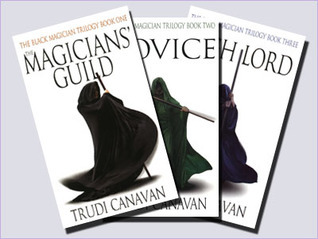
Book 1 of the Black Magician Trilogy Each year, the magicians of Imardin gather together to purge the city streets of vagrants and miscreants. Masters of the disciplines of magic, they know that no ordinary lowlife can oppose them. But their protective shield is not as imprenetrable as they think. The Guild's worst fear has been realised. There is an untrained magician loose in Imardin who must be found before her uncontrolled powers can destroy herself and the city.
Book 2 of the Black Magician Trilogy Sonea knows the other novices in the Magicians' Guild all come from powerful families, but she also knows she can turn to Rothen and Dannyl for help when she needs it. That is, until someone starts spreading malicious rumours about her - and Akkarin, The High Lord, steps in. Promoted to Guild Ambassador, Lord Dannyl leaves for the Elyne court. His first order from Administrator Lorlen is to resume, in secret, High Lord Akkarin's long-abandoned research into ancient magical knowledge. Not knowing the true reason for his journey, Dannyl is soon facing unexpected dangers.
Book 3 of the Black Magician Trilogy In the city of Imardin, where those who wield magic wield power, a young street-girl, adopted by the Magician's Guild, finds herself at the centre of a terrible plot that may destroy the entire world ... Sonea has learned much at the magicians' guild and the other novices now treat her with a grudging respect. But she cannot forget what she witnessed in the High Lord's underground room - or his warning that the realm's ancient enemy is growing in power once more. As Sonea learns more, she begins to doubt her guildmaster's word. Could the truth really be as terrifying as Akkarin claims, or is he trying to trick her into assisting in some unspeakably dark scheme?
Trudi Canavan was born in Kew, Melbourne, and grew up in Ferntree Gully, a suburb at the foothills of the Dandenongs.
In 1999 she won the Aurealis Award for Best Fantasy Short Story with “Whispers of the Mist Children”. In the same year she was granted a writers residency at Varuna Writers’ Centre in Katoomba, New South Wales.
In November 2001, The Magicians’ Guild was first published in Australia. The second book of the trilogy, The Novice, was published in June 2002 and was nominated for the Aurealis Award for Best Fantasy Novel. The third book The High Lord was released in January 2003 and was nominated for the Best Novel Ditmar category. All three books entered Australian top ten SF bestseller lists.
The Black Magician Trilogy reached the international market in 2004, published by HarperCollins’ EOS imprint in North America and Orbit Books in the UK. The trilogy is now rated by Nielsen BookScan as the most successful debut fantasy series of the last 10 years.
Trudi’s second trilogy, Age of the Five, has also enjoyed bestselling success. Priestess of the White reached No.3 in the Sunday Times hardback fiction bestseller list, staying in the top ten for six weeks.
In early 2006 Trudi signed a seven-figure contract with Orbit to write the prequel and sequel to the Black Magician Trilogy. The prequel, The Magician’s Apprentice was released in 2009 and won the Best Fantasy Novel category of the Aurealis Awards.
This is going to be a looooooooong review. First, I must say that had I read this trilogy as a teenager, I’d probably have loved it. However, being a literature scholar and well, slightly older, I can’t overlook its flaws, and I am infuriated by the fact that most of them to me, are due to a poor editing job.
For example: - two many pages in book 2 and 3 are devoted to summarizing the previous book(s). WHO buys the 2nd or 3rd installment in a series without having read the previous ones? An editor should have cut those passages - the books are sometimes VERY repetitive, mainly when characters have to explain to one another something we, as readers, already know. For example, Akkarin’s hearing in book 3 is the exact same story than the one he told Sonea at the beginning of the book. - too many subplots lead NOWHERE. You can simply skip them. For example, all of Dannyl’s passages. ALL - OF - THEM. Don’t get me wrong, I loved this character, but I kept on hoping that something would come out of his travels, or his acknowledging he’s gay. Well, no. And it would have been easy to tie to the main plot, for example in book 3, he could have suggested continuing looking for rogue guilds and convince them to fight alongside the Guild, maybe in exchange for more tolerance regarding their "unnatural habits" (and then the gay rights subplot would also have been tied to the main frame). His passages are a HUGE waste of space in book 2, that could have focused on useful things. - Same for the “Rothen will learn to be a spy” subplot in book 3. It doesn’t tell us anything more about Rothen, nor does it move the plot forward. - Ceryni’s girlfriend is ENTIRELY USELESS. She serves no purpose, had no influence on either the story or the characters, and has no reason to be in this story. And yes, sometimes a character can’t tell their motives or backstory right away (Akkarin for example) but at some point, THEY MUST, to have an interest in the story. Keeping a character tagging along for the sake of it should have been pointed as a mistake by a publishing team. - Pacing problems: large parts of the books just drag on and on and on, without adding anything further to either plot or characterization. For example, Sonea’s hide and seek game in book 1, takes HALF THE BOOK. Seriously, scratch off 100 pages. We need some of those chapters, to understand the Thieves, how they operate, the Thieve’s Road, and some characterization, but it really becomes repetitive at some point. Same thing with the bullying in book 2. Yes we get it, she’s being bullied and is too afraid to hurt them to unleash her magic. We don’t need then again 200 pages of her playing hide and seek with her classmates.
Why does it matter? True, it is still pleasant to read. So why should an editor have said “these passages should be cut”?
Simply because the story has to fit in 3 tomes and sadly those poor choices meant that some things that should have been better developed were rushed. There's too much that needs to be addressed in book 3, hence the many reviews saying that it's fast paced and filled with action, yes, but everything is dealt with very superfluously.
Mainly, Akkarin, and the Akkarin/Sonea relationship. - Akkarin remains purely unidimensional for more than 2 books.
* SPOILERS FROM NOW ON *
* YE BE WARNED ! *
* LAST WARNING !*
* STILL THERE?*
Ok then ....
It IS problematic because it makes the love story highly unbelievable. Sonea spends two years fearing and hating that man, granted, because she didn’t know his motives, but then suddenly falls in love within a fortnight. And this comes out of nowhere, as before she questions her feelings for him (book 3 part 2 literally HALFWAY throughout the LAST book!), we have no indication nowhere else that she feels anything for him. To me, book 2 here wasted a LOT of opportunities to develop their relationship. Akkarin imposés her to dine with him once a week. We SHOULD HAVE SEEN some interaction between them, maybe some conflicting feelings emerge in Sonea. Not necessarily love per say, but something that would have made her doubt he was truly evil, something that would have paved the way for her love for him. Instead it felt like she suddenly realizes he's not a reptilian and "a girl got needs", and whenever he touches her it's suddenly hellfire in her panties and lots of blushing and sighing and swooning ... jeez.
It was also important to flesh out the character of Akkarin a bit better, as before we learn that he loves / desires Sonea, we had no indication that he considered her as anything more than a hostage, or a pupil. Before she kills the spy and for the first time he touches her, there is no intimacy between them, there is nothing but a purely teacher / student relationship. Which makes their love story slightly yiiirk. Not only is he older, but he is an authority figure. The part when they’re in exile serves no other purpose than putting those 2 together, so more chapters should have been devoted to establishing a new ground for their relationship, to show that they’re on a more equal footing. It DOES always help a story to have more fully fleshed characters. It is not a waste of time to focus on their development. Focusing on useless characters and subplots is.
- The end is problematic too. Ok the writer wanted to have Akkarin die, that’s HER story. However this death was EGREGIOUS. You just CANT say there’s a solution, and then 3 pages later have your character die because they simply didn’t use it. It is BAD WRITING. Moreover, WTF are all the other characters doing? Why is nobody fucking helping? And I usually don’t mind not having the happy ending (even if I’m a sucker for it), but I hate when the death of a character makes no sense within the frame of the story. Not to mention it is highly incoherent with the character of Sonea. That she would rather take energy from her dying significant other rather than a building makes no sense whatsoever. I mean, WHO in their right mind would choose a BUILDING OVER THEIR LOVED ONE? Any reading team in a publishing house should have pointed this out.
And that is what infuriates me. Because this story could have been much better than what it is, if some different choices had been made. I would therefore have cut the trilogy differently, as, when you think of it, nothing much happens in books 1 and 2, and too much is rushed in book 3. To me, book 1 should have ended when Akkarin claimed Sonea's guardianship, because it doesn't matter if he is a "cardboard villain" in book 1. But more space was needed in book 2 to develop their relationship and his character through it, as we never have his POV. I rolled my eyes so hard when book 3 opens telling us a YEAR has passed between books 2 and 3, and Sonea's feelings towards Akkarin haven't changed AT ALL despite dining with him once a week. I mean, how plausible is that? And what a waste of opportunities regarding characterization. I'd probably have ended book 2 when we discover his secret, or perhaps when Sonea decides to help. More time in book 3 to reset their relationship on a more equal footing then.
Anywaaaaaay ...
I’m not sure of course whether the publishing house suggested some of those changes to Trudi Canavan and she disregarded them, or if the editor simply did a poor job, but as a result, I feel like I read the 1st draft of the trilogy, not the finished product.
I have picked up this trilogy and "Age of the Five" trilogy by the same author as a bit of light summer reading, since I love good fantasy, and this was recommended as such. I have since regretted the wasted money and time.
tl;dr - do not bother with these books, and probably not with the author overall - not unless you like reading about brainless, willpower-less, useless females who tend to lust after their older teacher/instructor figures. Based on the fact that there are at least 6 books by this author with this motif, I'd say she has a fetish for this and writes out her own fantasies.
My main problem with the trilogy overall, is that the main female lead is not acting intelligently, not standing up for herself, and despite being magically gifted, spends most of the time being useless. There are a lot of male authority figures in the book, and while I love reading about well-written characters of either gender, when the main character is a female that essentially goes along with the flow and does what a bunch of older men say, and does not think for herself, it gets boring really quickly. In addition, there is a lot of 'filler' - random things which happen which do not affect the outcome of anything, and chapters and chapters of what should be Chekhov's guns, but appear to be just wall decorations: it is as if the author wanted the books to be longer than they are, and put in random ramblings.
The plot is weak and formulaic, and the storytelling is not compelling.
I do not recommend either this trilogy, or "Age of the Five" trilogy by this author. In fact, I do not think I will bother reading anything by her after these 6 books.
The story itself was good, however there's too much rambling on about nothing and most parts are totally unimportant to the story. Sometimes I only read two or three sentences per page and I still got the overall meaning (as I said, the idea of the story is quite OK). Wouldn't bother to read it again though.
This series was, in my opinion, lazy. The so-called "twists" were easy to anticipate, the writing style was boring, the descriptive text minimally descriptive. Easy reading for younger readers if you think they can handle a thin smear of violence.
Characters are so poorly written, they do suicidally stupid things. Action scenes are well written, but the flow is bad, introduction is bad, and characters are really fucking bad. Could not read to the end, 2/10, not worth reading. First book is kinda okay in the middle, I guess.
I really enjoyed reading these books. In my opinion the storylines are brilliant and the writing technique is very good. I would recomend these books to anyone who likes magic and adventure.
Gówno takie, że nawet nie dałabym psu na to nasrać. Mój były krasz mi to polecił. Laseczki, nie zmieniajcie się dla chłopców, nie warto. Jebana fantastyka🙄
This trilogy is so good. I started reading whilst at a holiday cottage and had to smuggle the books back with me :) I would and have recommended this set to all ages. I loved Sonea and Akkarin, I was devastated by the ending. It is one of those stories that you think about long after you've read the last sentence.
The magic system is very interesting, a pool of magic that you can expend and share between each other. A wonderful contrast between sharing and stealing magic from your friends or from your slaves.
The powerful lowlife main character, who has the common folk's ideals and upbringing, coming to challenge the ways of the upper class rich folks way of life.
Argh, that was frustrating! I was really absorbed by these books, but the longer I wait to write this review, the longer my mental list of issues is becoming. It might have been a shorter list of quibbles, but I think it is the ending that has done me in. The series starts off as something of a Harry Potter-ish, coming of age, fantasy of manners sort of tale, but somewhere about 2/3rds of the way through the last book Canavan seemed to feel the need to start channeling JRR Martin. Not that I don't love GoT, but here I feel all jerked around, like my emotions were intentionally manipulated through events not consistent with the story. So at this point I'm just pissed off and want to unload everything I thought was wrong with the writing. So here I go:
1) the books were filled with SO MANY details and plot threads that have nothing to do with anything: - the bullying of Sonea - more than half of book 2 is about this. Seems like it might lead to something. But then it just stops and that is it. Even though it is hinted that she might need friends or at least supporters, once she starts to get them they are apparently irrelevant - Regin, in a similar vein. One might have thought that at least their final duel and the big deal that is made about weaker magicians being able to defeat stronger ones might relate to the final fight against the Achani. But no, they just brute force it in the end. - The building of the weather lookout. I thought this was supposed to help the Guild defend itself, but nothing happens with it - Every section with Dannyl after book 1, literally every one. Why have him look for info about ancient magic and learn nothing relevant? Why have him escape a chamber used to kill magicians and have nothing come of it? Why uncover a wannabe magician group and have them not relate to the main action at all? Huge waste of space... - Avara, Miss I-know-something-and-won't-tell-and-I-can-kill-them-but-won't-but-I-will-just-hang-around-for-some-unkown-reason - there are more I might come back to if I don't feel better by the end of the review
2) In the converse to the above, there are multiple plot developments that have no preceding drivers. For instance: -Sonea, Rothen and Lorlen spend a year knowing Akkarin's secret and keeping it hidden. Then one day Akkarin finds out, just out of the blue, just because... the plot outline must say its time. - Similarly, Akkarin spends a year blackmailing Sonea and Rothen to keep quiet, but they were already keeping the secret, so one wonders why the need for this - then one day Akkarin decides to tell Sonea everything, just because... the plot outline again probably. Why couldn't he have done this the year before? Why couldn't he have shown Lorlen and Rothen for that matter? A plot needs some sort of precipitous action for this sort of thing to be plausible.
3) The relationship building between Sonea and Akkarin is hugely problematic. She spends 2 years hating and fearing him and then literally overnight she seems to fall in love. Couldn't a little bit of ambivalence been built into their preceding relationship at least? They had dinner every frickin' week. No slowly changing feelings from Akkarin either, though he didn't hate her for two years, apparently also falls in love overnight AFTER he tells her his secret. Why did he tell her all of a sudden? Oh, that's right, no good reason! If this was going to be the major relationship of the book, I just find it annoying that no space was devoted to developing it until it suddenly morphed into romance at the end of the 3rd book.
4) The ending - I'm sorry, you just shouldn't kill your character after you told your readers of multiple tools they could use to win. There are bystanders, but they hardly help. There is a huge power source near by, but they decide not to use it. They have learned to fight more powerful magician's with finesse, not brute force (see point 1 above) but don't do it. Also don't give Sonea a baby by her dead lover at the end! Just don't! So cliche...
Finally, if it is going to be one of THOSE books that sacrifices characters, then it should be somehow internally consistent to the story. Most of the narrative tension of these books are around coming of age and social dynamics, with undercurrents of mystery. These sorts of books have happy endings. Sometime during book three the books do a 180, where the dynamics completely flip. It felt like Canavan decided she wanted the books to be more serious, hence needed a serious ending. But as I noted above, I felt like my emotions were being manipulated in purpose and not by actions that were evolving naturally from the story.
6) Minor annoyances with the narration -- the guy was pretty good at voices and accents, but he seemed to forget how to pronounce character names. (Is Tya "Teeya" or "Tiya"? Either is fine, just pick one). Likewise, character accents shouldn't switch between books (how do you speak Faren?)
I enjoyed these books, I have to admit during the first one I wasn't sure where it was going, I had my ideas but there were some unexpected twists.
I thought the first book was the weakest of the series personally, and some things were getting a bit silly towards the end but Trudi done it right with the magic, she told us they can do certain things within the first two books and then it came back in the third, which is standard but i have read books that forget to explain the rules of magic and it can be frustrating when someone pulls something out of their behinds to win the day... All in all I enjoyed them. Easy reading and the characters are a little more complex then just bad and good, which I enjoyed.
The first book you are thrown in at the deep end, there isn't any character building or side stories just into the thick! From the off and the pace doesn't really let up which I think is what made it something different for me, the characters are built on eventually but it was a different take and I thought it was lazy writing until I carried on the series, so don't judge it too harshly to start with.
Somewhere between Dark Academia and High Fantasy, lies The Black Magician Trilogy. Though each book tells a story in its own right, the three books come together nicely for a complete tale. The second and third books even dedicate most of their opening chapters to highlight or recap relevant events from the prior book. There are a number of characters who create the story, but at the center there is Sonea. She is an untrained mage at the beginning of the story but her discovery and training by the Magicians' Guild and its members are the heart of the series. The series is appropriately targeted to young adults, the books serially have Sonea growing up and into her powers. From being an orphan to acceptance into an elite school where she takes on bullies to taking on a greater evil beyond the classroom. The evil is just ominous and sinister enough. The little bits of romance injected into a not romance-centered story, and even the loss of central characters is handled in a way that an audience in their teens could appreciate the story. Some adults looking for truly dark high fantasy might not find the series packs the punch they are seeking but others who want a slightly lighter dark magic might enjoy this trilogy. (3.5/5)
Nie jest to najgorsza seria jaką w życiu czytałem, ale boję się nawet sięgać po trzecią część, czasami lepiej przerwać czytanie jeśli książki po prostu nie są dla ciebie. Doceniam miłość do świata, intrygujący worldbuilding i historię, ale sposób w jaki zostały przedstawione przyćmiewa akcję i odbiera charakter bohaterom. Główna bohaterka jest nieco generyczna, jej moc nie pochodzi z ciężkiej pracy tylko zostaje w niej odkryta - i to oczywiście nie jest byle jaka moc, już na etapie nowicjusza przerasta mocą większość mistrzów. System magiczny jest miękki do bólu, praktycznie wszystko może się tutaj wydarzyć, a jego ograniczeniem jest nauka kontroli i ograniczenia prawne narzucane przez gildię. Generalnie nastawiałem się na coś innego - jeśli ktoś świadomie chce przeczytać książkę o takich cechach to zapraszam, niech przeczyta nawet całą serię, ale ja osobiście poleciłbym raczej Zakon Drzewa Pomarańczy, który ma z tą serią kilka punktów wspólnych, a jest powiewem świeżości na rynku fantasy.
(FYI I tend to only review one book per series, unless I want to change my scoring by 0.50 or more of a star. -- I tend not to read reviews until after I read a book, so I go in with an open mind.
4.25*
First time read the author's work?: No
Will you be reading more?: Yes
Would you recommend?: Yes
------------ How I rate Stars: 5* = I loved (must read all I can find by the author) 4* = I really enjoyed (got to read all the series and try other books by the author). 3* = I enjoyed (I will continue to read the series) or 3* = Good book just not my thing (I realised I don't like the genre or picked up a kids book to review in error.)
All of the above scores means I would recommend them! - 2* = it was okay (I might give the next book in the series a try, to see if that was better IMHO.) 1* = Disliked
Note: adding these basic 'reviews' after finding out that some people see the stars differently than I do - hoping this clarifies how I feel about the book. :-)
I love how magic is portrayed in this series; it makes sense in-universe and works well with the lore surrounding it. The cat and mouse game of the first book followed by the "harry potter school" of the second book (my favourite, giving you a read idea of how powerful the protaganist really is) followed by the desperate gambles of the final book. My only gripe is the final confrontation of the series. The last death to occur there made no sense to me as there was a perfectly good well of power next to them that they were in fact protecting; Akkarin had the power to take it but it was ignored. Felt like a large plot hole to me. The romance felt somewhat tacked on. The sub plot of researching Akkarin's journey was enjoyable. Worth the time to read.
This entire review has been hidden because of spoilers.
The story of the two first books could be described in a sentence each, but it's so well-written and breath-taking that you can't put them down. The third book is the icing on the cake and will let you wanted to wander this imaginary world forever.
I loved all the characters and I love the fact that we follow several of them, in different sub-stories. The many unexpected plots and twists were the final argument to make that trilogy one of my all time favorites.
I picked up The Black Magician Trilogy (The Magicians’ Guild, The Novice, & The High Lord) as both a reread and a return to fantasy after a long stretch of time in other genres. Its greatest appeal was as an easy read for a tired brain in need of escapist distraction without too much intensity. I have nitpicks about the series, but it’s largely fit that bill. If you like magic school stories, consider this series, but don’t expect the school detail level of Harry Potter. There’s a prequel and a follow-up trilogy all published if you decide you want more.
Може би съм една от малкото фентъзийни читателки на света въобще, които никога, ама хич, ама съвсем не са и помирисвали Хари Потър в книжна форма, а във филмова бързо ги е отегчил, но въпреки това са затънали ��ко в дълбоката прегръдка на фентъзито като основен жанр в предпочитаното ежедневие, изсмукващ финанси и време на ежеминутна база. Защото не е една Роулинг на света, и каквото е създала, не е откровение свише, а просто сравнително читава история, порастваща със своите първоначални читатели. Моделът на объркано дете със способности екстраординерни и интровертен изглед към ритащия нависоко живот, е преексплоатиран стотици, ако не и хиляди пъти, съперничещ по изстисквателна способност само на вече станалата абсолютна кисела класика вампирски или свръхестествен романс. Труди Канаван е очевидно една от многото предложили лична трактовка на израстването в магически негостоприемна среда, но поне е добър опит, изключително лесно четим и кинематографично плачещ за филмиране.
Та какви ги вършат магьосниците на Канаван? Тук Хари е възприел образа на симпатично девойче, живяло из добрата част на копторите, в свят, където магията е нещо, което всеки носи из вените си, но малцина имат височайшото разрешение да се възползват от нея. Въобще изключителността изисква разрешение, одобрение и обучение, иначе неконтролируемата магия обикновено води до пламъци и земетресения, и тъй де — смърт и разрушения. Та нашата протагонистка е точно от тоя тип разрушителни магове, измъкнали се, или по-точно никога не навлизали в кастовата система на йерархичната магия, и след като поразрушава половината си родно гето, привлича вниманието на навирилите носове вълшебници и започва своя път по стълбицата на чудоправенето. Ами това е общо взето. Клишенце, съгласна, но с пластове внушения, трудно откриваеми между обичайните сценки на проби и грешки в дебрите на невъзможностите, но все пак присъстващи и носещи онази щипка различност, която прави книгите на Канаван реално важни за потенциално заинтересования от фентъзи читател.
Първата трилогия за Черния магьосник разказва за трудния старт на малката странно не-очилата магьосница Сониа. Е, не е точно малка, съвсем цъфнала тийнейджърка си е, но опазила чистотата си сред тъмнината на отходните дупки, в които са принудени да живеят нисшите класи, съпреживяващи с големите домове и алчните магове. След трагичен инцидент, в който по погрешка едва не овъгляват главната ни героиня, за пръв път представител на нисшата класа се овъртолва у висшите кръгове, което носи съвсем естествено завист, злоба и дребнавост на килограм, доказващо, че дори одаряването с наднормални възможности не може да се справи с нищожността на кривото дълбоко човешко нищожество, дремещо у всеки от нас. Следват отчаяни преследвания из катакомбите на престъпния свят, нервно криене по коридорите на магическия университет, привидно целево мандахерцане връз камънаците на опустошени държави. Идват и изгубена любов, няколко не случили се такива, овладяване на забранени познания, купчина смърт и неоправдана агресия. Както и тонове хомофобия, ксенофобия, социална неравнопоставеност, мизантропия, социопатия. Все забавни неща, поднесени по правилния начин, за да те трогнат, без да забиват в ъглите на милозливото отегчение.
Така весело обаче идва и огромният проблем на поредицата — тя си страда от светата троица на класическото фентъзи: повтаряемост, локумизация и разтакаване. Схемата на движение във всяка една книга си е общо взето една и съща, и ако при мен носеше успокоителна предвидимост в стил Едингс, то други ще отворят ей таквиз огромни усти да избълват лозунги от типа Пробвай нещо ново, Труди, или Има и други начини да се напише една книга, жено. Привидно мудният ритъм те води нежно прихванал те през кръста в ограничен като география свят, сред шепа познати и лесни за обичане герои, които ти стават ако не приятели, то доста близко до топли познати, чиито ежедневни мелодрами, дори подсилени с невъзможните фентъзийни елементи, не те оставят равнодушен и дистанциран от историята. Усетих как стисках безмислените си юмручета, следейки психическия тормоз над главната героиня, хапех устни при емоционалното й съзряване и намиране на любовта на най-нелогичното място и бърчех вежди пред сблъсъците й с непознатите външни, почти винаги желаещи да я използват по безкрай от начини и причини. А при мен рядко се случва да емпатизирам на привидно леко заспала кифла, която навежда миролюбиво главица пред изпитанията и ползва повече разума пред справедливата си чувственост. Та явно говорим за нещо достатъчно особено, за да трогне и подкиселеното ми от критикарство стомахче, смятайте.
Драматичната приказка на Канаван намира своето естествено продължение през поколенията в трилогията Изменникът шпионин, разказващ за сина на Сониа, който, знаейки истинската натура на родителите му, очаквам да е наистина достоен за възхищение чист източник на неземна сила. И по-непокорен, надявам се, от майка си. Какво да правя, винаги вземам страната на полуоткачените геройчета, които виждат двеста разярени орки и се мятат с усмивка, крива ножовка и песен на уста в мелето и винаги умират с някоя шегичка на уста. Любимото ми клише на кисело-веселия спасител по неволя, да. И макар Сониа да не е от типичния ми влюбчив типаж, някак намира начин да се включи към особеното място в сърцето ми, заделено за тихи неудачници с добри сърца. Понякога си заслужава да се вгледаш в безличното, за да откриеш различното.
This has got to be one of my favourite books of all time. I've got this trilogy in paperback and again on my kindle. The novice is one of my favourite books of all time, and my copy is practically in tatters. I've done a full review of these books please check out my YouTube channel in the link below https://youtu.be/Ov6HaC7P44w
I really enjoyed this, almost all the characters are likeable and have good motivations. The world building was brilliant, I thought and I enjoyed this read very much, along with the traitor spy trillogy.
Love these books. Powerfull, however very human main character, nice slowly evolving romance, the world is built perfectly, a lot of history included. Very smart book for YA.
- Good Dialogues - Good Characters - Good Character development - Good world building. - There is a romance in it. I think it is poorly written. - Slow but very good story telling.