Norte y Sur es la emocionante y panorámica novela de dos acaudaladas familias norteamericana durante los veinte agitados años que culminaron en la Guerra Civil. Son los Main, propietarios sureños de planatciones en Carolina, que defienden con orgullo una forma de vida aristocrática; y los Hazard, industriales de Pennsylvania, descendientes de un fugitivo inglés y ahora inmersos en el mundo de los inventos y el comercio. Cuando sus dos hijos se encuentran como cadetes de West Point y se convierten en íntimos amigos, las vidas de ambas familias quedan unidas para siempre.
Así comienza una narración llena de aventuras e iluminada con los diversos registros del alma humana: alegría y tragedia, amor y lujuria, prudencia y frenesí, ambición y sacrificio, generosidad y codicia, valor y cobardia... Y , por encima de todo, se ciernen las siniestras sombras de la esclavitud.
John William Jakes, the author of more than a dozen novels, is regarded as one of today’s most distinguished writers of historical fiction. His work includes the highly acclaimed Kent Family Chronicles series and the North and South Trilogy. Jakes’s commitment to historical accuracy and evocative storytelling earned him the title of “the godfather of historical novelists” from the Los Angeles Times and led to a streak of sixteen consecutive New York Times bestsellers. Jakes has received several awards for his work and is a member of the Authors Guild and the PEN American Center. He and his wife, Rachel, live on the west coast of Florida.
Also writes under pseudonyms Jay Scotland, Alan Payne, Rachel Ann Payne, Robert Hart Davis, Darius John Granger, John Lee Gray. Has ghost written as William Ard.
I really enjoyed this book and already purchased the other two in the trilogy. Historical novels seem to be my favorite all time reads even though I write thrillers. That's not to say I don't read extensively in mystery/thriller because I do. It might be that historical novels have a broader canvas and leaves more room for the author to make his/her mark on memory. That's definitely what happened here. The length of this book though was like reading three other books and put me farther behind on my TBR pile. Really loved this book. The style is third person omniscient which usually I don't prefer, but Jakes pulled it off. I don't know how I missed this book back when it came out. I think the cover might have had something to do with it. The cover at the time did not depict the seriousness of the book. I know, never judge a book by its cover. What I found most intriguing about this story was the run up to the civil war and how I was given a large dose of history I was unaware of through the eyes of the characters, families on both sides of the conflict. Both sides were well balanced without the author taking a position. Oddly, I couldn't help but see some of the same things in politics happening today that happened back then. How both sides are so polarized no one wants to take a step back, take a breath and even attempt to meet halfway. That's how the Civil War started with hate and giving no quarter. The characters are so well drawn I find myself still thinking about them after I finished the book. For me this is a true mark of a great story. If you like historical novels, I highly recommend this book. David Putnam author of the Bruno Johnson novels.
“A shell whined in over the highroad to Churubusco. The Mexican gunners in the convent of San Mateo had found the range…Sword in his left hand, pistol in his right, Orry [Main] crouched in the marshy cornfield beside the road. He cringed as he awaited the explosion of the shell. The concussion nearly knocked him over…To his left, a geyser shot up from the wet field, lifting cornstalks and bloody heads and limbs with it. It was mid-afternoon, the twentieth of August. Orry had been in heavy fighting for nearly three hours and had thought himself numb to the sights of violent death. The disappearance of an entire squad of men when the shell hit showed him how foolish he’d been. He gagged as the human remains splattered back to earth…” - John Jakes, North and South
For me, John Jakes’s North and South occupies a place in the top tier of historical fiction for one simple reason: it is absolutely committed to being two diametrically opposed things.
On the one side, North and South is one-hundred percent soap opera, awash in the low, quotidian drama of people falling in love, people falling out of love, plotters scheming about sex or power, and schemers plotting about power or sex. There are fisticuffs and battles, betrayals and revenge, and even a duel or two. It is crowd pleasing fun.
On the other side, North and South is one-hundred percent serious about the United States in the antebellum era, especially with regard to slavery. Big chunks of the novel are set in prewar South Carolina, and though there is plenty of serene gazing at the big white houses, magnolias, and genteel chivalry, it doesn’t go more than two or three pages at a time without reminding you of the raw, gaping wound of slavery.
As you might have noticed, my percentage math does not quite add up, in the same way this book does not quite add up. These different impulses – to divert and to teach – often bump and grind against each other. There are mixed messages galore, including a dance with moral relativism that lasts almost the entirety of the book’s 700-plus page length.
(I dare you to play the “both sides” drinking game, and down a mint julep each time a character equates the sin of slavery in the south with some other, supposedly equal sin in the north. Actually, I don’t dare you, because it will kill you).
The setup of North and South is simplicity itself, literalizing the figurative conception of a “house divided against itself.” While obvious, it is also quite effective. In the north, we have the Hazard family, and in particular George Hazard, who – when the novel opens in 1842 – is heading to the United States Military Academy at West Point. George comes from a wealthy family of Pennsylvania ironworkers. Before he even gets on the steamboat to take him up the Hudson, he meets Orry Main, the son of a wealthy rice grower in South Carolina.
George and Orry become friends the old fashioned way: by beating up some aggressive stevedores. From there, their bond grows and deepens, as they survive the sadistic, wonderfully-named upperclassman Elkanah Bent; fight in Mexico; and attempt to navigate the turbulent rapids of American domestic politics in the years leading to the Civil War.
While things begin with George and Orry, the story expands to include the other members of each family. Especially important, in the north, are George’s brothers Stanley and Billy, as well as abolitionist sister Virgilia. Among the Mains, a number of storylines belong to Orry’s progressive brother, Cooper; devious sister Ashton; and boring sister Brett.
Jakes writes in a firmly realist style. In his world, a thing is a thing, and he evokes that thing with detail. This works well for creating a sense of place, whether that is a muggy southern plantation or a smoke-belching northern factory. On the other hand, he tends to over-describe his characters thoughts and emotions, bluntly informing us the exact state of their hearts at any given moment. This has the effect of flattening the characters to a certain extent, by taking away ambiguities and shadings.
That is not to say that Jakes’s characters are not memorable, for they are, and not simply because they were performed with such utter devotion in the fabulous 1985 miniseries. The brooding Orry, his star-crossed lover Madeline, and Madeline’s ferociously hateful husband, Justin, are just three of the unforgettable creations in a lengthy dramatis personae. They can be short on psychological complexity, but never lack for impact.
Jakes keeps this story moving at a pell-mell pace, heedlessly speeding from one encounter to the next. The result of this pacing is a noticeable inconsistency in the big set pieces. For instance, Orry and George’s time in Mexico – despite some sharp scenes – generally feels truncated, despite it being one of the signature moments in their lives (with major repercussions for their futures). Truncation is a natural result of Jakes’s proclivity for needless subplots, and I wouldn’t have minded the disappearance of a character or two (such as Cooper, who does not exist in the miniseries).
Still, more often than not, Jakes is able to deliver. Near the end of the novel, he does a fine job narrating the travails of Cousin Charles, who is posted to Texas with the Second Cavalry. Also good is Jakes’s conception of a post-secession Charleston as a riotous Cabo San Lucas on spring break.
In any event, whether an arc pays off or not, there is no danger of getting bogged down. If you didn’t like a love scene, a battle, a fistfight, don’t worry, because there is another love scene, battle, or fistfight just around the corner. Of course, if you don’t like love scenes, battles, or fistfights – or brandy snifters, heaving bosoms, and expositional dialogue masquerading as everyday conversation – you best look elsewhere.
(A quick note on the love scenes, since you are all secretly wondering: they are of the goofily euphemistic, soft-R variety. People are definitely having sex, but there isn’t a single description that will have you reaching for a cigarette or clutching your pearls. The violence, though, is fully hardcore).
Being historical fiction, a number of real people make cameo appearances. Jakes does not really take the time to give any of these walk-ons an interesting characterization, and at times, their presence feels like window dressing. With that said, I give Jakes credit for his research, which is extensive. He is not always able to work that research into his novel organically, but it cannot be said that he has not studied the period of which he is writing.
This is as good a time as ever to segue to slavery, an institution which is inseparable from any discussion of the Civil War. Jakes is on record as making a determined effort to avoid being a southern apologist, even as several of his most likeable, dashing, and able protagonists have as their flaw a propensity for owning their fellow human beings. When all is said and done, I think Jakes succeeds rather admirably.
The evils of slavery, the ugly realities of involuntary, race-based servitude, are constantly at the forefront of North and South. To be sure, there are many voices rationalizing the practice, or equating the enslavement of people with “wage slavery” in the north, but those voices are consistent with 19th century viewpoints, and create the palpable tension that quivers like a live wire from the first page to the last. Jakes does a remarkable job of imagining what it must have felt like to live in these times, with the country trembling along the Mason-Dixon fault line. To exist in the years leading up to 1861 was to exist in the midst of a massive, deafening, multiparty argument among idealists and opportunists, between revolutionaries and reactionaries, all trying to forge their vision into being.
Unsurprisingly, Jakes is not perfect on this front. While there are black characters, we never really get their perspective. Too often – though there are exceptions – blacks seem more like audience members watching their fates argued over by others than active participants. Furthermore, I found it a bit troubling that the one abolitionist in the novel – that is, the one character whose moral compass actually points true north – is presented as literally mad.
Gone With the Wind, to which North and South aspires in setting, grandeur, and scope, is a better book. But – and this is important – North and South has the advantage of being simultaneously more sensitive and more accurate regarding issues of slavery and race.
This is all getting a bit heavy, so I’ll wrap it up.
You shouldn’t read a novel to learn history, any more than you should attend the Indy 500 in place of driver’s ed. Yet there is something to be said for the ability of fiction to spark your imagination, to encourage you to learn more about a person, an event, a period. There is also something to be said for the way that fiction can spark our empathy, and help us to connect with people, even though their lives and ours are separated by a century-and-a-half.
But let’s not get too serious here. Weighty themes are debated, to be sure, yet just about every character is willing to forget their own name at the glimpse of perfumed décolletage or britches that are just a bit too tight. There is a trashy heart at the center of North and South, and I say that with admiration.
Jakes ably fulfills the first imperative of historical fiction, to take you back in time, and once it gets you there, to keep you entertained.
After being trolled three times yesterday for not only reading things wrong, but also for wasting my Goodreads space and apparently everyone’s time creating picturebooks full of “stupid” and “uninformative” reviews that apparently belong on a place I’ve never heard of before called Buzzfeed (which I will make sure I remain in the dark about in order to take that as an eternal compliment) please consider this a fair warning: THIS “REVIEW” IS GOING TO BE STUPID AND COMPLETELY UNINFORMATIVE AND THE ONLY PLACE IT’S WORTHY OF BEING PUBLISHED IS TUMBLR.
This sucker has nearly 50,000 ratings and sits at 4.19 so obviously it’s considered to be pretty good. On the other hand, it’s also a real puppy squisher at 800+ pages and the first of a set of three (just as puppy squishy) books in a series so I could give zero poops if you ever read it or not. Instead I’m going to tell you about why I read it – or re-read it, as the case is here . . . .
(^^^If your brain made you do a rewind in order for you to sing that line, you might be old enough to understand how North and South was a real game changer for me. You might also be pretty awesome.)
Back in the dark ages before DVR and Netflix, families would all gather around their giant 19” television sets in order to watch what was known as a miniseries. Part television program/part movie these programs were shown in two-hour blocks over the course of how ever many days it took for them to play out. On Tuesday, December 3, 1985 the first episode of North and South aired and I begged for a reprieve from my bedtime in order to watch every moment due to the fact that I was certain I had discovered my future husband . . . .
(^^^In the show he suffered a leg injury in the war, in the book he lost an arm. Spoiled actors, unwilling to truly sacrifice their body for their art.)
Being that I was a Connecticut Yankee In King Arthur’s Court already being raised in a factory town, I had no desire to experience the life of the iron mill. Instead I set my sights on figuring out a way to become a proper Southern lady and live on a plantation one day. (Please note owning slaves and growing things were not of concern to my tiny little perverted mind. I just wanted to live in a big house and get to kiss Patrick Swayze whenever I felt like it.)
I also wanted to marry Orry but actually be Constance because . . . .
Well, just look at her. She was so beautiful. She was also Irish Catholic and I was Catholic and attended a church with an Irish-accented priest so I figured I could catch on real quick. Plus, her boobs looked real good in those dresses and at nine years old big boobs were something I really dreamed of being able to achieve one day (totally nailed that one too so yay me!).
With the help of either my mother or my aunt being part of a 1980s wedding . . . .
(^^^Picture borrowed from the interwebs, but we’re talking the EXACT same theme here.)
I was able to dig out a beauty like this from the recesses of the closet . . . . .
Which I proceeded to wear every time I went to my grandparents’ house and flitted about saying things like “I do declare” (couldn’t quite get that Irish brogue so I turned Scarlett) to the point where I was kindly told to shut the hell up.
I also learned how to slut-shame my first fictional character, but seriously . . . .
She was a total slut and deserved it.
Long story long, I became O.B.S.E.S.S.E.D So much so that when I discovered this monstrosity on my Grandpa’s bookshelf I decided to read it. The family probably should have recognized there was something not quite right about me when I chose an 800 page tome rather than Sweet Valley High but whatevs.
Obviously it’s been just a couple of years since I read this, but Good Golly Miss Molly it was even better than I remembered. For some reason I was thinking the timeframe was more compact (which would have made for some real snoozer bits) and due to my senility I was pleasantly surprised that this volume contained what I believed were books 1 and 2 upon starting. As I said before, I can’t promise you’ll love this – or even find it worth your time. For me, though, this is one of the great American novels and it has something for everyone. Romance, war, family, friendship, it’s all there. Sadly enough, even though North and South is set pre-Civil War, there are lessons that still ring true even today . . . .
“These foul times. We might have prevented all this if we’d responded with the best that’s in us. Instead, we seem to have responded with the worst. I wonder if we’re capable of anything else.”
Finally, THIS is my final book in the library’s Winter Reading Challenge proving to the porny librarian that this girl does not live on smut alone. NOW GIVE ME MY COFFEE MUG!!!!
This was a disappointment. Given its impressive rating, I expected some McMurtry-esque epic. What I got was a spectacularly overlong soap opera, chock-full of pantomime villains, cringeworthy sex scenes, and unresolved plot points. Not racist like its Civil War twinnie, Gone With the Wind, but every bit as cheesy.
Odlična knjiga o američkom građanskom ratu... Popularnosti knjige kod nas doprinela je i dobra serija snimljena po ovom romanu... Sećate se? S Patrikom Svejzijem... :)
Someone at work was about to take the North & South Trilogy to the library, but offered them to me instead. I took these three massive tomes, which I remembered dimly from the 1980s (along with the TV miniseries adaptation) with muted thanks. No, I'll never turn down a book, but I expected some poorly written, overblown mess -- something like what you'd get if VC Andrews decided to write a historical trilogy. I put it off for nearly a year, and then finally cracked open North and South, fully prepared to be underwhelmed.
Wow. I'm now on the second volume, and would like to belatedly join the John Jakes Fan Club. Wow again.
I've lived in the South since 1986, despite growing up as a full-blooded Yankee, ancestry going back to pre-Revolution days. And I read Gone With the Wind, so of course I kind of thought I knew about the Civil War.
Wrong. It seems I'm only now starting to understand this not-so-distant history of my country. I strongly recommend this series of books to anyone who feels they need to do some catching up. John Jakes has painstakingly researched the subject and managed to personalize it through his characters. His writing is clear, very readable, detailed without being dense, and entertaining enough to keep you turning the pages. I also need to add that it's currently spring of 2012, and the political turmoil that fills the headlines today shows VERY LITTLE change from what Jakes depicts during the mid-1800s. It's sobering and more than a little scary.
Not having finished all three books yet, I can't do proper justice to the series with a review at this point, but if there is to be any criticism, it would be a tendency to draw the villains a bit too floridly. Bent the Butcher and Ashton the scheming nympho have raised my skeptical eyebrows numerous times so far ... but they are, nonetheless, characters you "love to hate." Knowing full well that it's "only a story," I still want to find out just how much more havoc they have up their sleeves.
I'm about 2/3 of the way through Love and War, the second book, and will probably not pause before picking up the final installment, Heaven and Hell. I may even get into The Kent Family Chronicles, John Jakes's earlier historical series. But regardless, this author has enriched my reading and learning life with North and South, and I'd strongly encourage any historically impaired readers to seek out these books post-haste.
Too much of a soap opera read for me. I was under the impression that this was a pretty decent story that was tightly connected with the events of the Civil War as the backdrop. What I realized pretty quickly was that the story is the main focus and the Civil War part is just there for convenience. That's fine if the story is a compelling one or an interesting one. Unfortunately, I was disinterested in the fates of the Hazards and Mains fairly quickly and then I was left with nothing to hang my hat on. Needless to say, it wasn't what I was looking for and I will not be picking up books two and three.
John Jakes chooses to base the first book in the trilogy during some of the most trying years of US history, the lead up to the Civil War. Jakes tells the story of two families, the Hazards and Mains, as they progress through these trying times, beginning in the early 1840s. Meeting at West Point, George Hazard of Pennsylvania and Orry Main of South Carolina soon become best friends. They forge a friendship that is severely tested at numerous points, as the United States begins to tear apart over the issue of slavery and their respective families take up the cause for their region. Viewing the issue from completely different points of view, the Hazards and Mains find themselves at odds with one another, though members of their respective families see beyond the geographic and political differences to let love and friendship bind them together. Letting the story grown from George and Orry’s experiences to those of their respective families, Jakes thickens both the plot and the character development in this powerful story, addressing many issues of the day in a forthright and clear manner. A powerful opening to the trilogy, which will surely offer many more adventures and political intrigue at a time when the United States was at its most vulnerable.
Jakes does not only write to entertain, but surely to teach as well, a point to which he eludes in the Afterward. Forging a trilogy with such a strong political backdrop creates a setting and plot with much fodder and a great deal from which to draw. These were the most powerful and yet the weakest years of the United States as it sought to reflect upon its political strife to come out stronger. While not addressed by Jakes (again save for a sentence in the Afterward), the reader may see this novel as an eye-opening experience in the struggle between whites and blacks not properly remedied until a century later. Addressing issues around women’s rights, the divisive nature geography played in politics and commerce, as well as the abolitionist movement and inter-racial ties, Jakes offers a political commentary on all these issues in a powerfully crafted fictional tale. With raw emotion, Jakes captures the era and the nuances of daily life, making the story one of more than simply war and its devastation.
Kudos, Mr. Jakes for this sensational opening to the series I cannot wait to dig into the second novel, hoping it is as exciting as the first.
I LOVED THIS! I grew up watching the mini series and I loved being back with these characters. I read some things that I forgot about and read some things that weren’t included in the tv adaptation. I can’t wait to rewatch the series and dissect the differences. Loved!
Description: Part history, part novel, this book chronicles two great American dynasties over three generations. Though brought together in a friendship that neither jealousy nor violence could shatter, the Hazards and the Mains are torn apart by the storm of events that has divided the nation.
The mini series.
01 - North and South - (summer 1842 - summer 1844) 02 - North and South - (autumn 1844 - spring 1848) 03 - North and South - (spring 1848 - summer 1854) 04 - North and South - (summer 1854 - autumn 1856) 05 - North and South - (spring 1857 - November 1860) 06 - North and South - (November 6, 1860 - April 1861)
3.5* Είχα δει την τηλεοπτική σειρά με τον Patrick Swayze όταν ήμουν μικρή και είχα ενθουσιαστεί (και με τη σειρά και με τον Πάτρικ :P ) και είπα να διαβάσω και το βιβλίο. Ωραιότατη σαπουνόπερα εποχής με ενδιαφέροντα ιστορικά στοιχεία για την κατάσταση που οδήγησε στον Αμερικανικό εμφύλιο.Έχει έρωτες,έχει ίντριγκες,έχει μίση και μυστικά,όλα γενικά τα συστατικά μιας πετυχημένης σαπουνόπερας.Έχει και κάποιους χαρακτήρες τραβηγμένους απο τα μαλλιά και κάποια πράγματα που μοιάζουν να μην κολλάνε με την εποχή αλλά μου άρεσε,το βρήκα ενδιαφέρον και διασκεδαστικό.
A very popular book but by reading it, having enough patience to get almost to the middle, I understand that it's just a mediocre literary soap opera, not for my tastes.
If you’ve ever been on reddit r/menwritingwomen, it’s this. I would not be surprised if the 100,000 submission were all entirely taken from this book in one form of another.
Every time I go to Boothbay Harbor in Maine I hit the porch of the building next to the library. They have hundreds of books there, and the recommended donation is ten cents per book. At that price, I can buy all sorts of stuff that I'd never buy otherwise!
One of the books I picked up last time was John Jakes' North and South. After I finished it, I found out that it was the first of a trilogy. So I picked up the rest of the books at the library (yay library!). All together they came to over 2,200 pages.
John Jakes has written science fiction as well as quite of few of those massive tree-killing multi-volume sagas telling the story of a family from the day it evolved from slime mold to the day its eldest son becomes King of the Universe (sorry, I just channeled a bit of National Lampoon's Newspaper Parody). He's not a bad SF writer, although most of his genre fiction came earlier in his career; I imagine that when he found out how much dough he could rake in with those historical megabooks, he found it difficult to write good old low-paying SF. But he wasn't a bad writer.
The North and South series wasn't bad. It killed a week or two of spare time. But I do have a couple of reactions:
1. I am an abused reader. I'm not kidding. The novels are set before, during, and after the Civil War. There's some pretty rough stuff in them. When I reached the first scene of semi-torture, I found myself tightening up. Feeling almost panicked...almost disgusted. Why? Because I'd recently been exposed to the torture-porn book Chung Kuo by the despicable David Wingrove. I feel as if Wingrove tried to rape me, mentally, and now there's part of me that fears that each new book, each new author, will do the same.
John Jakes is an older-school author, of course, so he didn't get too graphic. And what torture there was, was less horrible because unlike the obviously mentally ill David Wingrove, Jakes didn't glory in the torture. I swear, Wingrove probably manually gratified himself over some of the filth that he wrote.
Good heavens. I didn't realize I'd be getting so extreme in this review. I honestly do feel as if I've been abused...I'm enraged at the mere memory of Chung Kuo.
At one point, the worst bad guy in North and South - a psycho - kills the wife of one of the protagonists. He cut her throat with a razor and uses her blood to write his name on her mirror, so her husband will know who did it. My reaction to reading that? "Thank god he didn't rape or torture her." That's what Chung Kuo did to me; made me grateful when a sympathetic character is only MURDERED!
2. John Jakes didn't play fair with the reader. In the first book, he introduces a sympathetic character, Cooper Main; he's the older brother of one of the main protagonists. He's a southerner, but an extremely progressive and enlightened one. He opposes slavery, arguing bitterly with his father over the issue. His story is told in the second-person, but we get into his head enough to see that he is honestly sickened by slavery, and is highly intelligent and forward-looking.
When the war starts he is saddened, but surprised by a feeling of love for his home state. He takes a role in the Confederacy's navel research department, but it is soon clear that he doesn't believe that victory is possible, and that the war is a tragic mistake. Eventually he marries, and has two children. Then his son is exploded and drowned while they are attempting to run a Yankee blockage.
The character goes insane. He becomes hateful, obsessed with vengeance, spending day and night trying to build new weapons "to kill Yankees". He verbally and emotionally abuses his wife and daughter, and strikes his wife. This is all the more difficult to read because the story of how he met and courted his wife was quite a romantic story.
This behavioral change is consistent with PTSD, of course. It seems a bit extreme, even so, but I'll allow for a bit of artistic license. But Jakes didn't leave it there. The character got worse and worse, until I had to wonder why the hell his wife didn't leave him. Jakes was bending the plot so far that it was in danger of breaking! And then the character himself had a total breakdown, went insane, and suddenly came back to his senses. He was his old self, but changed: he now believed that peace was all-important, and declared that he was leaving the war department and returning to his ancestral estate to help sow the seeds of peace and reconciliation. It's clear that equality for the soon-to-be former slaves is part of what he planned.
But between the end of the second novel and the beginning of the third, the character apparently underwent a complete rewrite. No longer devoted to peace, he became a ranting, close-minded bigot and ally of the Ku Klux Klan - a pure villain. There was no explanation, no evolution of the character, just a sudden, massive change which Jakes pretended wasn't much of a change at all.
It was like "BOOM! I had a bad bowel movement. Now I'm an evil Southerner again!". Totally ridiculous and unfair to the reader. I can only guess that Jakes felt he was running low on antagonists, so he had to quickly convert a sympathetic character into an antagonist.
That was annoying AND clumsy, Mr. Jakes. Did you think the readers wouldn't notice?
I can't really recommend the series. If I ever read it again, it could only be out of desperation. Say, if almost every other book I own somehow disappeared...and the TV was broken...and the internet was down...and the library was closed.
Come to think of it, my computer would have to be broken as well. And my family would have had to lose the ability to speak or play boardgames. And the phone would need to be down as well.
It wasn't an awful series, but it wasn't very good. John Jakes can (and has) done much better.
This entire review has been hidden because of spoilers.
During the first twenty years or so following his graduation from college, John Jakes spent that period writing many short stories and novels that featured science fiction, fantasy, westerns and the occasional historical fiction. Then he achieved literary success in the 1970s with the publication of The Kent Family Chronicles, a series of eight novels about a family between 1770 and 1890. Three years after the publication of that series' last novel, Jakes embarked upon another literary series called the North and South Trilogy..
The North and South Trilogy was a literary series that depicted the lives of two wealthy families - the Hazards of Pennsylvania and the Mains of South Carolina - during the years before, during and immediately after the U.S. Civil War. The first novel, 1982's "NORTH AND SOUTH", began with the establishment of the two families when their founders immigrated to the New World in the late 17th century. The novel jumped a century-and-a-half later when George Hazard, son of a wealthy Pennsylvania iron industrialist; and Orry Main, the son of a South Carolina rice planter, Orry Main; met as cadets at the United States Military Academy at West Point in 1842. The pair immediately become fast friends as they endure the brutal hazing of an older sadistic cadet from Ohio named Elkhannah Bent, and action during the Mexican-American War. The friendship between the two young men eventually form a connection between their respective families as they become acquainted with each other during family trips to the Newport summer resorts and Mont Royal, the Mains' rice plantation in the South Carolina low country. The novel also featured two characters who are not members of the two families - Bent and Grady, a fugitive slave who used to be owned by Orry's future brother-in-law.
Both the Hazards and the Mains find love, marriage or both throughout the novel. George meets and marries Constance Flynn, the daughter of an Irish immigrant attorney. Orry falls in love at first sight with Madeline Fabray, the daughter of a New Orleans sugar factor. Unfortunately for Orry . . . and Madeline, they meet and fall in love as she is preparing to marry the Mains' neighbor, the brutal and venal Justin LaMotte. George's younger brother, William (Billy) Hazard II falls in love . . . first with Orry's sister Ashton Main and later, with the youngest Main sibling, Brett. And George's older sister Virgilia, an ardent abolitionist, meets and fall in love with Grady, who turned out to be the slave of James Huntoon, Ashton's future husband.
More importantly, "NORTH AND SOUTH" depicted those last nineteen years of American history before the outbreak of the Civil War. Through the eyes of George, Orry and their families; John Jakes conveyed readers through life at the Military Academy at West Point - first through George and Orry's eyes during the 1840s and later, through Billy and Charles' eyes during the 1850s. Although John Jakes portrayed George and Orry's West Point experiences with more detail, the author's portrayal of the Military Academy during the following decade proved to be more interesting, as he conveyed how Billy Hazard and Charles Main struggled to maintain their own friendship amidst the growing sectional conflict that threatened to overwhelm the Academy and the nation.
What I found even more interesting is that the novel began during the 1840s - a decade in which the abolitionist movement began to become increasingly popular in many parts of North. Another significant event had also occurred during this decade - namely the Mexican-American War. Because of the war, George met his future wife, Constance Flynn, during a stop at Corpus Cristi, Texas; on the way to the battlefields in Mexico. The war also featured a backdrop for George and Orry's last dangerous encounter with Elkhannah Bent in the novel - during the Battle of Churabusco. The most important aspect of the Mexican-American War is that it left the United States with more Western territory to settle - including California. Although both the North and the South had been in conflict over the slavery issue for several decades, the addition of the new Western lands, along with the rise of the Republican Party in the following decade, heightened the conflict between the two regions. In fact, the conflict over whether or not slavery would be practiced in the new Western territories helped lead to the creation of the Republican Party and eventually, the election of Abraham Lincoln as the country's 16th president.
For some reason, many of today's readers seem very critical of long and thick novels. They are even more critical of a historical novel filled with a great deal of melodrama. As I have stated in my review of Jakes' 1984 novel, "LOVE AND WAR", I simply do not understand this criticism. "NORTH AND SOUTH" is a novel . . . a work of fiction. It is not a history book. Fans either complained over the presence of melodrama in Jakes' story or they complained over the abundance of historical facts that served as the novel's backstory. Like I said . . . I do not understand this mentality. Even if many literary critics have been unwilling to admit this, a great deal of melodrama have been featured in the novels of literary giants. And novelists like John Jakes have proven that one can create a first-rate novel with a solid balance of both melodrama and history.
Since "NORTH AND SOUTH" told the story of two families during the last two decades leading up to the outbreak of the Civil War, it only seemed natural that the topic of slavery would dominate its narrative. I can recall a YOUTUBE vlogger complaining that Jakes seemed a bit too "in the middle of the road" about slavery. This only seemed natural, considering the story's two main characters came from different parts of the country. Following their stints in the Army, George took over the management of his family's Pennsylvania steel manufacturing company and Orry took control of his family's rice plantation in South Carolina that included slaves. It was only natural that the novel's narrative would be about two men and their families trying to main their close friendship during the conflict over slavery.
Being slave owners, it only seemed natural that the Mains would see nothing wrong with slavery. Only three members of the family felt differently. Orry's older brother Cooper viewed slavery as a moral wrong and refused to own slaves himself when he assumed control of a shipping line acquired from a man who had borrowed money from his father. However, Cooper seemed more concerned with how emancipation would impact his family and state's economic situation than with the freedom of enslaved African-Americans. This would explain why he supported gradual emancipation. Charles Main, Orry and Cooper's younger cousin, also felt that slavery was wrong. But he was too young to understand that slavery could end and merely tolerated the institution . . . until he became a cadet at West Point. And Cooper's wife, Judith Stafford, a former teacher who had been schooled in New England, believed in the absolute abolition of slavery and civil rights for non-whites. Yet, she rarely expressed her views to others than her husband. Despite being Northerners, the Hazard family did not begin the saga as abolitionists - with three exceptions. George never gave slavery a thought until his first visit to the Mains' plantation, Mont Royal, following his and Orry's graduation from West Point in 1846. This visit led him to become an abolitionist, his politics remained moderate like Cooper Main's. Neither older brother Stanley, younger brother Billy, sister-in-law Isobel Truscott or his mother Maude seemed interested in abolitionism. This was not surprising since the Hazards struck me as a moderately conservative family. Only George's wife Constance and his sister Virgilia were fervent abolitionists. Virgilia's abolitionism was viewed as "fanatical" due to her unwillingness to hide her hatred of slavery and slave owners beneath a veneer of politeness.
I noticed that in the novel's second half, political moderates like George, Orry and Cooper seemed willing to blame political hardliners like Virgilia and rigid pro-slavery like Ashton Main and her husband, James Huntoon for the eventual outbreak of the Civil War. I could understand their aversion toward the country being driven toward war. And I realized they believed that compromise (namely the sacrifice of any future freedom for the slaves) could have prevented the outbreak of war. But unlike that YOUTUBE vlogger, I realized that Jakes was simply conveying the mindset of characters like George and Orry to his readers. If he truly believed George, Orry and Cooper's moderate mindset regarding politics and slavery, why bother creating characters like Judith Main or Constance Hazard?
Another complaint that YOUTUBE blogger had brought up was Jakes' lack of any slave characters. I believe her complaint was at best, minimal. Unlike the two novels that "NORTH AND SOUTH", 1984's "LOVE AND WAR" and 1987's "HEAVEN AND HELL", I must admit that the 1982 novel featured very little in-depth characterizations of either slaves or Northern blacks. There were occasional black characters that received brief viewpoints. But "NORTH AND SOUTH" only portrayed one non-white character with any real depth - namely Grady, James Huntoon's slave, who eventually became a fugitive and later, Virgilia Hazard's lover and common-law husband. For a novel in which the topic of slavery dominated the narrative, I found this rather odd and lacking.
I must also admit I do have some issues with Jakes' portrayals of his villains. Although I believe he did an excellent of delving into psyches, many of them were in danger of being portrayed as one-note personalities. And his worst villains seemed to be wrapped in a great deal of sexual perversion, violence or both. This especially seemed to be the case for characters like Elkhanah Bent, Ashton Main Huntoon, Justin LaMotte and the latter's nephew Forbes LaMotte. Bent is portrayed as a man with a sexual preference for anyone who happened to attract his attention - whether that person is a man, woman or child. Ashton is portrayed as a promiscuous female since the age of 14 . . . or younger. In fact, one sequence featured a visit made to West Point by her, Orry and their younger sister Brett in which Ashton ended up having sex with a handful of Northern-born cadets. Frankly, I thought Jakes had went too far in this sequence and he seemed to portray Ashton's highly sexual nature as something ugly and perverse. He also did the same for Virgilia Hazard, whose emotions regarding abolition and black men in general seemed to ring with excessive sexuality. On the other end of the scale; Jakes portrayed other villainous characters like George's sister-in-law, Isobel, as sexually frigid; and Orry's brother-in-law James Huntoon as sexually inadequate.
By the way, why did he portray Virgilia Hazard as a borderline villain? Many fans of his saga viewed her as a villain due to a general dislike of Southerners. Yet, the novel made it clear that Virgilia also harbored a strong dislike to those Northerners who opposed slavery, regardless if they were fellow citizens of Lehigh Station or members of her own family. I have to be honest. I still find it difficult to view Virgilia as a villain. As a character, she was on the right side of history - not only in her support of abolition and civil rights for non-white, but also in her embrace of interracial relationships. I found it difficult to condemn her for her beliefs.
One could condemn Virgilia for her willingness to embrace violence to end slavery. But honestly, this willingness only exposed the other characters' hypocrisy. In other words, many Americans like the other Hazards and the Mains continued to celebrate the country's use of violence to win independence from Great Britain during the late 18th century. Yet, they condemned Virgilia and other abolitionists like her for supporting the use of violence to end slavery. Even to this day, there are historians who continue to express this wish or desire that slavery had never ended via a four-year war, yet see nothing wrong in celebrating the violence of the American Revolution. I do not know if Jakes had intended this, but in another sequence in the novel, Virgilia had confronted Orry and Brett Main during the pair's visit to Lehigh Station in 1859. During a quarrel between her and Orry, Virgilia pointed out that it was only natural for those who participated in evil would deny it. And she was right. No matter how decent most members of the Main family were, they participated in evil - namely slavery - for their benefit. And they saw nothing wrong with this. Northern businessmen like George also profited from their business connections to the South. In the novel, George had agreed to help finance Cooper Main's new vessel that would ship slave-produced cotton to Europe. No matter how "fanatical", violent or confrontational people like Virgilia were . . . they were right about the country's ties to slavery.
Although I love the novel overall, there were segments that I really enjoyed. Among them were George's first visit to Mont Royal, Constance's early clashes with sister-in-law Isobel, the Hazard and Main families' first summer vacation at Newport, the Hazards' 1851 visit to Mont Royal, the Mains' visit to West Point, Ashton and Forbes' attempt to murder Billy following his wedding to Brett, and the whole Harper's Ferry segment beginning with Orry and Brett's visit to Lehigh Station and ending with their experiences during the Harper's Ferry raid. But if I had to choose the segments that I truly enjoyed, they were - the train crash that the Hazard family experienced on their way to Newport; Charles' conflict with Elkhanah Bent in Texas during the late 1850s; and especially Billy's experiences during the crisis at both Fort Moultrie and Fort Sumter.
I will admit that "NORTH AND SOUTH" has its flaws - especially the one-dimensional portrayals of its villains and a minimum of African-American characters in a story dominated by the topic of slavery. But after so many years, I still love the novel. I think it is one of the best literary depictions of life in the United States during the last two decades before the Civil War. And to that YOUTUBE vlogger who believed that Jakes' view on slavery may seemed a bit too conservative and suspect, I should point out that he ended the novel with a partial quote from Virginia-born Founding Father George Mason, who condemned the entire country for its participation in slavery . . . and expressed a prophecy that it will pay the consequences for that participation. Which it did.
This entire review has been hidden because of spoilers.
Este es la clase de bestseller ochentero que se nos viene a la mente en primer y significativo modo por la miniserie televisiva que fue protagonizada por Patrick Swayze (principal y probablemente único motivo de muchos para leer este libro) junto a un elenco de miedo, en una dramatización de la guerra civil norteamericana; y en segundo punto, por ser un melodrama familiar muy en la línea de los soap operas de los ochentas en que a falta de hombreras gigantescas hay faldas con miriñaques. (piensen en Dinastia y afines).
La historia narra la amistad de dos jovenes de diferentes ambientes que se conocen en la Academia Militar de West Point en 1842. Orrie Main, sureño hijo de plantador de arroz, y George Hazard , hijo de fundidores de hierro. Entrelazados entre los acontecimientos de la vida familiar, matrimonios, hijos y golpes de fortuna, aparece como hilo conductor el preambulo de la guerra civil entre el norte y el sur, muchos personajes históricos, oficiales que serán generales de la guerra, y como la mentalidad de la nación va diviéndose y agravándose hasta que estalla el conflicto hacia el final de este tomo (es una trilogía).
Sorprende , sin embargo que en el libro todas nuestras simpatias estan con George Hazard (o tal vez no tanto, siendo este el norteño) a pesar de ser ese chico a quien todo le sale fácil y al que todos odiamos secreta o no tanto en la escuela, su familia le da todo y pasa clases sin estudiar, y asi. Orry , en tanto es quien quiere seguir una carrera militar, estudia sin conseguir destacar y pone gran esfuerzo sin conseguir gran cosa. No es de extrañar su resentimiento y amargura cuando vuelve a casa. Lo que es muy raro es su encaprichamiento y suerte de amor platonico/obsesivo con Madeleine a lo largo de un montón de años. La vedad es que es muy dificil o imposible sentirle simpatia.
Para entonces los politicos ya hablaban de las diferencias irreconciliables entre los estados norteños y sureñ0s. Mucho blabla de cuestiones morales, pero todos saben que es un asunto económico. Los amigos, en tanto, luchan por seguir con su amistad. Pese a que cada vez están en lados más opuestos. Ambos son sujetos honorables, atados a recuerdos de la Academia y haber luchado juntos, y tratan de suavizar tensiones con la familia que no es tan tolerante. Personalmente, sé que hay familiares que nunca más se hablaron ni vieron por cuestiones de diferencias politicas, asi que esto resulta muy extraño, aunque sirve al montaje de la historia lo que es su fin después de todo.
------ «Los Main habían estado luchando por la libertad de los blancos, lo cual era algo muy deseable. La libertad de los negros era algo muy distinto, algo temible no sólo en sí mismo sino en relación con sus posibles consecuencias. Al final, George empezó a comprender parte del dilema sureño. Empezó a comprender la angustia que representaba la esclavitud para quienes la practicaban. No se podía permitir que escapara un esclavo porque, en caso de que uno lo consiguiera, miles podrían intentarlo. Los Main y personas como ellos eran esclavos del mismo sistema del que se beneficiaban. Compadeció a la familia de Orry, pero, por primera vez, también la despreció.» ----
Hay un villano que es un tipo que sostiene un deseo de venganza en contra de los protagonistas y sus familias por asociacion. Es un villano de caricatura, y sus motivos nunca resultan muy claros.
Tambien estan las mujeres 'malvadas', una en cada familia. Virgilia Hazard es una mujer obsesionada y resentida, con desilusiones que la retratan en un cuadro de siquiatria, y Orrie da boca a una comentario acertado en uno de sus raros momentos.
(Orrie:)«Virgilia, cállate y déjame terminar. Creo que lo que realmente quieres es llamar la atención. Burlarte del mundo porque crees, erróneamente, que éste te ha hecho daño. Con ello estás avergonzando a tu madre y deshonrando a esta familia. Ciertas cosas no las hacen las mujeres decentes tanto si el hombre es negro como si es blanco o púrpura.»
Desde el punto de vista de personajes femeninos, el autor parece pensar que la única pasión que dirige a la mujeres hacia ciertas metas es una suerte de ninfo-sadismo . . . mm, nope.
La única mujer inteligente y que le gusta leer, que se salva de esto (Madeline), tiene un destino no muy bonito, merced a secretos y el marido.
«—¿Sabes, Madeline, que hace años John Calhoun afirmó que los hombres de West Point estarían al mando de grandes ejércitos? No creo que se imaginara que estarían al mando de ellos para luchar entre sí.»
En conclusión: Entretiene, o mejor dicho esta bien para sacarse la curiosidad en como difiere de la entrega televisiva. Pero dudo que siga con el resto de los libros.
John Jakes never ceases to amaze me! I really enjoyed The Kent Family Chronicles so I just had to pick up North and South, and once again I didn't come back disappointed!
North and South is the intro to the Civil War Trilogy, with Jakes telling the story of 2 families, the Main Family of South Carolina, and the Hazards of Pennsylvania. Orry Main and George Hazard befriend each other when both happen to be going to West Point in the 1840s to serve in the American Mexican War.
From then on the Main and Hazard families become closer, but as time goes on their relationships are tested, with the talks of slavery and politics, and unknown to them at the time, the approach of the Civil War.
Excellent character development and setting, another epic Historical Soap Opera, Jakes creates unique characters, some you just love, and others you absolutely hate!
Looking forward to reading the rest of the Trilogy very soon!!
North and South is the tale of two families, the Hazards of Pennsylvania and the Mains of South Carolina. Orry Main and George Hazard meet in their first year at West Point Academy and begin a life-long friendship - although that friendship will be sorely tempted as the debate over the rights to own slaves threatens to split the country in two. After their military service in the Mexican wars end, George returns to run the family's iron works and raise his family, while Orry returns to the Main plantation to pine over the woman forever beyond his reach, Madeline LaMott.
"There was a clear rift in the Main household. A rift much like the one his own father said was slowly but inevitably dividing the country."
I think most everyone has seen the mini-series at least once and knows the basics so I'm not going to rehash them all over again, nor spoil it for those who haven't. Jakes does have a tendency to stereo-type his characters, and you will definitely notice it here. George's sister Virgilia is obsessed to the point of madness to free all slaves (and of course Jakes must make her sexually frustrated), and the revenge minded Elkanah Bent is badder than bad can be (and of course Jakes gives him homosexual tendencies to make him even badder). There's also Orry's delightfully OTT wicked sister Ashton who can't keep her hands out of any man's pants, a woman everyone can love to hate (you will looooove the way she helped several cadets celebrate, and the trophys she took home with her).
Despite the flaws, I still found this a compelling read as George and Orry battle to keep their friendship intact as the nation is on the brink of war. A door-stopper at 700+ pages in hardback, this really did very quickly and the pages literally flew.
John Jakes creates compelling characters weaving a captivating story, bringing history alive. He delivers exactly the book I wanted.
I wanted a story to bring alive the time of the US civil war. I wanted to better understand the mindset of the people. John Jakes brings the right amount of human weakness and strength to characters, letting us into their motivations in realistic fashion. I learned the stubbornness of the Southerners and the self-righteousness of the Northerners. I learned attitudes of many in-between the two poles, like Southerners who were not rich enough to own slaves but were loyal to their state. I discovered abolitionists and militant abolitionists; people who wanted peace, and people who wanted war.
This gives me new respect for creative people with creative solutions to thorny societal problems. I did not know that, Emerson I think it was, suggested the idea of paying the slave-owners to rid the country of slavery. Twenty-twenty hindsight shines light on ideas that would probably have worked; while imperfect they would have avoided bloodshed. I can respect an imperfect solution now, knowing the damages of the war.
Also, Mr. Jakes refrained from preaching, something so valuable while tempting in such a subject as slavery. He respects the reader enough to allow them to make up their own mind, using their own ethics.
This by far was the longest book I have ever listened to on audible. It was well worth every minute. It was an entertaining story about 2 families over several generations. This is the first of a trilogy and this one took place in the years leading up to the civil war. The characters were well developed and there were ones I loved and ones I hated. I especially liked how the author wove the story together over several generations with the families intersecting in different ways. I also like the historical aspect of the book and could feel the tension building with the mood of the time. The book felt like part drama, part thriller, part history and part adventures. It had a little bit of everything. I can't believe I hadn't read this before, but I am definitely going to continue with the series. A 5 star read for me.
Eerste kennismaking was jaren geleden. Ik las het als bibliotheek boek. Later kwam ik in de kringloopwinkel wederom dit boek tegen. Natuurlijk wilde ik het graag hebben. Heb het herlezen en het blijft een prachtig verhaal over twee families die elkaar leren kennen door de zoons. Een familie in het zuiden en een familie in het noorden. Het verhaal begint vlak voor de Amerikaanse Burgeroorlog. De volgende delen spelen grotendeels in de Amerikaanse Burgeroorlog.
This is a a awesome read if you like history… this trilogy will take you from before the civil war to the end with historical facts. The characters are great in the book. The author does a great job of portraying the climate of the time.
This book lost me within the first few pages. It starts off with some dude from Europe whining about how hard his life is, and how terribly hideous he looks after coming to America and working hard, and how his wife is crazy and barren. He is slave trading native Americans which is illegal/frowned upon, but he sees it as a way to make his fortune, or something. He sounds lovely. During the night they try to escape, and he and his assistant kill a few of the men, shoot one, cut ones head off I think, and eventually take the remaining few along with a woman to the slave auction place.
We get an internal monologue of the guy who basically thinks he should keep the woman for breeding purposes, and basically how he needs to have sons, while whining about loving his wife, but having to fulfill some legacy to justify his choice of keeping his sexy slave. Ugh. So he stops the auction, and decides to keep the pretty slave woman who was allegedly giving him fuck me eyes while he was slaughtering her people. Sure, Jan! Allegedly she is super gung ho that this crusty ass European kept her, and immediately consents and super enjoys bedroom stuff with him, and thats pretty much where their love story ends. I can not.
This is a huge problem for me. I completely understand how novels written in the past by predominately white, male, Western authors are culturally insensitive, and do not address things like race, rape, and consent through a modern lens. However, this shitty stupid novel was written in 1982, and I refuse to believe that this author was so ignorant, and actually believed that a Native woman taken captive and sold into slavery, who had just seen her people brutally killed really wants to have sex with the person who has just done this to her, fully consents, enjoys herself, and is extremely stoked about what her life has become.
Women who are taken into slavery and forced to have sex with their masters can not consent, period. I can confidently say nearly nobody wants to have sex with their captor unless they are extremely mentally disturbed. While I know that rape victims often struggle with their bodies natural response they cant help, nearly nobody in the history of the world has ever said "I am glad that I was raped by my slave master."
On top of that, she seems to find her master super attractive, and to me that implies that a self-proclaimed crusty, hideous, hair grown out, filthy old European man is seeming like a sexy upgrade to the Native American men the slave had seen, and lived with before before which is just... very ridiculous, and extremely offensive, and also rich coming from a mediocre (and thats generous) white male author. I understand there is no accounting for taste, but come.on. Please do not try to pull this rape fantasy crap, and expect me to take the rest of your shitty novel seriously.
I could also be less offended if this were the perspective of the delusional European main character, but its not that. Its the omnipotent author who is declaring this attractive woman who just saw something horrific at the hands of this man is somehow going to be fully on board with sex, and was actually longing for it. That is disgusting.
This book is so highly rated that I gave it a few more hundred pages, but it was just dull from then on. The writing was terrible, the characters felt one dimensional, the way that school life was handled at Westpoint is extremely dull, and I was bored to tears. Its basically listing a roster of dullass characters who benefited from nepotism and were sent to the school, and a few of them were fat I think. Fascinating. It was if the author had a list of points he wanted to make about north vs. south tropes, and then was making his way through the list creating terrible dialogue, and characters to suit the narrative he wanted to create, and I just got a few hundred pages in and could not be bothered to turn one more page, or suffer any longer.
EDIT: I'm changing my original rating. I was thinking about Catch-22 this morning which then led me to thinking about Madame Bovary and I realized that I gave this book the same rating I gave those, four stars. This is beyond ridiculous! Catch 22 was a wonderfully crafted book and Bovary used pacing like a scalpel, which relates directly to a complaint about this book. The pacing is so slapdash that I've never seen anything like it. I did really love some pieces but others were terrible and it was all uneven. My other major complaint is that his characters are, as I would describe it, hollow. I suppose two dimensional could be used, but I feel like hollow works better. You see all of these actions that people are doing but you don't ever feel like he has any grasp of his characters' psychology. Their behavior isn't backed by rational knowledge of the way people behaved. He seems to have been content to just make them do what he wants. And there are a hefty number of total freaking wackos in this book. If there truly are that many in our society we're all screwed. Anyway, when I realized that I had rated this the same as some skillfully written gems, I realized how bad it truly was and I have to change it. I'm still intending to read the other two books because I'll regret it if I don't and I'll never read this again. I'm not even sure it deserves three stars but I did enjoy it mostly. I do think sentiment is getting the way of accuracy. I totally don't recommend this to anyone.
__________________
The first half of this book was a solid three stars for me. I felt the writing was not particularly great and I wasn't all that interested in what was going on. The second half had me glued to the pages for a great deal of the time. So, uneven pacing, a very loose POV, completely awesome spots... It's really a 3.5 for me but I find that I liked it too much to handle it the way I usually handle half stars, which is to round it down and put it in the 3.5 star folder.
I read this when I was younger and I was disappointed in my younger self when I saw that the writing wasn't great. However, my younger self also would have given it four stars. This was good enough that I will definitely be reading the next one despite the fact that it's 1100 pages. Ouch.
I have a lot of issues with this book. It seriously annoyed me in many ways.
The historical interpretation is just so disingenuous. It's as point for point conventionally bias as a school textbook. The history is all so one-dimensional. First I don't believe anywhere near that amount of people were opposed to slavery for moral reasons, with perhaps a few rare exceptions ,most Yankees were opposed to slavery for economic reasons, yet in the book tariffs are shown more as a secondary cause after moral objections of slavery. bulllllshitt. Who are you trying to fool Jakes? Definite glorifying the just as generally racist north. People were not the open and free minded back then, to the degree they're portrayed in this book, or things simply would have been different.
Second, people are not that political. I'm a rather political person constantly frustrated by other's lack of care and interest in issues. If in this day age I have that problem, don't tell that in the 1850's every single person you meet on the street had a clear-cut, distinctive, strong political opinion. Unrealistic.
The ideological psychology of the whole book was sickening to me. Any passionate, revolutionary temperament is vilified, while the protagonists never do a single thing; take a single action for anything they believe. They continue to support a system they believe is wrong, that's far more insane, then following you're heart and conviction. The whole mood and tone of this book was twistedly conservative.
The only thing that really picked up the story for me was love-making/romance and even then is was good but not like the best I've ever read. The jealousy between the Main sisters’s was a little interesting. Honestly, was anybody else totally hoping that Billy would get killed by Forbes? Maybe I’m just macabre. Anyways that was a let down.
All the stuff at west academy was pretty boring.
Although the story was decently good but the lack of authentic history ruined it for me.
Wow, despite being a quick reader, this took nearly three weeks to read - it's an epic in every sense of the word! I think like a lot of people, I watched the TV series back when I was yeh-high, and I remember being totally besotted by it, even if the actual events that happened in it are a distant memory (I do remember that one of the characters rode a white horse with a dark grey mane - I really wanted that horse!).
Anyway - the book?
I enjoyed the read, although I'm glad that I had had a huge amount of practice reading huge fantasy series, so I could pretty much keep track of all the characters as they meandered in and out of the story line. As well as the two main families, there are characters that marry in to or fall out with, who help or hinder, or are added to support our heroes as they grow up.
The author does an amazing job of setting the political and social scene that created the spark that set off the war - the reasons are not all that clear cut, emotions are flying high and huge mistakes are made on both side of the line. A lot of the characters are just caught up in events, whilst those that actively seek to make things worth either get their comeuppance or are nicely set up for something to happen in the next two books.
My only real criticism is that sometimes a plot device was added and was just as quickly dismissed - for instance, the train crash seemed to come from nowhere, was over and done with in one short chapter, seemingly just to have the two sides of the Hazard family finally fall out. It almost seemed unreal, whereas other bits of action were drawn out more and so became more integrated with the story.
But that is a minor quibble - I really enjoyed this and can't wait to read the next volume.




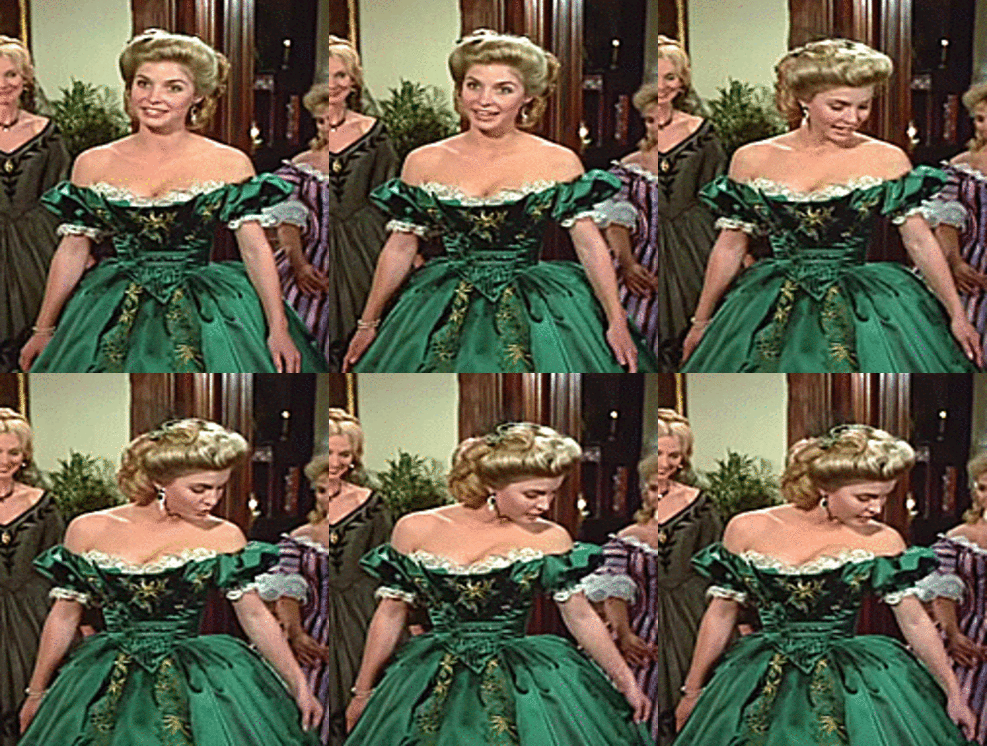


 The mini series.


