The beloved fable about loving your home from four-time Caldecott Honor-winner Leo Lionni.
A young snail dreams of having the biggest house—or shell—in the world. Then one day, his wise father tells him the story of another snail with the same dream. He grew and grew, adding bright colors and beautiful designs, until he found that his house came at a terrible cost. The young snail decides that a small, easy-to-carry shell might be best for a life of adventure and exploration.
Leo Lionni wrote and illustrated more than 40 highly acclaimed children's books. He received the 1984 American Institute of Graphic Arts Gold Medal and was a four-time Caldecott Honor Winner--for Inch by Inch, Frederick, Swimmy, and Alexander and the Wind-Up Mouse. Leo Lionni died in October of 1999 at his home in Tuscany, Italy, at the age of 89.
Leo Lionni has gained international renown for his paintings, graphic designs, illustrations, and sculpture, as well as for his books for children. He was born in Holland in 1910 of Dutch parents, and although his education did not include formal art courses (in fact, he has a doctorate in economics from the University of Genoa), he spent much of his free time as a child in Amsterdam's museums, teaching himself to draw.
Lionni's business training gradually receded into the background as his interest in art and design grew. Having settled in Milan soon after his marriage in 1931, he started off by writing about European architecture for a local magazine. It was there that he met the contacts who were to give him a start as a professional graphic designer. When he moved to America in 1939, Lionni was hired by a Philadelphia advertising agency as art director. Later he became design director for the Olivetti Corporation of America, and then art director for Fortune magazine. At the same time, his reputation as an artist flourished as he began to exhibit his paintings and drawings in galleries from New York to Japan.
Lionni launched his career as an author/illustrator of books for children in 1959. Originally developed from a story he had improvised for his grandchildren during a dull train ride, Little Blue and Little Yellow was the first of what is now a long list of children's picture books, including four Caldecott Honor Books.
A nice story about a snail who creates an impressive shell only to find the weight of his impressive home is taking it's toll. The snail decides that less is more and is happy with his lot.
The illustrations are very beautiful, you can see these have really had some time spent on them.
A snail learns that it’s better to be content with a small house than have a huge one.
In the snail’s case, an applicable proverb (as it points out practicality) but not a proverb that can be applied across the board to people. Ha ha.
Ages: 3 - 6
Content Considerations: nothing to note.
**Like my reviews? Then you should follow me! Because I have hundreds more just like this one. With each review, I provide a Cleanliness Report, mentioning any objectionable content I come across so that parents and/or conscientious readers (like me) can determine beforehand whether they want to read a book or not. Content surprises are super annoying, especially when you’re 100+ pages in, so here’s my attempt to help you avoid that!
So Follow or Friend me here on GoodReads! And be sure to check out my bio page to learn a little about me and the Picture Book/Chapter Book Calendars I sell on Etsy!
Leo Lionni seems to love to write message-laden books. In this book, a snail wishes for a big house. His father tells a story about a snail who got a big, beautiful house. But then the snails fades away and the house crumbles. (Meanwhile, my son is saying, "Fades away????? What does that mean?????" Uh....)
Anyway, the point is that a small house is good because we can be free, free, free. Personally, I think a small house sucks and I want a big beautiful house. I asked my son and he wants a medium-sized house. To each his own.
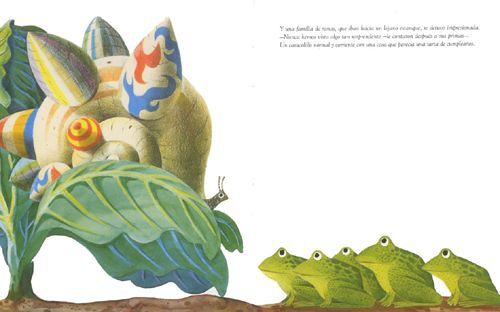
Ich finde die Moral dieses Buchs nicht nur holzhammermäßig, sondern auch falsch. Eine kleine Schnecke hätte gerne ein großes Haus. Als sie ein großes Haus hat, ziehen die anderen Schnecken weiter und sie stirbt, weil sie nicht mitkommen kann. Aber es wird nie über die Motivation für das große Haus gesprochen - alles spricht dafür, dass sie es nicht aus Habgier will, sondern aus Begeisterung. Sie schafft das Haus aus eigener Kraft, beutet dafür niemanden aus, und das Endergebnis ist nicht nur groß, sondern bunt und schön und beeindruckt Schnecken, Schmetterlinge und Frösche, die sich sicher noch lange davon erzählen werden und eindeutig einen ästhetischen Gewinn haben. Für einen Autor, der in Frederick für den Wert von Kunst und Poesie wirbt, finde ich es fast heuchlerisch, hier einer anderen Form von Kunst, die nicht flüchtig ist, ihre gesellschaftliche Bedeutung abzusprechen. Stattdessen wird Bescheidenheit und Naturgenuss propagiert, als wäre das eine zwangsläufig mehr wert als das andere. Die anderen Schnecken hätten der Schnecke mit dem großen Haus auch einfach mal ein paar Kohlkopfblätter vorbeibringen können. (Zweiter Stern trotzdem für die wunderschöne Illustration des künstlerischen Hauses, das aussieht wie die Sagrada Familia.)
When I was a child this book stirred my imagination like no other. Living in the woods, as we did at the time - I would search for magical colors wherever snails had been. The illustrations posses a sophistication reminiscent of the etchings from "Cabinet of Curiosities."
Bello bello. Belle le illustrazioni, belle le parole, dura ma essenziale la lezione. Non è nella grandezza che si trova la gioia, ma nella soddisfazione e nel godimento di ciò che si ha. Non avrei mai potuto prevedere che un libro sulle lumache mi sarebbe piaciuto tanto, ma credo che sia uno dei libri più francescani che ho letto in vita mia.
"Io la terrò sempre piccola, e quando sarò grande andrò dove mi piacerà". E così un giorno andò a vedere il mondo.
The illustrations are gorgeous... and worth that alone.... but the moral is slightly ambiguous. It definitely could be "be happy with what you have", or "always chasing after things instead of being at peace with your current life leads to unhappiness". Yet it could also be interpreted in more questionable ways: "Don't dream big, just settle". I'm sure the author had great intentions however, and even a simple message about living within your means and carrying a small load in life is a nice one. I will say however that the snail literally dying because of his big shell is pretty damn dark. Only read if you're prepared to have that conversation with your little ones.
A young snail tells his father, that he wants to have the biggest house in the world when he grows up. His wise father shared the tale of a snail who had the biggest house in the world, and how it lead to a tragic ending. The young snail went out into the world and saw many wonderful sights, and when asked why his house was so small, he shared the tale with others that his father shared with him.
Be careful what you wish for...ha ha. Young snail wants his shell to be the biggest shell house in the world. He learns a wise lesson from Father Snail in this book and realizes his shell is the perfect size for him. I like to use this book when I present my Leo Lionni author study. Lionni uses rich vocabulary in his tales such as awe, distant, cathedral and designs.
Ok so you sometimes believe that you shouldn't judge a book by it's cover and in this case the title. It's one thing to read something simple yet it's simplicity you still get some "bang". This book is not one of them but it's a nice read. Not bad nor it's good, just nice. Check the artwork which probably the reason you got drawn reading this.
I wish I had the biggest house in the world because I could put anything I want in it. But because of the story, I can’t get the biggest house in the world. I like the story, it taught me about not getting the biggest house in the world. (Alon, 6)
The Biggest House in the World was okay but not one of my favorite Lionni books. The moral is more blatant than what I usually see from him. Maybe it was the fable-within-a-fable format that was a bit odd.
Leo Lionni utiliza os animais para falar sobre sentimentos humanos. Nesta história a fabula tenta mostrar que não vale a pena ter muita coisa, mais vale ser leve para conseguir ter flexibilidade e mobilidade de conhecer o mundo, sem ficar refem de coisas e beleza.
This entire review has been hidden because of spoilers.
I liked this as a kid, but seriously, it also reads as, "If you get above yourself, or try to have really nice things, you'll die and fade to nothing." Oy.
Not sure I agree with the universality of the message in this fable. I want fewer possessions & more freedom... but not everybody does! Discuss w/ your students/ children.
The saddest book in the world. Leo Lionni has such a way with words, it feels different from your usual children’s book story, always fun to read, and the illustrations are incredible.