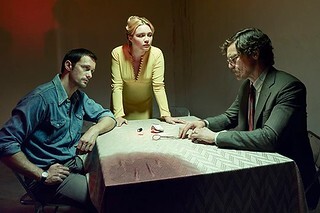
I have a vague memory of a column by George Will, back when I used to read him, about this 1983 novel. If memory serves, Will was upset that le Carré depicts the Palestinians as having a point of view, or maybe of just acknowledging that they exist. He likened the book to a Harlequin romance. He hated the dust jacket, and the typeface.
I don’t like any of the choices we’re given in the Middle East: choose one side or another, or say “a plague on both your houses,” or ignore it altogether. Le Carré doesn’t like them either, and offers no answers, easy or otherwise. He sees the big picture so well I wonder how well he sleeps.
Having only just read this novel, I’m surprised that it was so controversial. It could probably be published today without creating a ripple. Unfortunately, though, it would not feel dated.
I also remember not liking the movie with Diane Keaton. It seemed bowled over by its own premise: Wow, an actress, prone to fabulation, playing a part—in real life! A-and forgetting that she’s acting! Imagine that. But it’s been a long time, and maybe I should give it another shot.
As usual, though, as a novelist le Carré rocks. His gift for creating complex characters, for showing the small but telling gesture, his sense of humor, and his sympathy for his people…it’s all here. Sometimes I liked his characters, sometimes not, which I think is what was intended. Also, one of JLC’s less labyrinthine plots. He can make real drama out of a situation that a lesser writer (most of us, I’m afraid) would milk for just action or melodrama.
His 1993 introduction relates some of the footwork he did to research this novel. I hope he’s got a memoir in the works.
He is conceivably our George Orwell. Can I be the first to say that? Probably not. He also reminds me of Joseph Conrad.
As I’ve said before, I found him too subtle and patience-trying in my younger days but now I’m happily working my way through the catalog. Glad to have 7 or 8 unread JLC novels still ahead of me.
If any of them too pissed off George Will, then so much the better.
A few quotes and bits of business, typed out in the spirit of learning-by-doing, for the Aspiring Novelist’s/Working Writer’s Toolkit:
All Americans unsettled him; and most scared him, either by their knowledge or their ignorance, or both.
He had the answers children long for.
…deep down, like most rebels, she was only looking for a better conformity.
"Do you think we do not understand that your politics are the externalisation of a search for dimensions and responses not supplied to you when you most needed them?”
…she herself, that tiny gyroscopic creature deep inside that always managed to stay upright, tiptoed gratefully to the wings to watch.
“You’ve read Frantz Fanon. Violence is a cleansing force, remember? It frees us from our inferiority complexes, it makes us fearless and restores our self-respect.”
Briefly, they both smiled, though not at each other.
To resort to violence was to throw all their hard-earned goodwill out of the window. Besides, as professionals they deplored the very thought.
Under the compulsion of his presence, she had consigned her convictions to the dross of an earlier existence. She wanted none of them, unless he did.
“Our village was famous for its figs and grapes, for its fighters, and for its women, as beautiful and obedient as you are.”
“ … ‘The pogroms are about to begin,’ he said. I asked him—I, the smallest, who knew nothing—‘Father, what is a pogrom?’ He replied, ‘What the Westerners did to the Jews, so the Zionists now do to us. They have won a great victory and they could afford to be generous. But their virtue is not to be found in their politics.’ ”
…he was in the mood of a child who is criticising authority only in order to be reassured of its embrace.
He would set a straight course, only to look back and marvel at his degree of error.
If you have ever watched one, you know that an empty car is a truly stupid thing to stare at, and Litvak had watched a lot of them. With time, just by holding it in focus, you find yourself remembering what a fatuous thing a car really is without man to give it meaning. And what a fatuous thing man is to have invented cars in the first place. After a couple of hours it is the worst piece of junk you have ever seen in your life. You start to dream of horses or a world of pedestrians. Of getting away from the scrap metal of life, and returning to the flesh. Of your kibbutz and its orange groves. Of the day when the whole world finally learns the risks of spilling Jewish blood.
“What we call an unconscious agent.”
…there were enough armed men in different uniforms to begin their own war.
When he had finished, they asked her a number of grave questions about the chastity of Western women, of which they had heard disgraceful but not wholly uninteresting things.
I see this every day. I am a hardnosed Western journalist describing deprivation to those who have everything and are miserable.
Kurtz had asked a question; Minkel, who renounced all barriers to knowledge as unacceptable, proposed to answer it.
…from now on Khalil requires that there always be two things: two plans, two signs, in everything a second system in case the first fails; a second bullet in case the world is still alive.
She heard a woman’s wail rising to a clenched, beseeching sob; then a man’s urgent shout. Helga and Mario were advancing the revolution without her assistance.
The answer was in everything she had seen since the night she had signed on with the theatre of the real. For Palestine, it ran. For Israel. For God. For my sacred destiny. To do back to the bastards what the bastards did to me. To redress injustice. With injustice. Until all the just are blown to smithereens, and justice is finally free to pick herself out of the rubble and walk the unpopulated streets.