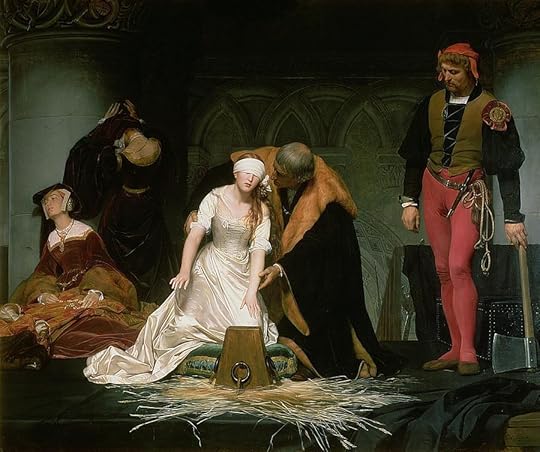
I'm copying this from other posts I made on the Tudor group but thought I'd share here, as well.
July 15/09
"I'm really enjoying learning more about Jane in The Children of England, also by AW. Thought I'd share a little for anyone who, like me, doesn't know much about her.
The first part of the book takes place directly after the death of Henry VIII and goes into a lot of detail regarding Jane's feelings toward her parents and her preference to learning above all else, as learning was the only thing she could do safely, without fear of punishment. It also speaks of her betrothal to Lord Hertford being broken in favor of her parents' desire for higher position, as well as to fit the Duke of Northumberland's schemes to raise his family's stature by marry his own son, Guilford Dudley (younger brother of Robert) to Jane. AW states that Jane would have preferred to never marry at all but accepted that marriage was a part of her role as an one in line to inherit the throne. She did, however, 'hate the Dudleys' and refused to marry Guilford on the grounds of her previous betrothal. Her parents finally won that argument when they flogged Jane into submission. When reading about Jane, you can't help but feel for the sweet girl who would have preferred to sit with a book than sit on a throne. She was incredibly Protestant and very intelligent. It would have been interesting to see what sort of Queen she would have made or what sort of life she would have lived had she been able to follow through on either of these paths.
The second part of the book focuses on Jane and Mary after the death of Edward VI. I'll be reading that in about 10 pages or so. I'll write more when I learn it. I highly recommend reading the book :)
July 17, 2009
From what I've just finished reading, Edward's Lord Protector at the time of this death was the Duke of Northumberland, who was Robert Dudley's father. He overthrew Edward's uncle, Lord Somerset (Edward Seymour - Jane Seymour's brother) and took total control of the ruling. Northumberland convinced Edward to change the line of succession set forth in Henry VIII's will to skip over Mary, Elizabeth and Frances Brandon (Henry's niece by his sister Mary), which was illegal and traitorous to defy. However, Northumberland had so much power that the other advisors felt that they could not go against him for fear of their lives.
The doctors all deemed that nothing could be done for Edward, who was incredibly sick at the end. He was coughing up blood, he had boils, ulcers and bedsores (to name a few) and could barely get out of bed, write letters or even speak.
Northumberland was not yet prepared to let him die. He needed more time to set affairs into order in a way that would benefit him (by getting Jane on the throne, who was married to his youngest son, Guilford Dudley). Northumberland hired what AW calls a female 'quack' - a woman who fed aresenic to Edward, which apparently prolonged his life though to great suffering on Edward's part.
When the new line of succession was agreed upon (unwillingly) and sworn to by all advisors in front of Edward himself, Northumberland no longer had a need to keep him alive and got rid of the 'quack', ending the poisoning. Interestingly, this woman was never seen or heard from again and some think that she was murdered. I have no doubt that Northumberland would not be above getting rid of a woman who helped him to poison a King!
Anyway, Edward, pre-illness, was really trying to participate and "do" more by way of ruling. He attempted to emmulate his father in all ways. If you look at pictures of him, he even stands like Henry did, feet apart and hands on hips. He wasn't as athletic as Henry but enjoyed watching sport and loves the masques, etc. When his uncle was Lord Protector he did not let Edward take part in many decisions. This led Edward to hate his uncle.
Northumberland was smart even to realize that he needed to at least make Edward believe that decisions were his to make but was also smart enough to know how to make Edward's decisions mirror his own.
July 22/09
Mary, for all of her good qualities, of which she apparently possessed many, was a brutal queen, relentless in her persecution of the Protestant heretics. She was very much a maternal figure. She acted as mother to Elizabeth at a young age and wanted nothing more than to be a mother and provide a son for Phillip and for England. Obviously, this was not destined to happen. Mary was older when she married Phillip and probably in the beginning stages of menopause. She probably suffered from what is known as a phantom pregnancy; wanting so badly to be pregnant that she convinced herself and her body that she was.
The worst part of this section of the book was reading about the burnings. So many men and women died as a result of heresy. During Mary's 'pregnancy', she convinced herself that in order to safely deliver a child, she must first rid England of all the heretics and she increased the persecution at this time. One woman was burned when she was 8 months pregnant. While burning, she delivered the baby. The executioner picked up the baby and threw it back in the fire! I can't imagine what it must have been like to have lived during a time like this, always in fear of your life and the lives of your friends and family.