The classic tale takes on modern themes in a retelling by master storyteller Michael Morpurgo, aided by Emma Chichester Clark's bright illustrations.
In the town of Hamelin, the rich folk live high off the hog, while the poor and sick must scavenge in the trash that’s left behind. And that trash keeps building up and up until a horde of rats overruns the town. In this lively retelling, a spunky street kid narrates the age-old tale of a piper who offers to rid a town of its rats for a single gold coin, then lures away the town’s children when the greedy mayor reneges on the deal. With a nod to contemporary social and environmental themes, former British Children’s Laureate Michael Morpurgo and illustrator Emma Chichester Clark team up to charm readers with a compelling — and ultimately hopeful — take on a timeless story.
Sir Michael Andrew Morpurgo, OBE, FRSL is the author of many books for children, five of which have been made into films. He also writes his own screenplays and libretti for opera. Born in St Albans, Hertfordshire, in 1943, he was evacuated to Cumberland during the last years of the Second World War, then returned to London, moving later to Essex. After a brief and unsuccessful spell in the army, he took up teaching and started to write. He left teaching after ten years in order to set up 'Farms for City Children' with his wife. They have three farms in Devon, Wales and Gloucestershire, open to inner city school children who come to stay and work with the animals. In 1999 this work was publicly recognised when he and his wife were invested a Member of the Order of the British Empire (MBE) for services to youth. In 2003, he was advanced to an Officer of the Order of the British Empire (OBE). He became a Fellow of the Royal Society of Literature (FRSL) in 2004. He was knighted in the 2018 for his services to literature and charity. He is also a father and grandfather, so children have always played a large part in his life. Every year he and his family spend time in the Scilly Isles, the setting for three of his books.
Awhile back, I read three picture books with the Pied Piper story and have another on my to-read shelf that I’ve been unable to obtain. I happened to see this book on the featured shelf at my branch library and grabbed it, not knowing what to expect, except that the cover appealed to me. The Pied Piper fable had a huge emotional impact on me when I was a child, and I really like the story.
This is a very text heavy picture book, so I’d say it’s for independent readers or reading aloud to school aged children, and possibly not in one sitting, although if time allows, reading the story all at once is the way to go.
This version of the story is told first person from the point of view of the young lame boy. I love his first impression of the Pied Piper as “wonderfully weird.”
So, I can’t give this book less than 4 stars. The pictures are remarkably good, I think. They’re intricately detailed and colorful and beautiful. They’re really special.
The story? Well, this one is different from any other Pied Piper tale I’ve ever read. It starts off darker than most versions, but ends up happier than any other version I’ve read. This telling has a definite additional moral too; it’s incredibly message heavy, even as compared to the original. Somehow, I didn’t mind that because I loved the message(s), and the characters, but its deviation from the standard bothered me somewhat, so I deducted a half star or so. As a child, I’m sure I’d have considerably preferred this version to any of the others, and definitely to the one I had read to me when I was young.
A somewhat dark tale is retold with a hopeful ending in Morpugo's The Pied Piper of Hamelin. While I enjoy the hopefulness of it, I also love how outlandish it seems--a rich mayor ready to completely turn over a new leaf just to get the children back? Sadly groundbreaking in this day and age. But that isn't to say that I don't like it--it centers the lost children and even goes to show that drastic measures can and should be taken.
Morpugo and Clark's retelling also provides more context, especially as it's told from the perspective of a disabled child, making this retelling even fresher. This book is bright, engaging, ominous, hopeful. It's a lot wrapped up in one book, but it does it well.
How can you not pick up a book by this powerhouse writer/illustrator duo? Reading their version of the Pied Piper was irresistible. This book really belongs with the Juvenile Fiction rather than picture books. It is quite wordy and would not work well for a story time read. On the other hand, it would make an excellent read aloud while being sure to also share the gorgeous artwork. A little beggar boy is our narrator giving us a firsthand account of the deplorable state of Hamelin Town and the brilliant musical abilities of the Pied Piper. A beautiful rendering of a classic tale.
Este autor se ha propuesto reescribir los cuentos clásicos alemanes. En este caso, desde la vista de un niño, recrea los detalles de este famoso cuento y, quizá sólo para mi gusto, enfatiza de más en la moraleja. Pero, al menos, logra conservar el espíritu de la historia.
Michael Morpurgo's take on the classic tale contains vibrant illustrations, sometimes encompassing two full pages, but the story leaves a bit to be desired. The classic telling of the Pied Piper is one that warns against breaking a contract (or promise), and teaches the lesson that there can be harsh consequences for promising to do something and not delivering. When the mayor promises to pay the Pied Piper to rid the town of rats, but then reneges on that promise, the Pied Piper retaliates by luring away all of the town's children: a tale of unbridled greed and the consequences that it can lead to.
This is not that story. Here, we have a similar set-up, but the story takes a sudden twist when the Pied Piper promises to return the children in one year and a day only if the townspeople get their act together and clean up the city, building housing for all of the "thief dogs" (children that live just outside the city in the giant trash heaps that attracted all the rats) and schools and public parks as well. So essentially, the Pied Piper extorts the townspeople by kidnapping their children and threatening to keep them forever if the town doesn't spend itself into oblivion realizing the Pied Piper's big-government dreams.
The one unique thing that this book does is tell the story through the eyes of one of the thief dogs. Unfortunately, even this falls a bit short, as the thief dog seems more a passive narrator along for the ride than an active commentator with insights into the life and decisions of the rest of the characters. Finally, the book is quite long and the grammar feels stilted. Given, I was reading this at nighttime feedings to my 10-month old daughter, but it still took us over 2 weeks to get through it.
The artwork pulls it up to 2 stars; the story masquerading as a progressive fantasy deserves only 1 at best. I wouldn't recommend it as a worthwhile version of the classic.
A fairy tale rewritten by Morpurgo - with a twist. This side of the story is a street dweller, an orphan in the town of Hamelin.
Emma Chichester Clark uses her distinct style to create a rather sad and mean-looking town, full of rich people who ignore the plight of the poor, and allow rubbish to accumulate which attract... you guessed it - rats!
Our narrator has lost a leg to an accident, is taken care of by other street kids, and watches in horror as rats slowly take over his miserly town. He makes a sympathetic 'Tiny Tim' character, everything has been thrown at him in life but he and his friends are resourceful enough and kind enough to keep each other alive.
The moral of the tale is quite openly pushed - the Piper explicitly tells the townspeople they CAN have their children back if they mend their ways, tidy their town, welcome the street kids and homeless people, make society better. And of course, this is a children's book...
Refreshing perspective of a well-known tale, great for discussions on community, homelessness, rubbish and recycling and being kind.
Not a picture book for a young child. Ideally this would be read by an independent reader aged 7 or older, though my son is 6 and I read it to him and he enjoyed the story and characters. The ending is happier than the traditional version of the tale, but with added morals for listeners/readers.
With thanks to Walker Books for the sample reading copy.
It is a take on the traditional story of the pied piper, from a perspective of the boy in a village of Hamelin. They are completely infested by rats, and the pied piper makes a deal with the Mayor and takes them away, as well as the children. He promises to bring them back if they Mayor changes his greed of money and makes Hamelin a better and safer place for children to live. There is a theme of promises and the idea of money making people evil and poor making people humble. Other ideas such as messages and music.
I think it could be looked upon as being a fable as there is a lesson to be learnt. I would be very happy to have this as a book to read out loud to a class, as there are great descriptions that can really inspire and captivate children. A possible lesson idea could be, at around half way through, the pied piper has led the children into the mountains and left the village without them. This could be a great time to stop and get the children to discuss what could happen next and write a descriptive piece of writing about what happens next from the main character's point of view. This would be a great idea to use in a lesson for shared reading.
It would also be good for guided reading, as there are some words that would challenge some children as to what the definition would be, as well as the pictures can really captivate the children's imaginations.
Michael Morpurgo is brilliant at making his stories really visual and descriptive, this would be a great opportunity to develop children's scene setting. With aims of using compound sentences and adjectives to describe landscape and journeys. This would be a great choice for a model fo writing.
Other lesson opportunities would be, perhaps having issues in other towns and places around the world and the children could come up with ideas/ inventions as to how they would attempt to fix the problem. Then once they have come up with their idea, they can present it to the class.
This story has many opportunities for hot seating as there are many different characters to choose from: - The mayor - Emma - Pied Piper - Villagers
So while I've been offline I've read a lot of books. I HAVE NOT CHOSEN TO GVE UP ON THE LAND OF BOOKS.
So why not rate children's books! Seems fun.
Pied Piper Of Hamelin The Pied Piper of Hamelin is the title character of a legend from the town of Hamelin, Lower Saxony, Germany. There are many contradictory theories about the Pied Piper. Some suggest he was a symbol of hope to the people of Hamelin, which had been attacked by plague; he drove the rats from Hamelin, saving the people from the epidemic. The Epidemic was about rats, the rats who had infested the town and caused a lot of ruckuses. This story was taught to me as a lesson in English and well it is interesting, very interesting. You do know the tale of the Pied Piper of Hamelin, who lured 130 children away by playing his pipe, but few people realize that the story is based on real events, which took place on the day of Saints John and Paul on 26 June in the town of Hamelin, Lower Saxony, Germany in 1284.
The fact that this is a true story amazes me, but wherever there are miracles there is trouble.
Hi there! You must be reading my review. I have to inform you about something, as written in my bio I am writing a book I thought to give a link to people who want a sneak peek, link: My Account where my book is Published It updates every week.
This is a Pied Piper story with a modern twist and a stern message. It doesn’t contain the usual tenets about keeping your promises and seeing that others get their proper recompense. The town of Hamelin isn’t inexplicably plagued with rodents. The beasts have arrived because the town is filthy with garbage heaps, shoddy housing and rampant poverty. These are situations in which only lowly vermin thrive and the rats find it very much to their liking indeed.
The Piper doesn’t take the children merely as a punitive measure for being cheated out of his fee. He genuinely wishes for them to grow up in happier circumstances than they can find in a world populated by cheating adults and filthy living conditions engendered by uncaring, spoiled authority.
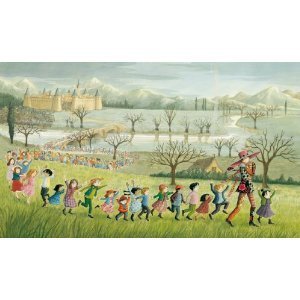
The illustrations are vibrant and colorful. However, the characters don’t have much in the way of facial expression. We are left to see full, two-page spreads such as the town being overrun by rats and the Piper leading them into the river to carry the story and they manage very well.
The story concludes with a happy ending, also completely different for this tale. It’s a morality tale for the 21st century and carries both warning and hope at its core. Children will enjoy the unusual twist and adults will be reminded just what we should do to make the world better for the next generation.
Long but luxurious. This version of the infamous tale is one to savour and share with younger readers over one or two nights due to its length. The delicate call for world wide humanity and compassion adds a sweet twist to a tale that was originally rather ominous. There is more than one villain here and, happily, more than one hero. Artfully transcribed and richly illustrated, this is a bookshelf keeper.
An engaging and child friendly retelling, but still with some lovely vocabulary and rhythm to the writing. Read it aloud to the kids and they were engaged the whole time.
Four stars because I like the original ending more, but I do appreciate Morpurgo's addition and the fact that my kids won't have nightmares tonight.
Morpurgo's variation differs somewhat from the originals - the beginning is far darker, with aspects that remind me of the children who live on rubbish dumps in places like Cambodia. Morpurgo reminds us of this tragedy that we, as a society, allow to happen right next to us. We turn a blind eye, or we blame the children for being orphans and/or poor. As the story progresses, the rats which overrun the town speak of waste and class bias. However, the end is an uplifting HEA .
A lengthy picture book told in first person, from the pov of the young crippled boy left behind, we get a really nice, modern, retelling of the legend.
Emma Chichester Clark's colourful illustrations beautifully enhance the narrative, moving what could be some very dark times to an approachable understanding, mixing a little whimsy with beautifully detailed landscapes.
leading the children from the town, image via amazon .co
Overall, we thoroughly enjoyed it. There are dark underpinnings (as would be expected of any tale tackled by the Grimms) which parents may need to take under advisement, but that shouldn't let us avoid the darker reads. At the very least, we get a HEA in this variant.
The story takes place in Hamelin. The city contains the wealthy class: the public sector including the mayor and counsellors. The rest of the people live in poverty and are considered rats that steal. It is ironic that the real thieves were the public workers getting wealthy over high taxes. The town becomes contaminated with garbage and the town is taken over with rats. The Pied Piper offers to help get rid of rats at a low price of a coin. The mayor objects, however, the Pied Piper drives out the rats by blowing his pipe. He comes back to Hamelin to request that the town cleans up the mess in order to keep the rats away. He takes all the children of the town to a safer atmosphere until the town has been cleaned up. After the specified time that the Pied Piper, the narrator goes to meet the Pied Piper and blow his pipe to let him know that the town has been cleaned up to his plans.
Morpurgo’s version of the Pied Piper is a great story for children. The illustrations, which are done in pencil and acrylic is tastefully done. I like the colours and the detail of the illustrations. The illustrations go along with the text. The text is intended for older children as the text is lengthy. This book would be suited for bed time reading, although it could be read over a couple of nights. Children between eight and ten would be suited for the text of this book. The topics that come from reading the story are valuable: greed, social responsibility, consequences to unethical behavior. The book also shows how important children are to a community by the fact that the mayor and the counsellors’ actions changed when the Pied Piper would not return the children until the town was safe for them. It is a good first step in getting children to develop their reading and vocabulary. Legends, such as the “Pied Piper of Hamelin" are valuable in our culture.
I received this paperback (2016 edition) book for free from the publisher in return for a review. The following is my honest opinion on this book:
When the town of Hamelin becomes infested with large and dangerous rats, the townsfolk employ the ‘thief dogs’ or homeless street kids to get rid of them. But with the rats increasing in population and ferocity even they cannot control them anymore. With the Mayor and his councillors at a loss of what to do a strange man ‘The Pied Piper’ appears.
I’ll be honest and say that I really don’t know the original tale of ‘The Pied Piper’ very well, I read it as a child but couldn’t remember the story so I was excited when Walker books offered me the chance to read and review this book. The story is told from the point of view of a poor lame boy who the Pied Piper picks later to send a message. I don’t want to give away the story to those people who, like me, haven’t read the story or have forgotten it but it’s a classic tale with a lovely message and a good ending.
The book is well written and set out well. It’s a touch smaller than A5 in size but has glossy pages with both text and pictures. The illustrations are all in the style like the one on the front cover. The text is easy to read and aimed at 5-7 year olds but I’m sure many different ages will enjoy reading this classic tale. It’s written in modern language and despite being a very different story to ones that are written today, children can understand and even relate to the themes in this book.
Although classic tales are always fun to read I really like this book due to its pictures. Every other page will have a colourful image and often the text and illustrations are along side each other. Even on the pages with only text there are still pretty borders on the sides and fun little rats near the page numbers. A great book with a great ending.
Most of you will know of the story of ‘The Pied Piper of Hamelin’, the legend of a rat catcher from Hamelin, Germany, who lured the rats away from the village by using his magical flute, but when the towns mayor refused to pay him, he lured the children away from the village never to be seen again.
Over the years, the story has been told by many, including the Brothers Grimm. This is Michael Morpurgo’s take on the classic tale, with a few twists to the original story, and a more happier ending.
The tale is told from the point of view of the little injured boy from the original story. It starts with the background on the boy, and how he came to be injured, then to his take on what happened with the Pied Piper in the village.
The book is engaging and shows children that even in today’s society, not everything is fair, and not everyone is kind.
The plentiful illustrations throughout the book really bring the story to life. From rats running around the page, to full double page pictures, artist Emma Chichester Clark has really shown us how beautiful her artwork is.
A wonderful old-fashioned children’s story, brought right up to date, so that today’s children will love it just as much as previous generations.
This is generally a bleak story, and there were some of those feelings still present here, though the ending is much more hopeful than the original. The narrator is the little boy with the mangled leg who isn't able to follow the children. He explains his background as a thief dog with other homeless, abused, starving children in the town of Hamelin. When the Pied Piper appears to drive out the rats (Hamelin is a garbage-filled dump of a town filled with horrible people), he asks for only one gold coin, apparently because one rich man creates ten poor ones. He still doesn't get paid, and he takes the children into the mountain for a year and a day, telling the boy that if the town doesn't clean up its act in a year and a day, providing housing, schools, food, and getting rid of the garbage, he keeps them. There's still something a little bit disturbing about this guy, frankly. The townspeople pull together and turn it into a socialist society out of Bernie Sanders' best daydreams, and the kids come home. It's a longer version of the tale, and there are some disturbing aspects here, but I can see it sparking some good conversation about social responsibility. It would probably work best at third or fourth grade level.
This entire review has been hidden because of spoilers.
A new, slightly more modern, take on the classic Pied Piper fable throws readers into 110 glossy pages full of beautiful illustrations, jam packed with colour, and some generous sized font for little readers.
I love the narration for this book; it's easily the best part. Our cheeky, witty narrator tells the tale in a way that the children in the family absolutely latch on to. I especially like how the writing style hasn't been overly simplified and, as such, challenges children to try out some more difficult words or phrases. Equally, there are some pages without any pictures and some pages dedicated to a large landscape picture or two. This breaks up the pace, giving newer readers a break, but also pushing more experienced young readers to come away from picture books and try out block text.
The book is sturdy enough to withstand grabbing hands, and smaller than the average picture book to fit snugly on the shelf. A great book with good illustrations to keep a young audience interested and it's lovely to see a new take on a real favourite classic tale.
This book was provided to me free from the publisher in exchange for an honest review; this in no way influenced my opinion of the product.
I love this re-telling of the Pied Piper story. Morpurgo gives the familiar story a very relevant spin with the rich Mayor and his cronies living high on the hog while the poor children eke out a living on garbage dumps: "And the mayor and his councillors were the nastiest of all the rich folk. The truth was that they were the real thieves. They'd gotten rich by taking money from the working people..." Buy this for the Occupy Seattle parents on your holiday list! I love Clark's colorful illustrations and my only complaint about this book is that the illustrations are almost too lovely. The text describes the kids living in the most abject poverty on heaps of garbage, yet the illustrations show clean children in brightly colored clothing (and hats! and boots!). Even the rats are rather cute.
I had fuzzy memories of The Pied Piper of Hamelin. All I remembered was that he played a tune that first drove out a bunch o'rats and then the aforementioned musician got ripped so he drove away a bunch o'children. I had no further recollection of the plot.
Reading this classic tale again in it's entirety was a pleasure. The acclaimed Michael Morpurgo retells the story with aplomb and the illustrations are stunning. A few essential homilies about overcoming greed and trying to create a better world for your children are nicely woven into the story.
One small passage that stayed with me:
"I offer you a fortune, and you say one gold coin is enough!" The Mayor simply could not believe it.
"I am not a greedy man,"replied the Pied Piper. "Enough is always as good as a feast."
A classic story is retold here by a master storyteller, Morpurgo, with considerably more text than current picture books, yet the illustrations are far more than supportive. The story has been expanded with complex situations, characters, and societal patterns that reflect aspects of modern culture. "Enough is always as good as a feast. When one man becomes rich, ten others become poor." This, being a traditional tale, can be forgiven for having an overt object lesson.
This morality tale that is well known in other versions is beautifully illustrated, and brings out more detail of the awful living conditions in the town and injects a happy ending. The double-page illustrations are majestic (when I saw them, I knew I wanted to read the book), and the borders on the left or right edges of many pages mirror the Piper's hodgepodge outfit. The book is heavy with text but worth the read.