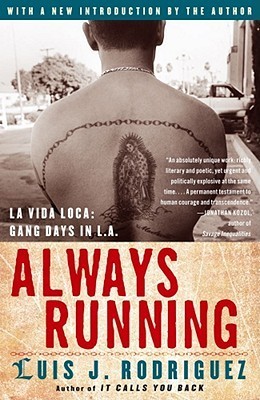
Always Running is an engaging and intelligent look into the socio-political factors that have led to the proliferation of street gangs in the last century in areas where large percentages of citizens have few opportunities but plentiful obstacles, told through the firsthand experiences of former gang member and now activist, Luis Rodriguez, as he grows up as an oppressed minority in the over-policed, but under-protected, gang-haven of East LA. Though his story is fairly common—his parents moved from Mexico to LA to improve their lives and in spite of their best efforts weren’t able to protect their son from getting absorbed into the world of gangs surrounding him—it’s how he tells the story that makes this book unique and valuable. Rodriguez doesn’t romanticize the gang lifestyle of drugs, women, and crime the way that other writers might do. Rather, Rodriguez uses real human emotion and insight to explain the sheer horrors of this lifestyle in an attempt to deter any kids from wanting to live it.
Though Always Running is a personal account of Rodriguez’s gang activity and later activism, it’s as much a historical account of the factors that led to the rise of gangs in LA in the 20th Century—and he blends the two perfectly. We see how those factors are similar to those that led Rodriguez to join a gang himself. He didn’t join because he wanted to do drugs, have power, and kill people, he joined because, if he didn’t, he’d be more vulnerable to being beaten, robbed, and/or killed growing up as an oppressed minority in a dangerous and chaotic world. A gang affiliation meant protection—but it also meant identity. Mexicans have long faced discrimination in this country, and many joined gangs as a way to celebrate their heritage of struggle. The book is filled with great quotes that explain this identity: “I’d walk into the counselor’s office for whatever reason and looks of distain greeted me—one meant for a criminal…It was harder to defy this expectation than just accept it…It was a jacket I could try to take off, but they kept putting it back on…So why not be proud? Why not be an outlaw? Why not make it our own?”
Though the book exposes a lot of ugliness, one of the major themes Rodriguez explores is his pride in Chicano heritage, and how this pride eventually inspired him to give up the gang lifestyle. When he’s able to explore his identity in more positive ways, such as through joining Chicano pride groups, painting murals, and writing about his experiences, Rodriguez slowly starts to leave the gang lifestyle behind, and in doing so, he begins to see through its shallowness and pointlessness. Though it may give kids protection and a feeling of pride, he shows how those doing the “protecting” may be the very people who you need protection from when you question their lifestyle and how silly their pride is when it comes at the expense of selling your own soul. Luckily for Rodriguez, he was able to escape this lifestyle, which is not something many of his friends could say. Death is always around every corner, and every turn of the page, and so few kids like Rodriguez are able to live long enough to see through this lifestyle and develop into productive members of society.
One of the most valuable parts of this book is its socio-political message about the horrible affects the oppression of minorities has on a society, and this message is as current and poignant today as it was when the book was written. Rodriguez explains how systemic racism was used throughout the history of LA to keep certain minority groups poor, disenfranchised, and controlled by their oppressors, and how this not only hurts the minority groups, but also hurts the oppressors. Society creates gangs then lives in fear of being attacked by them and police brutality results. It’s impossible today to turn on the news and avoid stories of policemen and women harassing, intimidating, assaulting, and sometimes, killing, specific demographics of US citizens for no other reason than their skin color, religious affiliation, national origins… This books is filled with so many examples of horrific crimes committed by police officers that it's hard not to be outraged. Granted, most of these crimes were committed against gang members, but these gang members were mostly misguided kids, and the cops, who are adults who’ve sworn to protect and defend US citizens, oftentimes cause more violence and crime than the gang members. Again, Rodriguez has a lot of great quotes to explain this: “In the barrio, the police are just another gang…Shootings, assaults and skirmishes between the barrios are direct results of police activity. Even drug dealing. I know this. Everybody knows this.” Quotes like this show why the Black Lives Matter movement is so important, and how it didn’t just emerge out of some bubble—the problem has always been here, and the more that people read books like Always Running, the better chances we have as a society to address it.
Part poetic personal story, part engaging historical lesson, part inspiration tale of redemption, part exultation of Chicano heritage, part poignant work of socio-political activism, Always Running is a multifaceted book dripping with live-in human experience and emotion, and I highly recommend it to everyone who cares about improving the world they live in.