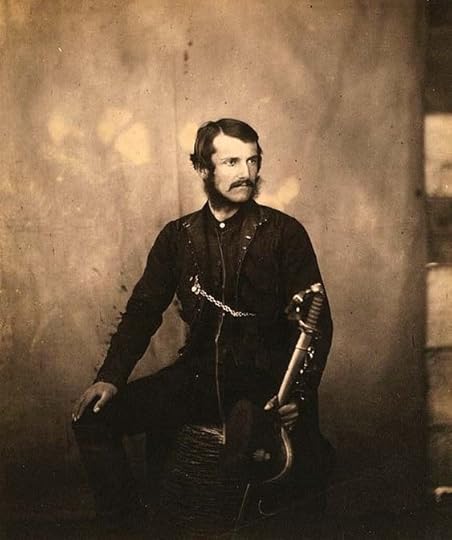
Frederick Gustavus Burnaby--soldier, traveler, writer, and pioneer balloonist--set out on an unofficial mission in 1875 to investigate the motives behind Russia's exclusion of foreigners from Central Asia. This is a great story of hardship and humor.
Another for the bedside cabinet. Reading of these exploits is so important for me, it always reinforces my determination to stay on the straight and narrow. I'm still young and so see myself as very lucky. I now have good friends and so I'm no longer alone. These folk are more than alone yet keep going, refuse to give up, and all for the betterment of their nation's interests.
“Only a few more versts, Oh one of Noble Birth!” Thus Colonel Burnaby was addressed by Russian sleigh drivers as he ploughed through the wintry blizzards – sometimes, bizarrely, with his sleigh pulled by camels – his huge form made even more gigantic by his voluminous fur wrappings. How I wish I could make a similar journey, and how I wish taxi drivers would always address me like that!
Colonel Burnaby’s main reason for wanting to go to Khiva – then an independent Khanate on the southern borders of Tsarist Russia – seems to have been because he was told it would be impossible to get there. He was also, of course, playing The Great Game – and playing it far better than any of the rather useless British diplomats. (It’s hard to know what is more incredible – that most foreign diplomats in Russia at that time couldn’t speak Russian, or that Burnaby could speak it fluently).
I loved this for its wit and humour, its excellent atmospheric descriptions of people and places now long gone or changed beyond recognition, and its snapshot of a particularly interesting time. Many Russians, and it would seem Burnaby himself, were convinced that before long Britain and Russia would be at war. It didn’t stop them all being very friendly and hospitable, although it is extraordinary to consider that in every conflict over the following 150 years Britain and Russia were allies, not enemies. (With the possible exception of the Russian Civil War, depending on which side you think was the legitimate Russian government).
Are there faults? Well, Colonel Burnaby was a Victorian, and he does go on a bit sometimes. Some of the appendices are a bit dry, though others are rather fascinating – such as one which seems to suggest the Russian military in the region were enthusiastic practitioners of pederasty – and which is, rather coyly, written entirely in rather bad Latin. Some will no doubt find his Imperialism difficult to stomach. But he was anti slavery and anti serfdom, and a realist about Indian self rule, and he is someone whose company I am sure I would have enjoyed. Others may disagree. When his servant keeps breaking his things, and saying piously it was the Will of Allah, he beats him, and when he protests, Burnaby says –
“It was the Will of God. You must not complain; it was your destiny to break my property and mine to beat you. We neither of us could help it, praise be to Allah.”
This made me laugh – clearly, there is no hope for me.
PS: The edition illustrated here only contains the first of the many Appendices which were included with the original edition. On the other hand, it also has a rather good introduction by Peter Hopkirk. The original edition with all the Appendices can be downloaded for free from the Project Gutenburg website.
"Fred G. Burnaby, the swashbuckling, six-foot-four-inches Household Cavalry officer, was an adventurer, traveller, eccentric and undoubted jingoist. He was reputedly the bravest man in England..." from the book lining.
(This was one of the books Dana read in "Two Years Before the Mast".)
Burnaby decides to use up his leave on a trip to Khiva, on a whim set off by a paragraph he read in a newspaper to the effect that the Russian government had given an order that no foreigner was to be allowed to travel in Russian Asia. He was a contrary kind of man, and the fact that it was winter didn't deter him in the slightest.
So this ends up being a trip in a sleigh, through -20 to -30 temperatures or worse, depending on the wind. Being pulled by horses or camels (of all things! I found this astonishing!) or having to ride through 2 foot drifts. He's accompanied by Nazar, his interpreter (Burnaby can speak Russian but not Tartar) who is diminutive, "not five feet tall" - referred to in some places as a dwarf, but I think probably just short (standing next to a 6'4 monolith of a man like Burnaby wouldn't help matters any).
The interesting bit for me was the people Burnaby encounters - their culture and lifestyle - living in tents, eating out of one stewpot, never bathing, sometimes sleeping out in the snow - is just amazing. And Burnaby proves to be no slouch himself.
A few quotes:
"By this time I had unstrapped the mess-tins, and was extracting their contents. "Let me be the carver," said my friend, at the same time trying to cut one of the cutlets with a knife; but he may as well have tried to pierce an iron-clad with a pea-shooter, for the meat was turned to a solid lump of ice. It was hard as a brick-bat, and when we tried the bread it was equally impenetrable; in fact, it was only after our provisions had been placed within the stove for about ten minutes that they became in any way eatable.In the meantime my companion had concocted a most delicious brew, and with a large glass of pale or rather amber-coloured tea, with a thin slice of lemon floating on the top, I was beginning to realise how pleasant it is to have been made thoroughly uncomfortable. It is only after having experiences a certain amount of misery that you can thoroughly appreciate what real enjoyment is. "What is pleasure?" asked a pupil of his master. "Absence of pain," was the philosopher's answer, and let any one who doubts that a feeling of intense enjoyment can be obtained from drinking a mere glass of tea, try a sleighing journey through Russia with the thermometer at 20 degrees below zero (Reaumur), and a wind."
"The sunrise was bright and glorious, and in no part of the world hitherto visited have I ever seen an aurora in such magnificence. First, a pale blue streak, gradually extending over the whole of the Eastern horizon, arose like a wall barring the unknown beyond. Suddenly it changed colour. The summit became like lapis-lazuli, the base a sheet of purple. Waves of grey and crystal radiated from the darker hues. They relieved the eye, appalled by the vastness of such a barrier. The purple foundations were in turn upheaved by seas of fire. The eye was dazzled by the glowing brilliancy. The wall of colours floating in space broke up into castles, battlements, and towers. They were wafted by the breeze far away from our view. The seas of flame meanwhile had lit up the whole horizon. They burst through their borders. They formed one vast ocean. The eye quailed beneath the glare. The snowy carpet at our feet reflected like a camera the wonderful panorama overhead. flakes of light in rapid succession bound earth to sky. At last the globe of sparkling light appeared arising from the depths of the ocean of fire. It dimmed the surroundings of the picture."
Another paragraph that impressed me was this - describing how, spending a night in a kibitka (tent) with a family, they open the top of it to let out the smoke from the fire which has become unbearable.
"It was a glorious evening, the stars as seen from the snow-covered desert were brighter and more dazzling than any I had hitherto witnessed. From time to time some glowing meteor would shoot across the heavens. A momentary track of vivid flame traced out its course through space. Showers of orbs of falling fire flashed for one moment and then disappeared from our view" Myriads of constellations and worlds above sparkled like gems in a priceless diadem. It was a magnificent pyrotechnic display, Nature being the sole actor in the spectacle, it was well worth a journey even to Central Asia."
"A Ride to Khiva" is as witty and fresh today as it was in 1877 when it was first published. Burnaby's account of a close shave with a Khivan barber unknowing of the ways of Western shaving methods is laugh-out-loud funny; his descriptions of his Turcoman and Kirghiz caravan drivers is both touching and troublesome. By powers of observation and analysis, Burnaby draws a direct link between smoking and heart disease: "The host taking up his pipe, slowly inhaled the fumes, until after about half a minute he fell back upon his carpet, apparently stupefied by the effects of the tobacco. Indeed, I subsequently heard that all natives that indulge in this kind of smoking are subject to heart disease..." Students of Central Asia and the Great Game will find "A Ride to Khiva" full of insight into the character of the various players, and an insider's viewpoint into the often brutal but never boring Great Game, which many claim is still being played today.
Captain Frederick Burnaby (1842 -1885) was a larger than life British soldier, who plunged into Victorian life with gusto. Able to speak seven languages, including Russian and French which were spoken by the lower and upper class respectively in Russia, he planned a trip from London to Khiva in the winter of 1875. Meticulous planning was necessary, including permission from the Russian authorities to travel to the city Khiva, which was strictly off limits to the English. Barnaby's writing style, now considered old fashioned, makes light of the hardships he faced in the coldest time of the year to cross the Steppes, however is absolutely captivating in his witty descriptions of the terrific cold, the landscape, the people and the Russian culture. Once the authorities discovered he had visited Khiva and met the Khan, they ordered him to return immediately. He wrote the book on his return to England.
In 1875, Captain Frederick Burnaby, a hulking multilingual officer in the British service, decided to trek across Russia in the dead of winter to suss out the situation in Russia’s newly captured territories of Central Asia. Burnaby, a stiff-upper-lip and rugged great gamer, wanted to learn firsthand about the situation in Central Asia and Russia’s plans for that region, and he needed to do it during a few-month break in his service, weather be damned.
Burnaby’s target was the ancient Silk Road city of Khiva, famed for its minarets, its wealth, and its hostility towards foreigners. Thirty-three years earlier, two British officers on a mission to nearby Bokhara were imprisoned and executed for daring to visit the region. Moreover, Russia had issued a military edict forbidding any foreigners from visiting. In order to reach Khiva, Burnaby would need to overcome Russia’s travel prohibition, cross thousands of miles of frozen steppe with temperatures plunging to minus 40 degrees, evade Turkoman raiders roaming a lawless no-man’s-land, seek entrance to a khanate with a reputation for arbitrarily murdering the uninvited, and somehow return on a strict time-schedule to prevent a court-martial.
None of this deterred Burnaby in the least, who wrote some letters, chatted up some ambassadors, packed his bags, and hopped the first of many trains en route to St. Petersburg. From there, he rode the railroad as far as it would go and set off on an arduous southward trek via coach and horse in one of the worst winters in memory. To succeed, he would have to survive bitter cold and frostbite, finagle or avoid suspicious officials, secure the help of guides, horsemen, and a caravan, and ultimately hope that Khiva would welcome, rather than forbid, his entry.
Burnaby’s narrative, a popular bestseller in his day, amalgamates his travel story, laden with anecdotes, with a history lesson and some sharp observations on Russian activities in Central Asia. While there are a few brief adventurous segments, the main difficulty Burnaby faces on his journey is the staggering cold. He plunges through snowstorm after snowstorm, day and night, relentlessly. His – and his companions’ – endurance through this weather awed me, and I felt the frigid air seep through the pages and numb my hands. At the same time, I sometimes felt as though there really wasn’t much for Burnaby to relate, and that his lack of curiosity in most of the people around him sapped some of the interest of his prose. Moreover, he seemed to lose interest in the journey toward its end.
For me, the most interesting part of the book was Burnaby’s perspective. He was fully a man of his time and place, condescendingly British, wholly narcissistic, and self-assured of his cultural and genetic superiority over all other people. But while he is blind to his prejudices, which strike us as backward today, he nonetheless has an excellent eye for detail, and is able to convey his impressions and experiences in a readable and engaging manner.
Though it must of course be read with a smirk and an appreciation of the period's mindset, A Ride to Khiva is a delightful adventure tale, close to Ursula LeGuin's The Left Hand of Darkness, ofor its setting and excitement. For anyone eager to learn about Russia in its most rustic sense, away from the palaces and French-speaking salons, Burnaby offers his enlightened perspective on the woes of travelers in this grand expanse of steppes and villages, giving the reader a window on the thoughts of his contemporaries concerning religious, cultural and military questions. I definitely recommend for those fond of travel journals and/or of political history!
Captain Frederick Burnaby’s “A Ride to Khiva” (1876) recounts his 1875 winter journey from St. Petersburg, Russia to the city of Khiva in what is now Uzbekistan, but was then the Khanate of Khiva. The Russians had closed Khiva to all European travelers. Burnaby undertook a mission to determine whether the Russian occupation of the area was to be used as a springboard for a Russian invasion of India. After a train ride to Sizeran (just west of Samara), he struggled through blizzards and bitter cold on sleigh, camel, and horseback to Khiva. He provides abundant detail on Russian troops and their weapons, Russian politics, geographic features, and the cultural characteristics of the indigenous populations of Central Asia. The book is a classic in the Great Game literature. It’s interesting and very well written. Highly recommended.
If you're doing historical research of what life on the fringes of the Russian Empire and inside Russia proper was like c. 1875 this is a five star book. But he is a Victorian writer, and although surprisingly self effacing with a fairly dry wit, it does go on a bit.
At the same time you start to understand what exactly 'travel' was like back then. He spends almost his entire trip to-ing and fro-ing and only a couple of weeks where he wanted to be.
For readers of first person histories this is great. Otherwise you'd best enjoy Victorian Lit before attempting.
I read this while in Uzbekistan which added to its interest for me. It is written some years ago and the style and language in the book are of that time - early 20th late 19th century.
It is the story of a journey from St Petersburg to Khiva in 1875. This man must have really been a brave and determined man as the journey was tough through temperatures well below zero. He slept in the most basic places and had to eat some bizarre and rank sounding food. He suffered frostbite and other painful experiences.
The journey was challenging but he also had to jump through various diplomatic and politic hoops in order to get permission to travel to Russian Asia as Uzbekistan was known then.
I found it interesting but not a book that I couldn't wait to get back to as it was a bit dated in style. I was a bit disappointed that there was not more about Khiva itself once he finally arrived there.
When I read a biography of Fred Burnaby I didn't really take to him but, as a travelling companion on this trip to Khiva, he is rather good fun. With his knowledge of languages, his willingness to 'rough it' and his interest in other cultures he is far from being a typical Victorian officer. It's an entertaining read with great descriptions of people and places - yes, they can be a bit florid, but he is a Victorian!
A book that took me longer to read than his journey himself, but certainly not due to boredom. This adventure through Russia and northern Uzbekistan was made so enjoyable both from my own experiences in the region but also from the wonderful 1800s language it was written in - giant words beautifully crafted to describe the landscape, people and customs. I’d happily read another of his books to be taken back into his elegant world of tartars, cossacks, camels and frostbite.
A fascinating adventure in a wholly different era of travel, but he devolves from dry wit into colonial condescension as the journey progresses. 5/5 for the journey and his deftly penned description of, 2/5 for the dude himself and all of his presumptuous ilk.
It was nice to step back in time. A great deal of things have changed while other things have not. It was interesting to be in the shoes of a 18th Englishman and read his impressions as he travelled.
Read this one about 10 years ago (along with On Horseback Through Asia Minor and while my memories of these books may be a bit fuzzy, I do remember they were engaging and entertaining. They describe winter reconnaissance journeys taken by the author (allegedly on his own initiative and at his own expense) during his annual leave from the British Army. Both books are written in a memoir style and contain anecdotes and observations (many of them humorous) on the local culture, geography, economic conditions and weather as well as police and military matters. As a Victorian British military man and an advocate of "the Empire", the author had a genuine interest in "the great game" and these reconnaissance journeys allowed him to take part in the game, supposedly as a freelance participant. Imagine military surveillance in winter weather and adventure-travel on horseback in remote back country. Both books are interesting and very enjoyable reads.
A great little travel book. An enjoyable journey that takes Burnaby from St Petersburg to Khiva. A great message about stereotyping and propaganda that is still relevant today. The Khivan prince turns out to be a nice guy. The style of his writing is a pleasure to read, and often made me smile. I especially liked the comment that the one of the men he met was "on the wrong side of 50." Love it.
Americans love to think of themselves as rugged individualists (as long as WE ALL are rugged individualists together), but, as this travel account proves, the Victorians have us beat hands-down. What spirit we've lost as more and more of us simply depend upon the computer, television, and our government to provide a semblance of life. Huzzah Burnaby!
Pretty good. Burnaby is a pretty good writer, but the stuff that happened in this one was not as interesting as the stuff in On Horseback Through Asia Minor.